

A ceramic pipe is a smoking pipe made from molded or hand-shaped white-firing clay, sometimes called pipe clay, finished either unglazed or with a food-safe glaze. Ceramic pipes are heavier and more durable against minor drops than glass, but they run hotter to the touch, build up residue faster, and have fewer compatible accessories than glass.
What Is a Ceramic Pipe Made From?
Ceramic pipes are made from a white-firing type of ball clay that potters call pipe clay. [1] This is the same family of clay that has been used to make tobacco pipes for centuries, and it is one of the standard materials for traditional pipe bowls alongside briar, meerschaum, and corncob.
The clay used for pipes originally came from deposits along the Rhine and Meuse rivers in Europe. By the 1500s, several cities had become major production centers, including Cologne, Utrecht, Liège, and Gouda. [2] Pipes made in Gouda, sometimes called Goudse pijp, were long-stemmed white clay pieces pressed in a mold and became popular after tobacco arrived in Europe through the Dutch East India Company.
There are two main ways a ceramic pipe is shaped. The first is molding, where the wet clay is pressed into a form. This was the most common method for everyday pipes, and any decoration was usually pressed into the mold at the same time. The second is hand shaping, which is more labor-intensive and was used for higher-quality pieces. [1] Many traditional clay pipes are left unglazed on purpose, while modern pieces are often finished with a food-safe glaze.
Because pipe clay has been worked for so long, the craft has its own history of trade regulation. The Worshipful Company of Tobacco Pipe Makers and Tobacco Blenders, a London craft guild, traces its formal incorporation back to 1619. [1] That long history is part of the reason clay pipes still feel familiar today, even when the rest of the smoking accessory market has moved on to newer materials.
If you are curious about how different pipe shapes and materials perform in everyday use, our guide on What Is a Steamroller Pipe and How Does It Work? is a useful next read after this one.
- Ceramic pipes are made from white-firing ball clay, also called pipe clay.
- The traditional clay deposits come from the Rhine and Meuse river valleys in Europe.
- Pipes are either molded in a press or shaped by hand, with hand shaping used for higher-quality pieces.
- Many traditional clay pipes are unglazed, while most modern ceramic pipes carry a food-safe glaze.
- Clay pipe making has a long trade history, including a London craft guild first incorporated in 1619.
What Are the Benefits of Ceramic Pipes?
The biggest practical benefit of a ceramic pipe is durability against small accidents. Specialist retailers describe ceramic as heavy-duty and more forgiving than glass when a pipe takes a minor drop or a quick temperature change. [4] For someone who carries a piece in a bag or a jacket pocket, that extra margin of toughness is a real plus.
Ceramic also holds heat differently than glass. The clay body absorbs heat as the bowl warms up, which can mean the surface stays warm without getting sharp hot spots in the same way thinner materials can. Some users also like that traditional unglazed clay does not add any flavor of its own, which is one of the reasons tobacco pipe smokers have stuck with clay for so long. [1] You get a neutral-tasting piece that does not introduce any new taste from the bowl itself.
Another benefit is shape. Because ceramic clay starts soft and is fired into a hard form, it can be molded into a much wider range of shapes than glass can. [3] That is the reason you see pipes shaped like cartoon figures, food items, animals, and other novelty forms almost always made in ceramic rather than glass. If you want a sculptural piece for the shelf as much as for use, ceramic is the easier material to work with.
Ceramic is also an environmentally friendly material in the sense that the raw clay is naturally sourced and the finished piece is inert. [3] And when it comes to deep cleaning, ceramic pipes respond well to the same isopropyl alcohol and salt method that works on glass, so you do not need a special cleaning kit.
If you are weighing ceramic against a smaller water-filtered hand pipe, our bubbler guide at How Do You Choose the Right Bubbler for You? is a useful comparison point.
- Ceramic is more forgiving than glass on minor drops and quick temperature changes.
- The clay body absorbs heat and does not add flavor to the bowl, which traditional tobacco pipe smokers value.
- Soft clay can be molded into far more shapes than glass, which is why novelty pipes are usually ceramic.
- Raw pipe clay is a naturally sourced material and the finished piece is inert.
- Ceramic pipes deep clean well with the same isopropyl alcohol and coarse salt method used for glass.
What Are the Drawbacks of Ceramic Pipes?
The main drawback of a ceramic pipe is heat. The same clay body that absorbs heat also holds onto it, so the outside of the pipe, especially around the bowl, gets hotter to the touch during use than a glass pipe does. [3] That means shorter lighting times and a brief rest between draws so the piece has a chance to cool. It is not a deal-breaker, but it is something to plan for.
Weight is another trade-off. Ceramic pipes are heavier than glass pipes of similar size, and that extra heft adds up over a long session or a long carry. [3] For someone who wants the lightest pocket pipe they can find, glass still wins.
Ceramic pipes also build up residue a little faster than glass, and the porous clay body can hold onto flavor from past sessions if you do not clean it regularly. On top of that, the ceramic accessory market is smaller than the glass market. You will not find the same range of percolators, ash catchers, or other add-on parts that the glass bong world has. [3] [4] If you like a modular setup, ceramic has fewer options.
The glaze on a ceramic pipe is worth thinking about too. The U.S. Food and Drug Administration has published guidance on lead in traditional pottery glazes. Lead is sometimes used as a flux to fuse the glaze to the clay, and if the piece is not fired at the right temperature, residual lead can leach out. The FDA flags certain problem types, including handmade pieces with a crude or irregular appearance, antique ware, damaged ware, and pieces with bright orange, red, or yellow decoration, as higher-risk categories. [6] A reputable ceramic pipe maker will tell you up front that the glaze is food-safe and lead-free.
If you use any electronic accessory alongside your ceramic pipe, replacement parts are easy to find in the same shop. For example, the Puffco 3DXL Chamber (Black) is a typical chamber-style component that swaps in and out without special tools.
- Ceramic pipes run hotter to the touch than glass, especially around the bowl, so you need shorter lighting times and brief rests.
- A ceramic pipe is heavier than a glass pipe of similar size, which adds carry weight.
- Residue and flavor from past sessions can build up faster on porous clay if you skip cleaning.
- Ceramic has fewer compatible accessories than glass, with far fewer percolator and ash catcher options.
- Glaze quality matters. Cheap or antique glazes can be a concern, so look for a maker that states the glaze is food-safe and lead-free.
How Does a Ceramic Pipe Compare to a Glass Pipe?
On durability, ceramic is the clear winner for everyday knocks. Glass, especially borosilicate glass, resists heat damage better than regular glass but still chips or cracks when it hits a hard floor. [4] A ceramic pipe is more forgiving of small drops and short temperature swings.
On heat, the two behave differently. Ceramic absorbs and holds heat, while glass heats up faster in the area right next to the flame and cools down faster once you stop. [3] Neither is better in every case. Ceramic is easier on the fingers once you let it settle. Glass is easier to cool back down between draws.
On weight, ceramic is heavier. If you want a pocket piece that disappears in your bag, glass is the lighter choice. On shape variety, ceramic can take far more sculptural forms, while glass shines in thin, blown shapes and color work. [3]
On accessories, glass has the bigger ecosystem. Percolators, ash catchers, downstems, and other add-ons are all designed with glass in mind. Ceramic has very few of these parts. [4]
On flavor carry, glass is non-porous and does not hold flavors between sessions, while porous ceramic clay can ghost a little over time if you do not keep up with cleaning. [3]
If you want a deeper side-by-side that also covers silicone as a third option, our Ceramic vs Glass vs Silicone Bongs: Which Is Best for You? guide runs through all three materials in more detail.
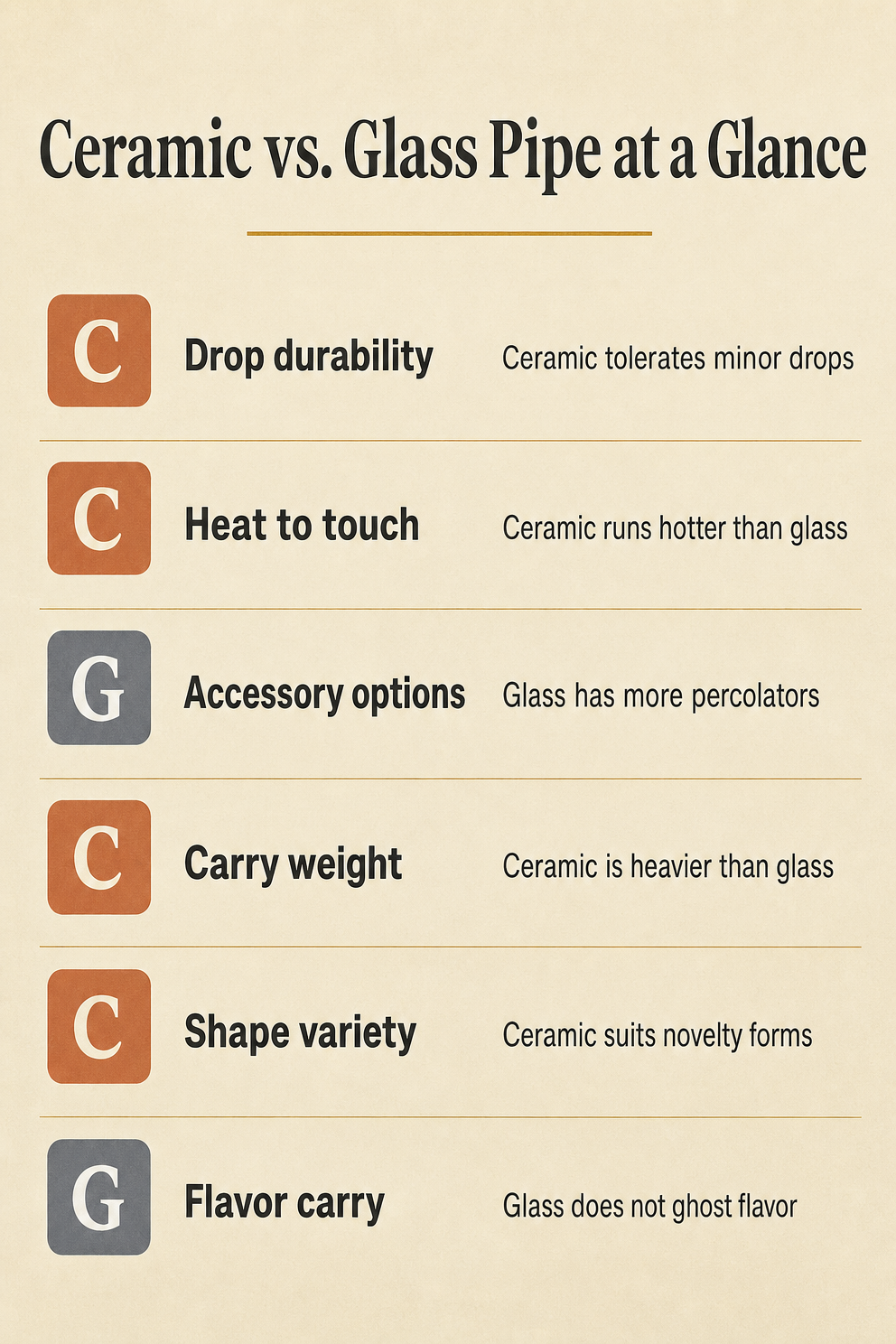
- Drop durability: Ceramic tolerates minor drops and short temperature swings better than glass.
- Heat to touch: Ceramic absorbs heat and runs warmer over a session; glass heats in a smaller area and cools faster.
- Carry weight: Ceramic is heavier than glass for a piece of the same size.
- Shape variety: Ceramic suits sculptural and novelty forms; glass suits thin blown shapes and color work.
- Accessory options: Glass has a much wider accessory ecosystem, including percolators and ash catchers.
- Flavor carry: Glass does not ghost between sessions; ceramic can hold onto flavor if you skip cleaning.
| Factor | Ceramic pipe | Glass pipe |
|---|---|---|
| Drop durability | More forgiving on minor drops and short temperature swings | Chips or cracks more easily on hard floors |
| Heat to touch | Absorbs heat and stays warmer across the bowl | Heats in a smaller area and cools down faster |
| Carry weight | Heavier than glass at the same size | Lighter, thinner-walled option for pocket carry |
| Shape variety | Suited to sculptural and novelty forms | Suited to thin blown shapes and color work |
| Accessory options | Very few percolators or ash catchers | Wide ecosystem of percolators, ash catchers, downstems |
| Flavor carry | Porous clay can ghost flavor if cleaning slips | Non-porous and does not ghost between sessions |
How Do You Clean a Ceramic Pipe?
The standard pipe-cleaning method works on both glass and ceramic because the residue you are trying to remove is similar, and the supplies are the same. [5] You will need a sealable plastic bag, 99% isopropyl alcohol, coarse salt, warm water, dish soap, and a cotton swab or bristle cleaning brush for stubborn spots.
The only ceramic-specific step at the end of the cleaning is to look at the glaze. A reputable manufacturer uses a food-safe glaze, but over time that glaze can crack or craze, and a cracked glaze lets moisture and residue work into the clay body underneath. [8] If you see any cracking or crazing on a ceramic pipe, the safe move is to retire the piece rather than keep using it.
If you are shopping for a new piece and want to see what glass pipes look like next to ceramic ones, the Glass Hand Pipes subcategory is a good starting point for browsing glass options side by side with your ceramic pick.
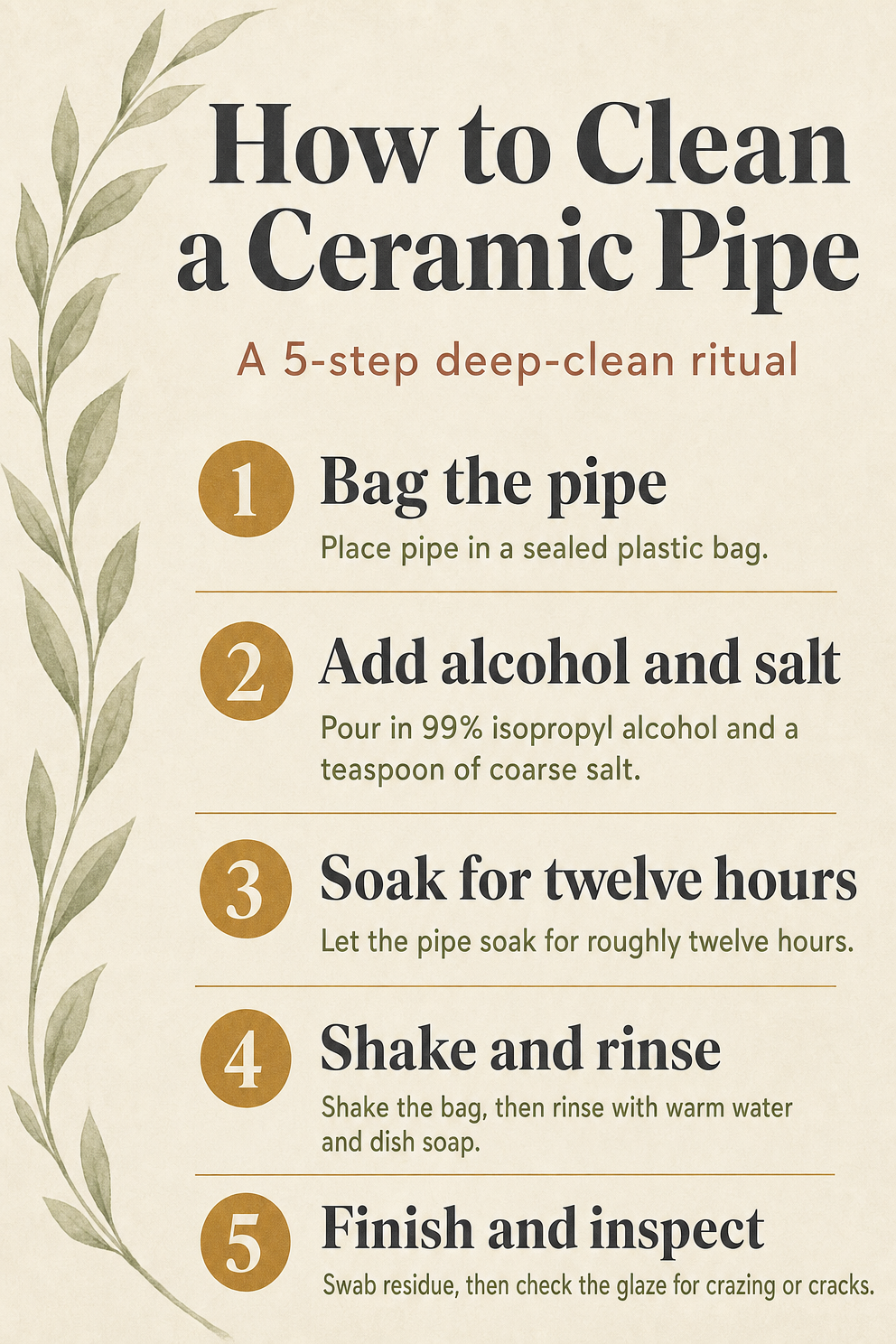
- Place the pipe in a sealable plastic bag.
- Pour in enough 99% isopropyl alcohol to cover the pipe and add a teaspoon of coarse salt.
- Seal the bag and let the pipe soak for roughly twelve hours.
- Shake the bag gently, then rinse the pipe with warm water and a small drop of dish soap.
- Use a cotton swab or bristle cleaning brush to remove any stubborn residue, then let the pipe dry fully.
- Inspect the glaze once the pipe is dry. Any visible cracking or crazing means it is time to replace the piece.
How Do You Spot a Safe Ceramic Pipe When You’re Shopping?
A safe ceramic pipe is the one that comes from a maker who is upfront about the materials. The first thing to look for is a clear statement that the glaze is food-safe and lead-free. Reputable ceramic pipe manufacturers put this on the product page or on the packaging. [8] If you cannot find that statement, that is a reason to keep looking.
Next, look at the surface. Run your eye over the glaze and check for any cracking, crazing, or rough patches. Even small surface flaws can let moisture into the clay over time. The glaze should look even and smooth across the whole piece. [8]
It is also worth thinking about decoration. The FDA’s general guidance on lead in traditional pottery glazes flags pieces decorated in bright orange, red, or yellow as a higher-risk category, along with handmade pieces that look crude or irregular, antique ware, and damaged ware. [6] That guidance is aimed at food pottery, but it is a reasonable proxy for any decorative ceramic you are putting near your mouth.
Pick the piece up. A ceramic pipe should feel solid and have a little heft to it. If it feels unusually light for its size, that can mean the walls are thin and the piece is more fragile than it looks. The weight is part of what you are paying for in a ceramic piece. [3]
Finally, think about the shape. Ceramic is the material of choice for novelty pipes shaped like figures, food, and other sculptural objects. If a shape looks impossible in glass, it is almost certainly ceramic. [3] A small novelty pipe like the GUITAR HAND PIPE is a good example of the kind of sculptural form that only ceramic can pull off.
- Look for a clear statement from the maker that the glaze is food-safe and lead-free.
- Check the glaze surface for cracking, crazing, or rough patches before you buy.
- Avoid pieces with bright orange, red, or yellow exterior decoration, and be cautious with antique or visibly damaged ware.
- Pick the piece up and confirm it has the solid, slightly heavy feel that ceramic is known for.
- If the shape looks too sculptural or novelty to be glass, it is almost certainly ceramic, and that is a feature, not a flaw.
Frequently Asked Questions
Do ceramic pipes get hotter than glass pipes?
Yes. Ceramic pipes and bongs run hotter to the touch than glass, especially around the bowl. Most users take shorter lighting times and a brief rest between draws to manage the heat.
Are ceramic pipes more durable than glass pipes?
For minor drops and quick temperature changes, yes. Ceramic is described as heavy-duty and more forgiving than glass from everyday knocks. Glass, particularly borosilicate, still wins on absolute heat tolerance and is the lighter, thinner-walled choice.
How long should you soak a ceramic pipe to clean it?
The standard method of 99% isopropyl alcohol plus a teaspoon of coarse salt in a sealed bag, used for both glass and ceramic, calls for roughly a 12-hour soak. After soaking, shake the bag, rinse with warm water and dish soap, and finish stubborn spots with a cotton swab or bristle cleaning brush.
Are glazed ceramic pipes safe?
Reputable manufacturers use food-safe glazes. The FDA’s guidance on lead-glazed traditional pottery flags handmade pieces with a crude or irregular appearance, antique ware, damaged ware, and pieces with bright orange, red, or yellow decoration as higher-risk categories, which is a reasonable proxy for what to avoid in a smoking pipe.
When should you replace a ceramic pipe?
Replace it when you see visible cracking or crazing of the glaze. Both are signs the protective surface has failed, and moisture or residue can start working into the body of the piece.
Is a Ceramic Pipe the Right Pick for You?
A ceramic pipe is the right pick if you want a heavier, more durable piece that travels well, if you like the neutral flavor and the long history of pipe clay, or if you want a sculptural or novelty shape that glass cannot easily make. It is also a good pick if you do not need a modular setup with percolators and ash catchers, because the ceramic accessory market is smaller than the glass one.
Glass is still the better choice if you want the lightest pocket pipe, the widest range of blown shapes, or the broadest accessory ecosystem. If you tend to take long draws in quick succession, glass also runs cooler to the touch and cools back down faster between draws.
Either way, clean your pipe on a regular schedule using the isopropyl alcohol and coarse salt method, and replace the piece if you ever see cracking or crazing in the glaze. With reasonable care, a well-made ceramic pipe is a long-lasting addition to your collection. And remember, Treehouse Lifestyle offers free shipping on orders $150+ if you are picking up a new piece alongside any other gear.
Sources
- Wikipedia: Tobacco pipe
- Wikipedia: White pipe clay
- Puffr (wholesale smoke shop, Denver): Ceramic Pipes: Pros, Cons, and How They Compare to Glass
- Fat Buddha Glass: Ceramic vs. Plastic vs. Glass: Which Is the Best for Bongs/Pipes?
- Weedmaps: How to Clean a Pipe
- U.S. Food and Drug Administration: Questions and Answers on Lead-Glazed Traditional Pottery
- U.S. Centers for Disease Control and Prevention (MMWR): Notes from the Field: Lead Poisoning in a Family of Five Resulting from Use of Traditional Glazed Ceramic Ware — New York City, 2017–2022
- House of Puff: 12 Secrets for How to Clean a Pipe