

Before comparing products, decide where the case will live: in a drawer, inside a backpack, in a car, or among other luggage. That decision changes the useful balance between weight, rigidity, access, and interior organization. A case for a shelf can be compact and simple; a case for repeated travel needs more deliberate support.
Do not confuse a padded exterior with a properly fitted interior. The outside can feel soft while the item still slides inside. Likewise, a rigid shell alone does not solve the problem if the foam leaves a gap around a joint. Protection comes from the complete system: measured space, cushioning, closure, and sensible packing.
Choose a padded case for glass accessories by measuring the piece first, matching the inside dimensions to its widest points, and selecting padding that holds it snugly without pressure. A good case stops movement, covers exposed glass, and uses a closure suited to the trip. Hard-sided cases with custom-cut foam are a recognized option for fragile gear, while soft cases trade some structure for lower weight. [1]
How Do You Measure a Glass Piece So the Case Actually Fits?
Start with the glass outside the case and write down its maximum height, width, and depth. Measure at the widest joint, base, mouthpiece, or other point that could catch on the interior. Use the case’s interior dimensions, not its outside measurements.
Remove detachable parts before measuring the main body. A bowl, downstem, cap, or mouthpiece may need its own foam pocket so it cannot knock against the larger piece. The goal is a snug fit with room for cushioning, not an oversized cavity where the glass can rattle. Protective cushioning works by deforming and damping vibration. [3] A useful related starting point is Bags / Cases.
Measure twice if the piece has an unusual curve. A straight height measurement can miss the diagonal space needed for a bent neck or angled mouthpiece. Sketching the outline on paper can help you see whether a rectangular case will waste space or press against a corner.
When a case lists only exterior dimensions, view that number as a starting clue rather than a promise. Wall thickness, hinges, lining, and foam all reduce usable room. Ask for the interior dimensions or compare them with your written measurements before ordering.
- Record the main piece’s height from its lowest stable point to its highest point.
- Measure the widest joint and the widest base, then use the larger number when comparing cases.
- List every removable part and measure its length, width, and depth separately.
- Add room for foam coverage, but do not add so much room that the piece can slide.
What Size Padded Case Do You Need for a Bong, Hand Pipe, or Dab Rig?
Choose the smallest case that fits the complete packed setup without bending, crushing, or crowding the glass. A hand pipe usually needs a compact case with one shaped compartment. A dab rig often needs a deeper body space plus smaller pockets for detachable parts. A bong may need a long compartment and careful support around its base and neck.
Think about organization as well as length. If accessories share one open cavity, they can touch during movement. Separate pockets or a divider make the interior easier to inspect and keep each item in place. For more storage ideas, see How Do I Store My Smoking Accessories the Right Way? and How Do You Protect Glass Accessories While Traveling?. A tall option such as SeshGear Tehchnicolor Zig Wag Beaker Glass Water Pipe – 10" / 14mm F / Colors Vary also shows why the piece’s actual height matters more than a generic case label.
A case should also leave enough room to close without the lid touching a protruding joint. If the lid presses down on the piece, the case is not correctly sized even if the body fits. A slightly taller interior with shaped foam is better than forcing the glass into a short compartment.
For a mixed collection, avoid choosing one giant case unless the insert can divide the space. Separate compartments make it easier to find a small accessory and reduce contact between items. They also make a quick visual check easier before and after a trip.
- For a hand pipe, prioritize a close-fitting compact sleeve or molded pocket.
- For a dab rig, choose depth for the body and separate space for removable pieces.
- For a bong, compare interior length and base width before considering exterior style.
- Select an interior that leaves no loose corner where glass can shift.
Hard Shell or Soft Padded — Which Protects Glass Better?
A hard shell gives the case a firm outer wall. Pairing that shell with custom-cut foam creates a structured space around fragile gear, which is why this format is common for equipment that needs a precise fit. [1] It is the stronger choice when the case may be pressed under other luggage or handled repeatedly.
A soft padded bag is lighter and easier to carry in a daily backpack. It depends more on the padding, seams, and the way you pack it. For a long glass piece, confirm that the bag supports the base and does not force the neck against the zipper. This is especially important when comparing a large piece such as Vitae Glass 18"Swiss Sphere + Trio Origin Bong.
Hard shells usually take more room in a closet and add weight, but that trade-off can be worthwhile when the case will be placed beside other objects. Look for foam that fills the space instead of a loose block that can shift inside the shell.
Soft bags are easier to compress into a larger bag, yet that convenience means other items can press against them. Keep hard objects away from the glass compartment, and do not use a soft bag as a substitute for a structured case on a demanding route.
- Choose a hard shell for repeated travel, crowded luggage, or a valuable irregular piece.
- Choose a soft case for short daily trips when low weight and flexibility matter.
- Inspect whether the foam is fixed, removable, or shaped to the exact item.
- Avoid a case whose outer wall flexes directly into delicate glass points.
| Feature | Hard Shell Case | Soft Padded Case |
|---|---|---|
| Outer wall | Firm rigid wall resists pressure from other luggage | Flexible wall that flexes and can be compressed |
| Foam type | Custom-cut foam shaped to the glass piece | Generic foam sheets or padded lining |
| Fit | Precise, holds the piece immobile | Looser fit, relies on careful packing |
| Weight | Heavier and bulkier in a closet or bag | Lighter and easier to carry daily |
| Best use | Repeated travel, checked baggage, valuable pieces | Short daily trips, light daily carrying |
Which Foam Type Cushions Glass Best?
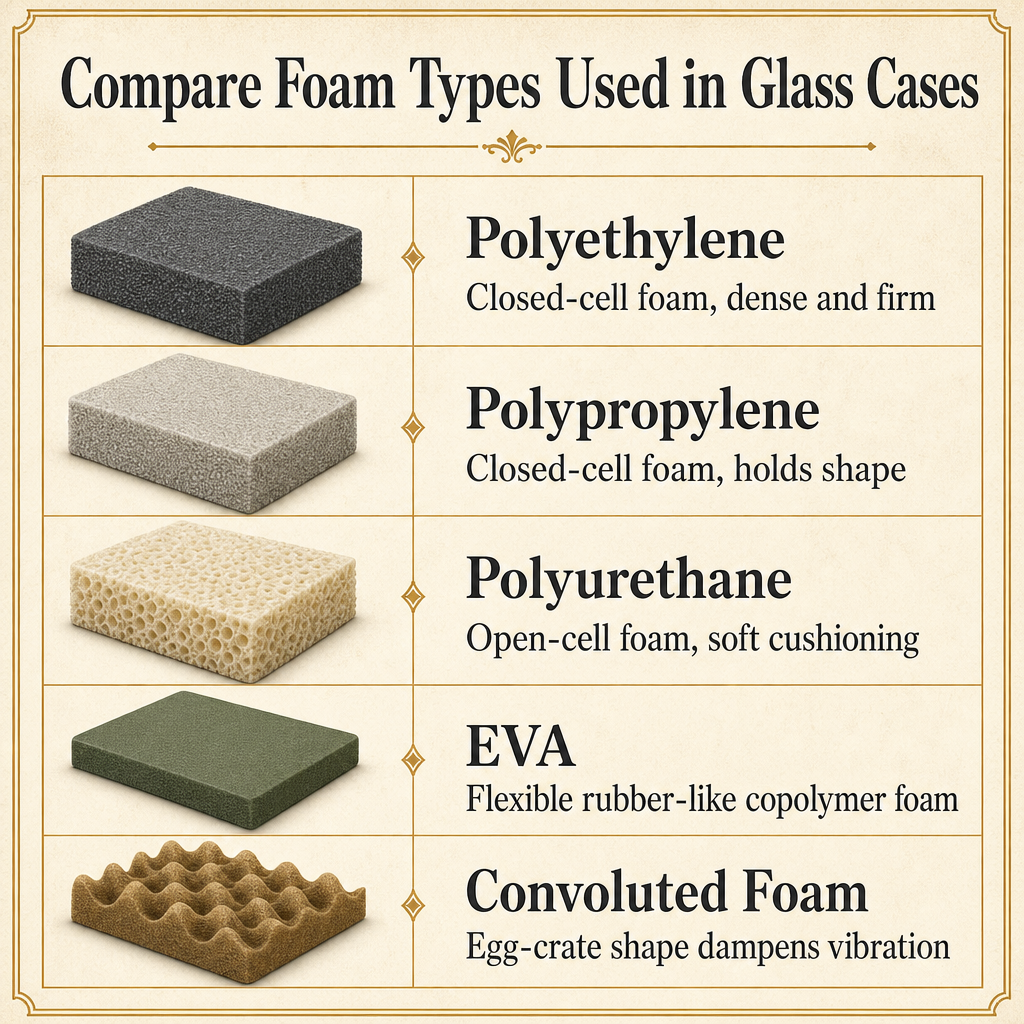
Protective cases use several polymer foams, including polyethylene, polypropylene, polyurethane, EVA, and convoluted foam. These materials do not all feel or behave the same. Some hold a firm shape, while others provide a softer nest for small or uneven pieces. The shared design goal is to absorb shock through controlled deformation and reduce vibration reaching the item. [3]
EVA is a flexible, rubber-like copolymer used in foam and cushioning products, with properties that vary by its formulation. [4] Read the case description for density and construction instead of choosing by a foam name alone. For a broader glass-quality discussion, use How Can You Tell If a Glass Smoking Piece Is Well Made?.
The insert’s shape matters as much as its label. A flat sheet may cushion a surface but fail to immobilize a neck. A cutout, divider, or layered insert can spread contact over broader surfaces and keep narrow parts from bearing all the movement.
Ask whether the foam is replaceable and whether the case maker offers a way to resize the insert. That matters when your collection changes or when one piece has a different footprint than the case was designed to hold.
- Polyethylene is a firm option when a case needs shape-holding support.
- Polypropylene is another structured foam used where the insert must retain its form.
- Polyurethane can provide softer cushioning for compact or irregular parts.
- EVA offers flexible foam construction, while convoluted foam adds a shaped contact surface.
How Thick Should the Padding Be Inside a Glass Case?
There is no single padding thickness that fits every glass accessory. The correct amount depends on the piece’s size, weight, shape, and the case wall. Borosilicate glass has a lower coefficient of thermal expansion than soda-lime glass and is harder to break when dropped, but it remains glass and still benefits from cushioning during transport. [2]
Use complete coverage as the test. Press the case gently from the outside and check that no hard edge is exposed and no part can move freely. A thick wall cannot compensate for an empty gap around the piece. If you are also learning the parts of a bong, What Is a Bong and How Does It Work? can help you identify what must be packed separately.
Think in layers rather than a single wall measurement. The bottom, sides, lid, and dividers all contribute to the packed fit. A case with generous bottom cushioning but thin side protection may still allow a narrow joint to contact the wall.
Pack only after checking the closed case. Gently move it in several directions and listen for movement. If anything taps, shifts, or rattles, reopen it and add a divider or adjust the insert rather than assuming the sound will disappear during travel.
- Small hand pipes need enough foam to cover every side without squeezing the bowl.
- Medium rigs need deeper sidewalls around joints, bases, and removable parts.
- Tall bongs need support at the base and neck, not just a thick top layer.
- Increase protection for hard-sided travel only when the interior still holds the piece firmly.
What Closure and Hardware Features Matter Most?
The closure should stay shut when the case is lifted, turned, or placed into a bag. Zippers are light and easy to open, while latches add a more rigid mechanical hold. Hinges are useful on hard cases because they keep the lid aligned and make repeated opening predictable.
Check the hardware as part of the whole case. A strong latch is less useful if the foam insert is loose, and a good zipper cannot fix a case that lets the glass move. Airport handling can route checked bags through conveyor-based systems, so a checked setup deserves more structure than a simple backpack sleeve. [6] If your setup includes a removable bowl, a product like SILICONE BEAKER BONG WITH REMOVABLE GLASS BOWL shows why detachable parts should be counted before choosing the compartment layout.
A closure should also match how often you open the case. Daily users may value a smooth zipper and a wide opening, while occasional travelers may prefer the positive feel of latches. In either case, inspect the attachment points where hardware meets fabric or shell.
Do a simple home test before a trip: close the empty case, open it, then pack it and repeat. The hardware should remain easy to operate without snagging the lining or disturbing the insert. Small failures are easier to fix at home than beside a departure gate.
- Test that the zipper closes fully and does not catch on the foam.
- Look for latches that resist opening when the case is pressed from the sides.
- Inspect hinges for alignment and a lid that closes evenly.
- Choose a handle and seams that can support the packed case without pulling apart.
What Features Matter for Carry-On vs Checked Luggage?
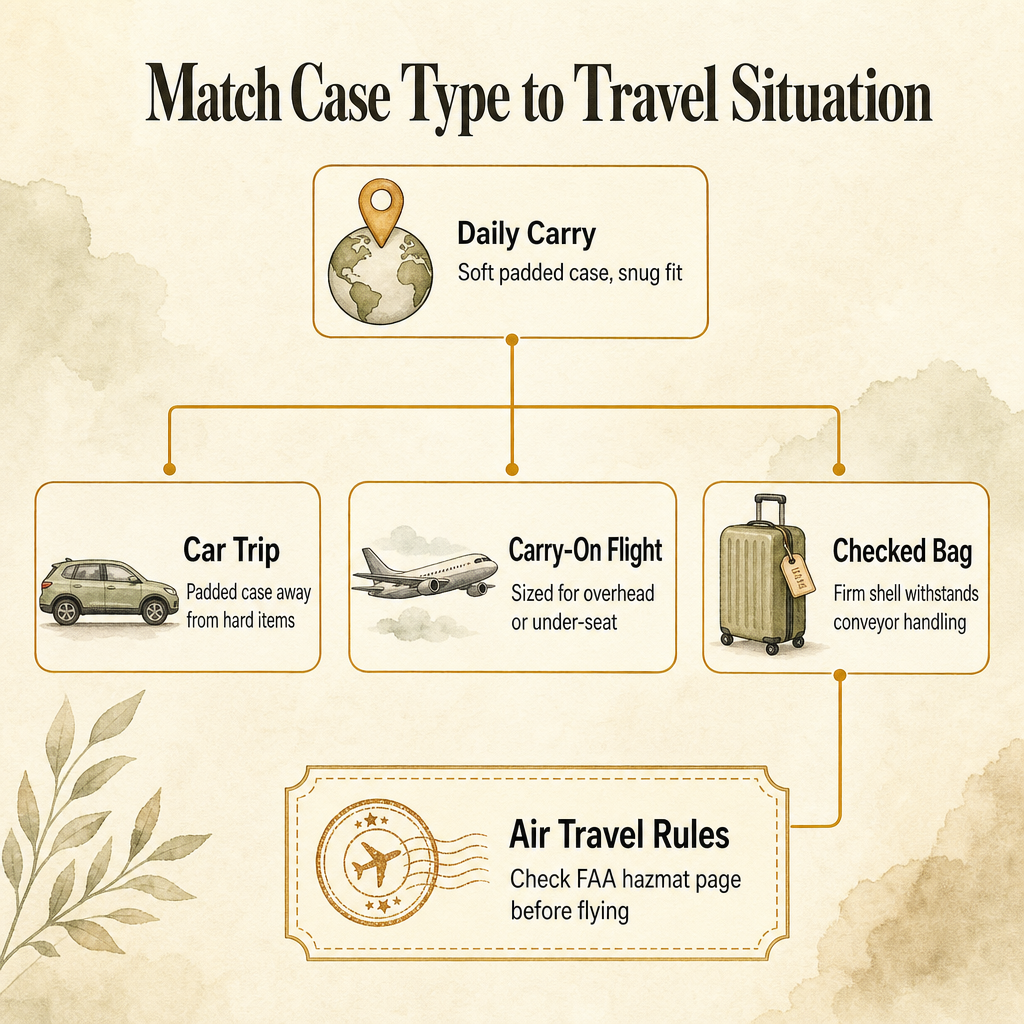
Carry-on luggage stays with the passenger and is sized for an overhead bin or under-seat space. Checked baggage travels separately through airport handling systems, where it may pass through conveyors and sorting equipment. [5] [6] That difference should guide the case, but it does not replace checking airline rules.
Before flying, review the FAA PackSafe program and the airline’s current policy. The FAA resource covers baggage rules for hazardous materials, batteries, and related travel concerns. [7] A case can protect glass from movement, but it does not make a restricted item permitted.
Carry-on sizing is not just about the glass. Handles, rounded corners, and exterior pockets add to the packed footprint. Measure the complete case and check the carrier’s current dimensions because allowances and enforcement can vary.
For checked luggage, place the protective case so it is not free to bounce around inside the larger bag. Surround it with soft clothing or other flexible packing, while keeping pressure away from the lid and avoiding a heavy object directly on top.
- For carry-on, measure the packed case against the airline’s current cabin-bag limits.
- For checked baggage, favor a rigid outer wall and a fully immobilized interior.
- Keep the case easy to open if an inspection is required.
- Check FAA and airline guidance before packing, especially when batteries or other regulated items are present.
| Feature | Carry-On | Checked Baggage |
|---|---|---|
| Where it travels | Stays with the passenger in the cabin | Transported separately through conveyor sorting systems |
| Sizing rule | Sized for overhead bin or under-seat storage | Sized only for protection; airline size limits differ |
| Handling risk | Light handling, mostly by the owner | Conveyor-based sorting with repeated impacts |
| Best case type | Snug foam interior and easy-open closure for inspection | Rigid outer wall and fully immobilized interior |
| Rule-checking | Confirm FAA PackSafe and airline cabin rules before flying | Confirm FAA PackSafe rules and any device or battery guidance |
How Do You Choose a Padded Case for Different Glass Accessories?
Match the case to the piece and the trip instead of buying by appearance. Treehouse Lifestyle lists Storage Accessories as a dedicated storefront category, alongside glass and other accessory categories. [8] That makes the category a useful place to compare storage formats, but the final choice still comes down to measurements and case construction.
Use this final walkthrough before you buy. A case is ready when the item stays in place, each detachable part has a home, and the closure remains secure without forcing the glass. The best case is not always the biggest or most expensive one; it is the one that fits the actual setup.
If you are unsure, rank your priorities in this order: fit, immobilization, coverage, closure, and convenience. Appearance and extra pockets come after those basics. This order keeps a stylish case from winning over one that actually matches the glass.
Keep the measurements with the case or in your phone. If you replace a piece later, you can compare its dimensions quickly instead of guessing from memory. A small note can prevent an expensive mismatch.
- Match a compact hand pipe to a small padded sleeve with a secure closure.
- Match a dab rig to a deeper case with separate pockets for removable parts.
- Match a tall bong to a long case with base and neck support.
- Match frequent or checked travel to a structured shell and shaped foam insert.
Frequently Asked Questions
What size padded case fits a glass bong, hand pipe, or dab rig without rattling?
Measure the height, widest joint, and removable parts, then choose interior dimensions that keep foam touching the piece on every side. Check the interior space, not just the product name, and test the packed case for movement before travel.
Hard shell or soft padded case — which protects glass accessories better?
Hard shells provide a firm outer wall and can use custom-cut foam. Soft cases are lighter but depend more on padding and careful packing. Check the interior space, not just the product name, and test the packed case for movement before travel.
What foam type is best for glass protection?
Common options include polyethylene, polypropylene, polyurethane, EVA, and convoluted foam. Choose based on fit, firmness, and complete coverage. Check the interior space, not just the product name, and test the packed case for movement before travel.
How thick should the padding be?
Use enough padding to cover every side and prevent movement. Complete contact matters more than one universal thickness number. Check the interior space, not just the product name, and test the packed case for movement before travel.
What matters for carry-on or checked luggage?
Size the case for cabin limits when carrying on; for checked luggage, use more structure and verify current FAA and airline rules. Check the interior space, not just the product name, and test the packed case for movement before travel.
So, Which Padded Case Should You Choose?
Measure first, choose a snug interior, and give every removable part its own space. Pick a soft padded case for light daily carrying or a hard shell with shaped foam for demanding travel. Then check the closure, inspect the seams, and confirm current travel rules before you leave.
Sources
- Case Club: Custom Foam Inserts for Cases Designed For You
- Wikipedia: Borosilicate glass
- Wikipedia: Package cushioning
- Wikipedia: Ethylene-vinyl acetate (EVA)
- Wikipedia: Carry-on luggage / Hand luggage / Cabin baggage
- Wikipedia: Baggage handling system
- U.S. Federal Aviation Administration: PackSafe for Passengers — FAA Hazardous Materials Safety
- Treehouse Lifestyle: Storage & Travel category page