
A portable vaporizer is a battery-powered, hand-held device for use away from an outlet, unlike a plug-in desktop unit with a larger chamber and balloon- or hose-based delivery. [1] Choosing one comes down to a few ordered decisions: pick a heating style (conduction, convection, or hybrid), pick a material (dry herb, concentrates, both, or 510-thread carts), and check battery, temperature control, and chamber build.
What Is a Portable Vaporizer and How Is It Different From a Desktop Vaporizer?
Portable and desktop vaporizers share the same operating principle: an electrical heating element warms material in a chamber enough to release compounds as vapor instead of burning them into smoke. [1] The form factor is what sets them apart. A portable runs on a battery and is built to be held and carried, while a desktop plugs into a wall outlet and stays in one place. [2] Desktop units typically have larger chambers, stronger heating elements, and balloon- or hose-based delivery. Portables trade some chamber size and heat output for a battery and a smaller body with an integrated mouthpiece.
If you are shopping for a portable, you are choosing around mobility, charging, and a smaller form factor. That does not make a portable the right choice for every buyer. Think about where you use the device, how long a typical session lasts, and whether you want it ready without being plugged in. If dry herb is your material, the Dry Herb Vaporizers collection narrows the search. If a larger battery-powered tabletop-style portable is what you want instead, a unit like the Hitoki Trident V3 is a useful reference point for what the portable category includes. The table below uses the same axes product reviewers compare on: power source, chamber size, heating element strength, delivery method, and where each device fits in a routine.
- Portable power source: a built-in or removable battery supports use away from an outlet, with session length limited by the cell.
- Desktop power source: a wall connection supports longer stationary sessions, larger chambers, and stronger heating elements without a battery limit.
- Portable delivery: the mouthpiece is attached to a compact body, so the device is held and used in one piece.
- Desktop delivery: the device may use a hose or balloon system, which keeps the body cooler and lets multiple users share a mouthpiece more easily.
- Portable chamber: usually smaller and suited to individual or short sessions, with material packed in small amounts at a time.
- Desktop chamber: usually larger and able to hold enough material for group sessions or longer draws on a single load.
| Axis | Portable vaporizer | Desktop vaporizer |
|---|---|---|
| Power source | Built-in or removable battery | Wall outlet (plug-in) |
| Typical chamber size | Small, loaded per session | Larger, loaded for longer or shared sessions |
| Heating element strength | Lower draw to preserve battery | Higher, sustained by wall power |
| Delivery method | Integrated mouthpiece on the body | Hose or balloon attached to the unit |
| Best fit | Use away from an outlet | Stationary use at a table or counter |
Conduction, Convection, or Hybrid: Which Heating Style Should You Look For?
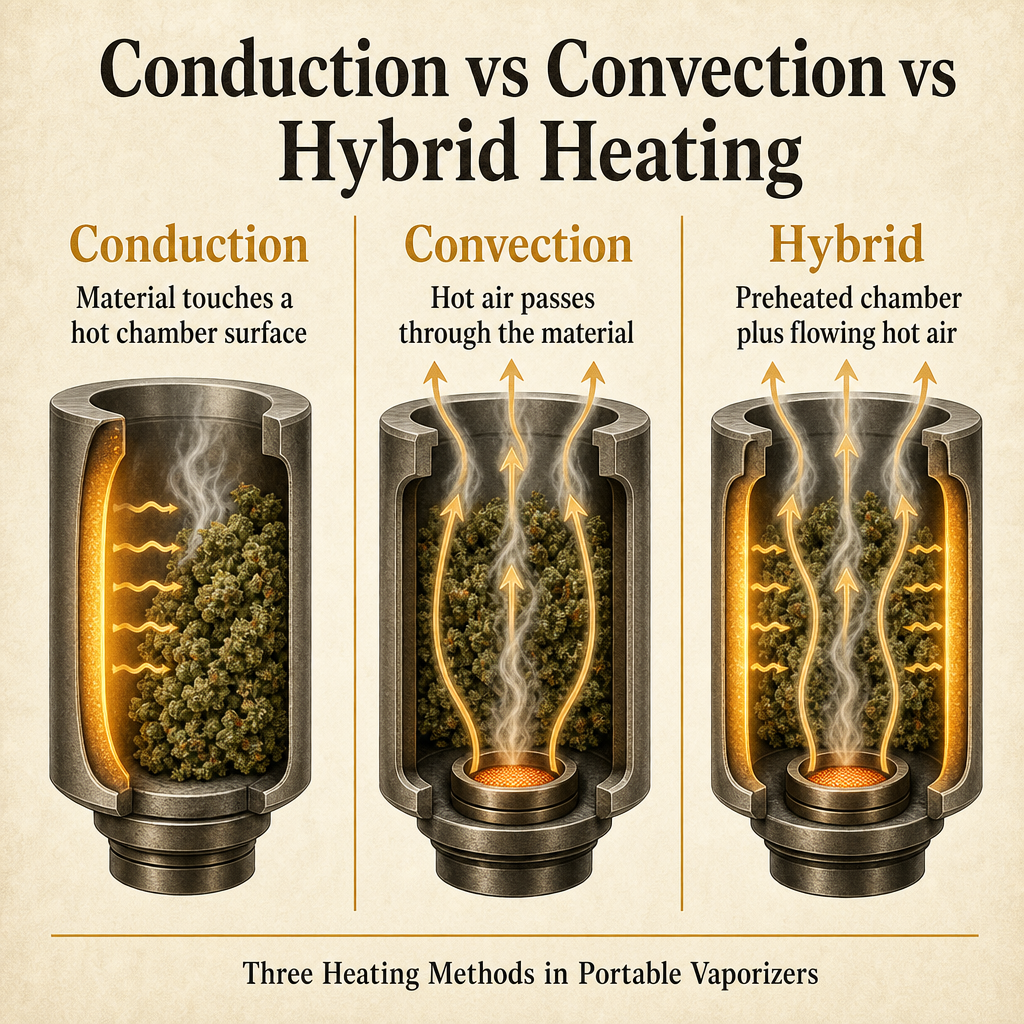
Heating style shapes a portable vaporizer more than almost any other spec, so it is worth understanding before comparing screens and app features. Conduction warming goes through direct contact between the material and a hot surface, typically a metal or ceramic chamber wall, and usually produces vapor quickly. [2] [3] The trade-off is uneven extraction when the material is tightly packed or a session runs long without stirring, because heat travels unevenly from the wall outward.
Convection heating moves hot air through the material without direct contact with the heating element. Because the hot air surrounds each piece of ground material, convection is generally credited with more even extraction and better flavor preservation. [3] [4] Convection devices often cost more, take longer to heat up, and draw more battery power during a session, since the device has to keep heated air moving through the chamber for the full session. Hybrid models combine the two approaches: a heated chamber preheats the material while hot air also moves through it. [2] [4] The goal is to capture some of the speed of conduction without giving up the even extraction convection is known for. For the underlying principle, see the What Is a Vaporizer and How Does It Work?; for how portables compare with desktops in routine, see Portable vs Desktop Vaporizer: Which Fits Your Routine?. Temperature is a related topic covered in What Temperature Should You Set a Vaporizer To?.
Grind size and pack density matter with either style, and they matter more than marketing copy usually admits. A very tight pack can restrict airflow and starve a convection chamber of the air it needs to move heat through the material. A loose or uneven load can change how material heats in a conduction chamber and create hot spots near the wall. Look for clear loading instructions and a chamber design that is easy to reach. A device with strong specifications is still annoying if the everyday loading routine feels fussy. Temperature is related to heating style but is not the same thing. Published research and product literature commonly describe dry-herb vaporizer settings around 160–220 °C (320–428 °F), with about 180 °C used as a reference point in cannabis vaporization research. [5] [6] [10] Use any single number as a starting point, not a rule. Follow the device instructions and stay within the stated range of the unit you buy.
- Conduction: choose it when quick heat-up and a simpler design matter most. Pay attention to chamber packing and whether the instructions mention stirring between draws.
- Convection: choose it when even heating and flavor preservation are priorities. Expect a higher price or a longer warm-up time on many models, and a higher battery draw over a session.
- Hybrid: choose it when you want a middle ground between a fast chamber preheat and moving hot air through the load. Read the spec sheet carefully because hybrid designs vary widely.
- Grind and pack: a medium grind with a loosely packed chamber works well for convection; conduction chambers often reward a similar grind plus occasional stirring for even extraction.
| Axis | Conduction | Convection | Hybrid |
|---|---|---|---|
| How heat reaches material | Direct contact with a hot chamber wall | Hot air passed through the material | Chamber preheats material while hot air flows through |
| Heat-up time | Short | Longer (often 20–30 seconds) | Between conduction and convection |
| Extraction evenness | Can be uneven if packed tight | Generally even | Varies by design |
| Flavor preservation | Good when chamber is stirred | Generally better | Varies by design |
| Typical price | Often lower | Often higher | Mid to high |
| Pack and grind sensitivity | Higher (stirring helps) | Lower (loose pack works well) | Varies by design |
Which Materials Should Your Portable Vaporizer Be Able to Handle?
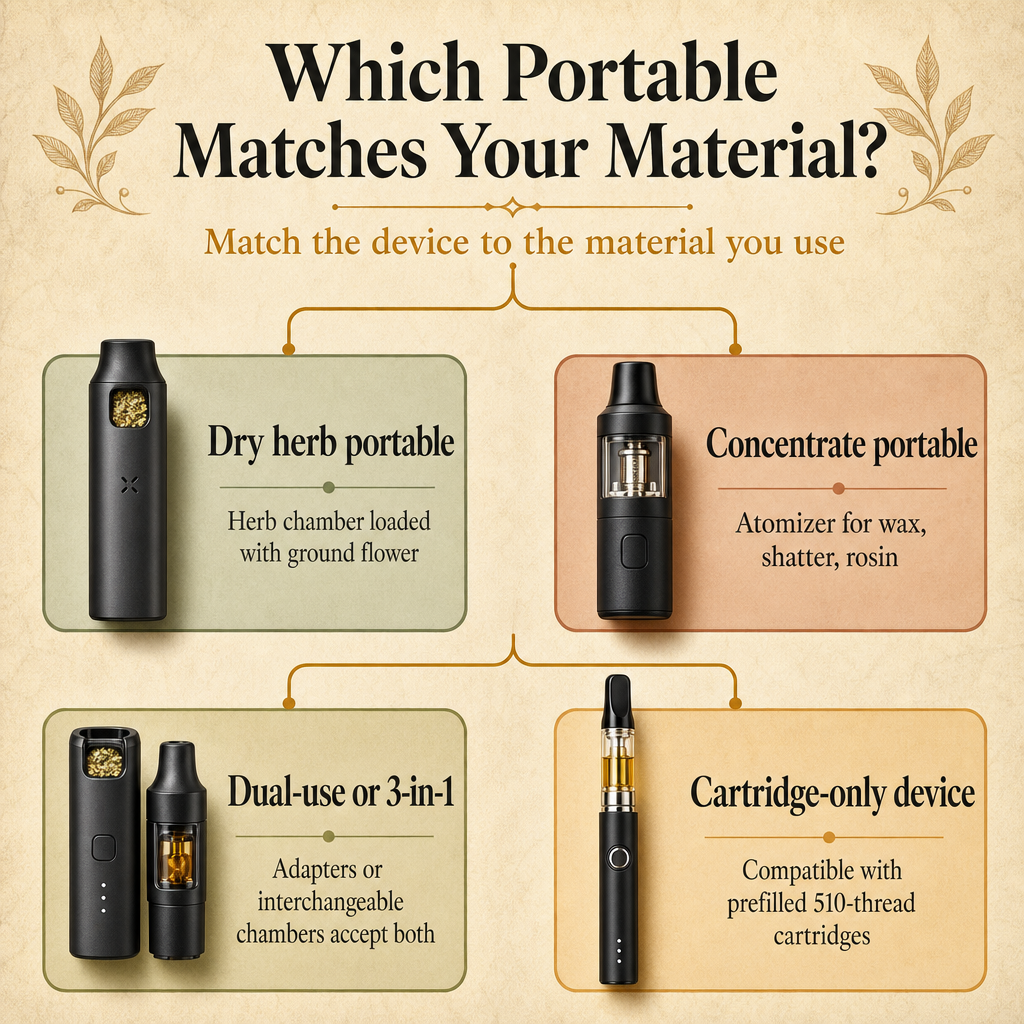
Decide what material you actually plan to use before comparing screens and app features. This decision narrows the shortlist faster than any other single choice. A dry-herb vaporizer has a chamber for ground flower, loaded with a small tool or a dosing capsule. A concentrate device, sometimes sold as a dab pen or wax pen, uses an atomizer built for wax, shatter, or rosin, which means a different chamber and a different loading method. [2]
Dual-use or 3-in-1 models use adapters or interchangeable chambers so the same body can accept both ground flower and concentrates. A fourth group of devices is built only for prefilled oil cartridges and uses a specific connection to attach them. If a slim pen-style device is what you have in mind, the What Is a Pen Vaporizer and How Do You Choose the Right One? explains that category in more detail.
Cartridge shoppers need to understand 510 thread before comparing batteries. 510 thread is the common connection standard for cannabis oil cartridges and pen-style batteries, so a cartridge from one manufacturer physically fits a battery from another as long as both use the same connector. [7] Proprietary pod systems use their own connections, so their pods are not interchangeable with standard 510-thread cartridges. [7] That distinction decides whether you can keep using your current cartridges with a new battery, or whether you have to commit to a specific brand’s pod line. The four paths below cover almost every portable you will run into while shopping. Pick the one that matches the material you already use.
- Dry herb: best match when you want a chamber for ground flower. Check chamber size, the loading method, and whether the device works with grinder output or dosing capsules for cleaner swaps.
- Concentrates: best match when you use wax, shatter, or rosin. Check the atomizer design, the loading tool included, and whether replacement atomizers or coils are sold separately.
- Dual-use or 3-in-1: best match when you want both material types in one device. Confirm that each chamber or adapter is included rather than sold as an extra-cost add-on.
- Prefilled cartridges: best match when convenience and a cartridge format are central to your routine. Confirm whether the device uses 510 thread or a proprietary pod before you commit.
What Should You Check on a Portable Vaporizer’s Battery and Charging?
A portable vaporizer has to balance heating power with battery size, and that balance shows up in every spec sheet. Product pages commonly list capacity in milliamp-hours (mAh), but that number is only one part of the picture. Heating style, session temperature, session length, and battery age all affect how often you have to charge. [8] [9]
The most useful battery comparison is not "biggest mAh wins" but a few related questions: is the cell replaceable or built in, what charging port does the device use, does the device support pass-through charging, and does it accept removable 18650 or 21700 cells? Each answer changes the everyday ownership experience, especially for someone who plans to keep the device for a few years rather than replace it annually.
Compare the battery details on every shortlist candidate. The list below covers the specs that matter most and the practical consequence of each one.
- Capacity: a higher mAh number can support more use between charges, but it can also add weight or size. Match capacity to how many sessions you typically run in a day.
- Built-in cell: the battery stays inside the device, which simplifies ownership. The trade-off is that the device may eventually need service or replacement once the cell wears out.
- Replaceable cell: you can carry a spare and extend the device’s useful life. Some dry-herb portables use removable 18650 or 21700 cells, which are widely available.
- Charging port: USB-C is common on newer devices; micro-USB and proprietary connectors still appear on older or lower-priced units, so check the listing before assuming a cable you already own will fit.
- Pass-through charging: some devices can operate while connected to a charger. Check the manual rather than assuming the feature exists, because pass-through is not universal even on premium models.
- Charge time and charger included: confirm whether the charger is in the box, how long a full charge takes from empty, and whether the manufacturer sells replacement batteries or parts.
How Much Temperature Control and Session Control Do You Actually Need?
Temperature control ranges from a single fixed setting on an entry-level pen to a precise digital setpoint shown on an LED or OLED display on a higher-end unit. Higher-end portable vaporizers commonly offer setpoints around 160–220 °C (320–428 °F) for dry herb, often paired with custom session length and other session settings. [8] [9] Entry-level pens and disposables tend to use one fixed temperature or three or four presets so the user does not have to think about a number.
The right amount of control depends on how you actually use the device. Precision is useful when you want to repeat a preferred setting or make small changes between sessions. Presets are easier when you want to press a button and start. More controls are not automatically better. A menu system that frustrates you becomes an expensive decoration, because the device ends up parked at one setting anyway. If you are weighing portable against a stationary option, the Desktop Vaporizers category is worth a look for what desktop-style temperature control looks like on a different form factor.
Look for these control features when comparing devices. The list below mixes temperature tiers with session and dose-control features that reviewers use as practical comparison axes.
- Fixed temperature: the simplest setup, with the fewest choices and the shortest learning curve. Common on disposable pens and entry-level dry-herb units.
- Preset steps: a small number of levels for quick changes. Useful when you only need a low, medium, and high option and do not want to dial in a precise number.
- Digital setpoint: a specific temperature selected with buttons or a dial, usually shown on an LED or OLED display. Best when you want repeatable sessions at a specific number.
- Session timer: sets a defined run length and can help create a repeatable routine, especially useful for people who micro-dose or share a device.
- Dose or app controls: may provide additional tracking or adjustments, depending on the device. Verify that the app is still supported for the model you are buying before counting on this as a long-term feature.
What Chamber and Airpath Materials Should You Look For?
Portable vaporizers may use stainless steel, aluminum, ceramic, or quartz in the chamber, and the airpath between the chamber and the mouthpiece may include glass or stainless steel components as well. [8] [9] The useful question is not which material sounds most impressive in marketing copy. It is whether the manufacturer clearly identifies the parts that contact heated material, and the route vapor takes to reach the mouthpiece. Without that information, a buyer cannot compare two devices on equal terms.
An isolated airpath means the vapor route is physically separated from parts such as the battery and electronics, so vapor does not pass over plastic components, solder, or reactive metals before it reaches the mouthpiece. Listings may describe this as an all-glass path, a glass-and-stainless path, or simply an isolated airpath. Look for specific construction details instead of vague phrases such as "premium materials." When comparing dry herb portables side by side, the Portable Vaporizers collection is a convenient place to see which models name their chamber and airpath materials up front.
When comparing devices in this category, check for these details in the spec sheet or product page. Each one is something a manufacturer should be able to answer in writing, not just with a buzzword.
- Named chamber material: the listing should identify whether the chamber is ceramic, stainless steel, aluminum, quartz, or another material, and not just call it a "heating chamber."
- Airpath description: look for an isolated airpath and a clear explanation of which materials sit between the chamber and the mouthpiece.
- Glass components: borosilicate glass may be used in a mouthpiece or vapor path; check whether it is removable and replaceable, since glass parts can crack if dropped.
- Heating technology: ceramic heating is a common specification, but the listing should explain which part uses it and how it is isolated from the airpath.
- Replacement parts: confirm that screens, mouthpieces, seals, and chambers can be obtained if needed, because these are the parts that wear out fastest.
How Do You Compare Portable Vaporizers Before You Buy?
Once you know your material and preferred heating style, run every candidate through an ordered shortlist process. Reviews and independent buying guides commonly compare vaporizers on flavor, vapor density, draw resistance, heat-up time, battery life, dose-control features, battery design, and warranty support. [4] [8] [9] Those are more useful than chasing a single "best" device, because the right choice depends on how you actually use it day to day. A device that wins on flavor but loses on battery life may not be the right pick for a long commute.
The numbered walkthrough below turns every earlier section of this guide into a ranked process. Run it against any two or three candidate devices, in the order shown, so you compare each device on the same axes from start to finish.
Step through the shortlist in this exact order:
After you finish the numbered walkthrough, score your final two or three choices against the same set of questions. Devices that look very different on a marketing page often converge once you compare them this way.
- Does the device do the one job you need without extra adapters you would have to buy separately?
- Can you charge it where you normally use it, with a cable you already own?
- Can you clean it and replace the parts that wear out, like screens and mouthpieces?
- Are the instructions specific enough to follow, including a stated temperature range?
- Is the warranty easy to understand, with a real support contact behind it?
How Do You Charge and Maintain a Portable Vaporizer?
A charging routine protects both the device and the place where you store it. The U.S. Food and Drug Administration publishes battery handling guidance for devices with rechargeable cells, and that guidance is the right starting point for any portable vaporizer. [11] The routine below is built from that guidance and is meant to be the order a new owner applies it on day one, not after a problem has already shown up.
Run the routine as a habit, not a one-time setup. Devices that get charged on a bedside table every night, or that sit in a hot car, are the ones regulators flag in their published guidance. A few small habits make the difference.
Use this routine every time you charge or store a portable vaporizer with a rechargeable cell:
- Read the manual first: use the supplied cable or the charger specified by the manufacturer, and keep the manual for reference when the device behaves differently than expected.
- Inspect before charging: do not charge a device with a damaged cable, a damaged battery wrap, or unusual heat. Contact the manufacturer for guidance if anything looks off.
- Choose a clear surface: charge on a clean, flat surface away from bedding, paper, and other flammable items, and never on a soft surface that traps heat.
- Stay present: do not charge unattended or overnight. Unplug the device when charging is complete if the instructions call for it.
- Manage removable cells carefully: do not mix battery brands, types, or charge levels, and use only the cell format approved for the device.
- Protect the device: keep it away from extreme temperatures and away from flammable gases or liquids such as oxygen, propane, or gasoline. [11]
- Clean as directed: let the device cool, then follow the manufacturer’s instructions for the chamber, screen, mouthpiece, and airpath. Replace worn parts with the correct components.
Frequently Asked Questions
What is the difference between a portable and a desktop vaporizer?
Is convection better than conduction in a portable vaporizer?
Neither style is universally better. Convection uses hot air passing through the material and is generally associated with more even heating and flavor preservation, while conduction heats by direct contact with a hot chamber surface and usually reaches temperature quickly. Hybrid devices combine both approaches. [3] [4]
Can one portable vaporizer handle both dry herb and concentrates?
Some dual-use or 3-in-1 devices can handle both with separate chambers or adapters. Many devices are designed for only one path — a herb chamber for dry flower, an atomizer for concentrates, or a 510-thread connection for prefilled oil cartridges — so always check the compatibility list before assuming a device is multi-use. [2]
What does 510 thread mean when buying a portable vaporizer?
510 thread is the universal connection standard for cannabis oil cartridges and pen-style batteries. A compatible cartridge can fit a compatible battery across manufacturers, while proprietary pods use their own connection and are not interchangeable with standard 510-thread cartridges. [7]
What battery specs matter most on a portable vaporizer?
How should you charge a portable vaporizer battery?
Follow the manufacturer’s instructions, charge on a clean flat surface away from flammable materials, do not charge unattended or overnight, do not mix battery brands or charge levels, and protect the device from extreme temperatures. The U.S. Food and Drug Administration publishes battery handling guidance that applies to any device with a rechargeable cell. [11]
What Is the Best Way to Choose Your Portable Vaporizer?
The right portable vaporizer is the one that matches your material, your heating preference, your battery routine, and your willingness to maintain it. Start with material compatibility — dry herb, concentrates, both, or prefilled cartridges — then compare heating style, battery and charging, temperature control, chamber and airpath materials, everyday handling, and warranty support. That order turns a crowded category into a manageable decision, and it stops you from paying for features you will not use.
Once you have a shortlist of two or three devices, run each one through the same ordered walkthrough from the comparison section, and use the same five questions to score your finalists on equal terms. Compare live inventory at Treehouse Lifestyle, where orders over $150 ship free, and use the dry herb and portable vaporizer collections to see which models name their chamber and airpath materials, list a stated temperature range, and back their battery with a clear warranty. A buying guide does the work for you only if you actually use it, so take the time to run the process end to end before you commit.
Sources
- Wikipedia: Vaporizer (inhalation device)
- Puffco: The Dry Herb Vape vs Concentrate Device Debate
- DynaVap: Conduction vs Convection Vaporizers: What’s the Real Difference?
- Healthy Rips: What Is A Convection Vaporizer And How Is It Different?
- National Institutes of Health / NCBI: Vapor Pressure, Vaping, and Corrections to Misconceptions Related to Medical Cannabis’ Active Pharmaceutical Ingredients’ Physical Properties and Compositions
- Fundación CANNA: Vaporizer Usage: Safety and Toxicology
- Leafly: A guide to the different types of cannabis vape carts
- Arizer: Arizer Solo 2 Review: A Comprehensive Look at the Pros and Cons
- Planet of the Vapes: Conduction vs Convection vs Hybrid: What’s the Difference?
- Canadian Journal of Public Health / NCBI PMC: Are vaporizers a lower-risk alternative to smoking cannabis?
- U.S. Food and Drug Administration: Tips to Help Avoid Vape Battery Fires or Explosions