

A complete guide to types, materials, designs, and care for hand pipes and bubblers
A hand pipe is a compact, portable smoking device—typically glass, metal, or silicone—that delivers smoke directly from the bowl to your lungs without water. A bubbler is a handheld water pipe that draws smoke through a small water chamber via a downstem, cooling and filtering it before inhalation. Both are designed for solo use and easy transport, but Hand Pipes give direct hits while bubblers provide a smoother, water-filtered draw.
What Is a Hand Pipe and How Does It Work?
A hand pipe is one of the simplest smoking devices you can own. It is a compact, portable pipe that you hold in your hand during use, hence the name. Smoke travels from the bowl through the stem and out the mouthpiece directly into your lungs—no water, no percolators, no additional parts. [1]
- Bowl: the chamber where material is placed and burned
- Carb: a small hole on the side that controls airflow during inhalation
- Stem: the narrow tube that connects the bowl to the mouthpiece
- Mouthpiece: the opening from which you inhale the smoke
The anatomy of a hand pipe is straightforward. Every hand pipe has a bowl where you place your material, a carb (short for carberator) which is a small hole on the side of the pipe that controls airflow, a stem that connects the bowl to the mouthpiece, and the mouthpiece itself from which you inhale. [4]
The carb is a small hole on the side of the pipe that you cover with your thumb while inhaling to control airflow. [4]
Using a hand pipe is a three-step process. First, you pack the bowl with your material. Second, you cover the carb with your thumb and light the bowl while inhaling gently to draw smoke through the stem. Third, you uncover the carb to clear the pipe and finish inhaling the accumulated smoke. Hand pipes are designed for solo use and easy transport, making them one of the most popular pipe styles available. [1]
Browse Glass Hand Pipes to explore related options.
Browse Silicone Hand Pipes to explore related options.
Browse Wood Hand Pipes to explore related options.
Browse Steam Roller Pipes to explore related options.
What Is a Bubbler and How Does It Differ from a Hand Pipe?
A bubbler is a hybrid smoking device that combines features of a hand pipe and a bong. Like a hand pipe, it is compact and designed for solo use. Like a bong, it uses water to cool and filter smoke before you inhale it. [2]
- Hammer bubblers are the most common style. They get their name from their shape—a vertical body with a stem that meets the pipe at roughly a 90-degree angle, resembling a hammer. The water chamber sits at the base of the vertical body.
- Sherlock-style bubblers have a vertical body with a curved mouthpiece that gives them an elegant, classic look. The smoke path in a Sherlock bubbler is naturally longer, which means it cools more before you inhale.
- Multi-chamber bubblers (also called double or triple bubblers) have two or three connected chambers. Smoke passes through each water chamber sequentially, cooling and filtering more thoroughly with each step. [3]
The key difference is the water chamber. In a bubbler, smoke does not travel straight from the bowl to your lungs. Instead, it passes through a downstem—a small tube that sits in the water chamber—and bubbles up through the water before reaching the mouthpiece. This water filtration cools the smoke, making each draw feel less harsh than it would from a dry hand pipe. [3]
Bubblers are generally smaller and more portable than bongs. They fit in the palm of your hand and are designed for one person to use at a time. Unlike bongs, which can hold multiple bowls or provide large hits for group sessions, a bubbler delivers a single, filtered draw at a time. [2]
All bubblers use water in the same basic way, but they come in several distinct styles.
What Materials Are Hand Pipes Made From?
Hand pipes come in four main materials: glass, metal, silicone, and wood. Each material has distinct characteristics that affect durability, flavor, maintenance, and price. Understanding these differences helps you choose the right pipe for your lifestyle. [1]
- Borosilicate glass: heat-resistant, non-porous, preserves flavor, breakable
- Stainless steel or titanium: extremely durable, possible metallic taste over time
- Food-grade silicone: flexible, nearly unbreakable, easy to clean, may retain odors
- Wood: natural aesthetic, unique grain patterns, porous, requires more maintenance
Glass pipes are the most popular type, and most are made from borosilicate glass. This is the same type of heat-resistant glass used in laboratory glassware and high-quality kitchenware. Borosilicate glass has a melting point over 1,000 degrees Fahrenheit and resists thermal shock, meaning it will not crack when exposed to the direct flame of a lighter. [5] It also does not off-gas when heated, so it does not affect the flavor of your material. [8]
Metal pipes are typically made from stainless steel or titanium. They are nearly indestructible and excellent for travel or for anyone who tends to drop their gear. Metal pipes do not crack, but some users report a metallic taste developing over time, particularly with certain metal alloys. [1]
Silicone pipes are made from food-grade silicone and are extremely flexible and durable. They can be bent, dropped, and stepped on without breaking. Heat-resistant and easy to clean, silicone is a practical choice for people who want a pipe that can survive heavy use. [1]
Wood pipes offer a classic, natural aesthetic. Each piece has a unique grain pattern, and many smokers appreciate the traditional look and feel of a wooden pipe. However, wood is a porous material, which means it absorbs moisture and residue more readily than glass or metal. This requires more frequent cleaning to prevent buildup and odors. [1]
| Material | Durability | Flavor | Maintenance | Best For |
|---|---|---|---|---|
| Borosilicate Glass | Breakable | Excellent | Easy | Flavor purity |
| Silicone | Nearly unbreakable | Good | Easy | Travel, durability |
| Metal | Extremely durable | Fair (may affect taste) | Low | Durability, portability |
| Wood | Moderate | Good | High | Aesthetic, traditional feel |
What Types of Hand Pipes Can You Buy?
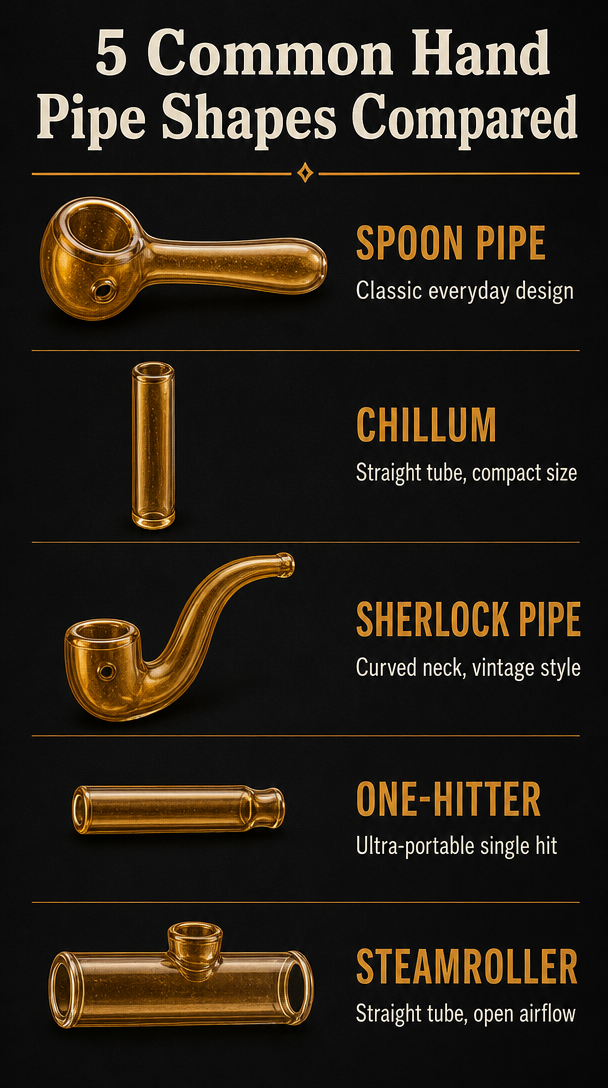
Hand pipes come in several distinct shapes, each with its own character and way of delivering smoke. The shape affects the smoking experience, the presence or absence of a carb, and the overall intensity of the hit. [1]
- Spoon pipes: curved body, side carb, versatile and easy to use style
- Chillums: straight tube, no carb, direct-rip, simple and discreet
- Sherlock pipes: curved stem, natural smoke cooling, side carb, classic look
- One-hitters: micro-dosing size, no carb, pen-sized, highly portable
- Steamrollers: straight tube, carb near mouthpiece, direct and powerful hit
Spoon Pipes are a widely-used hand pipe style. They have a curved body that fits comfortably in your hand, with the bowl set at one end and the mouthpiece at the other. A small carb sits on the side of the curve. Spoon pipes are versatile, easy to use, and available in virtually every material. [4]
Chillums are straight tube pipes with no carb and no curve. You pack one end and inhale from the other, making them a direct-rip style pipe. Because there is no carb to release, the entire draw happens in one continuous inhale. Chillums are simple, discreet, and efficient. [1]
Sherlock Pipes have a distinctive curved stem that gives them a classic, elegant look. The curve naturally cools smoke as it travels from the bowl to the mouthpiece, which many smokers find produces a more comfortable draw. Sherlock pipes typically have a carb on the side of the curve. [1]
One-hitters are tiny pipes, often roughly the size of a pen, designed to hold a single small dose of material. They usually have no carb. One-hitters are popular for their discreteness and efficiency, making them a practical choice for on-the-go use. [4]
Steamrollers are a straightforward and intense option. They are essentially a straight tube with the bowl at one end and the mouthpiece at the other. The carb on a steamroller is typically positioned near the mouthpiece. Because smoke travels in a direct line from bowl to mouth, steamrollers deliver a powerful, unfiltered hit. [1]
How Do You Clean and Maintain a Hand Pipe or Bubbler?
Keeping your pipe clean directly affects the quality of every session. Over time, residue from repeated use builds up in the bowl, stem, and water chamber, which can affect flavor and airflow. Regular cleaning restores performance and extends the life of your pipe. [6]
- Disassemble the pipe and place pieces in a zip-top bag with isopropyl alcohol (91%)
- Add coarse salt to the bag and shake vigorously for 30 to 60 seconds
- Let pieces soak for at least 30 minutes to break down residue
- Scrub the bowl and stem with a pipe brush, then rinse thoroughly with warm water
- Allow all pieces to dry completely before reassembling and using
For hand pipes, the cleaning process is straightforward. Start by disassembling the pipe if possible. Place the pieces in a zip-top bag and cover them with isopropyl alcohol (91% is ideal for thorough cleaning). Add a tablespoon or two of coarse salt—such as rock salt or Epsom salt—and seal the bag. Shake the bag vigorously for 30 to 60 seconds, then let the pieces soak for 30 minutes. After soaking, scrub the bowl and stem with a pipe brush to dislodge any remaining residue. Rinse each piece thoroughly with warm water until you no longer smell alcohol. Allow everything to dry completely before reassembling. [6]
Bubblers require more frequent cleaning than hand pipes because the water chamber is an environment where bacteria, mold, and residue can develop. Clean your bubbler at least weekly, or every two weeks at a minimum. [6]
Bubbler cleaning follows the same zip-top bag method. Place the bubbler in a bag with enough isopropyl alcohol to cover the water chamber, add salt, seal, and shake. Pay special attention to the downstem, which can accumulate residue deep inside. Use a small pipe brush to clean the downstem, being careful not to push too hard and crack the glass. Rinse thoroughly with warm water. For stubborn residue in the downstem, a cotton swab can help dislodge buildup without damaging the glass. [6]
Regardless of pipe type, there are a few things you should never do when cleaning. Avoid using harsh chemicals such as bleach or abrasive cleaners, as these can leave residue that is harmful when heated. Do not use sharp objects such as knives or wire pins inside the stem or downstem, as these can crack or puncture the glass. Never clean a pipe in a dishwasher, as high heat and detergent residue can damage glass and wood. [7]
How Do You Choose the Right Pipe for Your Needs?
Choosing the right pipe comes down to understanding how different materials, types, and features align with your priorities. There is no single best pipe for everyone, and most experienced smokers end up owning several for different situations. [1]
- Portability: silicone or metal for travel; glass for home or careful transport
- Maintenance: glass and silicone are easiest to clean; wood requires the most attention
- Durability: metal lasts a long time; glass breaks but can last with care
- Flavor: borosilicate glass preserves flavor best; metal may impart a taste over time
- Intensity: steamrollers deliver strong hits; one-hitters offer mild doses
- Budget: silicone is most affordable; glass ranges from budget to premium
Portability is a major factor. If you need a pipe you can carry everywhere without worrying about breakage, silicone or metal are the best choices. If you want the purest flavor and do not mind being careful with your gear, glass is the standard. [5]
Maintenance needs vary by material. Glass and silicone are the easiest to clean and maintain. Wood requires more frequent attention to prevent residue buildup in the grain. Metal is low-maintenance but can develop odors over time if not cleaned regularly. [1]
Durability matters if you are clumsy, travel often, or want a pipe that can handle being passed around. Metal pipes are the most durable option, followed by silicone. Glass pipes are fragile but can last for years with careful handling. [1]
Flavor is where glass pipes shine. Because glass is inert and non-porous, it does not react with smoke or retain flavors from previous sessions the way wood or metal might. If flavor purity is your top priority, borosilicate glass is the industry standard. [5]
Intensity and hit size also play a role. Steamrollers deliver the most direct, intense hits. Spoon pipes and Sherlock pipes offer a moderate draw. One-hitters are designed for small, controlled doses. Bubblers cool smoke through water for a less harsh experience. [3]
Budget is a practical consideration. Glass pipes range from affordable to high-end artist pieces. Silicone pipes are generally the most affordable. Metal pipes fall in the mid-range. Wooden pipes vary widely depending on the type of wood and craftsmanship. If you are shopping online, look for retailers that offer free shipping on orders $150+ to get the best value.
| Factor | Glass | Silicone | Metal | Wood |
|---|---|---|---|---|
| Durability | Fragile | Nearly unbreakable | Extremely durable | Moderate |
| Flavor | Best | Good | Fair | Good |
| Maintenance | Easy | Easy | Low | High |
| Portability | Care required | High | High | Moderate |
| Price Range | $ to premium | Affordable | Mid-range | Varies |
What Should You Know About Pipe Safety and Durability?
Taking care of your pipe means taking care of yourself. A damaged pipe is not just a less enjoyable experience—it can be a safety risk. Understanding how to recognize damage, store your pipe properly, and know when to replace it are essential skills for any pipe owner. [7]
- Inspect your pipe before each use for cracks, chips, and scratches along the smoke path
- Do not use a cracked or broken pipe—adhesives from repairs can release harmful compounds when heated
- Choose glass or ceramic over plastic pipes, as plastic can release harmful chemicals when heated
- Store pipes in a protective case or pouch and avoid extreme temperature conditions
- Replace damaged pipes rather than attempting to repair them with adhesives
The most important safety rule is simple: do not use a cracked or broken pipe. Glass can crack from dropping, from thermal shock (sudden temperature changes), or from general wear over time. When glass cracks, the structural integrity is compromised. If you try to use a cracked pipe, the heat from a lighter can widen the crack, and the adhesives used in some glass repairs can release harmful compounds when heated. [7]
Regular inspection is the best way to prevent accidents. Before each use, take a moment to hold the pipe up to a light source and check for cracks, chips, or scratches along the smoke path. Run your finger along the bowl and stem to feel for any damage you might not see. This takes only a few seconds and can prevent a bad experience. [7]
Different materials have different durability profiles. Glass pipes are the most fragile but also the most heat-resistant and flavor-neutral. Metal pipes are the most durable but can affect flavor over time. Silicone is nearly unbreakable but may retain odors if not cleaned thoroughly. Wood is attractive but porous, which means it can harbor bacteria if not cleaned regularly. [1]
Storage matters for longevity. Keep your pipe in a protective case or soft pouch when not in use, especially if you carry it in a bag or pocket. Most pipes come with at least a basic pouch, and hard cases are available for glass pieces. Avoid leaving pipes in extreme temperatures, such as in a hot car or near freezing conditions, as temperature fluctuations can compromise seals and glass over time. [7]
When in doubt, replace. Pipes are consumable accessories, and even high-quality pieces have a finite lifespan. If your pipe shows signs of damage that you are not comfortable assessing, the safest choice is to replace it. [7]
What Are Common Questions About Smoking Accessories?
What’s the difference between a hand pipe and a bubbler?
A hand pipe has no water chamber—smoke travels straight from the bowl through the stem to your mouthpiece. A bubbler has a small water chamber that smoke passes through before reaching you, which cools and filters the draw. Both are portable and one-hitter sized, but bubblers generally produce a smoother hit.
What are the main types of hand pipes?
The most common types are spoon pipes (curved shape with a side carb), chillums (straight tube with no carb, direct-rip), Sherlock pipes (curved stem with natural cooling), one-hitters (tiny micro-dosing size), and steamrollers (straight tube with a carb near the mouthpiece that delivers the most direct hit).
What material is best for a hand pipe?
Borosilicate glass is the industry standard because it resists high heat without cracking and does not affect flavor. Silicone is nearly unbreakable and good for travel. Metal is extremely durable but can impart a metallic taste over time. Wood offers aesthetic appeal but requires more maintenance and can harbor residue if not cleaned regularly.
How often should you clean a hand pipe or bubbler?
Bubblers should be cleaned at least weekly or every two weeks to prevent bacteria, mold, and resin buildup in the water chamber. Hand pipes can be cleaned as needed depending on use frequency—buildup in the bowl and stem is the main concern. The iso alcohol and salt soak method works for both types.
Can a cracked or broken pipe still be used safely?
No. Cracked glass pipes should not be used—adhesives used in repair can release toxic compounds when heated. If a pipe has visible cracks, chips, or broken seams in the smoke path, it should be replaced. Regularly inspect your pipes before use, especially after dropping them.
How Do You Find the Right Hand Pipe or Bubbler for You?
Hand pipes and bubblers each have a distinct place in the smoking world. A hand pipe delivers a direct, fast hit with minimal setup and maximum portability. A bubbler adds water filtration for a cooler, smoother draw in a compact, handheld form. Both have loyal followings, and many smokers eventually own at least one of each.
The right choice depends on your priorities. If you want something nearly indestructible for travel, look at silicone or Metal Hand Pipes. If flavor is your top concern, borosilicate glass is the industry standard. If you want the smoothest possible draw from a portable device, a bubbler is worth exploring.
No matter which style you choose, keeping your pipe clean and in good condition will always improve the experience. Inspect your pipe before each use, clean it regularly, and replace it when you notice damage. A well-maintained pipe performs better, lasts longer, and is safer to use.
Ready to explore the options? Browse the full selection of hand pipes and bubblers available at Treehouse Lifestyle. Free shipping applies on orders over $150.
Where Does This Smoking Accessory Information Come From?
- HEMPER: Types of Hand Pipes: Your Guide to Smoother Hits
- GRAV: The Difference Between Bongs and Bubbler Pipes
- 420 Science: What is a Bubbler? Bubblers Vs. Pipes
- 710 Pipes: Smoke Shop Glossary: 45 Essential Terms
- The Cave Smoke Shop: Introduction to Pipes
- Weedmaps: How to Clean a Bubbler Step-by-Step
- Health Canada: Cannabis Accessories for Inhalation: Minimizing Your Risk
- Smokits: Smoke Shop Terminology 101