




A complete guide to rolling papers, pre-rolled cones, grinders, rolling trays, tips, and rolling machines
Rolling a clean, consistent smoke starts with the right accessories. Rolling papers, pre-rolled cones, herb grinders, Rolling Trays, tips, and rolling machines each serve a specific purpose in the preparation process, and choosing the right ones comes down to your material preferences, session size, and how much effort you want to put in. This guide walks through every major accessory category so you can stock your kit with confidence.
What Are the Different Types of Rolling Papers and Which Material Is Best?
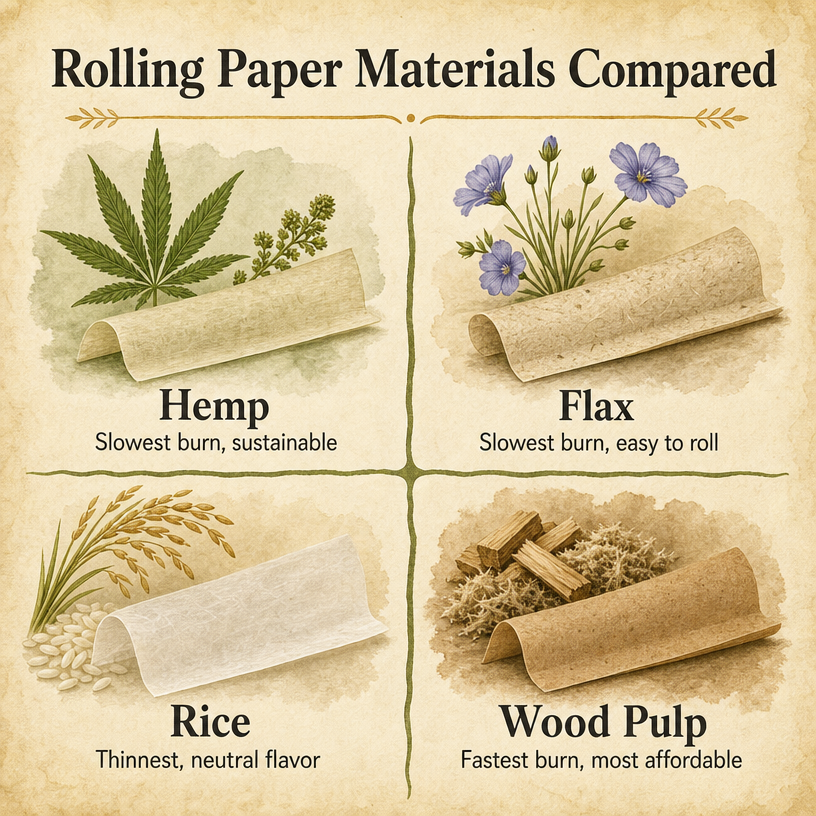
Rolling papers are the foundation of any rolling kit. The material a paper is made from directly affects how it burns, how thick it is, and what flavor it adds to your session. Most Rolling Papers sold today fall into four main material categories: hemp, rice, wood pulp, and flax. [1]
- Hemp: Slow burn, durable, sustainable option favored by regular smokers
- Rice: Ultra-thin, most neutral flavor, lets herb taste come through
- Wood pulp: Affordable and traditional, burns faster than hemp or rice
- Flax: Easy to roll, slow burn, a solid all-around choice
- Specialty materials: Cane, orchid, and citrus papers offer unique characteristics for curious rollers
Hemp papers burn slower than most other materials, which means fewer relights and a longer session. Hemp is also a sustainable crop that grows quickly, making it a popular choice for environmentally minded smokers. [2]
Rice papers are the thinnest option available. Because they are so light, they add almost no flavor of their own, letting the natural taste of your herbs come through. Rice papers can be trickier to roll because they are delicate, but many smokers consider the clean flavor worth the extra care. [1]
Wood pulp papers are the most traditional option and are generally the most affordable. They burn faster than hemp or rice papers and have a more noticeable papery taste. If you are new to rolling and do not want to invest heavily upfront, wood pulp papers are a reasonable starting point. [1]
Flax papers burn slowly and are easy to work with, making them a favorite among experienced rollers. Flax fibers create a paper that is durable enough to handle without tearing while still offering a slow, even burn. [2]
Beyond the four main types, some brands offer specialty papers made from cane, orchid, or citrus pulp. These are less common but worth exploring if you want to fine-tune your rolling experience over time. [2]
Browse Filters / Tips to explore related options.
What Rolling Paper Size Should I Use for My Session?
Rolling paper sizes determine how much herb a joint can hold and how long it burns. Choosing the right size depends on whether you are smoking solo or sharing, how much herb you want to use per session, and your personal preference for smoking duration. [3]
- Single Wide: Solo sessions, smallest smoke, holds 0.3 grams or less
- 1 1/4: Most common size, works for one or two people, holds 0.3 to 0.5 grams
- King Size: Group sessions, longest burn, holds 0.7 to 1.0 grams
- King Slim: Longer narrow format, moderate herb capacity, good middle ground
Single Wide papers measure roughly 68 to 70 millimeters long and 34 to 36 millimeters wide. This is the smallest standard size and is best suited for solo sessions or for smokers who prefer a small, quick smoke. Single wide papers typically hold 0.3 grams or less. [3]
1 1/4 papers are the most commonly sold size in most smoke shops. They measure approximately 76 to 78 millimeters long and 45 to 48 millimeters wide and hold around 0.3 to 0.5 grams. This is a versatile size that works well for one or two people. [3]
King Size papers are the largest standard option, measuring 100 to 110 millimeters long and 55 to 60 millimeters wide. They hold roughly twice the herb of a 1 1/4 paper, approximately 0.7 to 1.0 grams, and burn noticeably longer. King size is the preferred choice for group sessions or anyone who wants an extended experience. [4]
King Slim papers offer a longer format with a narrower width compared to standard king size. They hold a moderate amount of herb and are popular with smokers who want a longer smoke without the full width of a standard king size paper.
When selecting a size, think through a few practical questions. Will you be smoking alone or with friends? How much herb do you typically want to use in a single session? Do you prefer shorter, more controlled smokes or longer sessions that last? The answers will point you toward the right size for your needs.
Read What Smoking Accessories Do Beginners Need? for more detail.
Should I Use Pre-Rolled Cones or Roll From Scratch?
Pre-rolled cones are exactly what they sound like: rolling papers that have already been shaped into a cone and sealed at one end. You simply fill the cone, pack it, and smoke. This eliminates the skill requirement of shaping and sealing a joint from a flat paper. Pre-rolled cones have become widely available in a range of materials including bleached wood pulp, unbleached wood pulp, hemp, and bamboo. [5]
- Pre-rolled cones: Ready to fill, consistent shape and burn, saves time, eliminates skill requirement
- Hand-rolling from scratch: Full control over every variable, satisfying ritual, improves with practice
- Hemp and unbleached cones: Preferred for cleaner flavor and fewer additives
- Bamboo cones: Thin burning but raise sustainable sourcing concerns
- Starting with cones: A useful learning tool before committing to hand-rolling technique
One of the main advantages of cones is consistency. Because the shape and density are already set, every cone you fill and pack will burn in roughly the same way. This is particularly useful if you are new to rolling, have limited dexterity in your hands, or simply want to roll faster without sacrificing uniformity. [10]
Pre-rolled cones also let you choose the cone material to suit your flavor preferences. Hemp and unbleached wood pulp cones are generally preferred by smokers who want a cleaner taste, while bamboo cones are thin burning but raise ecological sourcing questions. [5]
Rolling from scratch gives you complete control over every variable. You choose the paper, the size, how tightly you pack it, and the ratio of herb to airflow. Many smokers enjoy the ritual and find that hand-rolling becomes faster with practice. The trade-off is that your first several attempts may produce uneven rolls that burn inconsistently. [10]
If you are just getting started with rolling, cones are a practical way to learn how different pack densities and herb amounts affect your smoke before investing time in developing hand-rolling technique. As you grow more comfortable, you can experiment with both approaches and decide which fits your lifestyle better.
What Are the Different Types of Herb Grinders?
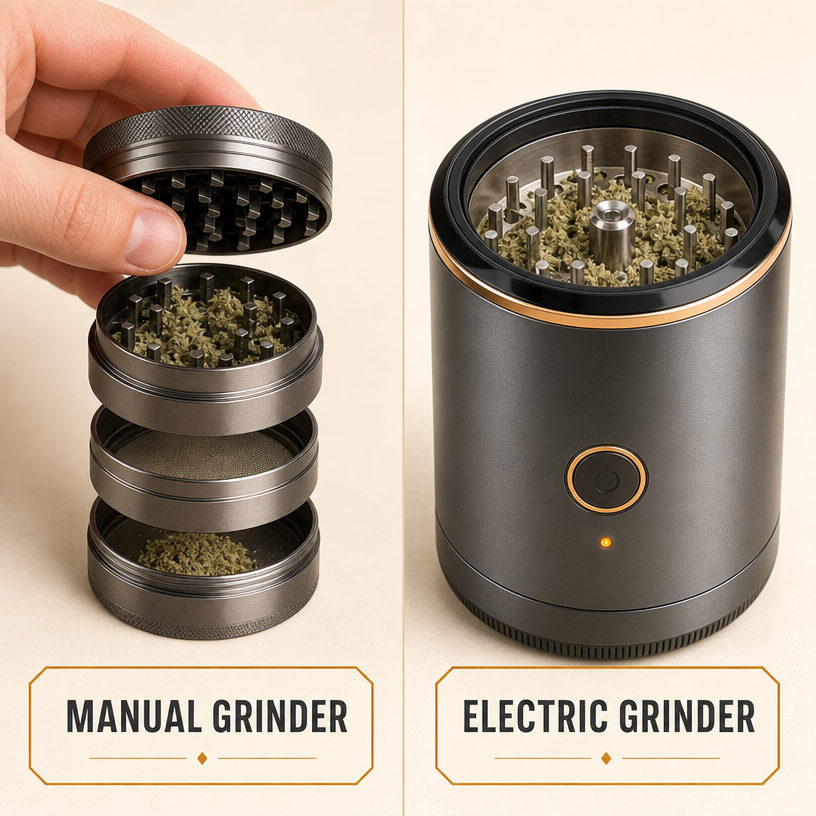
Herb Grinders are tools that shred whole herbs into an even, fluffy consistency. An even grind burns more uniformly than hand-shredded herb, which means fewer relights and a smoother smoking experience. Grinders fall into two broad categories: manual and electric. [6]
- Two-piece manual: Basic grinding, two chambers, simple and affordable
- Three-piece manual: Adds a kief screen, collects concentrated trichomes
- Four-piece manual: Includes kief screen plus a dedicated kief collection chamber
- Electric grinder: Push-button operation, seconds processing time, ideal for limited hand dexterity or frequent rolling
Manual grinders are the most common type. They use interlocking teeth to tear through herbs when you twist the two halves together. Manual grinders come in several piece configurations. A two-piece grinder has a top and bottom chamber and gets the job done simply. A three-piece model adds a screen that catches kief, the concentrated trichomes that collect during grinding. A four-piece grinder includes the screen and adds a second collection chamber specifically for kief, giving you a separate compartment to store and later use this potent material. [6]
Manual grinders are valued for their high degree of control, near-silent operation, and portability. They fit easily in a pocket or bag and do not require batteries or a power outlet. If you prefer a hands-on approach and enjoy the tactile feel of grinding by hand, a manual grinder is a straightforward choice. [6]
Electric grinders use spinning blades or burrs to process herbs in seconds. You load your herbs, close the lid, and press a button. Within a few seconds the herbs are ground to your desired consistency. Electric grinders are especially useful for anyone with limited hand strength or dexterity, for smokers who roll frequently and want faster preparation, or for anyone who simply prefers the convenience of push-button operation. [6]
The main drawbacks of electric grinders are their reliance on a power source, larger physical size, and generally higher price compared to manual models. They are also louder due to the motor. For regular home use where counter space is not a concern, an electric grinder can be a worthwhile upgrade that noticeably speeds up the preparation process.
What Are Grinder Teeth Made From and How Do They Compare?
Grinder teeth are the individual pegs or points inside a grinder that do the actual work of shredding herbs. The material these teeth are made from affects how long the grinder stays sharp, how evenly it grinds over time, and whether it can affect the flavor of your herbs. The most common materials are anodized aluminum, stainless steel, plastic or acrylic, zinc alloy, and wood. [6]
- Stainless steel: Hardest and most durable, resists wear and flavor transfer over long-term use
- Anodized aluminum: Lightweight, corrosion-resistant, good everyday durability at a moderate price
- Zinc alloy: Heavy-duty metal option between aluminum and stainless steel in durability
- Plastic or acrylic: Budget choice, teeth dull quickly, can impart unwanted flavor
- Wood: Aesthetic appeal, inconsistent tooth quality, harder to clean and maintain
Anodized aluminum grinders are the most widely available. Aluminum is lightweight, corrosion-resistant, and holds up well to regular daily use. Over very long-term use, aluminum grinder teeth may begin to show wear marks, and some users report noticing tiny metal flakes in their herbs after extended grinding. [6]
Stainless steel grinder teeth rank significantly higher in durability. Stainless steel is harder than aluminum and resists scratching, wear, and metal transfer far better over time. Grinders with stainless steel teeth stay sharper longer and maintain consistent grinding performance after months or years of heavy use. If longevity and reliable performance are your priorities, stainless steel is the superior choice. [7]
Plastic or acrylic grinders are typically sold as entry-level or budget options. The teeth on plastic grinders dull relatively quickly with regular use, and the material can impart a faint flavor to your herbs that you may notice over time. Plastic grinders are not recommended for regular use but can serve as a temporary solution if you are just starting out. [6]
Zinc alloy falls in the middle ground between aluminum and stainless steel in terms of durability and price. It is heavier duty than plastic and holds up better than standard aluminum over time, but it does not match the long-term wear resistance of stainless steel.
Wood grinders are primarily chosen for their visual appeal and natural feel rather than grinding performance. Cleaning can be more difficult, and tooth quality varies widely depending on the manufacturer. Some wood grinders work well while others struggle to produce an even grind.
For most buyers, anodized aluminum offers the best balance of cost and everyday durability. If your budget allows and you want a grinder that will maintain its performance for years, stainless steel is worth the extra investment. Plastic models work in a pinch, but the dulling teeth and potential flavor issues make them a poor long-term choice.
Read What Are the Different Types of Hand Pipes? for more detail.
Should I Use Glass Tips or Paper Tips for My Joints?
Tips, also called filters, serve two purposes: they keep herbs from falling out of the open end of a rolled cone and they provide structural rigidity that makes the joint easier to hold and smoke. The two most common options are reusable glass tips and disposable paper tips, and each has distinct characteristics worth understanding. [8]
- Glass tips: Reusable, stay firm when heated, maintain neutral flavor throughout the smoke, generate less waste
- Paper tips: Disposable, convenient, can affect flavor near the end of a session
- Custom paper tips: Thicker and stiffer than standard tips, more structural support during rolling and smoking
- Reusability: Glass tips last through hundreds of sessions with simple cleaning
- Mouthfeel and flavor: Glass maintains an open airway and consistent draw from start to finish
Glass tips are reusable. Unlike paper, glass does not soften or break down when exposed to heat from a burning joint. This means a glass tip stays firm from the first draw to the last, maintaining an open airway throughout the entire smoke. Because they do not burn, glass tips do not affect the flavor of your session the way a paper tip can near the end of a joint when the paper begins to char and break down. [8]
Another practical advantage of glass tips is their reusability. A single glass tip can be used hundreds of times with simple periodic cleaning, making it a less wasteful option compared to disposable paper tips. If you are mindful of reducing single-use waste, glass tips are worth considering. [8]
Paper tips are the traditional cardboard variety that often come attached to rolling paper books or sold separately in packs. They are completely disposable, which means no cleaning or maintenance. Some smokers prefer paper tips for their convenience, and they are available in a range of shapes and rigidity levels. The trade-off is that paper tips can become soggy from herb moisture, may affect flavor toward the end of a smoke, and create ongoing waste with each joint you roll. [8]
Custom paper tips are another option. These are often slightly thicker and stiffer than the standard tips that come with rolling papers, making them easier to handle and less likely to collapse during rolling or smoking. If you prefer the convenience of disposable tips but want more structural support than standard paper tips offer, custom paper tips strike a practical middle ground.
If reusability, mouthfeel, and consistent flavor throughout the session are priorities for you, glass tips are the better choice. If you prefer the simplicity of grabbing a tip and tossing it after use, paper tips remain a perfectly serviceable option. Many smokers keep both on hand to use in different situations.
Why Should I Use a Rolling Tray?
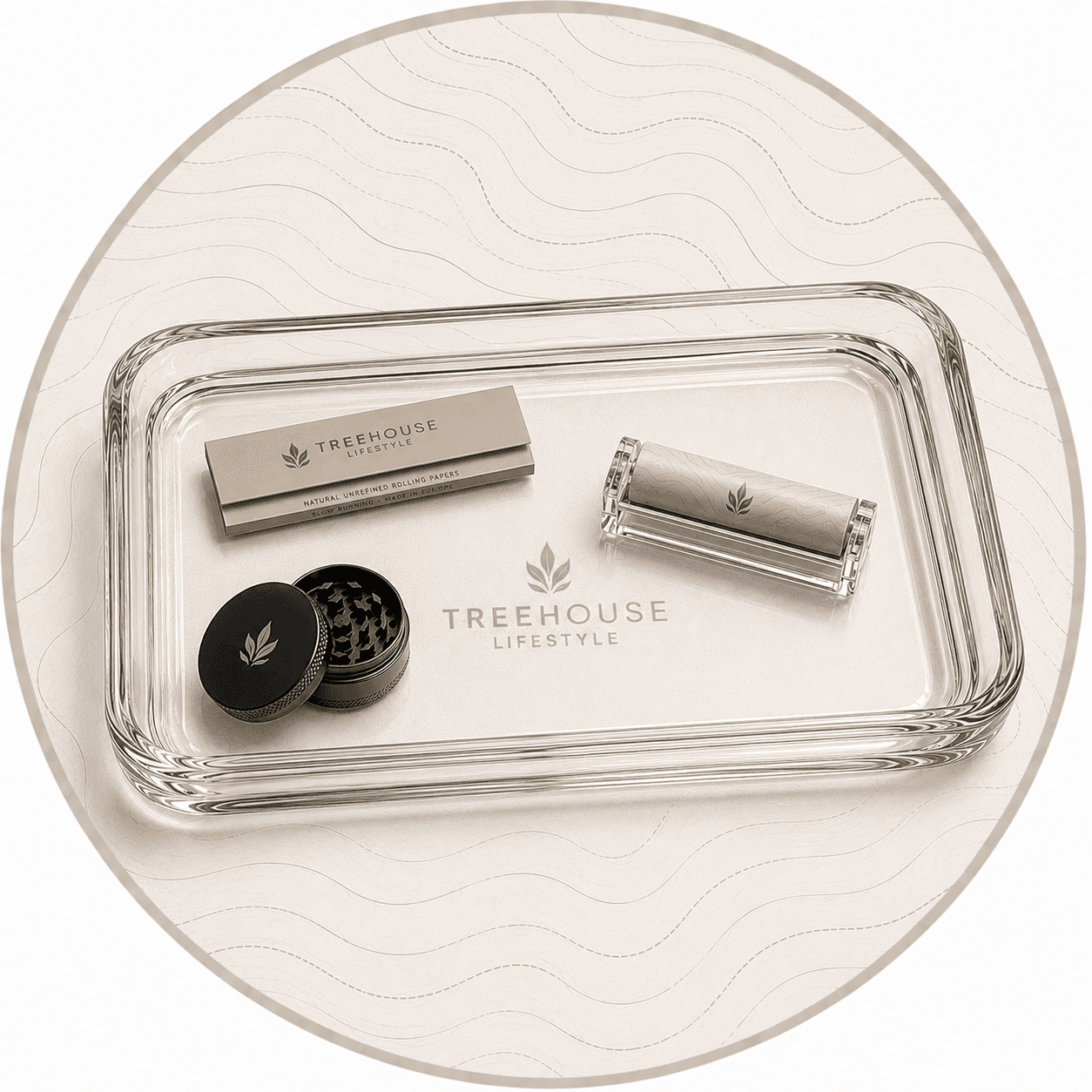
A rolling tray is a flat, enclosed surface specifically designed for the rolling process. The raised edges keep herbs and small accessories from rolling or spilling off the surface, which is one of the most practical benefits of using one. Without a tray, it is easy to knock herb onto the floor or lose small pieces like tips or tobacco sticks between cushions or under furniture. [9]
- Containment: Raised edges keep herbs and small accessories from spilling or going missing
- Organized workspace: Dedicated space for papers, grinder, tips, and herb keeps the process smooth
- Easier cleanup: Wipe down a single flat surface instead of cleaning herbs off a table or floor
- Size options: Compact trays for travel, large multi-compartment trays for home and group sessions
- Extra features: Some trays include lids or built-in compartments for added convenience
Beyond keeping everything contained, a rolling tray gives you dedicated space to organize your materials. You can keep your papers, grinder, tips, and herb each in their own area of the tray, which makes the process faster and more enjoyable. When your materials are scattered across a cluttered surface, the rolling process becomes more stressful than it needs to be. [9]
Rolling trays also make cleanup significantly easier. Instead of wiping herbs off a table or vacuuming the floor after every session, you simply gather what is in the tray and wipe the flat surface. For regular smokers, this convenience adds up over time.
Tray sizes range from compact models designed for travel to large multi-compartment trays built for group sessions. A smaller tray easily fits in a bag or backpack and keeps your rolling setup portable. A larger tray with multiple compartments works well at home when you are rolling for yourself or a group and want everything within reach. [9]
Some trays come with built-in compartments or lids, while others are simple flat surfaces with raised edges. The extra compartments are useful for keeping different accessories separated, and a lid makes it simple to close everything up and put it away when you are done. If you are new to rolling, a basic tray without extra features is a perfectly good starting point.
How Do I Use a Rolling Machine for Consistent Rolls?
A rolling machine, sometimes called a joint roller or rolling helper, is a device that holds a rolling paper and mechanically funnels herbs into a consistently packed cylinder. The result is an evenly filled, evenly packed joint every time without requiring manual dexterity or practice. Rolling Machines are particularly useful for anyone with limited hand strength, anyone who rolls multiple joints at once, or anyone who simply wants uniform results without investing time in developing hand-rolling technique. [10]
- Place a rolling paper inside the machine with the adhesive strip facing down toward the funnel
- Fill the herb chamber with your ground herbs
- Rotate or slide the packing mechanism to funnel and compress the herb into an even cylinder
- Lick or dampen the adhesive strip and press it firmly to seal the paper closed
- Practice two or three times to develop a feel for herb quantity and pack tightness
Using a rolling machine involves a straightforward step-by-step process. First, open the machine and place a rolling paper inside with the adhesive strip facing downward toward the funnel. Second, close the machine and hold it upright. Third, open the top herb chamber and fill it with your preferred amount of ground herb. Fourth, rotate or slide the packing mechanism to funnel and compress the herb into the paper in a tight, even cylinder. Fifth, lick or dampen the adhesive strip and press it closed to seal the paper. [10]
After a few practice runs, you will develop a feel for how much herb to use and how tightly to pack for your preferred smoking experience. Some smokers prefer a looser pack for easier airflow, while others prefer a tighter pack for a slower burn. Adjusting these variables is simple with a rolling machine because the process is repeatable and consistent. [10]
Rolling machines work well for anyone who wants uniformity without the learning curve of hand-rolling. They are also useful for preparing several rolls in advance for a social gathering or personal use throughout a day. The main requirement is keeping the machine clean, particularly the adhesive areas, to ensure a clean seal on every joint.
What Are Common Questions About Smoking Accessories?
What are the best rolling paper materials for a slow burn?
Hemp and flax rolling papers burn the slowest of the four main materials. Rice papers are the thinnest and offer the most neutral flavor, but they do not necessarily burn slower than hemp or flax.
What rolling paper size holds the most herb?
King size rolling papers are the largest standard size and hold roughly twice the herb of a 1 1/4 size paper. A king size paper holds approximately 0.7 to 1.0 grams, compared to 0.3 to 0.5 grams in a 1 1/4.
What is the most durable grinder material?
Stainless steel grinder teeth are the hardest and most durable, resisting wear and scratching better than anodized aluminum or plastic over long-term use.
Are glass tips better than paper tips?
Glass tips are reusable, stay firm when heated, and remain taste-neutral throughout the session. Paper tips are disposable and affordable but can burn and affect flavor near the end of a joint.
Do pre-rolled cones burn differently than hand-rolled joints?
Pre-rolled cones provide a consistent shape and pack every time, which can lead to a more even burn. The material of the cone paper itself, such as hemp, unbleached wood pulp, or bamboo, affects flavor differently.
What Is the Best Way to Build Your Rolling Accessory Kit?
Building a quality rolling accessory kit does not require spending a lot of money, but having the right tools does make the process noticeably easier and more enjoyable. A solid grinder forms the foundation of any kit because an even grind leads to a more consistent smoke. Adding a couple of different rolling paper options, such as one hemp and one rice paper, gives you flexibility depending on your session size and flavor preferences.
From there, consider whether you want to start with pre-rolled cones for convenience or hand-rolling for the full ritual experience. Rolling trays are a worthwhile addition from day one since they contain mess and speed up cleanup. Glass tips or paper tips are a personal choice, but having at least one option on hand is essential for keeping herbs in place during the smoke.
As your kit grows, a rolling machine can be a useful addition if you find yourself rolling the same size and style frequently and want faster, more consistent results. Treehouse Lifestyle carries a wide selection across every accessory category discussed in this guide, and free shipping is available on orders over $150 so you can stock up on everything you need at once.
Where Does This Smoking Accessory Information Come From?
- Smoke Cartel: Hemp vs. Rice vs. Wood Pulp: Choosing the Right Rolling Paper
- Zig-Zag: Best Rolling Papers: Rice, Hemp, or Wood Pulp?
- Zig-Zag: Your Complete Guide to Rolling Paper Sizes 2022
- Marijuana Packaging: King Size vs 1 1/4: Comparing Rolling Paper Sizes
- Still River Wellness: What Are the Best Cones on the Market?
- Smoke Cartel: Manual vs. Electric Herb Grinders: Which One Is Right for You?
- 420 VapeZone: Stainless Steel Grinder Guide & Comparison
- Bluntd Cones: What Are the Benefits of a Glass Tip?
- Greengo: What is a Rolling Tray and Why Would You Use One?
- 42 Degrees: Your Ultimate Guide to Using a Rolling Machine