

A complete guide to understanding vaporizer types, heating methods, and finding the right device for your needs.
A vaporizer heats botanical material below its combustion threshold to produce vapor instead of smoke. Combustion occurs around 446°F (230°C); vaporization happens at lower temperatures, which is why many people who switch from smoking to vaporizing report a noticeably different experience. Vaporizers come in three main form factors — portable (battery-powered), desktop (plugged into a wall), and pen-style (ultra-compact) — and they use either conduction heating, convection heating, or a hybrid of both. The type you choose affects everything from vapor quality to maintenance needs. This vaporizer guide covers the complete landscape so you can make an informed decision.
Treehouse Lifestyle carries a wide selection of vaporizers across every category, with free shipping on orders $150+.
What Are the Main Types of Vaporizers?
Vaporizers fall into three broad form factors, each built around a different lifestyle and usage pattern. The category you choose shapes nearly every other decision, from where you can use the device to how much maintenance it requires.
- Portable vaporizers — Battery-powered, compact, and designed for use anywhere. Ideal for people who want to vaporize on the move.
- Desktop vaporizers — Plugged into a wall outlet for high power output. Best for home sessions where consistent, large vapor production is the priority.
- Pen-style vaporizers — Ultra-compact and pocket-sized. The simplest option for beginners who want something discreet and easy to use.
Portable Vaporizers run on rechargeable batteries and are designed for on-the-go use. They fit in a bag or a large pocket and are the most versatile category. Most portable devices heat up in under a minute and offer temperature control so you can fine-tune each session. [1]
Desktop Vaporizers plug into a wall outlet and draw significantly more power than battery-powered devices. This extra power translates into larger, more consistent vapor clouds and more precise temperature control. Desktop units are best suited for home use where you do not need to move the device around. [1]
Pen-style vaporizers are the most compact option. They are slim enough to slip into a shirt pocket and typically operate with a single button or no button at all. Pen-style devices are popular among beginners because of their simplicity and low barrier to entry. [9]
Browse Pen Vaporizers to explore related options.
What Is the Difference Between Whip and Balloon Vaporizers?
Whip-style and balloon-style are the two subtypes of desktop vaporizers, and the difference comes down to how the vapor is delivered to you during and after the session.
- Whip-style vaporizers deliver vapor through a direct tube during the session. You draw vapor through the whip each time you inhale, giving you real-time control over the experience.
- Balloon-style vaporizers fill a portable bag with vapor. The bag can be detached and passed around, making it easier to share with multiple people in one session.
- Both are desktop-only categories that require a wall outlet. They produce significantly more vapor than portable devices but are not designed for mobility.
Whip-style vaporizers deliver vapor directly through a glass or silicone tube during the session. You inhale as the device heats the material, drawing vapor through the whip and straight into your mouth. The experience is immediate and interactive — you control the pace with each draw. Whip-style devices tend to produce denser, warmer vapor compared to balloon-style units. [9]
Balloon-style vaporizers fill a bag with vapor that you then inhale at your own pace. The bag detaches from the device, making it easy to pass around a room or save the vapor for later. Balloon-style units are popular in social settings because multiple people can share a single filling without crowding around the device. [9]
Both styles require proximity to a power outlet and take more time to set up and clean than portable options. If you want the most powerful home setup, desktop vaporizers in either style will outperform any portable device in vapor output and temperature precision.
Read What Smoking Accessories Do Beginners Need? for more detail.
Read What Is a Dab Rig and How Do You Use One? for more detail.
What Is Conduction Heating in a Vaporizer?
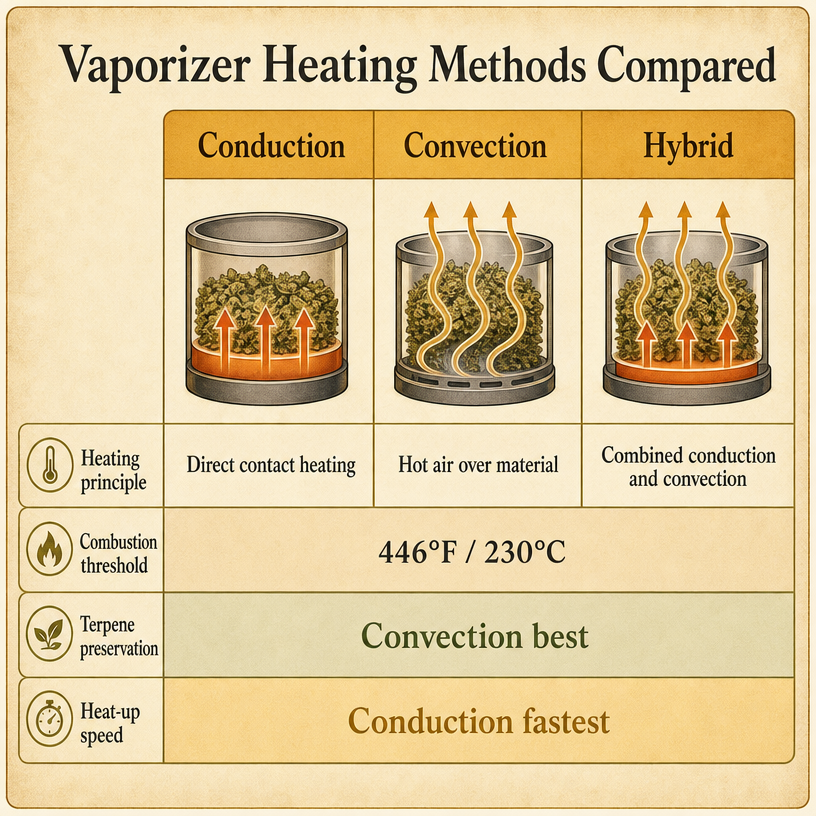
Conduction heating works by bringing the botanical material into direct contact with a heated surface inside the device. The heat transfers from the surface to the material through physical touch, which is why this method heats material quickly and efficiently. [1]
- Heat transfers through direct contact between the heating element and the botanical material, producing vapor quickly and efficiently.
- Hot spots can develop in the material because direct contact does not distribute heat evenly across the entire chamber.
- Continued degradation between draws may occur because the heating surface stays in contact with the material even when you are not actively drawing.
- Conduction vaporizers generally heat up faster than convection units, making them a practical choice when speed matters.
Because the heating element stays in contact with the material, conduction devices can develop hot spots where the temperature is higher than surrounding areas. This can lead to uneven vaporization and, in some cases, continued material degradation between draws. The material closest to the heating surface may darken or scorch slightly while other areas remain less heated. [2]
Conduction is common in more affordable portable vaporizers because it requires less complex engineering than convection-based systems. The fast heat-up time is a real advantage if you want to start a session quickly without waiting for the device to reach temperature. [4]
If you choose a conduction vaporizer, occasional stirring of the material between draws helps distribute heat more evenly and gets more consistent vapor across the session. [2]
What Is Convection Heating in a Vaporizer?
Convection heating passes hot air over or through the botanical material without any direct contact between the heating element and the herb. The hot air carries enough energy to vaporize the active compounds, and the vapor is then carried to you through the airway. [1]
- Hot air passes over and through the material without touching the heating element directly, producing more even vaporization across the entire chamber.
- Terpene preservation tends to be better with convection heating because the material is not exposed to direct surface heat that can degrade delicate compounds.
- Heat flow stops immediately when you stop drawing on the device, which reduces material waste and gives you more precise control over each session.
- Convection heating generally takes longer to reach operating temperature compared to conduction-based devices.
Because there is no direct contact between the heating element and the material, convection heating eliminates hot spots and produces a more even result across the entire chamber. The flavor profile tends to be cleaner and more true to the original material, which many users notice right away. [2]
Another key characteristic of convection heating is that heat flow stops the moment you stop drawing on the device. Without airflow, the hot air disperses and the heating process pauses. This gives you more control over each session and reduces the risk of material degrading when the device is left idle. [2]
The trade-off is that convection heating typically takes longer to bring the material up to temperature compared to conduction. The hot air needs time to fill the chamber and penetrate the material evenly. [4]
What Is a Hybrid Vaporizer and Why Does It Matter?
Most modern vaporizers sold today do not rely on a single heating method. Instead, they combine conduction and convection into a hybrid design that tries to capture the strengths of both approaches. [1]
- Combines direct-contact conduction heating with hot-air convection heating in a single device to balance fast heat-up times with even vaporization.
- Delivers faster heat-up than pure convection while producing better-flavored vapor than pure conduction in most conditions.
- Has become the dominant design approach in mid-range and premium portable vaporizers because it removes the need to compromise between speed and quality.
In a hybrid setup, some heat transfers through direct contact with the heating surface while additional heat comes from hot air flowing through the material. This dual approach gives you the fast heat-up time that conduction provides while still delivering the even, flavorful vapor that convection is known for. [2]
Hybrid designs are now the most common approach in mid-range and premium portable vaporizers. The added complexity is worthwhile for most users because it removes the need to choose between speed and vapor quality. [4]
When shopping for a vaporizer, it is worth checking the product description to understand which heating methods the device uses. Some devices market themselves as hybrid but rely primarily on one method with the other playing a supporting role. Reading the specifications helps you set accurate expectations for heat-up time and vapor quality.
| Heating Method | How It Works | Best For |
|---|---|---|
| Conduction | Direct contact heating | Fast heat-up, affordable devices |
| Convection | Hot air over material | Best flavor, terpene preservation |
| Hybrid | Conduction + convection combined | Balancing speed and vapor quality |
| Combustion threshold | 446°F / 230°C | The point to stay below for vaporizing |
What Is the Difference Between Dry Herb and Concentrate Vaporizers?
The material you plan to vaporize is one of the most important factors in choosing a device. Dry Herb Vaporizers and Concentrate Vaporizers are designed for different materials, and using the wrong type of material in a device not designed for it can produce poor results or damage the unit.
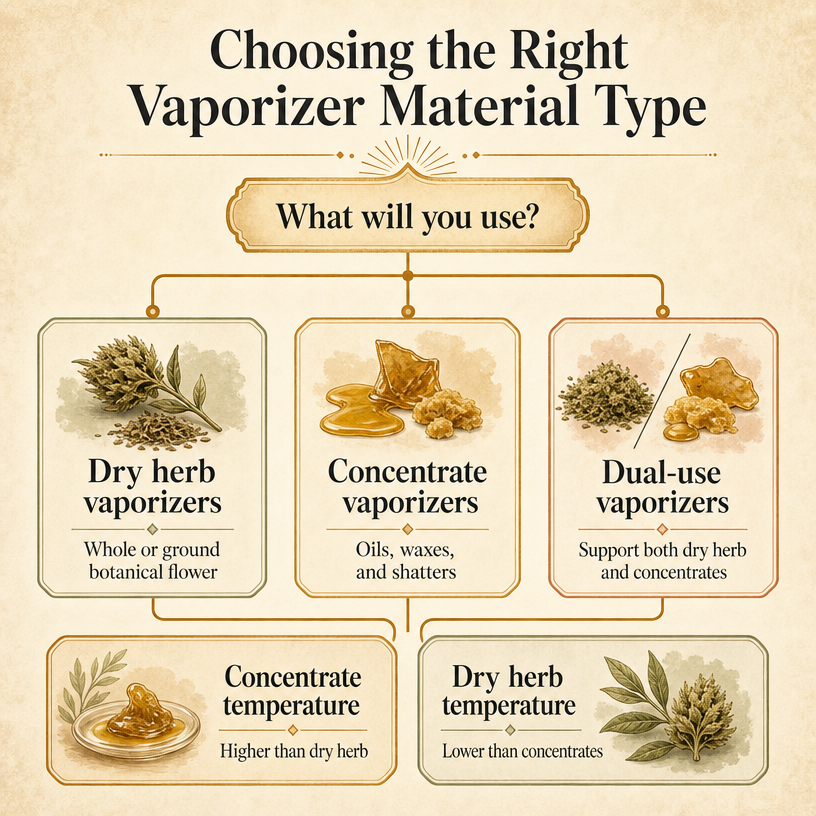
- Dry herb vaporizers heat whole or ground botanical flower at lower temperatures than concentrates, using a chamber designed for loose plant material.
- Concentrate vaporizers handle processed extracts such as oils, waxes, and shatters, which require higher vaporization temperatures and a different heating chamber design.
- Dual-use vaporizers support both dry herb and concentrates through interchangeable components, giving you flexibility without needing two separate devices.
- Using the wrong material type in a device not rated for it can produce poor vapor quality or damage the heating chamber.
Dry herb vaporizers are built to heat whole or ground botanical flower. The flower is placed in a chamber where direct heat or hot air brings it to the vaporization temperature. Dry herb vaporization typically occurs at lower temperatures than concentrate vaporization. [1]
Concentrate vaporizers handle processed extracts such as oils, waxes, and shatters. These materials are more potent and dense than dry herb, and they vaporize at higher temperatures. Concentrate devices often feature a different heating chamber design — such as a quartz bucket or coil-based atomizer — to handle the material safely and efficiently. [5]
If you want flexibility, some devices support both dry herb and concentrates through dual-use or hybrid designs. These units include interchangeable components or chambers that let you switch between material types without owning two separate devices. [5]
| Material Type | What It Is | Vaporization Temperature |
|---|---|---|
| Dry Herb | Whole or ground botanical flower | Lower temperatures |
| Concentrates | Oils, waxes, and shatters | Higher temperatures than dry herb |
| Dual-Use | Supports both dry herb and concentrates | Varies by mode selected |
How Does Temperature Control Affect the Vaporizing Experience?
Temperature settings directly control vapor density, flavor, and the range of compounds released during a session. Most modern vaporizers include a temperature dial or digital display so you can set the exact temperature for each session rather than relying on a fixed preset. [3]
- Lower temperatures (315°F–350°F / 157°C–177°C for dry herb) preserve more terpenes and produce lighter, more flavorful vapor with milder effects.
- Higher temperatures (380°F–430°F+ / 193°C–221°C+) produce denser vapor and release more compounds, which changes the character and intensity of the session.
- Most modern vaporizers include adjustable temperature controls so you can fine-tune settings to match your personal preference for each session.
Lower temperatures — roughly 315°F to 350°F (157°C to 177°C) for dry herb — preserve more of the delicate terpene compounds that contribute to flavor. The vapor at lower settings tends to be lighter and less dense, and the effects are generally milder. Many users prefer starting at lower temperatures to experience the full flavor profile of the material. [1]
Higher temperatures — 380°F to 430°F (193°C to 221°C) and above — produce denser vapor with more visible clouds. At these temperatures, more compounds are released, which changes the overall character of the session. Some users find higher temperatures produce vapor that feels harsher on the throat. [3]
Optimal temperature is personal preference. The best approach is to start at a lower setting and gradually increase it session by session until you find the temperature that produces the vapor density and flavor you enjoy most.
How Do You Maintain and Care for a Vaporizer?
Regular maintenance keeps a vaporizer performing well and extends the life of the device. A clean heating chamber and airway produce better vapor quality and reduce the buildup of residue that can affect flavor over time. [1]
- Brush out the heating chamber after each session to prevent residue from hardening and sticking to the heating surfaces.
- Wipe down the chamber walls and any accessible surfaces with a dry or lightly damp cotton swab to remove loose material and oils.
- Perform a deep clean with isopropyl alcohol every one to two weeks for conduction devices and every few weeks for convection-style devices, depending on usage frequency.
- Allow all disassembled components to dry completely before reassembling the device to avoid moisture entering the electronics or heating system.
The maintenance routine varies depending on the heating method. Conduction devices tend to accumulate residue more quickly because the material sits directly against the heating surface. Brushing out the chamber after each session and wiping down surfaces with a cotton swab helps keep residue from hardening and becoming difficult to remove later. [1]
Convection devices accumulate buildup in the airway and any glass components rather than the heating chamber itself. Regular brushing of the airway and periodic soaking of glass parts in isopropyl alcohol keeps the air path clear and maintains vapor quality.
A deep clean with isopropyl alcohol is recommended every one to two weeks for conduction devices and every few weeks for convection-style units, depending on how frequently you use the device. Avoid using excessive amounts of liquid inside the heating chamber, and always let the device dry completely before reassembling and using it again.
What Are Common Questions About Smoking Accessories?
Are vaporizers safer than smoking?
Vaporizers eliminate combustion, which removes the tar and ash produced by burning material. However, research from the American Lung Association and the European Respiratory Society has found that vaporizer emissions can still contain potentially toxic substances including acetaldehyde, acrolein, formaldehyde, and ultrafine particles. Whether vaporizing is safer than smoking is a personal decision that depends on your health priorities and usage patterns.
What is better, conduction or convection heating?
Neither heating method is universally better — each suits different priorities. Conduction heats faster and produces stronger hits, but it can cause uneven hot spots and continued degradation between draws. Convection produces smoother, more flavorful vapor and better preserves terpenes, but it heats more slowly. Most mid-range and premium devices use hybrid heating to combine the strengths of both methods.
How does temperature affect the vaporizing experience?
Temperature settings control vapor density, flavor, and the compounds released. Lower temperatures preserve more terpenes and produce lighter vapor. Higher temperatures produce denser vapor but can reduce flavor quality. Most modern vaporizers include a temperature dial or digital control so you can fine-tune your sessions to your personal preference.
How often should you clean a vaporizer?
How often you clean a vaporizer depends on how frequently you use it and what material you vaporize. For regular users, a quick brush-out of the heating chamber after each session keeps residue from building up. A deeper clean with isopropyl alcohol — wiping down the chamber, stem, and any glass components — is recommended every one to two weeks for conduction devices and every few weeks for convection-style devices.
What type of vaporizer is best for a beginner?
A portable vaporizer with a simple single-button interface is generally the easiest starting point for a beginner. They are compact, affordable, and require no setup beyond charging. If you primarily use at home and want the most powerful experience, a desktop vaporizer delivers bigger hits, but it requires being near a power outlet and takes more time to learn and maintain.
How Do You Choose the Right Vaporizer for Your Needs?
Choosing the right vaporizer comes down to understanding how you plan to use it and what material you prefer. A portable vaporizer with hybrid heating gives you the most flexibility if you want to vaporize on the go. A desktop unit is the right choice if raw vapor output and temperature precision are your top priorities and you do not need to move the device around. A pen-style vaporizer is the simplest entry point for beginners who want something compact and straightforward.
Once you know the form factor and heating method that fit your lifestyle, look at the temperature range the device offers and how much control it gives you over that range. Fine-tuneable temperature settings make it easier to find the sweet spot for the material you use and the vapor density you prefer. Regular cleaning and proper storage extend the life of any vaporizer, so factor maintenance into your decision just as you would battery life or warranty coverage.
Browse the full selection of vaporizers at Treehouse Lifestyle to find a device that fits your needs, with free shipping on orders $150+.
Where Does This Smoking Accessory Information Come From?
- Vaping360: How Do Dry Herb Vaporizers Work: Beginner’s Guide
- Camouflet: Convection vs Conduction Vaporizer Heating Technology
- PAX: The Importance of Temperature in Vape
- HEMPER: Convection vs Conduction Vapes: Which One is Better?
- Planet of the Vapes: Vape Pens vs Dry Herb Vapes: Pros, Cons & Which Is Right for You
- American Lung Association: Health Risks of E-Cigarettes and Vaping
- European Respiratory Society: Herb vaporizers are not safe for health. Particles emissions from dry chamomile vaporization
- Lawrence Berkeley National Laboratory: Emissions from Vaporizable Cannabis Concentrates Have Potential Health Risks
- Arizer: Whip vs Balloon Vaporizer