
Rolling tips — also called filters, tips, or crutches — are the small mouthpiece pieces placed at one end of a hand-rolled roll. They keep loose material out of your mouth, hold the roll open for airflow, and give you a place to grip without burning your fingers. This rolling tips guide walks through sizes, materials, and formats so you can match the right tip to your paper.
What Are Rolling Tips and Filters, and What Do They Do in a Roll?
Filter tips, filters, tips, and crutches all describe the same small mouthpiece piece that sits at one end of a hand-rolled roll. The names are used interchangeably by both consumers and brands, so seeing four different words on packaging is normal rather than confusing. [1] Whether the package says "tips," "filters," or "crutches," the item inside does the same job inside the roll.
A tip performs three practical roles once it is placed in the roll. First, it acts as a barrier that helps keep small pieces of material out of your mouth while you pull. Second, the folded or pre-cut tip holds the end of the roll open so air can flow freely through the column. Third, it gives you a firm, unburned surface to grip, which keeps your fingers away from the lit end of the roll. [1] Without a tip, the end of the roll can collapse, become harder to draw through, or get soggy quickly.
It is worth knowing the difference between a crutch and a roach, because both words describe the end of a roll. A crutch is the filter tip placed at the end of a roll before it is smoked. A roach is the small leftover charred end of a roll that has been smoked down. [1] The two words refer to opposite moments — one before, one after — and confusing them can lead to wrong product descriptions or wrong pack counts when shopping.
For shoppers who want a single category page that gathers all of these options, the Treehouse Lifestyle Filters / Tips page groups paper crutches, pre-rolled cotton and cellulose filters, and reusable mouthpieces in one place. If you also use water-filtered pieces like the SILICONE BEAKER BONG WITH REMOVABLE GLASS BOWL, the tip serves a different role than a water piece — it sits at the smoker’s end of the roll rather than filtering material along the path.
- Keeps loose material out of the mouth by acting as a small barrier at the smoker’s end of the roll
- Holds the end of the roll open so air can flow through the column smoothly
- Provides a firm, unburned grip surface so your fingers stay clear of the lit end
What Are the Common Filter Tip Sizes and Which Rolling Paper Fits Each?
Rolling papers come in a handful of standard sizes, and filter tips are sized to match each one. The tip has to be roughly the same width as the paper so the roll stays closed at the smoker’s end. If the tip is too wide, the roll will not seal cleanly; if it is too narrow, the end collapses and the draw suffers. [1] [2]
The standard paper sizes for hand-rolled rolls are single-wide, 1¼, 1½, double-wide, king-size, and king-slim. Paper dimensions range roughly from about 2.75 × 1.4 inches up to 4 × 2 inches depending on which size you pick. [1] [2] Smaller papers take narrower tips, larger papers take wider tips, and specialty tip lines are labeled to match each paper width.
The most common size pairing on retail shelves is 1¼ paper with 1¼ tips. 1¼ is the everyday default for hand-rolled rolls, and just about every brand of perforated paper tips, pre-cut strips, and reusable mouthpieces sells a 1¼ option. King-slim papers pair with slim tips, single-wide papers pair with single-wide tips, and king-size papers pair with wide tips. [1] [2]
If you are still settling on which paper size you use most, our guide to What Rolling Accessories Do I Need and How Do I Choose the Right Ones? walks through the broader rolling accessory checklist, and the dedicated What Are Rolling Paper Sizes and Which One Should I Use? piece covers paper dimensions and capacity in detail. Tip shopping becomes much easier once you know the paper size you keep coming back to.
- Single-wide papers — pair with single-wide tips; smallest standard size
- 1¼ papers — pair with 1¼ tips; the everyday default width used by most rollers
- 1½ and double-wide papers — pair with the wider tip variants sold for those sizes
- King-size papers — pair with wide tips; longest and widest standard paper
- King-slim papers — pair with slim tips; long length with a narrow profile
How Do Paper, Cotton, Cellulose, Glass, and Wood Tips Differ in Feel and Function?
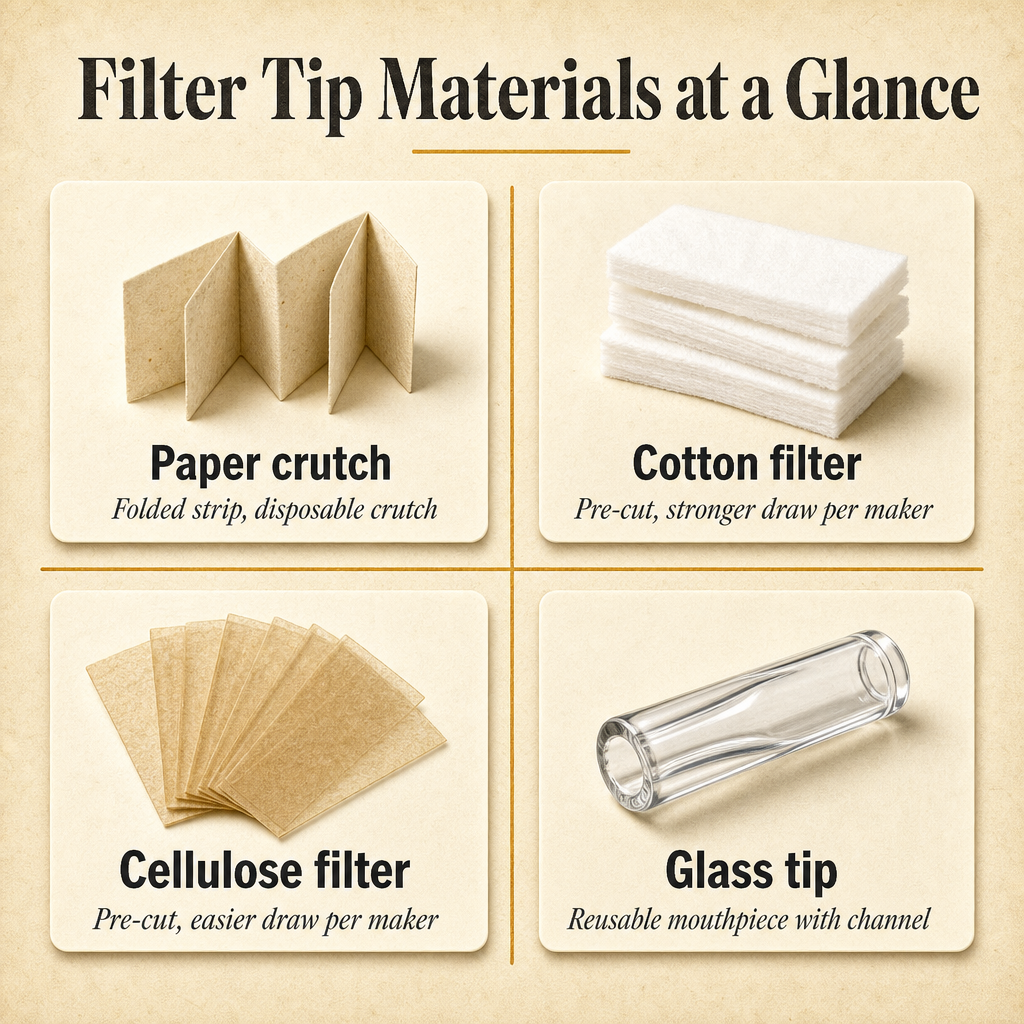
Filter tips are sold in five common materials, and each behaves a little differently. The five are paper, cotton, cellulose, glass, and wood. Paper tips are disposable and folded at home; cotton and cellulose tips are pre-cut strips sold ready to use; glass and wood tips are reusable mouthpieces that slide onto the end of the roll. [1] [2] Understanding how each material differs helps you pick a tip that matches the feel you want.
Paper tips are usually sold either as perforated strips that the user folds into a multi-layer crutch — often called a W or M fold — or as flat pre-cut strips that drop straight into the roll. [1] Paper is the most common tip material because it pairs directly with the paper used for the roll itself. Specialty tip paper in some products is coated with polyvinyl alcohol to control adhesion and stiffness. [2]
Cotton tips are pre-cut strips of compressed cotton, sold ready to drop into a roll. The manufacturer of RAW Pure Cotton Filters describes the draw as noticeably stronger — slightly harder to pull through — as part of how the cotton version performs compared with other tip materials. [5] If you want a tip that feels tight at the end of the roll, cotton is the material to look at first.
Cellulose tips are pre-cut strips made from cellulose fiber, the same family of material used in industrial cigarette filters. Modern cigarette filters were introduced in the early 1950s and are typically made from cellulose acetate fiber, paper, or activated charcoal. [3] [4] In a hand-rolled context, the manufacturer of RAW Slim Cellulose Filters describes their draw as easier than the cotton version, which is a useful point of comparison for shoppers trying to choose between the two. [6]
Glass tips and wood tips sit in a different category. They are reusable mouthpieces that slip onto the end of a roll rather than being inserted inside it. They typically contain a narrow internal channel or spiral insert intended to cool and partially restrict airflow as the draw passes through. [7] Because they are reusable, glass and wood tips are sold as single pieces or small sets rather than in hundreds of strips.
If you are curious about how paper materials affect the roll itself — separate from the tip — our What Are Hemp, Rice, and Wood Pulp Rolling Papers Made Of? guide walks through hemp, rice, and wood pulp rolling papers in detail. The tip material and the paper material can be matched independently, so a hemp-paper roll can still use a cotton or cellulose tip if you prefer that draw.
- Paper tips — disposable; sold as perforated strips to fold at home or flat pre-cut strips; cheapest per tip
- Cotton tips — pre-cut strips of compressed cotton; manufacturer describes the draw as stronger
- Cellulose tips — pre-cut strips of cellulose fiber; manufacturer describes the draw as easier than cotton
- Glass tips — reusable mouthpieces that slip onto the roll; contain a narrow internal channel
- Wood tips — reusable mouthpieces similar to glass; designed for repeated use rather than disposal
| Material | Format | Draw characteristic (maker description) |
|---|---|---|
| Paper | Perforated strip (folded) or flat pre-cut strip | Neutral; matches the paper used for the roll |
| Cotton | Pre-cut strip, dropped into the roll | Stronger draw (harder to pull through) per RAW |
| Cellulose | Pre-cut strip, dropped into the roll | Easier draw than cotton per RAW |
| Glass | Reusable mouthpiece slipped onto the roll | Restricted by an internal channel or spiral insert |
| Wood | Reusable mouthpiece slipped onto the roll | Restricted by an internal channel or spiral insert |
How Do You Fold a Crutch and Place It When Rolling?
Folding a paper crutch takes less than a minute once you have done it a few times. The result is a small, firm mouthpiece that holds the end of the roll open. Most perforated tip strips sold for hand-rolled rolls are pre-scored so the crutch folds into the same shape every time. [1] [2]
If you want to skip the folding step, pre-rolled cones already come with a built-in crutch at the tip. The Juicy Terp Infused Squeeze Pre-Rolled Cones | Blue Haze | 30pk Display is one example — the crutch is already in place inside the cone, so you only have to fill the cone and pack it down. That option is useful for beginners or anyone who simply prefers not to fold their own tip each time.
If you prefer the traditional folded crutch, the steps below walk through the standard W-fold from start to finish. The technique works with any perforated tip strip sized to your paper, so a 1¼ strip is the everyday default for 1¼ papers.
Once the crutch is folded and placed, the rest of the rolling process is the same as rolling without a tip. The crutch simply gives you a stable, structured end to grip and draw through.
- Step 1 — Tear off one perforated strip from the tip booklet so the strip is roughly the width of the rolling paper and a few inches long
- Step 2 — Accordion-fold the strip two or three times back and forth so the folds look like a W or M when viewed from the side
- Step 3 — Pinch the folded crutch flat between your fingers so the folds hold their shape and the crutch forms a small rectangular pad
- Step 4 — Tuck the crutch into one end of the rolling paper before you add material, leaving a small section sticking out to form the mouthpiece
- Step 5 — Fill the roll, seal the paper, and the crutch is locked into place as the smoker’s end of the finished roll
Do Pre-Rolled Paper Tips, Cotton Filters, and Cellulose Filters Come in Different Pack Counts?
Specialty filter tips are sold at retail in fixed pack counts that vary by material and product line. Knowing the published pack counts makes it much easier to compare price-per-tip across product lines without inventing numbers. [5] [6] [8]
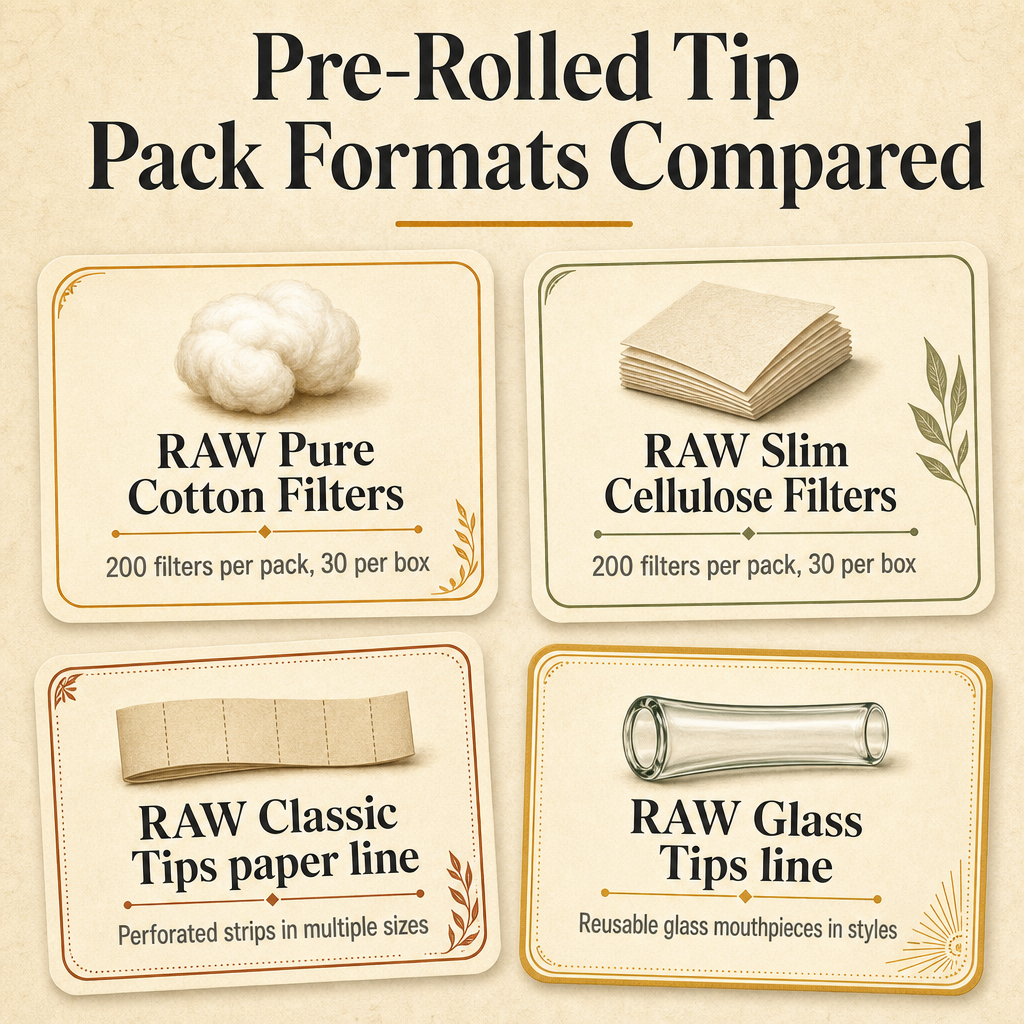
RAW Pure Cotton Filters are sold at 200 filters per pack, with 30 packs per box according to the manufacturer. [5] RAW Slim Cellulose Filters follow the same format at 200 filters per pack, 30 packs per box. [6] The matching pack format makes it simple to compare a cotton box and a cellulose box on a per-tip basis.
Perforated paper tips are sold in different formats from cotton and cellulose filters. Instead of pre-cut strips, perforated paper tips are sold as strips in their own counts — RAW offers a range that includes RAW Original Tips, RAW Perforated Gummed Tips, RAW Black Tips, RAW Wide Tips, RAW Slim Herbal Tips, RAW Perforated Wide Tips, RAW PROTIPS, and pre-rolled tips in tins and boxes. [8] Each line has its own published strip count on the packaging.
Glass tips and reusable mouthpieces are sold differently again. They are sold as single pieces, small sets, or small display cases rather than as hundreds of strips, because each tip is meant to be reused many times rather than discarded after a single roll. [7]
When you are comparing total cost across formats, divide the package price by the published count to get price-per-tip for paper, cotton, and cellulose. For products like the RAW Black Classic Inside Out Rolling Papers | King Size Slim | 50pk Display, the package is sold by paper count rather than by tip count, so that comparison works against tip packs rather than within them.
- RAW Pure Cotton Filters — 200 filters per pack, 30 packs per box (manufacturer listing) [5]
- RAW Slim Cellulose Filters — 200 filters per pack, 30 packs per box (manufacturer listing) [6]
- RAW Classic Tips perforated paper line — sold as strips in multiple sizes including Original, Black, Wide, Slim Herbal, and PROTIPS [8]
- RAW Glass Tips line — sold as reusable single mouthpieces in styles like Whirlwind, Turbo, Black Glass, and DLX Glass Tipped Cones [7]
What Are Reusable Glass, Wood, and Ceramic Tips, and How Do They Work?
Reusable tips are a third category of filter option alongside disposable paper crutches and pre-rolled cotton or cellulose filters. Instead of being folded or dropped inside the roll, reusable tips are designed to be slipped onto the end of a finished roll. They stay in place during the session and are then removed, cleaned, and used again on the next roll. [7]
Glass tips, wood tips, and ceramic tips are the three most common reusable materials. Each is machined or molded into a small cylindrical mouthpiece that matches the diameter of a standard paper end. Inside the tip there is usually a narrow internal channel or a spiral insert that the air passes through on the way to your mouth. [7] The channel restricts the airflow slightly compared with an open-ended roll, which gives the draw a tighter feel.
The internal spiral or channel is the feature that distinguishes reusable tips from a plain hollow tube. A spiral insert adds a longer path for the air to travel, which spreads the draw over more surface area inside the tip. [7] Different reusable tip styles use different channel layouts — some use a smooth straight channel, some use a spiral, and some use a stacked disc arrangement — but they all share the basic structure of an outer body with a restricted inner path.
Spiral metal inserts are another reusable option mentioned in the same retail category. Instead of a glass or wood body, a metal spiral is inserted directly into the end of the roll and acts as the mouthpiece. The spiral can be removed and reused across many rolls, which is why it is sold as a small reusable piece rather than a high-count pack. [7]
Reusable tips are a good fit for rollers who want a structured mouthpiece every session without buying fresh pre-cut strips. They are also a natural complement to other reusable smoking accessories — if you want a wider look at mouthpiece-style pieces, our guide to What Are Specialty Pipes and How Do You Choose the Right One? covers specialty pipes in a similar buying-guide format.
- Glass reusable tips — slip onto the end of the roll; usually contain a narrow internal channel or spiral insert
- Wood reusable tips — slip onto the end of the roll; built from machined or molded wood; reusable across many sessions
- Ceramic reusable tips — slip onto the end of the roll; ceramic body with an internal channel for the draw
- Spiral metal inserts — inserted directly into the end of the roll; act as a reusable mouthpiece without a separate body
- All reusable options are designed to be cleaned and reused rather than discarded after a single roll
Frequently Asked Questions
Are filter tips, filters, tips, and crutches the same thing?
Yes. Filter tips, filters, tips, and crutches are used interchangeably in the same product category by both consumers and brands. They all refer to the small mouthpiece piece placed at one end of a hand-rolled roll.
How is a crutch different from a roach?
A crutch is the filter tip placed at the end of a roll before it is smoked. A roach is the small leftover charred end of a roll that has been smoked down. The two terms are easy to confuse because both describe the end of a roll, but they refer to opposite moments in the roll’s life.
Do filter tips actually filter smoke the way a cigarette filter does?
Industry and educational sources describe filter tips as a mouthpiece barrier that helps keep small pieces of material out of the mouth, holds the roll open so air can flow, and gives the smoker a place to hold the roll without burning their fingers. They are not designed to filter smoke the way a manufactured cigarette filter is.
Which tip size should I buy for the rolling paper I use?
Match the tip width to the paper width. Standard hand-rolled paper sizes range from single-wide up to king-size and king-slim, with paper dimensions roughly between 2.75 × 1.4 inches and 4 × 2 inches. If you use 1¼ papers, look for tips labeled 1¼; if you use king-slim papers, look for slim tips, and so on.
How do cotton and cellulose pre-rolled filters differ in draw?
The manufacturer of RAW Pure Cotton Filters describes the draw as noticeably stronger (slightly harder to pull through), while RAW Slim Cellulose Filters are described by the same maker as having an easier draw than the cotton version. Both are sold at 200 filters per pack with 30 packs per box.
Are glass and wood tips reusable?
Yes. Glass tips, wood tips, and ceramic tips are reusable mouthpieces designed to be slipped onto the end of a roll, and they typically contain a narrow internal channel or spiral insert intended to cool and partially restrict airflow. They sit alongside disposable paper crutches and pre-rolled cotton or cellulose filters as an alternative category.
Which Filter Tip Should You Buy?
Filter tips come down to four practical decisions: paper size, material, format, and draw feel. The first decision is the easiest — match the tip width to your rolling paper width. If you use 1¼ papers, a 1¼ tip is the obvious pick; if you use king-slim papers, a slim tip is the match. Mismatched widths lead to rolls that do not seal cleanly or draws that feel uneven, so sizing up front saves frustration later.
The second decision is material. Paper crutches are the cheapest and the most traditional; cotton and cellulose pre-cut strips are the most convenient; glass, wood, and ceramic reusable tips are the longest-lasting. The third decision is format — disposable strips and reusable mouthpieces live in the same shopping cart but solve different problems, so most rollers end up buying both styles for different situations.
The fourth decision is draw feel. If you want a tighter pull, look at cotton. If you want an easier pull, look at cellulose. If you want a structured mouthpiece you can use across many rolls, look at glass or wood reusable tips. Treehouse Lifestyle carries rolling tips, filters, and crutches across paper, cotton, cellulose, glass, and wood materials, with free shipping on orders $150+.
Sources
- Weedmaps: How to roll a joint (Weedmaps Learn)
- Wikipedia (Rolling paper): Rolling paper
- Wikipedia (Cigarette filter): Cigarette filter
- Wikipedia (Cellulose acetate): Cellulose acetate
- RAW (HBI International): RAW Pure Cotton Filters
- RAW (HBI International): RAW Slim Cellulose Filters
- RAW (HBI International): RAW Glass Tips product category
- RAW (HBI International): RAW Classic Tips product category