
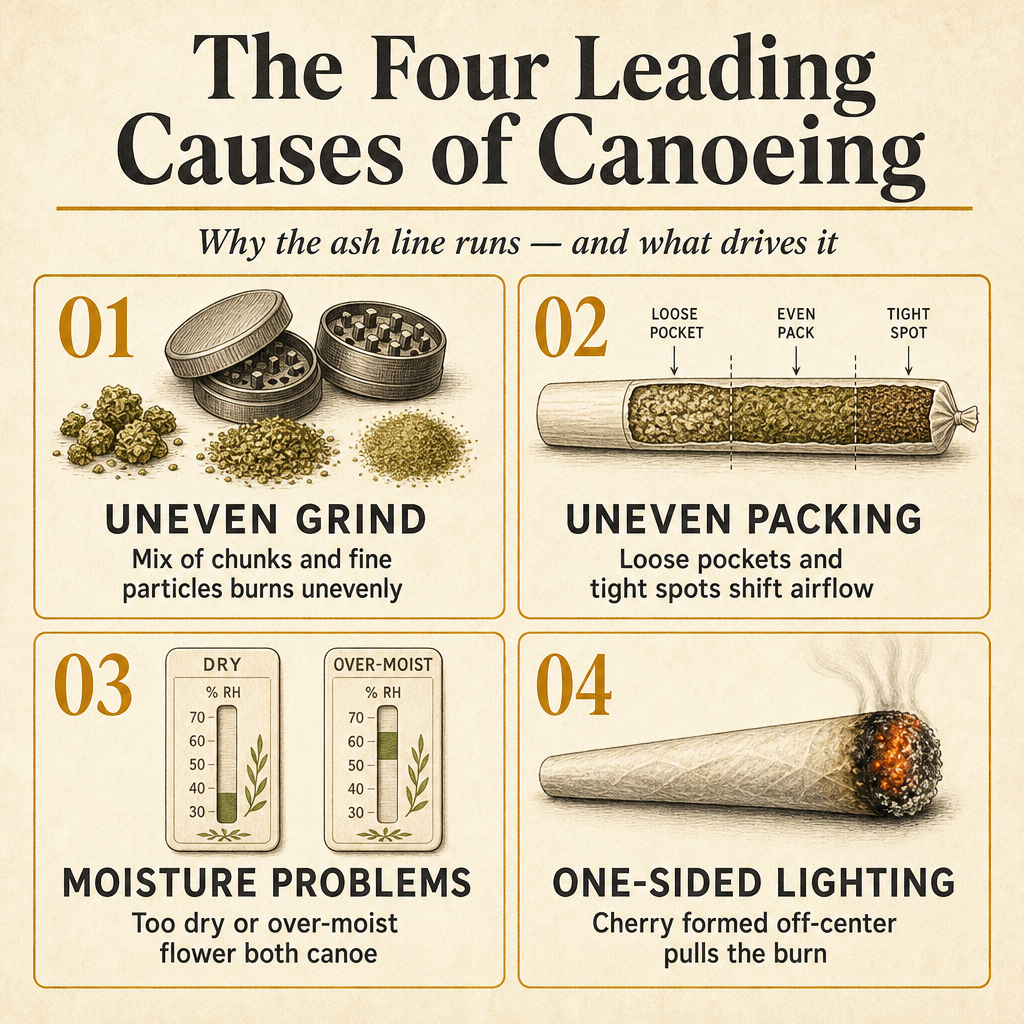
A joint burns unevenly — also called canoeing — when the cherry runs faster down one side of the paper than the other, leaving an angled ash line instead of a level one. Canoeing is driven by four interacting causes that almost all trace back to airflow: an inconsistent grind that mixes chunks with finer particles, uneven packing density that creates loose pockets and tight spots, moisture problems in the flower, and lighting that only catches one side of the tip before the cherry is fully formed. [1] [2]
Once any one of those is off, the side with more airflow pulls ahead and the imbalance grows as the joint burns down. The fix is prevention on the front end — a fine, even grind, a uniform pack at the right density, properly stored flower at the right moisture level, and an even, fully-cherried lighting — plus a few mid-burn corrections (slow pulls, rotation, gentle loosening, or a touch of moisture on the racing side) when the joint starts to run. [3] [5]
The rest of this guide walks through each cause, the exact lighting sequence that prevents canoeing, how paper material and thickness shape the burn, and what to do when you are already mid-roll and the cherry starts to drift.
What Is Canoeing and Why Does It Happen?
Canoeing is the most common form of uneven burning. It describes a joint whose cherry is racing ahead on one side of the paper while the other side lags, leaving an angled, slanted ash line instead of a level one that drops straight across the tip. [1] The name comes from the shape of the burn — the higher side looks like the raised end of a tipped canoe, and the lower side looks like the open hull. Once that imbalance starts, it tends to widen as the joint burns down because the faster side keeps receiving more airflow.
Almost every canoeing joint can be traced back to one or more of four interacting causes. The first is an inconsistent grind that mixes larger chunks with finer particles. The second is uneven packing density inside the roll, which creates loose pockets and tight spots side by side. The third is a moisture problem in the flower — too dry or too moist both produce the same drift. The fourth is one-sided lighting, where the cherry forms off-center before you ever take the first pull. [2] [3]
These four causes are not independent. A grind that is too chunky makes the packing job harder. Moisture that is off makes a chunky grind worse. A lighting that only catches the right edge of the tip will canoe regardless of how good the rest of the roll is. That is why prevention is so much easier than correction — getting the first three right on the front end makes the fourth almost automatic. [5]
The four causes map onto the categories of accessories that matter most when you roll: Rolling Papers the paper itself controls thickness and fiber, Grinders a quality grinder controls grind consistency, and Filters / Tips the right filter tip controls the mouth-side airflow that keeps the cherry from drifting back toward you. If you have ever wondered why some rollers seem to get an even burn every time while yours keeps canoeing, the answer is almost always in how those three pieces were handled before the joint was ever lit. For a broader overview of how these accessories fit into a complete rolling kit, see our What Are the Best Gift Ideas for Someone Who Loves to Roll?.
- Canoeing is a one-sided burn that leaves an angled ash line and tends to widen as the joint burns down
- Uneven grind — chunks mixed with fine particles — drives one side to ignite and burn faster than the other
- Uneven packing density creates loose pockets and tight spots side by side, shifting airflow inside the roll
- Moisture problems in the flower — too dry or too moist — produce the same drift either direction
- One-sided lighting that catches only part of the tip before the cherry is fully formed sets up an immediate imbalance
How Does Grind Consistency Make a Joint Burn Unevenly?
Grind is the most-cited single cause of canoeing, and the reason is straightforward once you picture what is happening inside the roll. When a joint mixes larger chunks with finer particles, the smaller material has far more surface area relative to its mass and ignites first. It burns faster, expands faster, and pulls more airflow into that side of the paper. The chunks sitting next to the fines do not ignite at the same rate, so the burn front runs ahead on the side with more fines and leaves the chunky side trailing. [1] [2]
A consistent grind fixes that almost entirely. When every particle in the roll is roughly the same size, every part of the joint ignites at roughly the same rate, and the cherry drops evenly across the tip instead of running to one side. This is also why grinder quality matters so much — a grinder that produces a uniform medium-fine grind is one of the highest-leverage pieces of rolling equipment you can buy. [3] [5]
If you are new to grinding or shopping for a grinder, our guide to What Rolling Accessories Do I Need and How Do I Choose the Right Ones? walks through the full kit, and our deeper What Should I Look for When Buying a Weed Grinder? explains exactly what to look for in a grinder. A good grinder does not just make rolling easier — it is the single biggest lever you have for an even burn. For accessories that complement your rolling setup, including the filter tips that affect how air moves through the mouth side, our What Are Rolling Tips and Filters, and Which One Should You Use? covers the full range.
If a joint is already running because of a chunky grind, the mid-burn fix is to slow your pulls, rotate the joint to give the slow side more flame exposure, and gently work any large chunks loose so they break up against the paper. If you tend to over-grind into powder, our guide on percolator bongs at What Is a Percolator Bong and How Does It Work? explains how airflow works in adjacent accessories and how overly fine material can choke the cherry on the front end.
The easiest way to test whether your grind is the cause is to roll the next joint with a clearly more uniform consistency and see if it burns evenly. The difference between a chunky hand-broken grind and a uniform grinder-broken grind is usually visible within the first quarter-inch of ash.
- Break the flower into smaller pieces with your fingers or a coarse grinder first pass, aiming for popcorn-kernel-sized chunks
- Run it through a medium grinder setting to knock those chunks down to a consistent medium-fine texture
- Pulse the grinder in short bursts rather than holding it down — over-grinding creates powder that chokes airflow and burns hot on one side
- Sift out any stems or seeds that did not break down — these sit like rocks in the roll and create dead spots where airflow stalls
- Aim for the texture of coarse sand or dried herbs: every particle visible should be roughly the same size so the cherry ignites evenly across the tip
How Do Moisture and Packing Density Cause Canoeing?
Moisture problems drive canoeing in both directions, and both ends of the spectrum create the same drift. Flower that is too dry burns hot and fast on the side that gets more airflow, and that hot, fast side pulls ahead of the cooler side within the first quarter-inch of ash. Flower that is over-moist or improperly dried does the opposite — it burns unevenly because the wet side refuses to ignite and the dry side keeps advancing, then the wet side goes out, then the dry side keeps running. Either way, you end up with a one-sided ash line. [1] [2]
The fix for moisture problems is storage. Keep flower in an airtight container in a cool, dark place, and use a humidity pack sized for the volume of the container. Over-humidified flower can be brought back to a usable range by leaving the container open briefly to dry, but the bigger lesson is prevention — moisture is a setup problem, not a mid-burn problem. [3]
Packing density is the second half of this equation and the one most rollers underestimate. A roll that is packed loose in some spots and tight in others creates airflow pockets inside the paper. The loose pockets receive more oxygen and burn ahead, while the tight sections slow the burn. The result is exactly the same drift you would see from a chunky grind or a one-sided light. [4]
The goal is a uniform pack from tip to crutch. Pack firmly enough that the joint holds its shape and stays lit, but not so tight that you have to suck hard to pull air through. A useful test is to draw through the unlit joint — if you can feel a steady, easy stream of air with no hot spots or dead zones, the density is right. If one section pulls harder than the rest, redistribute the material before you light up.
When packing density is the cause of a mid-burn drift, the fix is to gently loosen the over-packed section with a pin or paper clip, or pinch the paper from the outside to redistribute the material without breaking the seal. Both corrections work best in the first half of the joint before the cherry has run too far to recover.
- Too-dry flower burns hot on the side that gets more airflow — store with a humidity pack and check the texture before rolling
- Over-moist flower refuses to ignite on the wet side and goes out repeatedly — dry it back to the usable range before rolling
- Loose pockets inside the roll receive more oxygen and pull ahead of the burn front, creating a fast side
- Tight sections slow the burn and create a lagging side that the fast side races past
- A uniform pack from tip to crutch, firm enough to hold shape but not so tight you have to suck hard, eliminates most density-related canoeing
What Is the Right Way to Light a Joint So It Burns Evenly?
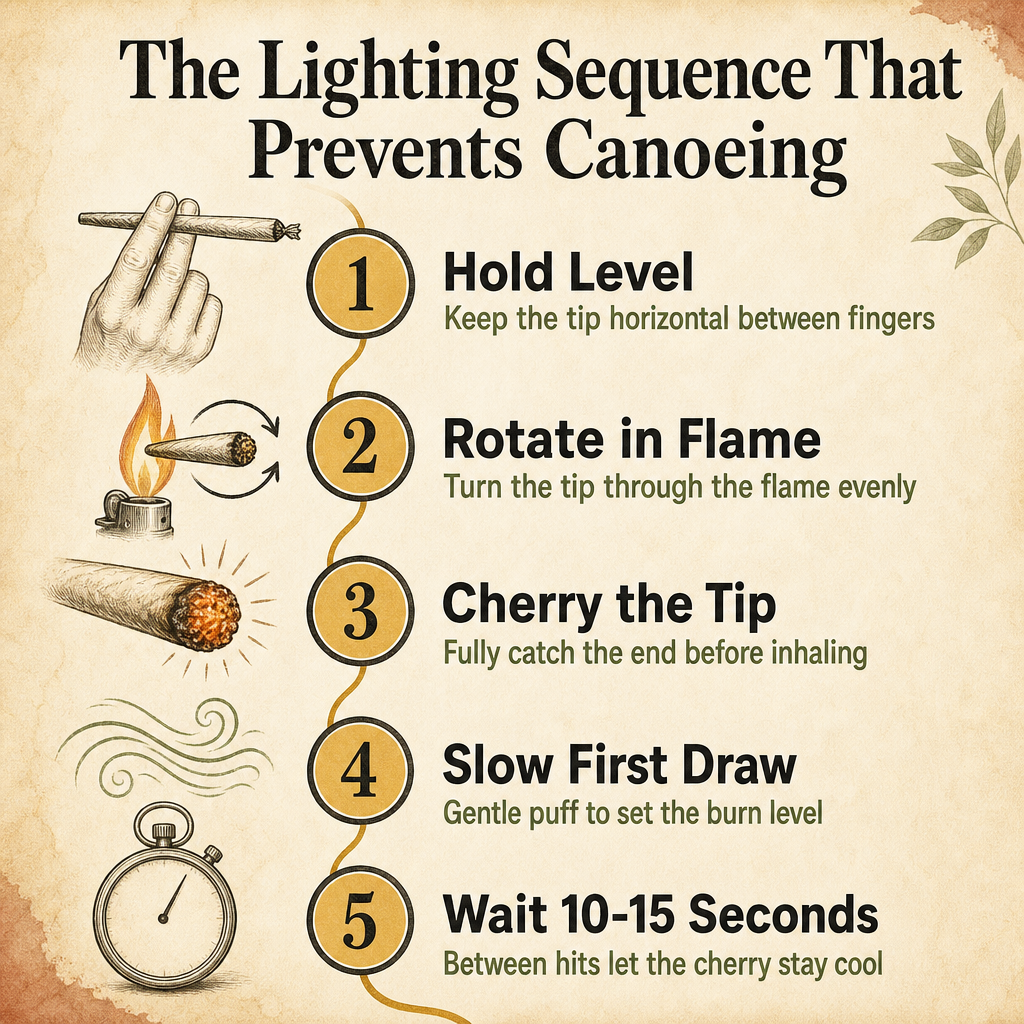
Lighting is the cause most rollers can fix on the spot without re-rolling the joint, and the sequence practitioners recommend is short and repeatable. Hold the joint level between your fingers, rotate the tip through the flame, fully cherry the end before inhaling, and start with a slow gentle puff. Each step exists to keep the cherry centered on the tip rather than catching only one edge. [1] [2]
The first mistake is holding the joint at an angle. If the tip is tilted, the flame naturally catches the lower edge of the paper first and the cherry forms off-center before you ever take a pull. The fix is mechanical: hold the joint horizontally with the tip pointed slightly down toward the flame, then rotate the tip slowly through the flame so the entire end catches evenly. A butane lighter gives you more control than a match for this — the flame stays put and you move the joint through it. [3]
The second mistake is inhaling before the cherry is fully formed. A half-lit tip with a glowing patch on one edge is the most reliable recipe for a canoe. Wait until the entire end of the joint has a thin, even layer of glowing material — that is the cherry — and only then take the first pull. Rushing this step is what causes most one-sided burns at the start. [5]
The third mistake is the first pull itself. A hard, fast pull drags airflow to whichever side the paper is already tilted toward and accelerates whatever imbalance has formed. A slow, gentle puff lets the cherry drop evenly across the tip and sets the burn pattern for the rest of the joint. After the first two puffs, you can return to a normal draw.
Between hits, hold the joint vertically and leave the ash on the tip. The ash acts as a protective layer that keeps the cherry cool and balanced, and the vertical orientation prevents gravity from pulling the cherry to one side of the paper. Practitioners recommend waiting 10 to 15 seconds between hits to give the cherry time to settle into an even ring across the tip. [5]
If the joint has already started canoeing despite a careful lighting, the mid-burn sequence is to slow your pulls, rotate the joint slightly to expose the slow side to more flame, and use a pin or paper clip to gently loosen any over-packed bud inside the paper. These three corrections, applied in the first half of the joint, will reset the cherry more often than not.
- Hold the joint level between your fingers with the tip horizontal before lighting — a tilted tip is the first cause of one-sided burns
- Rotate the tip slowly through the flame so the entire end catches evenly rather than lighting one edge at a time
- Wait for the cherry to fully form across the tip before the first pull — a half-lit tip guarantees a canoe
- Take the first two puffs slow and gentle to set an even burn pattern before returning to a normal draw
- Hold the joint vertically between hits and leave the ash on the tip as a cooling layer, waiting 10 to 15 seconds before relighting
Does the Rolling Paper You Use Change How Evenly a Joint Burns?
The paper matters more than most new rollers expect. Thickness, fiber material, and how the paper was manufactured all change how the joint behaves once it is lit. A paper that is too thick burns slowly and unevenly; a paper with a low-quality fiber structure catches on one side; a paper with additives like chlorine or calcium carbonate burns at a different rate than a clean natural fiber. [4]
Thinner papers with a uniform fiber structure are generally described by manufacturers as burning more evenly than thicker, lower-quality papers. The reason is that thinner paper offers less material for the cherry to consume on one side versus the other, and a uniform fiber structure means the burn front can travel at a consistent rate instead of stuttering through uneven patches. [2]
Fiber material makes a noticeable difference too. Hemp and bamboo are the two fibers most often associated with an even, level burn, partly because they have a tight, regular structure and partly because they tend to be manufactured in thinner weights than wood-pulp papers. Wood-pulp and rice papers can also burn evenly when manufactured well, but the manufacturing quality varies more across brands. [6]
Additives are the third variable. Some papers are bleached or treated with calcium carbonate to control how they burn and how they look. Additive-free papers are often described by enthusiasts as burning more evenly, though the effect varies by paper and brand. If you have been canoeing joints on a paper you have used for years, it is worth trying a different brand or a hemp or bamboo fiber to see if the burn changes. [4]
Paper shape also plays a role. King-size papers give you more room to work with during rolling, which means a more uniform pack is easier to achieve. Smaller papers compress the same amount of material into a shorter roll, which can exaggerate any unevenness in grind or pack density. If you are working on getting a level burn, king-size hemp or bamboo papers are the easiest starting point. [6]
Treehouse Lifestyle carries a range of rolling papers across materials and thicknesses, including ultra-thin hemp options that are well-suited to an even burn. Browse the rolling papers section to compare fiber types, weights, and sizes — and remember that free shipping on orders $150+ applies across the shop.
- Thickness — thinner papers burn more evenly because there is less material for the cherry to consume unevenly on one side
- Fiber material — hemp and bamboo tend to produce the most even burns because of their tight, regular fiber structure
- Additives — bleached or calcium-carbonate-treated papers can burn at a different rate than clean natural fibers
- Manufacturing quality — uniform fiber structure and consistent weight matter more than the specific material
- Paper size — king-size papers give you more room for a uniform pack, which reduces density-related canoeing
How Do You Fix a Joint That Is Already Canoeing?
Once a joint has started to canoe, the goal is to reset the cherry before the imbalance widens past the point of recovery. The mid-burn corrections that practitioners reach for are slow pulls, rotation, gentle loosening, and a touch of moisture on the racing side. Each one addresses a specific cause, and they work best in the first half of the joint when there is still enough unburned material to recover. [1] [2]
The first correction is to slow your pulls. A hard drag pushes airflow toward whichever side the cherry is already running, which widens the imbalance. A slow, gentle pull gives the slower side time to catch up and lets the cherry settle into a more even ring across the tip. This single change often resets a mild canoe within a quarter-inch of ash. [3]
The second correction is to rotate the joint. Pointing the slow side of the cherry briefly into the flame — or rotating the joint a quarter-turn between hits — gives the slow side more direct heat exposure and lets it catch up. Most rollers do not think to rotate, but it is one of the most reliable mid-burn fixes when the joint has started to drift. [5]
The third correction is to gently loosen any over-packed bud inside the paper. Use a pin, paper clip, or the tip of a toothpick to break up tight sections without breaking the seal of the joint. A looser section receives more airflow, which can pull the slow side back to even. This works best in the first half of the joint where the cherry still has time to redistribute.
The fourth correction is moisture on the racing side. A barely-damp fingertip brushed across the racing edge of the paper cools that side slightly and slows its burn. This is a more advanced correction — too much moisture will extinguish the cherry — but a light touch can be enough to give the slow side the time it needs to catch up. [1]
Between hits, the habits that prevent the drift from coming back are simple. Hold the joint vertically so gravity does not pull the cherry to one side. Leave the ash on the tip as a protective cooling layer. Wait 10 to 15 seconds between hits so the cherry has time to settle into an even ring. These three habits work together — the vertical hold, the ash layer, and the cool-down gap — to keep an even burn going once you have corrected the initial drift. [5]
- Slow your pulls — gentle draws give the slow side time to catch up and let the cherry settle into an even ring
- Rotate the joint a quarter-turn between hits or point the slow side briefly into the flame to give it direct heat
- Gently loosen any over-packed bud inside the paper with a pin or paper clip to redistribute airflow to the lagging side
- Apply a barely-damp fingertip to the racing edge of the paper to cool that side and slow its burn
- Between hits, hold the joint vertically, leave the ash on the tip, and wait 10 to 15 seconds before relighting
Frequently Asked Questions
What does it mean when a joint is canoeing?
Canoeing means the cherry is running faster down one side of the joint than the other, leaving an angled ash line instead of a level one. It is the most common form of uneven burning and is driven almost entirely by airflow imbalance inside the roll.
What is the most common cause of a joint burning on one side?
An uneven grind is the most cited single cause. When a joint mixes larger chunks with finer particles, the smaller material ignites and burns faster than the chunks, which pulls the cherry ahead on one side and widens the imbalance as the joint burns down.
Does moisture in flower make a joint canoe?
Yes, in both directions. Flower that is too dry burns hot and fast on one side; flower that is over-moist or improperly dried burns unevenly and goes out repeatedly. Either moisture extreme creates the kind of irregular airflow that drives canoeing.
What is the right way to light a joint so it does not canoe?
Hold the joint level between your fingers, rotate the tip through the flame so the entire end catches evenly, and let the cherry form fully before the first inhale. Then start with slow gentle puffs rather than a hard pull, which would drag airflow to one side and accelerate the canoe.
How do you fix a joint that is already canoeing?
Slow your pulls, rotate the joint so the slow side of the cherry catches up, gently loosen any over-packed bud inside the paper, and apply a touch of moisture to the racing side. Between hits, keep the joint vertical and leave the ash on the tip so the cherry stays cool and balanced.
Do rolling paper materials actually change how evenly a joint burns?
Yes. Thinner papers with a uniform fiber structure are generally described by manufacturers as burning more evenly than thicker, lower-quality papers, and hemp and bamboo are the fibers most often associated with an even, level burn.
What Is the Best Way to Stop a Joint From Canoeing?
Canoeing is an airflow problem with four predictable causes: uneven grind, uneven packing, moisture issues in the flower, and one-sided lighting. Most canoeing joints can be traced back to at least one of those, and most can be prevented entirely by getting those four steps right on the front end.
If you only have time to fix one thing, fix your grind. A uniform medium-fine consistency from a quality grinder is the single highest-leverage change you can make, and it removes the most-cited cause of canoeing. From there, store your flower in an airtight container with a humidity pack, pack the joint to a uniform density, and use the lighting sequence in this guide to set an even cherry on the first pull.
Treehouse Lifestyle carries a curated selection of grinders, rolling papers, and filter tips that work together to give you an even burn. Order over $150 and shipping is free, so you can pick up everything you need for a level-burning roll in a single order.
Sources
- DaySavers: Why Do Pre-Rolls Canoe and How to Fix Them When They Do
- Stoops NYC: Why Some Joints Canoe and Others Burn Even
- Cheeba Cheebas: How To Light A Joint Evenly: Expert Budtender Tips To Prevent Canoing
- Zig-Zag: Why Ultra-Thin Rolling Papers Deliver a Superior Burn
- Talking Joints Memo: Follow These Tips And Your Joints Won’t Ever Canoe Again
- Kashmir420: Why Rolling Papers Tear or Burn Unevenly (And How to Fix It Like a Pro)