

Dabbers prefer quartz pipes and bangers because fused quartz is chemically inert, heats up fast, and preserves the natural flavor of cannabis concentrates without reacting with them or carrying taste between sessions [1] [3] [6]. Quartz is almost pure amorphous silica with an extremely low coefficient of thermal expansion, so it survives the rapid temperature swings of normal torch use [1] [2].
Quartz also costs less than titanium and is more widely available, which is why it has become the default nail material for most concentrate setups [3] [4].
The tradeoffs are real: quartz is fragile to drops and can crack if you cool it too quickly with cold water, alcohol, or a cold swab [5] [8].
Understanding those tradeoffs is what separates a quartz banger that lasts for years from one that splits after a few months.
What Is a Quartz Pipe or Quartz Banger Made From?
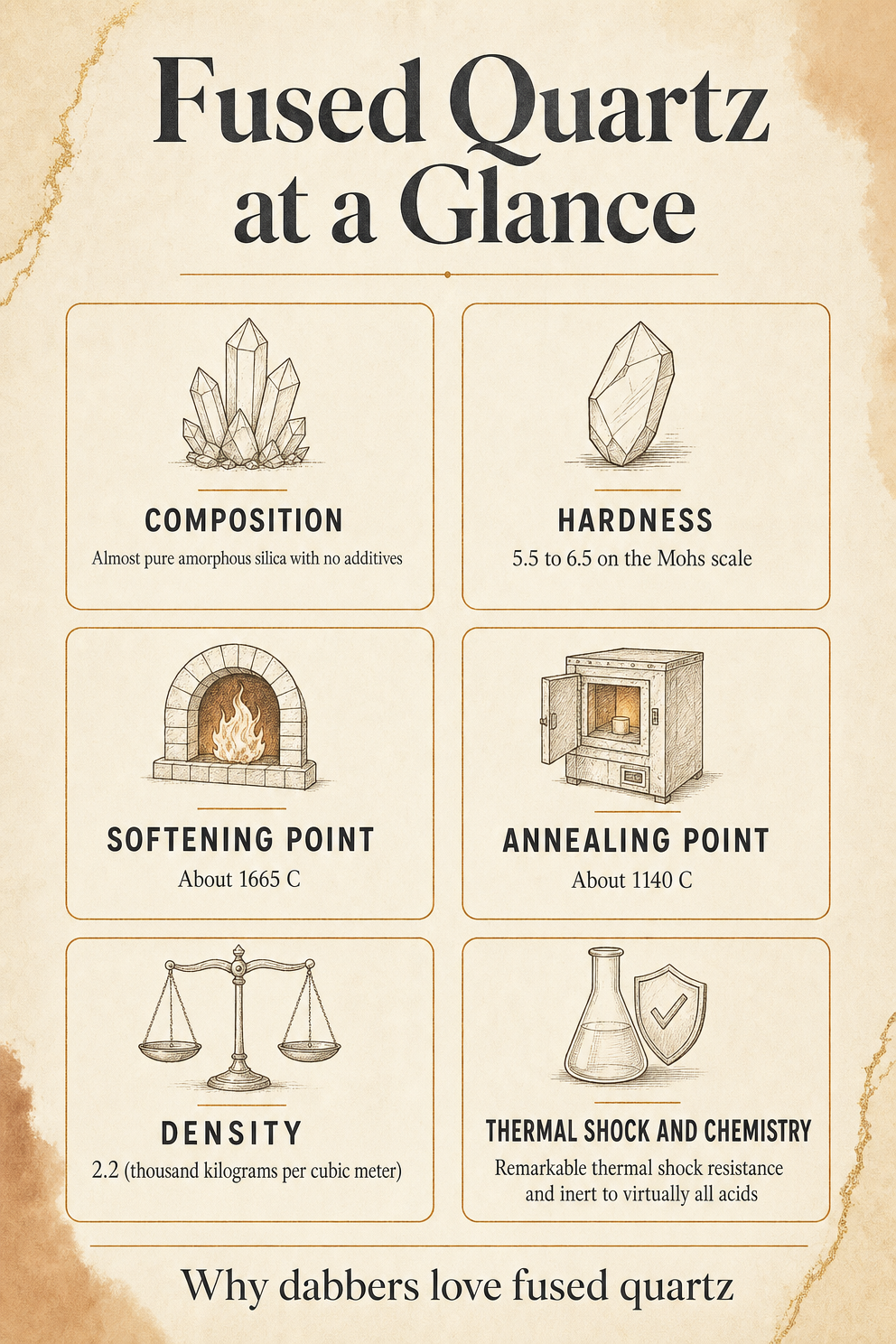
A quartz pipe or quartz banger is made from fused quartz, a special glass that is almost pure silica in amorphous, non-crystalline form [1]. Soda-lime, lead, and borosilicate glasses all mix in other materials to make them easier to melt and shape. Fused quartz does not add those ingredients, which is why it behaves differently when it gets hot and why it does not react with cannabis concentrates [1] [3].
Fused quartz has an extremely low coefficient of thermal expansion, about 5.5×10⁻⁷ per K averaged over 20–320 °C, which gives it a remarkable ability to undergo large, rapid temperature changes without cracking [1] [2]. That single property is the reason a real quartz banger can survive the heat of a butane torch cycle after cycle, even when you heat it cold and dump it hot. It is also why most cracks in normal dabbing use come from cooling too fast, not from heating.
The manufacturer-published numbers tell the same story. Fused quartz has a density of about 2.2×10³ kg/m³, a hardness of 5.5–6.5 on the Mohs scale, a softening point around 1665 °C, and an annealing point near 1140 °C [2]. Those temperatures are far above anything a butane torch reaches in normal dab use, so the banger never gets close to its softening point during a session.
Chemically, fused quartz is inert to almost everything, including virtually all acids regardless of concentration, with the noted exception of hydrofluoric acid [1]. Specialist dabbing publications describe that inertness as the reason quartz does not react with cannabis concentrates and does not absorb or ghost terpenes between sessions [3] [6]. If you want the flavor of one dab to taste like the next one, quartz is the material that makes that possible.
If you are curious about how quartz compares to other glass accessories in a different part of the setup, this guide on Glow in the Dark Bongs: Do They Work and Are They Safe? covers glow-in-the-dark bongs and how their glass chemistry differs.
- Composition: almost pure amorphous silica (SiO₂), with no additives to lower the melt temperature [1].
- Hardness: 5.5–6.5 on the Mohs scale, harder than typical pipe glass but softer than titanium [2].
- Coefficient of thermal expansion: about 5.5×10⁻⁷ cm/cm·°C over 20–320 °C, which is the source of its thermal shock resistance [1] [2].
- Softening point: roughly 1665 °C, well above any temperature a butane torch produces [2].
- Chemical behavior: inert to virtually all acids, so it does not react with concentrates or absorb terpenes [1] [3] [6].
How Does a Quartz Banger Compare to Titanium and Ceramic Nails?
Specialist retailers commonly frame the choice between dab nail materials as a tradeoff: quartz wins on flavor, titanium wins on durability, and ceramic wins on heat retention [3] [7]. Each material has a clear advantage, and the right pick depends on what you care about most in your sessions.
Quartz bangers heat up the fastest, distribute heat evenly across the bottom, and deliver what specialist guides describe as a pure, unaltered flavor because quartz is non-porous and chemically inert [3] [4] [6]. Quartz also costs less than titanium and is the most widely available option, which is why most new dabbers start with quartz. The catch is fragility: quartz is brittle and cracks if you drop it on a hard surface.
Titanium nails are the most durable choice and are favored for e-nail setups because the metal conducts heat evenly from the coil [3] [4]. They heat in under ten seconds and hold heat well, but they can carry a metallic taste unless they are properly seasoned. Ceramic nails, including alumina ceramic, retain heat the longest and feel familiar to users who cook on stovetop-style rigs, but they are porous and prone to flavor carryover if not cleaned promptly.
For most dabbers who want to taste the concentrate itself rather than the nail, quartz is the default. The flavor-focused case is reinforced across manufacturer guides that describe quartz as the go-to material for users who prioritize terpene retention at lower temperatures [6]. If your priority is durability, titanium is the better fit; if your priority is long, slow heat sessions, ceramic has its place [3] [7].
If you want a broader look at how materials change the experience of glass and silicone rigs, this comparison of Ceramic vs Glass vs Silicone Bongs: Which Is Best for You? walks through the same flavor-versus-durability tradeoffs at the bong level.
- Quartz: best flavor fidelity, fastest heat-up, non-porous and inert, fragile to drops, most affordable [3] [4] [6].
- Titanium: best durability, fast heat-up, favored for e-nail use, can carry a metallic taste unless seasoned [3] [4].
- Ceramic (alumina): best heat retention, porous enough to hold flavor carryover if not cleaned promptly, brittle under thermal shock [3] [7].
- Price and availability: quartz is the most common and least expensive, titanium sits at the top of the price range, ceramic lands in between [3] [4].
- Best fit by priority: pick quartz for flavor, titanium for durability and e-nail use, ceramic for slow, long heat sessions [3] [7].
How Long Does a Quartz Banger Take to Heat Up?
A standard-thickness quartz banger reaches working temperature in about 30–45 seconds with a butane torch when you keep the flame moving in slow circles across the bottom and lower walls [5]. Thicker-walled quartz bangers, often 3–4 mm, can take up to 60 seconds to reach the same temperature but hold heat longer and cool more slowly, which gives a longer window to drop the concentrate [5].
Specialist retailer guides report a faster range as well, citing roughly 10–15 seconds for quartz bangers in general, against under 10 seconds for titanium [4]. The difference between the 30–45 second and the 10–15 second ranges comes down to target temperature and banger thickness: low-temp dabbing targets a cooler working range, while higher-temp sessions push the banger further. Either way, quartz heats noticeably slower than titanium but faster than ceramic.
The biggest variable is wall thickness. A thin-walled quartz banger heats fast and also cools fast, so it rewards quick, low-temp sessions. A thicker quartz banger takes longer to heat but forgives a slower pace because the thermal mass holds the temperature. Most low-temp dabbers prefer thicker walls because the longer heat window means the banger does not drop below the working temperature before they finish the dab.
Technique matters too. Holding the flame on one spot concentrates heat and risks a hot spot, while moving the flame in slow circles distributes heat evenly and shortens the time to a usable temperature [5]. The goal is even heat across the bottom of the banger, not a glowing-red surface, which only burns the concentrate.
If you are still getting comfortable with the rhythm of heating, dropping, and timing, this primer on What Is a Dab Rig and How Do You Use One? walks through the full dab rig workflow from torch to cleanup.
- Standard thickness: roughly 30–45 seconds to working temperature with a butane torch and a moving flame [5].
- Thick walls (3–4 mm): up to 60 seconds to reach temperature, but heat retention is longer and the cool-down is slower [5].
- Specialist retailer range: about 10–15 seconds for quartz versus under 10 seconds for titanium [4].
- Flame technique: slow circles on the bottom and lower walls produce even heat without hot spots [5].
- Target temperature: heat until the banger is evenly warm, not red-hot, then wait a short cool-down before dropping the concentrate [5].
What Quartz Banger Shapes and Wall Thicknesses Are Available?
Quartz bangers come in the same geometry family as other nail materials, and the shape choices are independent of the material [5] [6]. The most common shapes are flat-top, beveled, terp slurper, opaque-bottom, thermal banger, and colored-barrel variants. Each shape directs airflow and heat a little differently, and the right one depends on whether you use a carb cap, a directional cap, or no cap at all.
Flat-top bangers are the most common starting point and work with nearly any standard carb cap. Beveled tops add a small angled edge that some users prefer for cap fit. Terp slurpers have an interior design that pulls concentrate around the bottom of the banger as you inhale, which concentrates the vapor. Opaque-bottom bangers have a frosted or sintered base that adds thermal mass and produces a more even heat pattern. Thermal bangers add an inner wall or jacket that holds heat longer, and colored-barrel variants are purely cosmetic [5] [6].
Wall thickness is the main performance variable, and it directly trades heat-up speed for heat retention. A thin-walled quartz banger heats in seconds but also cools in seconds, which works for quick low-temp sessions but punishes a slow drop. A thick 3–4 mm wall takes longer to heat but stays in the working temperature range long enough to dab at a relaxed pace [5]. For most users, a mid-thickness banger (around 2–3 mm) is the easiest compromise.
Joint size and gender are also part of the fit decision. Standard quartz bangers come in 10 mm, 14 mm, and 18 mm joint sizes in male or female configurations to match your dab rig. If you want to see how a quality hand pipe is built from quartz-style borosilicate glass, the INSIDE OUT DICHRO HAND PIPE SPOON shows a hand-blown piece in the same broader glass family.
Picking the right shape is really about your carb cap and your session length. If you use a simple cap and want a quick, flavor-focused hit, a flat-top or beveled standard-wall banger is plenty. If you want longer low-temp sessions or terp slurper airflow, go thicker and consider a thermal or opaque-bottom design [5] [6].
- Flat-top: most common shape, compatible with nearly any carb cap, easy for beginners [5] [6].
- Beveled: small angled top edge for a snugger carb cap fit, similar performance to flat-top [5].
- Terp slurper: interior design that moves concentrate around the bottom as you inhale, concentrates the vapor [6].
- Opaque-bottom: frosted or sintered base that adds thermal mass and evens out the heat pattern [5].
- Thick walls (3–4 mm): longer heat retention and slower cool-down, costs heat-up speed [5].
Why Do Quartz Bangers Crack, and How Can You Prevent It?
Quartz has near-perfect thermal shock resistance to heating, which means the torch itself will not crack a real quartz banger [1] [3]. Almost every crack in normal dabbing use comes from rapid cooling, not rapid heating. The temperature differential between a hot banger and a cool liquid or tool is what creates the stress that eventually splits the quartz [5].
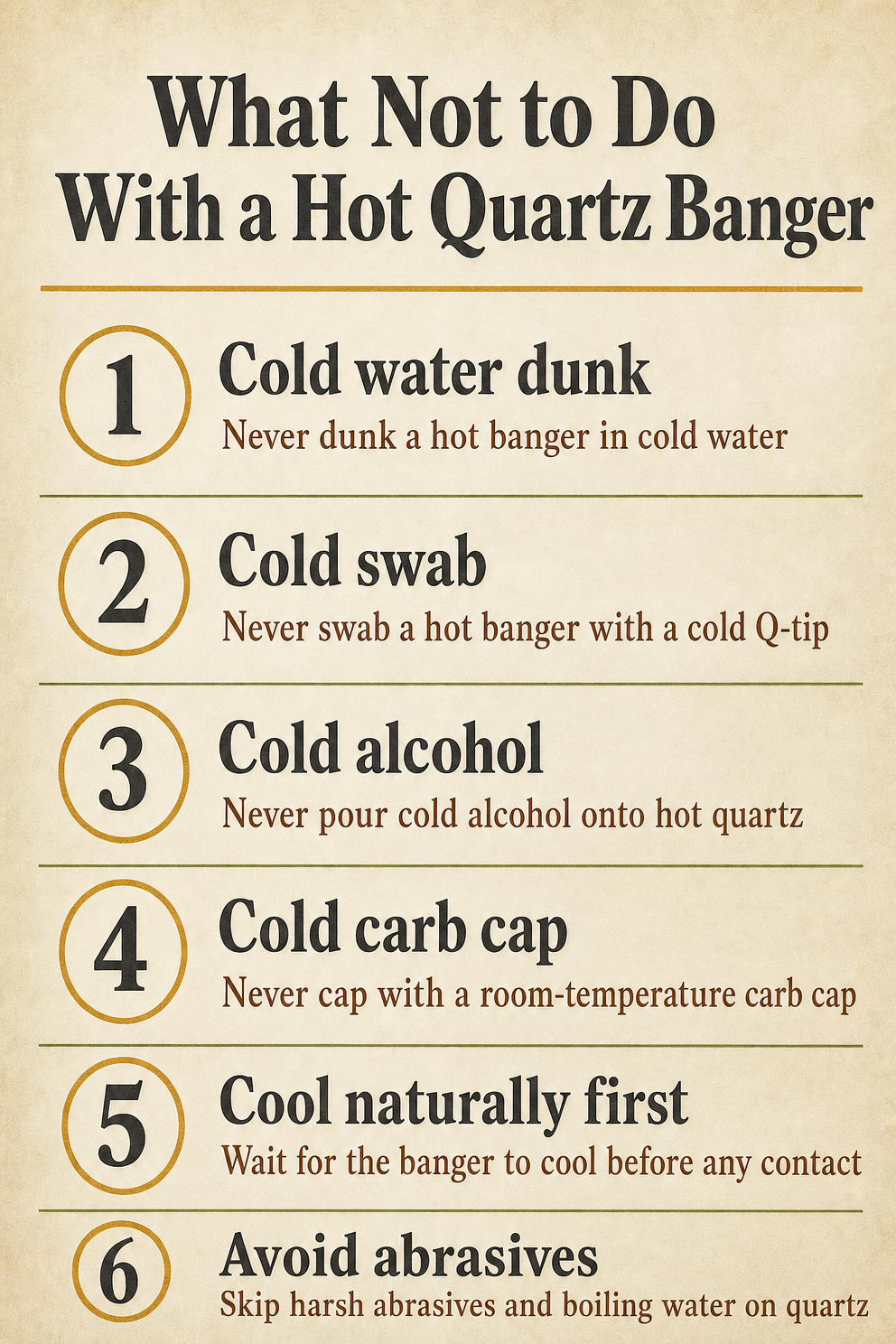
The most common cooling mistake is dunking a hot banger in cold water or cold isopropyl alcohol. The cold liquid against the hot quartz creates micro-fractures, tiny stress cracks that you cannot see at first. Each dunk adds more micro-fractures, and over time the structure weakens until the banger splits at the joint or across the bottom [5]. The same thing happens when you swab a hot banger with a cold cotton Q-tip, or when you cap a hot banger with a room-temperature carb cap.
Prevention is mostly about patience. Let the banger cool naturally before any contact with a cooler material, even if that means waiting a few extra minutes [5]. The rule is simple: no cold liquid, no cold swab, no cold cap on hot quartz. If you want to clean the banger mid-session, swab the still-warm interior with a dry cotton Q-tip; the residue comes off easily when the quartz is warm and you avoid the temperature shock.
Manufacturer guides also warn against abrasives and against cleaning hot glass with cold liquid for the same thermal-shock reason [8]. The fix is the same: cool first, then clean with isopropyl alcohol and a soft cotton swab, never steel wool or rough scrub pads on quartz.
If you want to browse quartz bangers built for the kind of heat cycles that cause those micro-fractures when mishandled, the Quartz Bangers catalog covers the full Quartz Bangers subcategory with current stock.
- Never dunk a hot banger in cold water or cold alcohol: the temperature difference creates micro-fractures that eventually crack the piece [5] [8].
- Never swab a hot banger with a cold Q-tip: swab the warm interior with a dry cotton tip instead [5].
- Never cap with a room-temperature carb cap: let the banger cool first so the cap does not shock the quartz [5].
- Never use abrasives or steel wool on quartz: soft cotton swabs and isopropyl alcohol are the safe cleaning tools [8].
- Always let the banger cool naturally before any contact with cooler materials: patience is the single biggest crack prevention step [5].
How Do You Clean a Quartz Banger Without Damaging It?
The simplest cleaning routine is the one that prevents most problems. After each dab, while the banger is still warm but not hot, swab the interior with a dry cotton Q-tip to lift the bulk of residue [5]. The warmth keeps the residue soft and easy to lift, and a dry swab avoids any temperature shock from a cold wet tip.
For stubborn buildup that a dry swab will not lift, do a periodic deep clean. Remove the banger from the rig, place it in a small glass container, and pour in enough 91%+ isopropyl alcohol to cover the bottom and lower walls. Let it soak for 30 to 60 minutes, then rinse with hot water and let it air dry fully before reuse [5] [8]. The alcohol dissolves the stuck-on concentrate without touching the quartz surface.
What you do not do matters as much as what you do. Do not pour cold alcohol onto a hot banger, do not dunk the banger in cold water, and do not use abrasives like steel wool or rough scrub pads [8]. Each of those creates the same thermal-shock or surface-scratch damage that shortens banger life. Boiling water is also out, because the temperature change relative to a still-warm banger can shock the quartz.
If your rig itself needs cleaning, the same rule applies: take it apart, soak the components separately in isopropyl alcohol, rinse with hot water, and air dry before reassembly [8]. For dabbers who prefer a pre-assembled setup, this guide on Quartz Dab Rigs covers the Quartz Dab Rigs subcategory for ready-to-go options.
A simple routine is enough for most users. Swab warm after every dab, deep clean with isopropyl alcohol once a week or so depending on how much you dab, and replace the cotton swabs as needed. The routine is short, the materials are inexpensive, and it extends the life of the banger significantly [5] [8].
- Step 1: After each dab, swab the still-warm interior with a dry cotton Q-tip to lift the bulk of residue [5].
- Step 2: For stubborn buildup, remove the banger from the rig and soak in 91%+ isopropyl alcohol for 30–60 minutes [5] [8].
- Step 3: Rinse with hot water and let the banger air dry fully before reuse [8].
- Step 4: Never use abrasives, never pour cold liquid on hot quartz, and skip boiling water for the same thermal-shock reason [8].
- Step 5: Repeat the routine weekly or as needed based on how often you dab, and replace the cotton swabs regularly [5] [8].
Which Quartz Banger Should a New Dabber Choose?
For most new dabbers, quartz is the right default material because it costs less than titanium, is widely available, and delivers the cleanest flavor of the three common nail materials [3] [4]. The next decision is shape, then wall thickness, then joint size. Matching each choice to how you actually dab is what makes the first banger feel right.
If you mostly want low-temp flavor chasing, a flat-top or beveled banger with thicker 3–4 mm walls gives you a long working window and the thermal mass to stay in the low-temp range [5]. Pair it with a simple carb cap and a moving-flame torch technique, and you have a setup that is forgiving of small timing mistakes.
If you dab daily and want a setup that handles heavier use, an opaque-bottom or thermal banger is a sensible upgrade. The opaque bottom adds thermal mass and evens out hot spots, while a thermal banger’s inner wall holds heat longer between hits [5] [6]. Either option is still quartz, so flavor stays pure.
If you plan to convert to an e-nail later, quartz still works but titanium is the more common e-nail pairing because titanium’s higher thermal conductivity transfers heat evenly from the coil [3] [4]. Most dabbers start with quartz for the affordability and flavor, then add a titanium nail if and when they switch to e-nail temperature control.
For travel, a small standard-wall flat-top banger is the easiest to replace if something goes wrong, and small quartz bangers are cheap enough to keep a spare. If you want a ready-made travel setup rather than building one piece by piece, the Big Face Mini Rig 4-Piece Kit is a compact four-piece kit sized for portable use.
The simplest buying rule is this: pick quartz for the first banger, pick a shape that fits your carb cap, and pick a wall thickness that matches your session length. You can always upgrade later once you know how you actually use it [3] [5] [6].
- Low-temp flavor focus: flat-top or beveled banger with thick 3–4 mm walls and a simple carb cap [5].
- Daily heavy use: opaque-bottom or thermal banger for more thermal mass and even heat [5] [6].
- Future e-nail conversion: start with quartz for affordability, plan to add a titanium nail when you switch to temperature control [3] [4].
- Travel: small standard-wall flat-top banger, cheap enough to keep a spare on hand [5].
- Default rule: quartz first, then match shape to your carb cap and thickness to your session length [3] [5] [6].
How Long Does a Quartz Banger Last With Regular Use?
With correct heating and natural cooling, a quartz banger can last for years [3] [5]. The same low coefficient of thermal expansion that lets it survive the torch also lets it survive repeated heat cycles when it is treated well. Lifespan shortens sharply when the banger is regularly dunked hot, swabbed cold, or capped with a cold carb cap, because each thermal-shock event adds micro-fractures that eventually split the piece [5].
The visible signs of wear are easy to read once you know what to look for. Clouding on the inside of the banger is the first sign that residue has built up or that the quartz has been overheated repeatedly. Small chips at the joint where the banger meets the rig are a structural warning, because the joint is the part that takes the most mechanical stress. Any hairline crack, even one you can barely see, is the cue to replace the banger rather than continue using it [8].
Daily dabbers who follow the warm-swab and natural-cool routine typically get a year or more out of a standard quartz banger, and longer with thicker walls [5] [8]. Users who are harder on their bangers, who dunk it hot or swab it cold as part of their habit, may see cracks within a few months. The lifespan is mostly about the user’s habits rather than the banger itself.
Replacement is straightforward. Quartz bangers are inexpensive and fit standard joint sizes, so most dabbers keep a spare on hand. If you want a single piece to rotate in when a banger wears out, the One Hitters catalog covers a related glass subcategory with the same joint sizing conventions, useful as a reference when comparing build quality.
The short version is that quartz is durable when used correctly and fragile when used carelessly. A banger that is heated with a moving flame, cooled naturally, and cleaned with warm swabs and isopropyl alcohol will outlast a banger that is dunked hot or scrubbed cold. Handle the quartz like the engineered material it is, and it will return years of clean flavor [3] [5] [8].
- Expected lifespan with correct use: years for a well-treated banger, often more than a year for daily dabbers [3] [5].
- Early sign of wear: clouding on the inside, usually from residue or repeated overheating [5].
- Structural warning: small chips at the joint, where the banger takes the most mechanical stress [8].
- Replacement cue: any visible hairline crack means the banger should be retired rather than used further [8].
- Habit impact: thermal-shock habits (cold dunk, cold swab, cold cap) shorten lifespan from years to a few months [5] [8].
Frequently Asked Questions
Is fused quartz the same as regular glass?
No. Fused quartz is a glass consisting of almost pure silica (silicon dioxide, SiO₂) in amorphous, non-crystalline form, with no other ingredients added to lower the melt temperature [1]. Soda-lime, lead, and borosilicate glasses all add other materials to change their working properties, which is why fused quartz behaves differently under heat. That purity is also why it does not react with cannabis concentrates.
Does a quartz banger change the flavor of concentrates?
Specialist retailer and manufacturer guides consistently describe quartz as pure, unaltered, and chemically inert in flavor [3] [4] [6]. Quartz does not react with concentrates and does not absorb terpenes between sessions, so the next dab tastes like the concentrate, not the banger. Titanium can carry a metallic taste unless seasoned, and ceramic is porous enough to hold flavor carryover if not cleaned promptly.
Can a quartz banger crack from heat or thermal shock?
A real quartz banger will not crack from torch heat alone. Fused quartz has an extremely low coefficient of thermal expansion (about 5.5×10⁻⁷ per K over 20–320 °C), which gives it near-perfect thermal shock resistance to heating [1] [3]. Almost every crack in normal use comes from cooling too quickly: dunking a hot banger in cold water or alcohol, swabbing with a cold Q-tip, or capping with a room-temperature carb cap. Let the banger cool naturally before any cold contact [5].
How do you clean a quartz banger without cracking it?
Swab the still-warm interior with a dry cotton Q-tip after each dab to lift the bulk of residue. For stubborn buildup, remove the banger from the rig and soak it in 91%+ isopropyl alcohol for 30 to 60 minutes, then rinse with hot water and let it air dry fully [5] [8]. Avoid abrasives, and never pour cold liquid onto a hot banger; the temperature difference causes the same micro-fractures that lead to cracking.
What sizes and thicknesses of quartz bangers are available?
Quartz bangers come in the same geometry family as other materials: flat-top, beveled, terp slurper, opaque-bottom, thermal banger, and colored-barrel variants, in standard joint sizes (10 mm, 14 mm, 18 mm) and gender options [5] [6]. Wall thickness is the main performance variable: standard walls heat in roughly 30–45 seconds, while thicker 3–4 mm walls can take up to 60 seconds but hold heat longer and cool more slowly [5].
How long does a quartz banger last with regular use?
With correct heating and natural cooling, a quartz banger can last for years [3] [5]. Lifespan shortens sharply when the banger is regularly dunked hot, swabbed cold, or capped with a cold carb cap, because each thermal-shock event creates micro-fractures that eventually split the piece [5]. Visible clouding, small chips at the joint, or any hairline crack is the cue to replace the banger rather than continue using it [8].
Is a Quartz Banger the Right Choice for Your Setup?
A quartz banger is the right choice for most dabbers who want clean flavor at a fair price, and it is the easiest material to learn on because quartz is forgiving of timing mistakes when used with patience. Fused quartz is almost pure silica, heats up fast, does not react with concentrates, and does not ghost terpenes between sessions, which is why specialist guides consistently rank it as the top choice for flavor fidelity [3] [4] [6].
The single biggest factor in how long a quartz banger lasts is the user’s habits. Heat with a moving flame, cool naturally, swab warm, and deep clean with isopropyl alcohol only when needed, and the banger will reward you with years of use [5] [8]. Handle the banger like the engineered material it is, and quartz is one of the most dependable materials in the whole dab rig lineup.
If you have been on the fence between quartz, titanium, and ceramic, the simplest rule is this: pick quartz for flavor and value, pick titanium for durability and e-nail use, and pick ceramic for slow heat retention [3] [7]. Most new dabbers are happiest starting with quartz, learning the temperature window that suits their concentrate, and upgrading the banger later once they know their own session style.
Sources
- Wikipedia: Fused quartz
- Technical Glass Products, Inc. (TGP): Properties of Fused Quartz
- Grasscity (smoke-shop specialist retailer): Quartz vs. Titanium vs. Ceramic: What’s the Best Dab Nail Material?
- MunchMakers (dab-rig specialist retailer): Quartz vs Titanium Bangers: Which Heats Better?
- Azarius (smoke-shop encyclopedia): Quartz Banger Temperature and Care Guide
- Lowtemp Industries (concentrate-tools specialist): In-Depth Guide to Dab Bangers: Types and Uses
- Oil Slick Pad (smoke-shop retailer): Quartz vs Titanium vs Ceramic Dab Nail Guide 2026
- MunchMakers (dab-rig specialist retailer): How to Clean a Dab Rig: Remove Reclaim and Buildup