
A vape cartridge is a small, pre-filled or refillable container that holds e-liquid or cannabis oil along with a built-in heating element called an atomizer. It attaches to a battery through a threaded or proprietary connection — most commonly the 510 thread — and when the battery fires, the heating element vaporizes the oil and the aerosol travels out through the mouthpiece.
What Is a Vape Cartridge and What Does It Actually Do?
A vape cartridge is the upper half of a cartridge-based vape system. It is the part that holds the liquid and turns it into a vapor when the battery is activated. Most cartridges are designed to screw onto a compatible battery and be replaced when the oil runs out or the coil wears down[1].
Inside the cartridge you will find a sealed chamber filled with e-liquid or cannabis oil, a small heating element called an atomizer, and a mouthpiece at the top. When the battery sends current to the atomizer, the coil heats up and vaporizes the liquid. The cartridge itself does not contain a battery — power always comes from a separate battery unit.
The most common way to attach a cartridge to a battery is with the 510 thread, which has become the industry standard for both nicotine and cannabis oil cartridges. Some brands use magnetic or snap-fit connections for their own closed systems, but the 510 thread is what you will see most often on store shelves. If you are shopping for 510 Batteries510 Batteries to pair with a 510-thread cartridge, the two are designed to fit each other right out of the box.
- A pre-filled or refillable container that holds e-liquid or cannabis oil.
- Contains an integrated heating element (an atomizer) that turns liquid into vapor.
- Attaches to a battery unit through a threaded or proprietary connection.
- The 510 thread is the most widely adopted connector in the industry.
What Are the Main Parts Inside a Vape Cartridge?
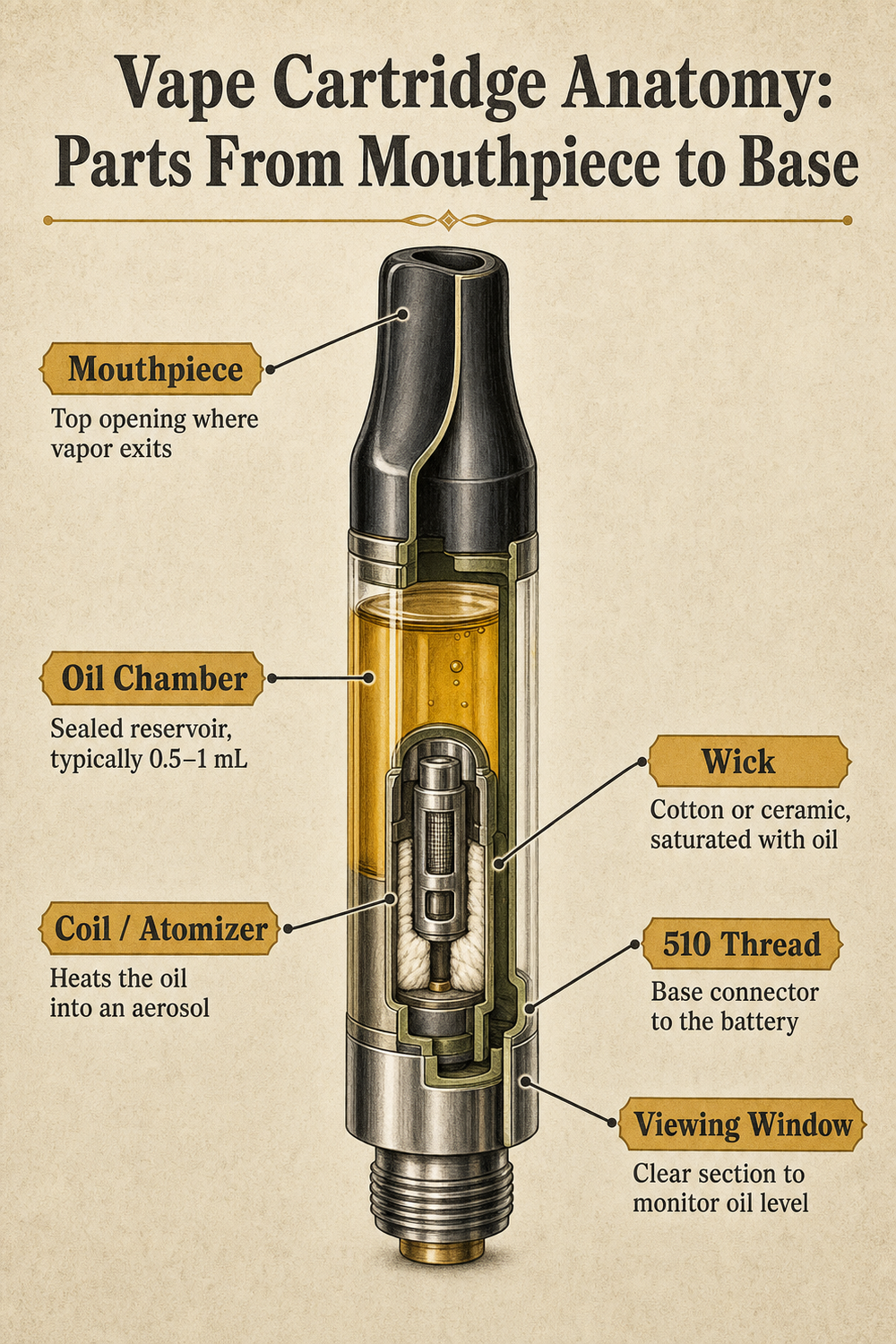
Every vape cartridge is built from a small set of parts that work together. Even though cartridges come in many shapes and sizes, the core anatomy stays the same from brand to brand. Knowing what each part does makes it easier to compare cartridges and troubleshoot problems later.
From top to bottom, the cartridge starts with a mouthpiece, then an oil chamber, then the coil and wick that make up the atomizer, then the connection thread at the base. Many designs also include a small clear window so you can see how much oil is left[2]. If you want a deeper walkthrough of how parts fit together in vapor hardware, the Treehouse Lifestyle guide on What Are the Parts of a Bong, Rig, or Pipe and How Do They Work?What Are the Parts of a Bong, Rig, or Pipe and How Do They Work? uses the same anatomy approach for other devices.
The oil chamber is usually 0.5 mL or 1 mL on most cartridges, and the coil and wick sit at the bottom of the chamber in direct contact with the oil. The base holds the electrical contacts and the threaded connector, which is what carries current from the battery up into the coil.
- Mouthpiece: the opening at the top where vapor exits the cartridge.
- Oil chamber: the sealed reservoir that holds the e-liquid or cannabis oil, typically 0.5 mL or 1 mL.
- Coil and atomizer: the heating element that turns liquid into an aerosol when current flows through it.
- Internal airflow path: the channel that carries vapor from the coil up to the mouthpiece.
- Connection thread: the threaded base that screws onto a compatible battery.
- Viewing window: a clear section, found on many designs, that lets you check how much oil is left.
How Does a Vape Cartridge Actually Work With a Battery?
A cartridge does not produce vapor on its own. It needs current from a battery to heat the coil and aerosolize the oil. Once you understand the operating sequence, the role of each part of the system falls into place.
There are two common ways to fire a cartridge. Button-press activation requires you to hold a button on the battery while you draw. Draw-activated cartridges fire when an internal sensor detects the airflow of your draw, with no button press needed. Either way, the next steps are the same: the battery sends current through the threaded connection into the cartridge’s coil, the coil heats the saturated cotton or ceramic wick, and the oil turns into a vapor. The vapor then moves through the cartridge’s airflow path and out the mouthpiece.
Voltage matters here. Most 510-thread batteries put out somewhere between 2.8 V and 4.8 V, and the higher the voltage, the hotter the coil runs. Higher voltages tend to produce more visible vapor; lower voltages tend to use less oil per draw. If you are new to refillable cartridges, start at a low or middle voltage and adjust from there. For a related look at simpler all-in-one devices that work on the same principle, see our guide on What Are Disposable Vapes and Should You Try Them?What Are Disposable Vapes and Should You Try Them?.
- Activation: a button-press or auto-draw sensor tells the battery to send current.
- Connection: current flows from the battery through the 510 thread into the cartridge’s contacts.
- Heating: the current reaches the coil, which heats the saturated cotton or ceramic wick.
- Vaporization: the oil on the wick turns into a thin aerosol as the coil warms it.
- Delivery: the aerosol travels through the internal airflow path and exits through the mouthpiece.
What Is a 510 Thread and Why Does It Matter?
The 510 thread is a small threaded connector at the base of a cartridge that screws into a matching base on a vape battery. The name comes from the spec itself: ten threads at a 0.5 mm pitch on a roughly 5 to 7 mm diameter shaft (the genuine spec is M7 × 0.5 mm)[4]. It is short, simple, and standardized, which is exactly why it caught on.
Before the 510 thread became standard, every brand used its own connector. That made it hard to mix and match cartridges and batteries — a cartridge from one brand often would not fit a battery from another. The 510 thread fixed that problem. Today, any 510-thread cartridge is designed to connect to any 510-thread battery, so you can pair them across brands without worrying about fit. This is also why the 510 thread has become the de facto standard for both cannabis oil and nicotine cartridges.
Not every brand uses 510. Some companies prefer proprietary magnetic, snap-fit, or brand-specific threads because they lock customers into their own hardware and consumables. You will see this most often in closed disposable or all-in-one ecosystems where the cartridge is built into the device. If you want maximum flexibility, stick with 510-thread gear. For a broader look at how the different formats stack up, see our guide on What Are the Different Types of Vape Accessories and How Do I Choose Them?What Are the Different Types of Vape Accessories and How Do I Choose Them?.
- 510 thread spec: roughly 10 threads at 0.5 mm pitch on a 5–7 mm diameter shaft (genuine M7 × 0.5 mm).
- Cross-compatible: any 510-thread cartridge is designed to work with any 510-thread battery.
- Industry standard: the de facto connector for cannabis oil and nicotine cartridges.
- Proprietary alternatives: some brands use magnetic or snap-fit connections that only fit their own hardware.
What Is the Difference Between a Cartridge and a Pod?
Cartridges and pods are often grouped together in the same category, but they are built differently and they live in different device ecosystems. If you have ever wondered why a 510-thread cartridge will not click into a JUUL-style device, this section is for you.
The biggest difference is the connection. Cartridges are usually cylindrical and use a 510-thread or similar threaded connection that screws onto a battery. Pods are usually rectangular or flat, and they snap into place with a magnetic or proprietary press-fit connection. The shape of the device follows the shape of the consumable, so cartridges tend to look like small tubes and pods tend to look like little plastic cassettes.
Capacity is the other big difference. Most cartridges hold between 0.5 mL and 1 mL of liquid, which fits the 510-thread form factor. Pods are larger and usually hold between 1.5 mL and 5 mL because their rectangular shape gives them more internal volume. Cartridges tend to be the format of choice for cannabis oil, while pods are more common in nicotine salt systems, but you will find overlap in both directions. The table below summarizes the main differences.
- Shape: cartridges are typically cylindrical; pods are usually rectangular or flat.
- Connection: cartridges use 510-thread or similar threaded connections; pods use magnetic or proprietary press-fit connections.
- Capacity: cartridges typically hold 0.5–1 mL; pods typically hold 1.5–5 mL.
- Ecosystem: each format pairs with its own device line, with limited cross-compatibility between them.
| Feature | Cartridge | Pod |
|---|---|---|
| Shape | Cylindrical | Rectangular or flat |
| Connection | 510-thread or similar threaded | Magnetic or proprietary press-fit |
| Typical capacity | 0.5–1 mL | 1.5–5 mL |
| Common ecosystem | Cannabis oil and nicotine | Nicotine salt systems |
| Cross-compatibility | Fits any 510-thread battery | Fits only its own device line |
How Do You Choose a Vape Battery That Works With Your Cartridge?
If you already have a 510-thread cartridge, picking a battery is mostly a matter of matching a few specifications. The good news is that almost every 510 battery on the market will physically fit a 510 cartridge. The differences come down to capacity, voltage, how it activates, and what safety features it includes.
Capacity, measured in milliamp hours (mAh), tells you how long the battery will last between charges. A small 510 battery in a pen-style form factor is usually around 350 mAh, while a larger mod-style battery can be 900 mAh or more. Voltage range tells you how much power the battery can deliver to the coil — most 510 batteries run from about 2.8 V up to 4.8 V[5], with variable-voltage models letting you dial in a setting.
Activation method is a matter of preference. Button-press batteries give you more control because you decide when to fire; draw-activated batteries are simpler because you just inhale. Safety features are not optional: look for short-circuit protection, overcharge cutoff, and low-voltage lockout at a minimum. If you want a starting point, browse Vape PensVape Pens in our store — every model there is built to pair with 510-thread cartridges.
- Capacity (mAh): how long the battery lasts per charge — higher mAh means longer runtime.
- Voltage range: usually 2.8–4.8 V; variable-voltage models let you adjust the heat.
- Activation method: button-press gives control; draw-activated fires when you inhale.
- Safety features: short-circuit protection, overcharge cutoff, and low-voltage lockout should be standard.
What Materials Are Used to Build a Quality Cartridge?
Cartridge materials affect how the cartridge holds up over time, how it handles heat, and how the liquid interacts with the inside of the chamber. Most of the differences between a budget cartridge and a higher-end one come down to what the heating element is made of and what the tank is built from.
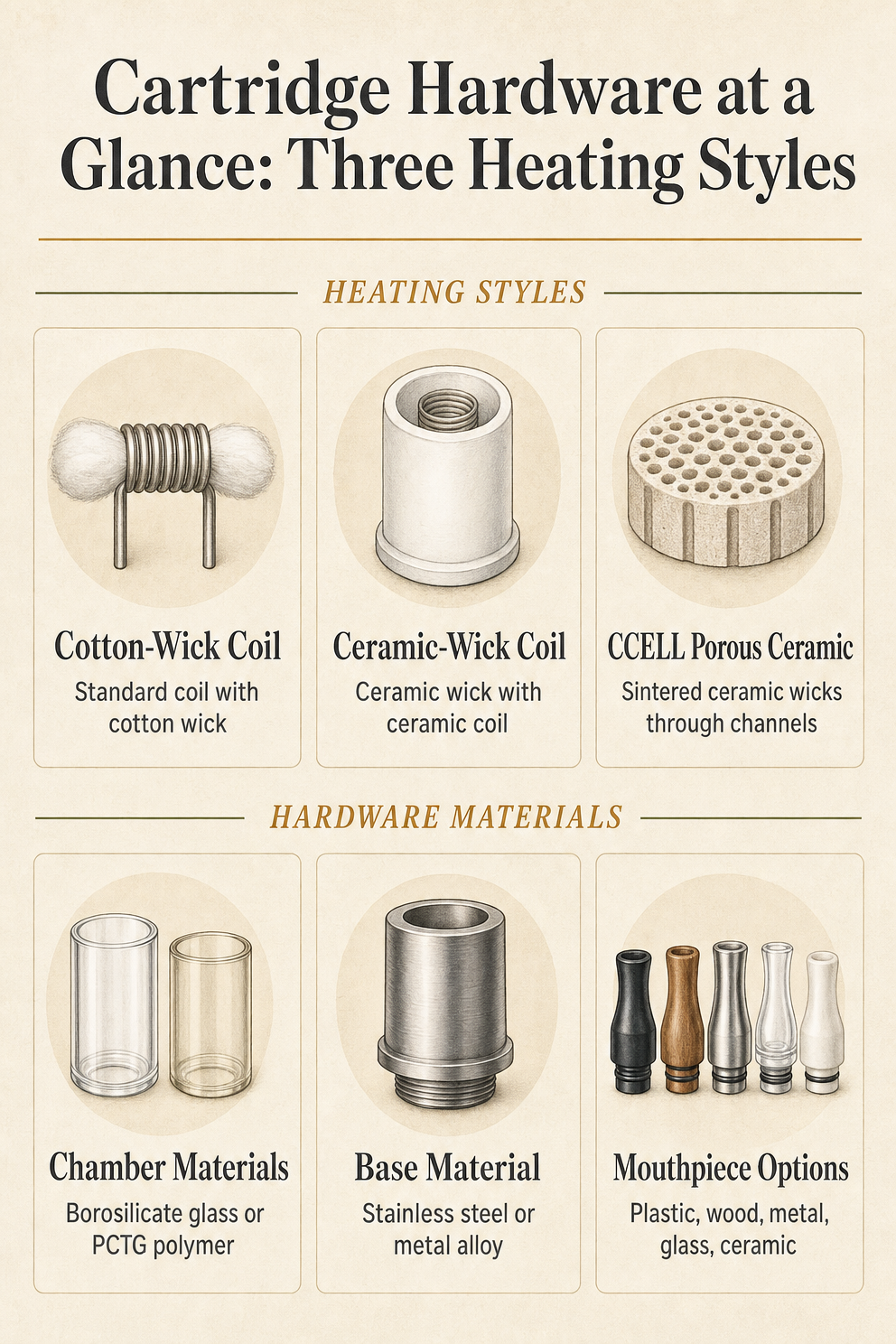
Heating elements come in three main styles. Cotton-wick cartridges pair a standard wire coil with a small piece of cotton that soaks up oil and feeds it to the coil. Ceramic-wick cartridges use a ceramic wick with a ceramic coil, which tends to be more durable than cotton. CCELL-style cartridges use a porous ceramic cylinder — a single piece of sintered ceramic with microscopic channels that wick oil without any cotton at all. CCELL designs are widely used for thicker cannabis extracts because the porous ceramic handles viscous oil well.
The tank itself is usually made from borosilicate glass or a food-grade polymer such as PCTG[6]. Borosilicate glass is rigid and heat-tolerant; PCTG is lower-weight and more impact-resistant. The base of the cartridge is typically stainless steel or another metal alloy, and the mouthpiece can be plastic, wood, metal, glass, or ceramic[2]. If you are interested in a related class of vapor hardware, browse our Electric RigsElectric Rigs for desktop and portable e-rig designs that share many of these materials.
- Cotton-wick coil: a standard wire coil paired with a cotton wick that feeds oil to the heat.
- Ceramic-wick coil: a ceramic wick with a ceramic coil — more durable than cotton.
- CCELL porous ceramic: a sintered ceramic cylinder that wicks oil through tiny channels, with no cotton.
- Chamber materials: borosilicate glass or food-grade polymers such as PCTG.
- Base material: stainless steel or another metal alloy.
- Mouthpiece options: plastic, wood, metal, glass, or ceramic.
What Federal Regulations Apply to Vape Cartridges in the United States?
Vape cartridges in the U.S. are regulated at the federal level by the Food and Drug Administration under the Tobacco Control Act. The FDA classifies cartridges as components of Electronic Nicotine Delivery Systems (ENDS)[7], which means the same rules that apply to e-cigarettes and vape pens also apply to the cartridges they use.
The biggest federal rule is the minimum sale age. Since December 20, 2019, it has been illegal for any retailer to sell ENDS products — including cartridges — to anyone under 21. This covers brick-and-mortar stores, vape shops, and online sellers, and it applies to every component the FDA regulates, not just the finished device.
Beyond age, the FDA also oversees the manufacture, import, packaging, labeling, advertising, promotion, sale, and distribution of ENDS products. Most new cartridge-based products need premarket authorization from the FDA before they can be legally sold in the U.S. If you are shopping for compliant hardware, stick with licensed retailers — Treehouse Lifestyle ships to most states with free shipping on orders $150+ on vapor hardware and accessories, including Desktop VaporizersDesktop Vaporizers and compatible parts.
- Federal scope: the FDA regulates ENDS and their components, including e-liquids, cartridges, atomizers, and certain batteries.
- Minimum age: retailers are prohibited from selling these products to anyone under 21 (effective December 20, 2019).
- Premarket authorization: most new cartridge-based products require FDA approval before legal sale in the U.S.
- Covered components: e-cigarettes, vape pens, e-hookah, e-cigars, e-liquids, atomizers, batteries (with or without variable voltage), cartomizers, clearomizers, and tank systems.
Frequently Asked Questions
Are vape cartridges refillable or one-time use?
Both formats exist. Many cartridges arrive pre-filled and sealed for single use, while refillable cartridges have a chamber designed to be topped up with compatible oil or e-liquid and reused until the coil wears out. Refillable designs pair with most 510-thread batteries.
Will any 510-thread battery work with any 510-thread cartridge?
Yes, in principle. The 510 thread is the de facto industry standard, so a 510-thread cartridge is designed to connect to any 510-thread battery. Some closed ecosystems use proprietary magnetic or snap-fit connections that only work with their own hardware.
How long does a typical vape cartridge last?
Lifespan depends on chamber size (commonly 0.5 mL or 1 mL), how heavily it is used, the oil’s thickness, and the heating element. Cotton-wick cartridges tend to wear sooner than ceramic and CCELL designs, which are noted for more consistent vapor over time.
What is the difference between a ceramic coil and a CCELL cartridge?
A ceramic coil uses a ceramic wick with a standard heating coil wrapped around or near it. A CCELL design uses a sintered porous ceramic cylinder that wicks oil through microscopic channels with no separate cotton wick — widely used for thicker cannabis extracts.
Do vape cartridges have a viewing window to check oil level?
Many designs include a clear section in the tank — usually borosilicate glass or food-grade polymer — that lets you monitor how much oil remains. Opaque metal-bodied cartridges do not offer this visibility.
What Should You Take Away About Vape Cartridges?
A vape cartridge is a small container that holds e-liquid or cannabis oil and a built-in heating element, designed to screw onto a battery through a 510-thread connection. Inside it you will find a mouthpiece, a sealed oil chamber, a coil and wick, an airflow path, and on many designs a clear viewing window. When the battery sends current through the thread, the coil heats the wick, the oil turns into a vapor, and that vapor exits through the mouthpiece.
The 510 thread is what makes the whole ecosystem work — it lets you pair cartridges and batteries across brands without worrying about fit. Cartridges differ from pods in shape, connection, and capacity. Battery choice comes down to capacity, voltage, activation method, and safety features. Cartridge quality comes down to heating element style (cotton, ceramic, or CCELL) and tank materials (borosilicate glass or PCTG). And across all of it, the FDA regulates ENDS hardware under the Tobacco Control Act, with a federal minimum age of 21 and premarket authorization requirements for most new products.
If you are shopping for a setup, start by deciding whether you want 510-thread cartridges and a separate battery, or a closed pod system. Match the battery specs to the cartridge, and stick with hardware that uses the materials and safety features covered in this guide.
Sources
- Vuse (BAT/Reynolds): Vape Cartridge Guide: What It Is & How It Works
- Kurvana: Vape Cartridges: A Comprehensive Guide
- ASM Vape: What Is a 510 Cartridge? Meaning, How It Works & Types Explained
- Theraleaf: 510 Thread Vape Carts Guide: Universal Compatibility
- Seaweed Delivery: Vape Pens 101 — Anatomy, Usage & Troubleshooting
- Vapehitech: The Complete Guide to CCELL Cartridges: Technology, Types, and Best Practices
- U.S. Food and Drug Administration: Vaporizers, E-Cigarettes, and other Electronic Nicotine Delivery Systems (ENDS)
- We Card (FDA-supported retailer training): Federal Law Summary — Tobacco and Vaping Retailers