
A vape tank is a refillable, threaded attachment that usually holds 2 ml or more of e-liquid and uses replaceable coils. A vape cartridge is a smaller, threaded attachment — typically 0.5 to 1.0 ml — that is built for thicker oil-based extracts and is often sold pre-filled and replaced as a whole unit. The two formats look similar on the outside, but they solve different problems and pair with different batteries 510 Batteries.
Pick a tank if you want to refill your own e-liquid, swap coils when flavor drops, and choose between sub-ohm or mouth-to-lung draw styles. Pick a cartridge if you want simple screw-on use with a 510-thread battery and pre-filled oil in a compact, portable format What Is the Difference Between a Bubbler and a Bong?.
What Is the Difference Between a Vape Tank and a Vape Cartridge?
The cleanest way to see the difference is to line them up side by side. A tank is the refillable, reusable half of a mod setup, and a cartridge is the small, often pre-filled attachment that screws onto a 510-thread battery. Both screw onto something, both hold liquid, both have a coil — but they are not interchangeable hardware.
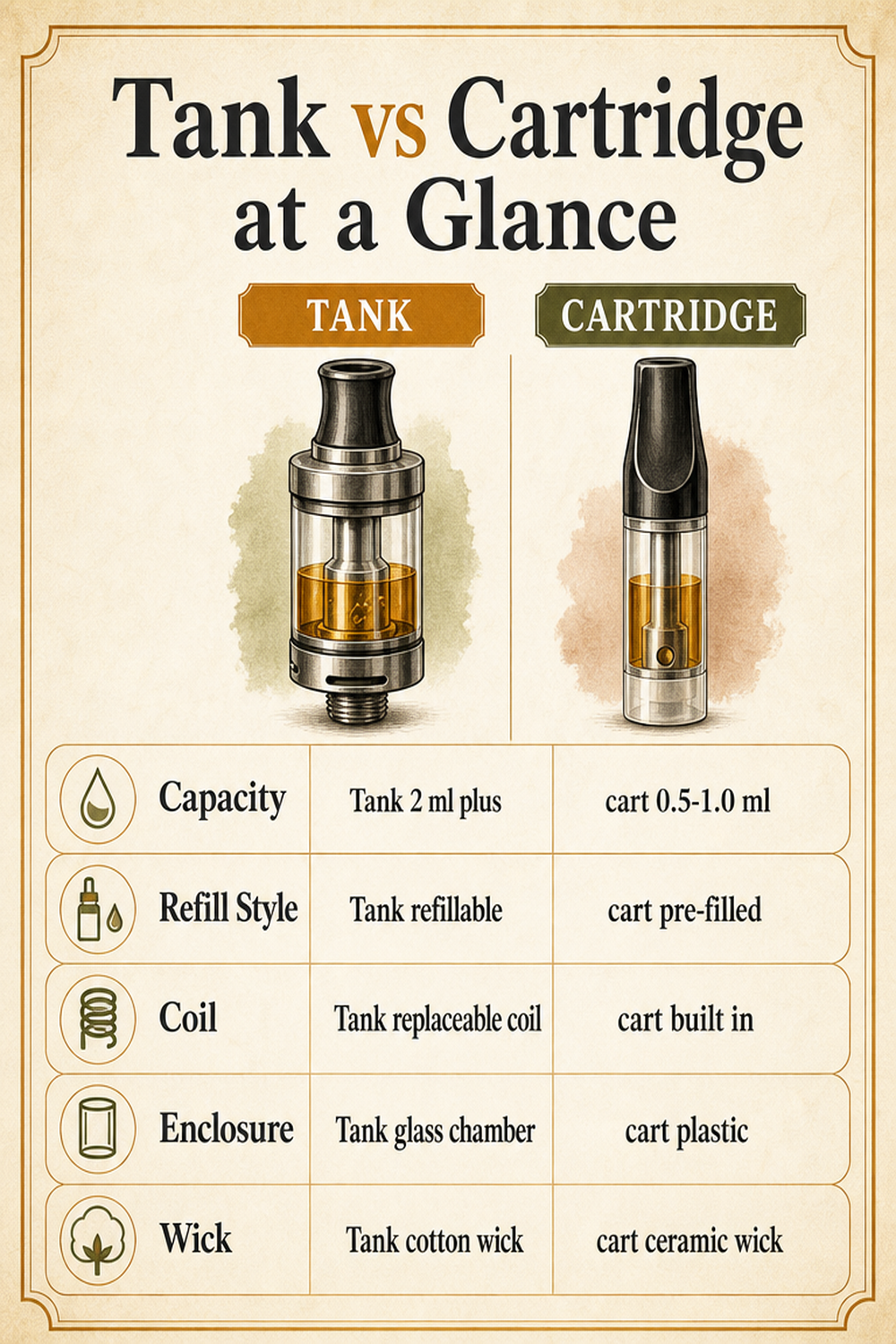
Tanks are usually 2 ml or larger, sit on top of a mod or box-style device, and use a replaceable coil inside a glass or plastic chamber. Cartridges are smaller, often 0.5 to 1.0 ml, and ship pre-filled with thick oil from the maker [1]. Once a pre-filled cartridge is empty, you replace the whole unit rather than swapping a coil [2].
Think of the tank as the reusable workhorse and the cartridge as the disposable, ready-to-use option. The category you shop in is set by the liquid you want to use: thin e-liquid goes in a tank, thick oil goes in a cartridge.
- Capacity — tanks typically hold 2 ml or more; cartridges usually hold 0.5 to 1.0 ml [1]
- Refill style — tanks are refillable and reusable; cartridges are most often pre-filled and replaced as a whole unit [2]
- Enclosure — tanks usually use a glass or clear plastic chamber so you can see liquid level; cartridges typically use opaque plastic housings
- Coil — tank coils are replaceable parts you swap out; cartridge coils are built in and replaced with the whole unit [1]
- Typical pairing — tanks pair with mod or box-style batteries; cartridges pair with compact 510-thread batteries
How Does a Vape Tank Work vs a Vape Cartridge?
Both formats work by heating a coil to turn liquid into vapor, but the path from reservoir to mouthpiece looks a little different in each one. A tank is built for repeated refills, while a cartridge is built for sealed, single-use oil.
Inside a refillable tank, a cotton wick sits inside a replaceable coil head. E-liquid soaks into the cotton from the chamber, the coil heats up on activation, and the vapor travels up through the mouthpiece [1]. The chamber, airflow ring, mouthpiece, and base are all separate parts you can take apart, clean, and rebuild [5].
Inside a cartridge, a ceramic wick sits in a small chamber that is filled with thick oil during manufacture. The coil heats the oil, the vapor moves up through the mouthpiece, and when the oil runs low or flavor drops, the user replaces the whole cartridge rather than opening it up What Is a Recycler Bong and How Does It Work?.
- Wick material — tanks usually use cotton, which wicks thin e-liquid quickly; cartridges usually use ceramic, which handles thicker oil better [1]
- Chamber — the tank chamber is open and refillable from the top or side; the cartridge chamber is sealed and filled at production time
- Coil position — the tank coil sits in a threaded base that you unscrew to swap; the cartridge coil is bonded into the housing and replaced with the unit
- Mouthpiece — both end in a mouthpiece, but tank mouthpieces are removable for cleaning while cartridge mouthpieces are fixed
- Activation — both formats are activated by the battery, but cartridge batteries are typically button-free auto-draw, while tank mods are usually button-activated with adjustable wattage
Which Holds More E-Liquid or Oil — a Tank or a Cartridge?
If capacity is your deciding factor, the tank wins by a wide margin. Most tanks hold 2 ml or more, and larger bubble-tanked versions stretch to 4, 5, or even 8 ml. Most cartridges land between 0.5 and 1.0 ml.
The size gap is not an accident. Tanks are designed for thin e-liquid that flows easily, so a larger chamber is straightforward to engineer. Cartridges are designed for thicker oil-based extracts that move more slowly, so a smaller, sealed chamber keeps the wick fed at a steady rate without leaks [1].
Wick choice follows the liquid. Cotton wicks feed thin e-liquid efficiently, which is why you see cotton in tanks. Ceramic wicks feed thicker oils more reliably, which is why you see ceramic in cartridges Rolling Machine vs Hand Rolling: Which Is More Consistent?.
- Capacity — tank 2 ml and up, often 4–8 ml with extended glass; cartridge 0.5–1.0 ml [1]
- Refill method — tank refills from the top or side with a bottle; cartridge is filled once at production and replaced empty
- Enclosure — tank glass or clear plastic that shows level; cartridge opaque plastic housing
- Wick — tank uses cotton; cartridge uses ceramic [1]
- Coil — tank coil is replaceable; cartridge coil is built in and replaced with the whole unit [2]
Are 510-Thread Cartridges Compatible With All Vape Batteries?
The 510 thread is the industry-standard connection used by most vape cartridges and most 510-thread batteries. The thread pattern is the same across the vast majority of products on the shelf, which is why so many combinations just work [3].
That said, the standard is not perfect. Manufacturing tolerances vary by brand, so some cartridges screw down tighter or looser than others on the same battery. A small mismatch in pin depth or thread height can change how well the connection reads, even when both pieces are technically 510 [4].
Voltage match is the other half of the equation. Cartridges are designed for a specific voltage window, and pairing one with a battery outside that window can produce weak output or burnt flavor. Match the battery’s output range to what the cartridge maker lists.
- Thread standard — 510 is the common thread for oil cartridges and most dedicated cartridge batteries [3]
- Voltage match — pick a battery whose voltage range lines up with the cartridge’s stated window
- Manufacturing tolerance — thread height and pin depth vary by brand, so fit is close but not identical across every pairing [4]
Which Is Cheaper Over Time — a Refillable Tank or Pre-Filled Cartridges?
The honest answer is that it depends on how much you use and what you put in. A refillable tank costs more up front — you buy the mod, the tank, and a small stockpile of coils — but each refill is just e-liquid, which is cheap by the milliliter. A pre-filled cartridge skips the upfront cost of a mod, but every replacement is a fresh cartridge at retail price Rolling Machines.
For a heavy user, the math usually comes out in favor of the tank. After you have bought a few coils, the per-milliliter cost of e-liquid is much lower than the per-milliliter cost of pre-filled cartridges. For a light user, the cartridge often wins on simplicity — no coils to swap, no bottle to carry.
The other cost is maintenance time. Tank coils need to be swapped every few days or weeks depending on use, and the tank itself needs occasional cleaning [5]. Cartridges replace themselves; when flavor falls off, you throw the unit away and screw on a fresh one.
- Upfront hardware — tank setup costs more because you buy a mod or box plus the tank; cartridge setup costs less because a basic 510 battery is inexpensive
- Ongoing consumables — tank refills are e-liquid only, which has a low per-ml cost; cartridges are replaced whole at retail price each time
- Coil replacement vs whole-cart replacement — tank coils are cheap and swapped individually; cartridges have no serviceable parts inside
- Maintenance time — tanks need occasional cleaning and coil swaps [5]; cartridges need no cleaning and no coil swaps
- Break-even point — heavy users usually come out ahead on a tank within a few weeks; light users may never reach the break-even point
Do Vape Tanks Produce More Vapor Than Cartridges?
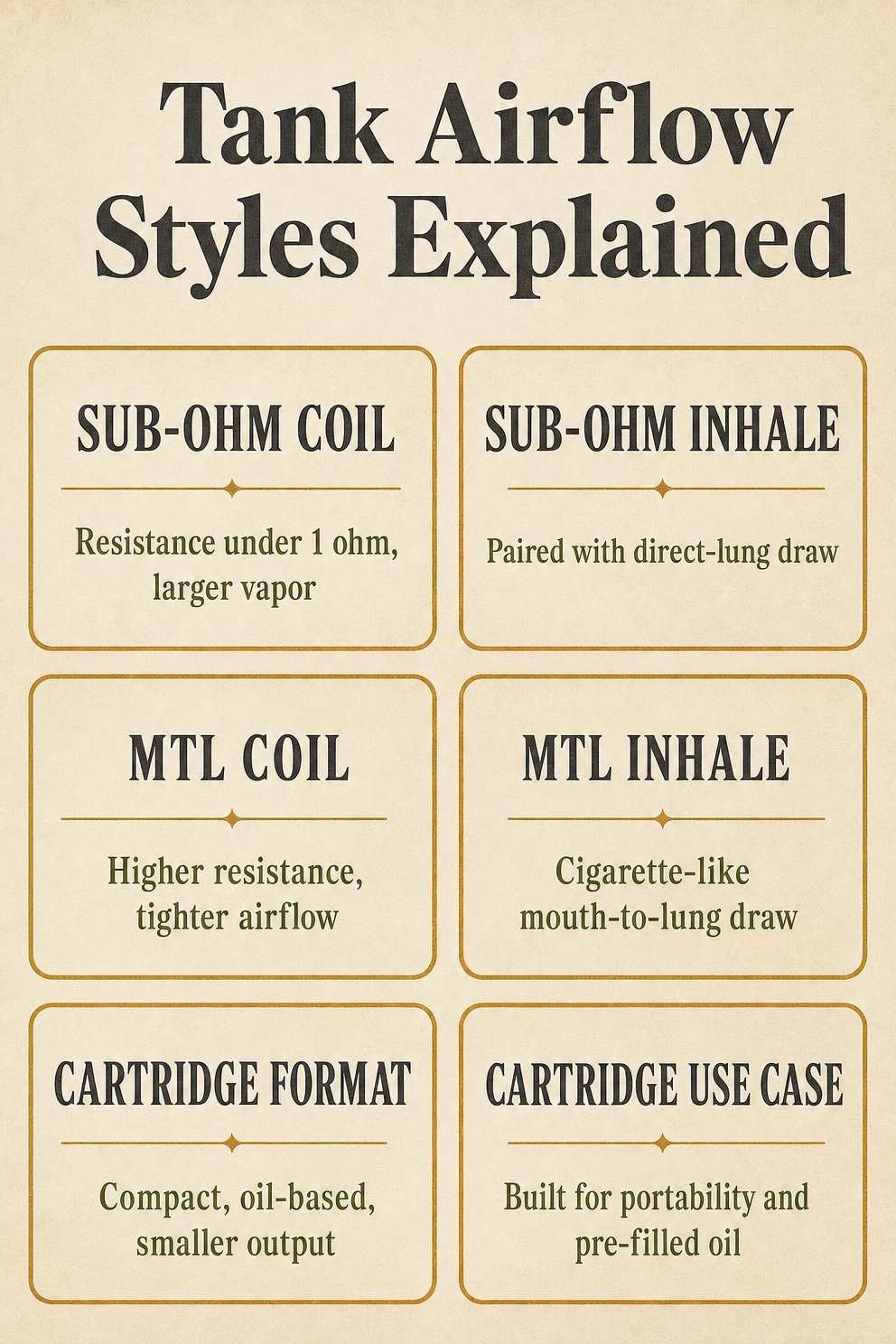
In most cases, yes — a refillable tank, especially one fitted with a sub-ohm coil, can put out a noticeably larger vapor cloud than a typical 510 cartridge. The reason is mechanical: sub-ohm coils use resistance under 1 ohm, draw more power from the battery, and pair with a direct-lung inhale that fills the lungs in one breath [6].
Tanks also come in a mouth-to-lung (MTL) style that flips the script. MTL tanks use higher-resistance coils with tighter airflow and are designed for a slower, cigarette-like draw. The vapor output is smaller than a sub-ohm tank, but the experience is closer to a tight, controlled pull [6].
Cartridges sit at the compact end of the scale. Their sealed chamber, small coil, and 510-battery power limits cap the cloud size, which is why most cartridge setups are chosen for portability and pre-filled convenience rather than for big vapor Vape Pens.
- Sub-ohm tank — coil resistance under 1 ohm, larger vapor, paired with a direct-lung inhale [6]
- MTL tank — higher coil resistance, tighter airflow, smaller vapor, paired with a cigarette-like mouth-to-lung draw [6]
- Standard cartridge — small sealed chamber, lower power draw, smaller vapor output, designed for portability [1]
What About FDA Rules That Apply to Vape Tanks and Cartridges?
In the United States, the FDA classifies e-cigarettes, vapes, and similar electronic nicotine delivery systems — collectively called ENDS — as tobacco products. That umbrella covers disposable devices, cartridge-based devices, and tank systems alike, and it gives the FDA authority over manufacturing, import, packaging, labeling, advertising, sale, and distribution [7].
The premarket review framework means new ENDS products generally need FDA authorization before they can be legally marketed. For buyers, this translates to a marketplace where products come and go as manufacturers work through the review process.
Cartridge-based ENDS have also been subject to specific enforcement action on flavors. Since February 2020, the FDA has prioritized enforcement against unauthorized flavored cartridge-based e-cigarettes other than tobacco and menthol, which reshaped the flavored cartridge shelf [8]. Tanks and refillable setups occupy a different lane in that regulatory picture.
A few practical notes worth keeping in mind before you buy: state and local rules can be tighter than the federal floor, age verification is required for any ENDS purchase, and shipping restrictions vary by carrier and destination. If you are ordering online, confirm the seller ships to your state and that your order meets the minimum for free shipping on orders $150+. Keeping the receipt and original packaging also makes any warranty or return process much smoother if a coil, tank, or cartridge arrives with an issue.
- ENDS classification — the FDA regulates e-cigarettes, vapes, and similar devices — including tank systems and cartridges — as tobacco products [7]
- Premarket framework — new ENDS products generally need FDA authorization before they can be marketed
- Flavored cartridge enforcement — unauthorized flavored cartridge-based e-cigarettes other than tobacco and menthol have been an enforcement priority since 2020 [8]
- Buyer takeaway — tank and cartridge hardware on a U.S. shelf is operating inside that regulatory framework; buy from sellers that follow state and local rules
Frequently Asked Questions
Can you refill a vape cartridge, or is it disposable?
Most cartridges on the shelf ship sealed and pre-filled and are designed to be used until empty and then replaced as a whole unit. Refillable 510-thread cartridges do exist and let you top them off with your own oil, but they are a smaller slice of the market than pre-filled cartridges [2].
Is a vape tank the same as a pod system?
They overlap but are not the same. A pod system uses a small snap-in or magnetic pod, often with a fixed coil, that drops into a slim battery. A tank is a threaded refillable attachment with replaceable coils that screws onto a mod or box device [1].
What kind of liquid goes in a tank vs a cartridge?
Tanks are built for thin e-liquid and use cotton wicks that wick efficiently at lower viscosities. Cartridges are built for thicker oil-based extracts and usually use ceramic wicks that handle thicker material at the slower flow rates cartridges need [1].
How often do you replace a tank coil vs a cartridge?
A tank coil is a replaceable part — you swap the coil inside the tank when flavor drops or vapor thins, usually over a span of days to weeks depending on use. A cartridge’s coil is built in, so when flavor drops the whole cartridge is replaced [5].
Do all 510-thread cartridges fit all 510-thread batteries?
The 510 thread is the industry-standard connection, so most 510-thread cartridges will physically screw onto most 510-thread batteries. Manufacturing tolerances vary by brand, so connection quality can differ between brands and a small mismatch in pin depth or voltage window can affect performance [3] [4].
So Which Format Is the Better Pick?
Neither format is universally better. They are built for different jobs. A refillable tank is the right call when you want to swap flavors, manage your own e-liquid, choose between sub-ohm and MTL draw styles, and bring down the per-milliliter cost over time. A 510-thread cartridge is the right call when you want a compact, simple setup with pre-filled oil and no coil swaps.
Before you pick, decide three things: what liquid you want to use, how often you plan to use it, and whether portability or per-use cost matters more to you. With those answers in hand, the tank vs cartridge question usually answers itself. Treehouse Lifestyle carries both formats alongside 510-thread batteries and replacement accessories, with free shipping on orders $150+, so you can compare side by side and pick the format that fits your routine Pulsar Sipper Wax & 510 Cartridge Vaporizer Bubbler.
Sources
- Innokin Technology: Vape Cartridge vs. Tank: What’s the Difference?
- RhythmNVape: Vape Cartridge 101: What It Is and How It Works
- iKrusher: 510 Battery & Cartridge Compatibility Explained: What You Need to Know
- Camouflet: Vape Cartridge 510 Battery Guide: Best Picks & How to Choose
- PerfectVape: How to Clean and Maintain Your Vape Tank and Coils
- Vaping360: Best Mouth to Lung Tanks
- U.S. Food and Drug Administration (FDA): E-Cigarettes, Vapes, and other Electronic Nicotine Delivery Systems (ENDS)
- PubMed Central (PMC): Impact of the FDA flavour enforcement policy on flavoured electronic cigarette use behaviour changes