
Recycler bongs are water pipes with two or more connected glass chambers joined by tubes. When you draw, water and vapor travel up into a second chamber, then drain back down and repeat the loop for the whole pull. That looping action cools the vapor and keeps splashback out of your mouth.
The name comes from that looping water-and-vapor action, not from the piece somehow reusing smoke itself. Recyclers are usually smaller than a standard bong — roughly 5 to 10 inches tall — and most are built from borosilicate glass.
These pieces are designed around concentrates and are favorites with people who care about flavor. You can also use one with flower by swapping the banger for a regular bowl. This guide explains how the loop works, how recyclers compare with standard bongs and percolator bongs, the main style families, what to check before you buy, and how to keep those narrow tubes clean.
What is a recycler bong and how does the recycling loop work?
At its simplest, a recycler bong is a bong with an extra chamber. The base chamber holds the water, and a tube carries the smoke or vapor up into a second chamber while you draw. Gravity pulls the water back down, and the cycle keeps turning until you stop inhaling [1].
Glass makers build this loop into the piece itself, so there are no moving parts. The water moves because your draw creates pressure and the connecting tubes give it a path to follow [2]. When you stop, the chambers settle and the water drains back to the base, ready for the next pull [3].
The name trips people up. The recycler label describes the water and vapor looping through the glass — not the piece reusing smoke. The smoke or vapor travels the loop along with the water; it is not recirculated like air in a fan [1] [3]. For a closer look at the parts that make the loop possible, skim What Is a Recycler Bong and How Does It Work?.
- Fill the base until the water covers the percolator openings.
- Load the piece — a heated banger for concentrates or a bowl for flower.
- Start drawing; the pull carries the smoke or vapor down through the water and up the connecting tube.
- The smoke or vapor enters the upper chamber and the water keeps moving around it.
- Gravity drains the water back into the base, and the loop turns again.
- The cycle repeats for as long as you draw, then settles when you stop.
How is a recycler bong different from a standard bong or a percolator bong?
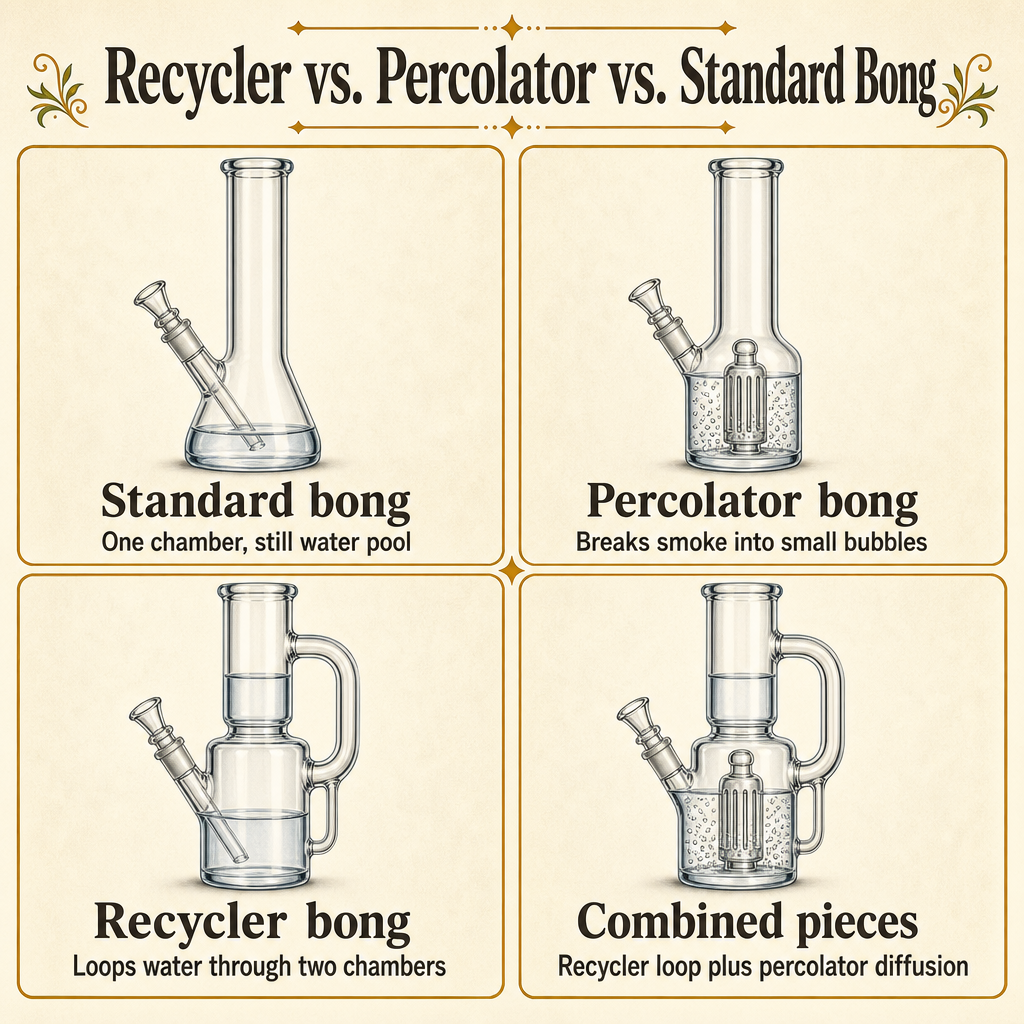
A standard bong does one main job: your pull sends the smoke through a pool of water and up to you. That water sits still, so the smoke passes through it once [7]. The design is simple, reliable, and easy to clean, which is why beakers and straight tubes stay so popular.
A percolator bong adds diffusion. Its percolator breaks the smoke into many small bubbles, which gives the smoke more contact with the water as it rises [10]. Percs come in styles like showerhead, tree, honeycomb, and matrix, and some pieces stack several of them along one vapor path [10].
A recycler takes a different route. Instead of simply making more bubbles, it moves the water itself — up into a second chamber and back down, over and over, for the whole pull [4]. The two ideas are separate, and builders often combine them in one piece, such as a recycler loop sitting on top of a percolator base [7]. For the full breakdown of how percolators do their job, read What Is a Percolator Bong and How Does It Work?.
Water levels also behave differently across the three designs. A standard bong just needs the downstem covered, and a percolator needs water above its slots. A recycler needs enough water to reach both chambers so the loop can actually turn — which is why many new recycler owners fine-tune the level during their first few pulls [1] [5].
- Standard bong: one water pool — the smoke passes through it once and the water stays still.
- Percolator bong: extra diffusion breaks the smoke into many small bubbles for more water contact.
- Recycler bong: two connected chambers keep the water and vapor moving in a loop.
- Percolators add bubbles; recyclers add circulation.
- The two designs are often combined, so many pieces offer both effects at once.
- Recyclers tend to be shorter and more complex to clean than a basic beaker.
| Design | How it filters | Water behavior | Typical use |
|---|---|---|---|
| Standard bong | One pass through a still water pool | Water sits still | Simple, everyday smoking |
| Percolator bong | Breaks smoke into many small bubbles | Water rises through the perc slots | Extra diffusion from showerhead, tree, or honeycomb percs |
| Recycler bong | Loops water and vapor through two chambers | Water circulates for the whole pull | Flavor-focused concentrate use |
| Combined pieces | Recycler loop plus percolator diffusion | Water moves and diffuses at once | Both effects in one piece |
What are the main types of recycler bongs?
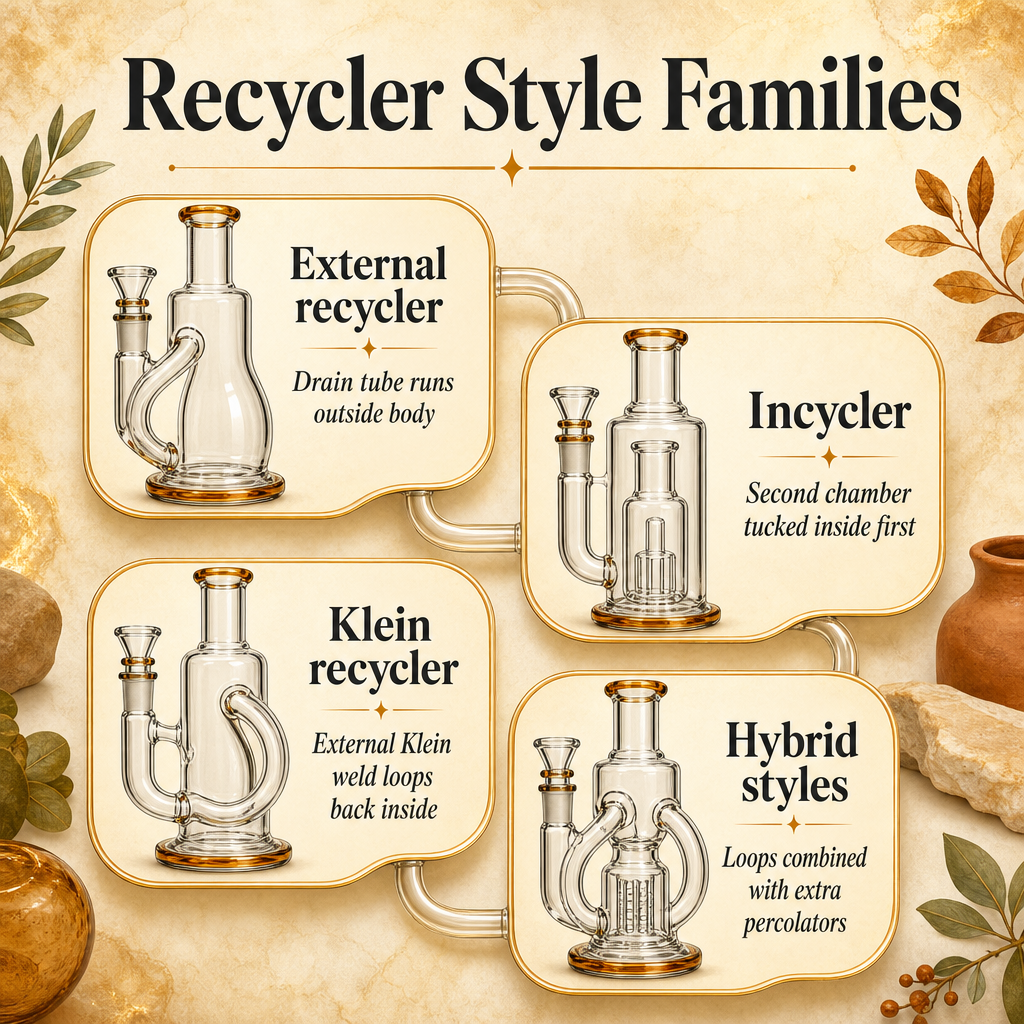
Walk into any shop and you will find recyclers in a few named layouts. The names describe where the extra chamber and the drain tube sit, not how the piece performs. Knowing the families helps you read a product photo at a glance [4].
An external recycler routes the drain tube outside the main body, so you can watch the water trace a full loop around the glass. An incycler tucks the second chamber inside the first, which keeps the piece compact. A Klein recycler uses an external drain — the Klein weld — that loops back inside to bypass the percolator [5].
The layout you pick changes more than the look. Angled intake holes create a visible vortex — often called a tornado or whirlpool — in the upper chamber while you draw [4]. After the pull, watch how steadily the chamber drains; that drain behavior is one of the first signs of build quality [6].
One honest warning: shop terminology is not standardized [4] [6]. One retailer’s cycler can look like another’s incycler, and similar loops carry different names from brand to brand, so trust the photos more than the label. Ready to window-shop? Start in our Recycler Bongs category to see real pieces in each layout.
- External recycler: the drain tube runs outside the body so you can see the whole loop.
- Incycler: the second chamber sits inside the first for a more compact build.
- Klein recycler: an external Klein weld drain loops back inside, clear of the percolator.
- Hybrid designs: recycler loops paired with extra percolators or funnels.
- Fine print: names vary by retailer, so use the pictures to judge the layout.
What should you check before buying a recycler bong?
Most recyclers stand about 5 to 10 inches tall, so they fit easily on a desk or shelf [1] [6]. Before you buy, think about where the piece will live and whether that size suits your routine. A compact loop is the point, so very tall recyclers are less common than short ones.
Glass quality matters more than brand names. Borosilicate glass handles repeated heating and cooling well, and quality pieces usually run about 4 to 5 mm thick [6] [9]. Hold the piece up to a light and look for even walls and clean seals around the joints.
Last, plan for upkeep. The narrow connecting tubes collect residue quickly, so a recycler needs regular cleaning [1]. If that trade sounds fair, you are on the right track. While you compare, a taller everyday water pipe such as the Daze Glass – Approx. 16 Striped Glass Water Pipe shows how simple a classic layout can be — and Treehouse Lifestyle offers free shipping on orders $150+ when you are ready to order.
- Pick the size: 5 to 10 inches is the common range for a desktop piece.
- Check the joint size: 14mm is the standard, with 10/14/18mm options on incyclers.
- Look for borosilicate glass around 4 to 5 mm thick.
- Inspect the welds and joints for even walls and clean seals.
- Watch the drain: a quality loop empties steadily after a pull.
- Set the water level — just enough to cover the perc openings, then test the draw.
Are recycler bongs better for flower or concentrates?
Recyclers were designed around concentrates, and they stay popular with people who chase flavor [1] [7]. The steady loop keeps the vapor moving while you draw, which fits the shorter, lower-temperature hits most dabbers take.
That does not mean flower is off-limits. Swap the banger for a standard bowl and the piece works the same way — the loop does not care what is in the bowl [2] [6]. Many smokers still prefer flower in a beaker or straight-tube bong, which retailers describe as the more common choice [1].
Match the piece to what you reach for most. If concentrates are your routine, a recycler earns its place on the shelf. If you mostly smoke flower and want one piece for everything, a classic bong is the safer bet. Still deciding between a full-size bong and a smaller piece? What Is the Difference Between a Bubbler and a Bong? compares bubblers and bongs side by side.
- Concentrate users: recyclers are built for this, and flavor-focused dabbers love the loop.
- Flower users: a recycler works fine with a bowl instead of a banger.
- Beaker and straight-tube bongs remain the most common choice for flower.
- For concentrates, pair the piece with a banger, torch, and carb cap.
- For flower, add a bowl, a screen if you like, and a grinder.
What materials are recycler bongs made from and how do the options compare?
Borosilicate glass is the material you will see most in recyclers. It is made with boron compounds that add acid resistance and strength, and it handles repeated heating and cooling without stress [9]. When a shop says hard glass, it usually means borosilicate. Soda-lime glass — the soft glass used in budget pieces — costs less but does not take temperature changes as well [9].
Other materials show up across the wider bong category, even if they are rare in recyclers. Acrylic is light and inexpensive but scratches and clouds over time. Silicone is flexible and hard to break, which suits travel pieces. Ceramic and metal pieces exist too, each with its own look and feel [9]. Most recycler owners still pick glass: it shows off the loop clearly, and a little extra care is a fair trade for that view [9].
For a recycler specifically, borosilicate glass is the practical pick. The narrow tubes and thin walls ask for a material that will not crack through repeated heating and cooling. As you compare options, weigh durability, ease of cleaning, and price together. And if you like seeing the craft up close, the INSIDE OUT DICHRO HAND PIPE SPOON shows how glass makers play with color and texture.
- Borosilicate glass: strong and heat-resistant — the standard for quality recyclers.
- Soda-lime soft glass: cheaper, but less steady through repeated heating and cooling.
- Acrylic: light and budget-friendly; it scratches and clouds over time.
- Silicone: flexible and hard to break, which suits travel pieces.
- Ceramic: heavy, decorative, and more fragile than glass.
- Metal: durable and inexpensive, with its own cleaning quirks.
How do you clean a recycler bong so the narrow tubes don’t clog?
Recyclers need more upkeep than a single-chamber bong because the narrow connecting tubes collect residue fast [1] [2]. If the loop starts to gurgle or the water stops moving, residue is usually the reason. A quick routine once a week or two keeps the tubes clear [2].
The standard method is an isopropyl alcohol and coarse salt soak [8]. The alcohol breaks down the sticky buildup, and the salt acts as a gentle abrasive as you shake the piece. Use alcohol at 90% or higher, keep it away from heat and open flames, and rinse everything completely before your next use [8]. A soft-bristle brush helps when shaking alone cannot reach the narrow tubes [8].
Pay extra attention to the high-resin areas: the downstem, the bowl or banger, and the percolator [8]. Those spots collect the most buildup and clog first. If you would rather keep things simple, straight-tube designs are the classic low-maintenance choice — see our Straight Tube Bongs if that sounds like you.
- Empty the old water and rinse the piece with warm water.
- Remove the bowl or banger and the downstem.
- Pour isopropyl alcohol (90% or higher) into the base.
- Add a generous scoop of coarse salt — Epsom or rock salt works.
- Cover the openings and shake gently for a few minutes.
- Let it soak for at least 30 minutes, then shake again.
- Rinse thoroughly with warm water and let it air dry.
Frequently Asked Questions
How much water should you put in a recycler bong?
Fill just enough to cover the perc openings, then test the draw. Too much water floods the upper chamber and causes splashback or gurgling; too little water breaks the recycling cycle so the loop stops turning.
Can you use a recycler bong with flower?
Yes. Recyclers are designed around concentrates and are popular with flavor-focused users, but you can use them with flower by swapping the banger for a bowl. Several retailers still describe the beaker or straight-tube bong as the more common choice for flower.
What joint size do recycler bongs use?
14mm is the common joint size, and the incycler family specifically supports 10/14/18mm joint compatibility. Check the joint size before buying so your banger or bowl fits the piece.
Do recyclers filter the smoke more than once?
Industry copy sometimes describes the repeated water contact as the smoke being filtered more than once. The recycler name comes from the looping water and vapor action, not from the piece somehow reusing smoke itself.
Why does my recycler bong gurgle or splash?
Gurgling or splashback usually means there is too much water in the piece. Fill just above the perc intake holes and test the draw — the loop should cycle steadily without gurgling.
Should you buy a recycler bong?
A recycler bong is a fun, functional twist on the classic water pipe. The looping water keeps the vapor moving through the whole pull, the second chamber guards against splashback, and the compact glass fits easily into most setups. These pieces are built around concentrates, but they handle flower just fine with a simple bowl swap.
The trade-offs are honest ones: the narrow tubes collect residue faster, so cleaning becomes part of the routine, and quality borosilicate glass costs more than budget alternatives. If the steady loop sounds worth it, match the size and joint to your setup, keep the water level right, and the piece will give you years of good use.
Sources
- DankStop: What Is a Recycler Rig? How It Works + Types
- AFM Smoke: What Is a Recycler Bong? How They Work and Why
- MJ Arsenal (glass manufacturer): What Is a Recycler Bong? How They Work and Why They’re Worth It
- The Dab Lab: What is a Recycler Rig? | Types of Recycler Dab Rigs
- Mood: What Is a Klein Recycler? How It Differs from Standard Rigs
- Smoke Cartel: Incyclers Explained: Internal Recycler Dab Rigs
- Grasscity: Recycler vs. Percolator Bong: Which is Better for Your Sesh?
- Calgary Co-op Cannabis (licensed retailer): How to Clean a Bong with Isopropyl Alcohol and Salt
- Tank Glass (manufacturer): 6 Types of Materials used to Manufacture Bongs
- Hemper: Understanding Different Types of Bong Percs