

A one-hitter pipe is a slender, cigarette-sized pipe with a screened narrow bowl that holds roughly 0.1 to 0.3 grams of ground flower for a single inhalation [1]. The small chamber is built for solo, measured hits, which is why one-hitter pipes pair with a dugout for portion control, stash conservation, and discreet carry use [2] [1].
What Is a One-Hitter Pipe, Exactly?
A one-hitter is a small pipe with a narrow bowl that holds just enough dry, sifted material for a single inhalation, often called a hit [1]. The bowl is screened so the material stays in the chamber while air passes through. Most one-hitters are about the size and shape of a cigarette, which is part of what makes them easy to spot on a shelf and easy to carry.
The defining trait of a one-hitter is its small chamber. Instead of holding a full bowl that is shared across several draws, the chamber is sized for one person and one inhalation [2]. That is the main thing that separates a one-hitter from a spoon pipe or a chillum, both of which hold more material and are built for longer sessions.
The same pipe goes by several names. You may see it called a bat, oney, tay, oney bat, taster, or taster bat [1] [2]. Some designs are even shaped to look like a regular cigarette for low-key carry. The names and shapes change, but the chamber size stays small.
For a broader look at how a one-hitter sits next to other small pipes, the What Are the Different Types of Hand Pipes? guide compares one-hitters with spoons, chillums, and novelty shapes.
- Slender, often cigarette-sized pipe with a narrow screened bowl.
- Chamber sized for a single hit, roughly 0.1 to 0.3 grams of ground material [1].
- Common aliases include bat, oney, tay, taster, taster bat, and oney bat [2].
- Built for solo, measured use rather than shared sessions.
How Much Cannabis Does a One-Hitter Hold and Why Does It Matter?
Most cigarette-sized one-hitters hold about 0.1 grams of ground material per hit, with the broader category spanning roughly 0.1 to 0.3 grams in the bowl [1] [3]. The exact capacity depends on the pipe’s length, bowl diameter, and how tightly the material is packed, but it is always much smaller than a spoon pipe bowl.
The small chamber is the whole point. Because each hit uses a measured amount, you know roughly how much material you are going through each time [2]. That makes a one-hitter a common pick for people who want to keep their use measured, low-key, or easy to budget.
The small size also stretches a stash. A single eighth of an ounce of ground flower can fill a one-hitter chamber many times over, so the same material lasts longer than it would in a larger bowl [3]. For new consumers, this is often an easier starting point than jumping straight into a bigger pipe.
If you are weighing a one-hitter against larger gear, the What Is a Percolator Bong and How Does It Work? piece walks through how percolator bongs work and why some people prefer a chamber they can sip from instead of a full chamber they clear.
- About 0.1 grams per hit on most cigarette-sized one-hitters, with a 0.1 to 0.3 gram range across the category [1].
- Each hit is a measured amount, which makes session size easier to track [2].
- A small chamber stretches a stash further than a spoon pipe or chillum bowl [3].
- Often picked as a first pipe because the small dose is easier to manage.
What Is a Dugout and How Does It Pair With a One-Hitter?
A dugout is a small case, usually rectangular and made of wood, built to carry a cigarette-sized one-hitter and a supply of ground material together [1] [2]. It is the traditional partner piece for a one-hitter and the simplest way to keep your pipe and your stash in the same pocket.
Most dugouts have two chambers. The larger compartment holds a small amount of ground material, and a narrower cylindrical slot is sized to fit a one-hitter end-to-end [1]. The lid usually swings shut on a small hinge or slides closed, so the whole set is one compact unit.
To use a dugout, open the lid, dip the open bowl of the one-hitter into the ground material with a gentle twist, lift the pipe out, and close the lid. The pipe is loaded and ready to light without a separate tray or grinder nearby. Some dugouts come with a built-in grinder section or a screen that keeps larger bits out of the bowl.
For a sense of how a dugout pipe compares to a spoon pipe in everyday use, the What Is a Spoon Pipe and How Does It Work? article walks through spoon pipe anatomy and chamber size.
- Small case, usually rectangular wood, with two internal compartments [1].
- One compartment holds ground material; a narrow slot holds the one-hitter itself.
- Lid swings shut so the pipe and stash stay together in one pocket.
- Pairs naturally with a press-and-twist packing style.
What Materials Are One-Hitters Made From?
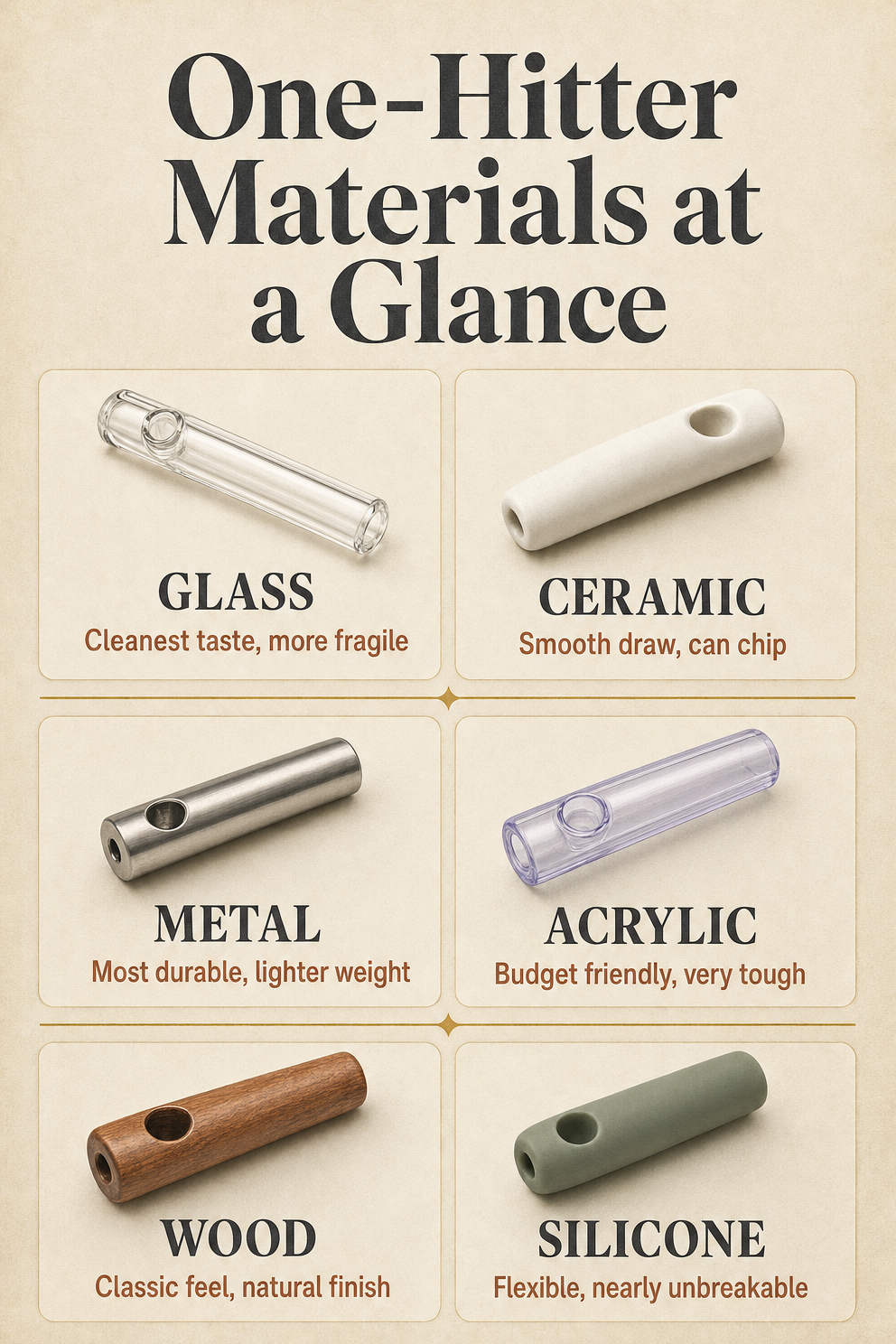
One-hitters come in a range of materials, and each one has trade-offs in taste, weight, durability, and feel [2] [4]. Most shoppers settle on a material based on whether they want clean flavor, a tough carry piece, or something in between.
Glass is often described as offering the cleanest taste because the material does not add flavor of its own, but it is also the most fragile option [2] [4]. Ceramic shares some of that flavor profile, with a smoother draw than metal but a tendency to chip if dropped.
Metal one-hitters, made from aluminum, steel, or titanium, are valued for durability and lower weight [2]. Acrylic is the most budget-friendly option and is very tough, though it can hold onto flavors over time. Wood gives a classic look and a natural finish. Silicone is flexible and nearly unbreakable, which is why silicone-based gear, including options like Silicone Bongs, has become popular for travel.
If you carry a one-hitter every day, durability tends to matter more than flavor nuance. If you mostly use it at home and want to taste the material itself, glass is the usual pick.
- Glass: cleanest taste, most fragile [2] [4].
- Ceramic: smooth draw, can chip if dropped.
- Metal (aluminum, steel, titanium): most durable, lighter weight [2].
- Acrylic: budget friendly and very tough.
- Wood: classic feel with a natural finish.
- Silicone: flexible and nearly unbreakable; travel-friendly.
How Do You Pack a One-Hitter the Right Way?
Packing a one-hitter well is mostly about grind size and a light touch. The chamber is small, so a uniform grind fills it evenly without leaving gaps or blocking the draw [3] [4]. A medium-fine grind, about the texture of dried oregano, is the starting point most guides recommend [2] [3].
Once the material is ground, the pipe does most of the work. Press the open bowl straight down into the ground material with a gentle twist, and friction packs the chamber for you [3]. There is no need to press hard — a firm, even twist is enough.
After the chamber is loaded, give the pipe a light tap against your palm to settle the material so it does not shift when you light it. The bowl is then ready. You can browse options in the One Hitters category to see how different designs handle packing.
If you are new to the press-and-twist method, expect a short learning curve. The first few times you pack, the chamber may end up too loose or too tight. Both have simple fixes, and the next section walks through them.
- Grind the material to a medium-fine consistency, about the texture of dried oregano [2] [3].
- Press the open bowl into the ground material with a gentle twist to fill the chamber by friction [3].
- Tap the pipe against your palm to settle the pack before lighting [2].
- Do not press hard — the chamber is small and overpacking will clog the draw.
- Repack with a fresh twist if the chamber looks uneven or has gaps.
How Do You Use a One-Hitter Step by Step?
Once the chamber is packed, the use sequence is short and consistent. Most one-hitters do not have a carb hole because the chamber only holds enough material for a single hit, so the pipe is built around one draw, one clear, and a repack [2].
Light the tip of the bowl with a flame held slightly away from the material, and draw slowly through the mouthpiece at the same time [2] [3]. Slow, even pulls keep the material lit without scorching it. As you draw, rotate the pipe slowly so the flame walks around the edge of the bowl instead of sitting in one spot.
When the hit is done, clear the ash. Tap the pipe against your palm, blow gently through the mouthpiece, or — on self-ashing designs — press the ejector mechanism to push the spent material out the back of the chamber [2] [3]. The pipe is then ready for the next pack.
Between sessions, a cotton swab and a bit of isopropyl alcohol keep the screen and chamber clear. If you prefer not to roll anything, keep Rolling Papers on hand for alternative session formats.
- Light the bowl with a flame held slightly away, drawing slowly through the mouthpiece [2].
- Rotate the pipe as you draw so the flame moves around the edge of the bowl [3].
- Clear ash by tapping the pipe, blowing through the mouthpiece, or using a self-ashing ejector [2].
- Most one-hitters do not have a carb hole — the chamber is sized for one draw, one clear, one repack.
- Wipe the screen and chamber with a swab between sessions to keep the draw open.
What Are the Most Common One-Hitter Problems and How Do You Fix Them?
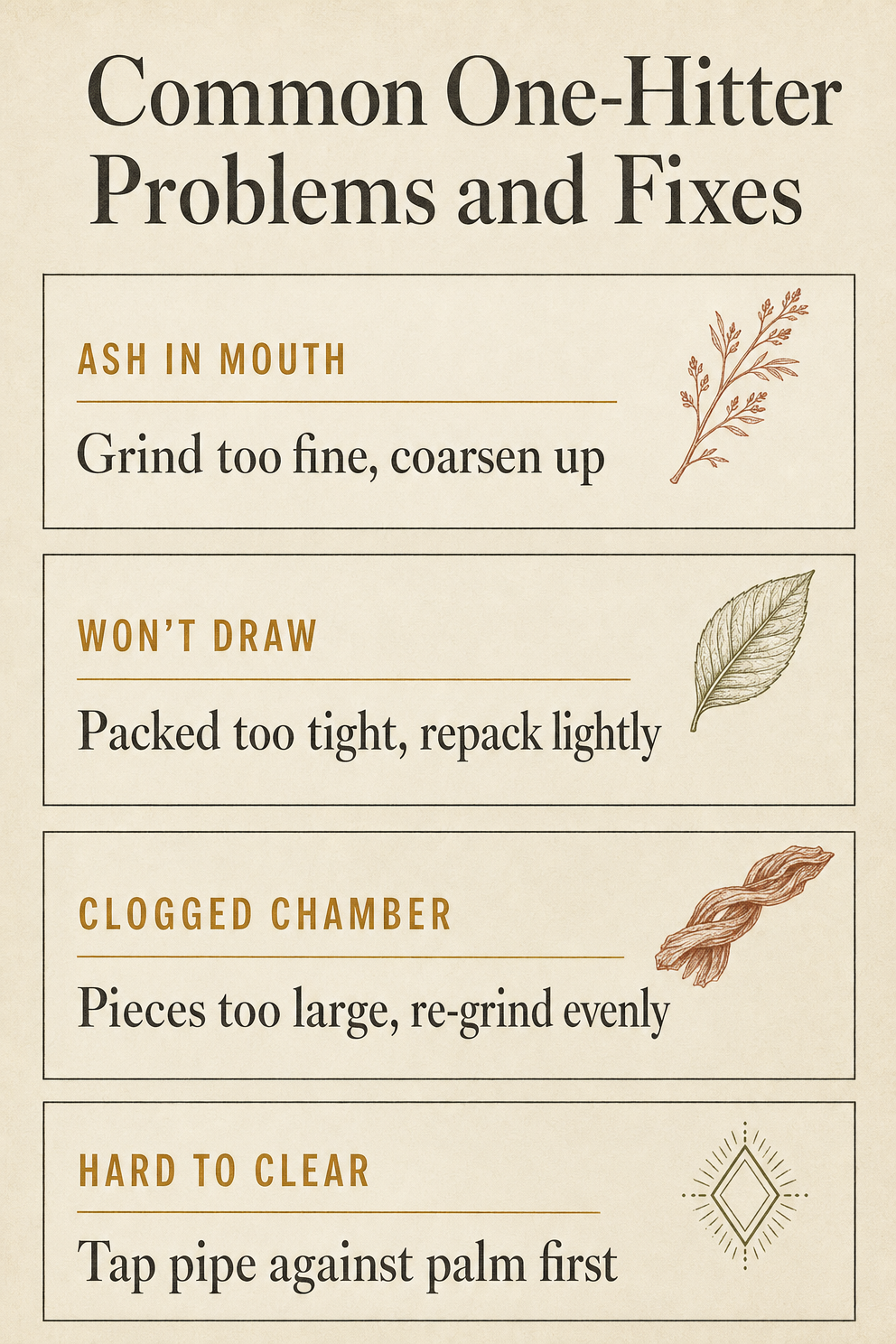
Two problems show up over and over with one-hitters: ash pulling into the mouth, and a pipe that will not draw at all [3]. Both have a specific cause and a simple fix, and once you know what to look for, the issue is easy to clear up.
If ash pulls into your mouth, the grind is almost always too fine. A powdery grind falls through gaps in the screen as you draw. The fix is to coarsen the grind slightly — aim for a sandy, even texture — and repack [3]. Coarser material packs into the chamber in a way that lets air through without dragging ash with it.
If the pipe will not draw, the chamber is either packed too tightly or the pieces are too large. Tight packing collapses the airflow, and large pieces leave gaps that block the draw instead of opening it [3]. The fix is the same either way: tap the pipe out, re-grind evenly, and repack with a light twist.
If the chamber is hard to clear after a hit, tap the pipe against your palm before you blow through the mouthpiece. That knocks loose ash out of the bowl so the screen stays open [2] [3]. For deeper cleanups, dedicated E-Chambers can keep the screen clear over time.
- Ash in mouth: grind is too fine — coarsen to a sandy texture and repack [3].
- Will not draw: chamber packed too tightly — tap out, re-grind evenly, repack lightly [3].
- Clogged chamber: pieces too large — re-grind evenly and refill with a gentle twist [3].
- Hard to clear: tap the pipe against your palm before blowing through the mouthpiece [2].
- Screen buildup over time: clean with a swab and isopropyl alcohol between sessions.
How Do You Choose the Right One-Hitter for Your Routine?
The right one-hitter is the one that fits the way you actually use it. A few decision criteria cover most of the field: material, carry style, and cleanup preference [2] [3].
If you mostly use a one-hitter at home, glass gives clean flavor and a familiar feel, and you can keep it on a shelf without much worry. If you carry one every day, metal, silicone, or acrylic are tougher choices and will shrug off pocket wear [2]. Wood sits in between — classic look, moderate durability.
Carry style is the next filter. If you want one piece that holds both pipe and stash, look for a cigarette-sized one-hitter and a matching dugout. If you already keep your material in a separate container, a standalone pipe is enough.
Cleanup preference matters too. Self-ashing designs have an ejector that pushes ash out the back of the chamber, which is convenient between hits. Standard designs rely on tapping and blowing. For an example of a metal, ejector-style option built around the press-and-twist method, the DART Pro Titanium is a frequently cited carry piece.
- At-home use: glass offers clean flavor and a familiar feel [2].
- Daily carry: metal, silicone, or acrylic hold up to pocket wear [2] [4].
- Pipe and stash together: pair a cigarette-sized one-hitter with a dugout.
- Minimal cleanup between hits: pick a self-ashing ejector design [3].
- Standard cleanup: a plain pipe with a tap-and-blow clear is enough [2].
- Long-term care: keep a swab and isopropyl alcohol on hand for screen buildup.
| Carry Style | Material to Look At | Cleanup Pattern |
|---|---|---|
| Pocket carry, daily | Metal, silicone, acrylic | Tap or ejector between hits |
| Home use, on a shelf | Glass, ceramic, wood | Swab and alcohol between sessions |
| Pipe and stash together | Cigarette-sized pipe + dugout | Reload from dugout chamber |
| Low-touch between hits | Self-ashing ejector design | Press to clear, repack |
Frequently Asked Questions
What is a one-hitter pipe?
A one-hitter is a slender pipe — often cigarette-sized — with a screened narrow bowl designed to hold about 0.1 to 0.3 grams of ground flower for a single inhalation.
How much cannabis does a one-hitter hold?
Most one-hitters hold roughly 0.1 grams per hit, with the broader one-hitter category typically covering about 0.1 to 0.3 grams in the bowl.
What is a dugout and how does it work with a one-hitter?
A dugout is a small rectangular or cylindrical case with two compartments: one for ground material and a narrow slot that holds a cigarette-sized one-hitter, so the pipe and its supply stay together.
How do you pack a one-hitter?
Grind to a medium-fine consistency, press the open bowl into the material with a gentle twist to fill the chamber by friction, then tap the pipe to settle the pack.
What materials are one-hitters made from?
Common materials are glass, ceramic, metal (aluminum, steel, titanium), acrylic, wood, and silicone, with glass typically described as offering the cleanest taste and metal or acrylic valued for durability.
Why do people choose a one-hitter over a larger pipe?
The small chamber is associated with measured single hits, conserving a stash, and discreet or on-the-go carry — features that make one-hitters a frequent first pipe and a common carry option.
Is a One-Hitter Pipe the Right Choice for You?
A one-hitter is the simplest way to take a single, measured hit from a small chamber. The bowl is sized for one person and one draw, which keeps each session short and easy to budget. Pair it with a dugout and you have a pocket-ready pipe-and-stash set that works the same way every time.
If you are new to pipes, the press-and-twist packing method, the small chamber, and the tap-and-clear use sequence are quick to pick up. If you are an experienced consumer, the same small chamber is what makes a one-hitter a reliable carry piece.
Start with a material that matches where you will use it — glass or ceramic at home, metal or silicone on the go — and pick a standard or self-ashing design based on how much cleanup you want between hits. Either way, the rest of the routine is the same: grind, press-and-twist, tap, light, draw, clear, repack.
Sources
- Wikipedia: One-hitter (smoking)
- Weedmaps: How to Use a One-Hitter Pipe
- The DART Company: How to Pack a One Hitter and Use it Like a Pro
- Session Goods: How to Use a One Hitter: Beginner’s Guide [Step-by-Step]