

How often should you clean a bong? Change the water daily and deep-clean the glass weekly. Swab vaporizer screens and a quartz banger after each session, then soak them every few uses. Clean a grinder monthly for light use, every two to three weeks for regular use, and weekly for daily use [1] [6].
How Often Should You Change Bong Water and Deep-Clean the Piece?
For a bong or water pipe, the everyday habit matters more than the occasional deep clean. Stale water is a bigger source of odor and visible film than the resin on the glass, and most glass specialists recommend swapping the water daily for routine users [1] [2]. People who use their bong several times a day often rinse and refill after every session on top of the weekly soak.
On top of the daily water swap, plan a full deep clean about once a week. Two named industry experts interviewed by a major outlet put it the same way: weekly cleaning is the floor for regular users, and connoisseurs sometimes clean their pieces every session [2]. The weekly clean is also the right moment to check the bowl, the downstem, and the perc for buildup.
If you only have time for one habit, make it the daily water swap. It keeps a piece pleasant to use between soaks and cuts down the film that forms when water sits for days. Pair it with a weekly alcohol and salt soak and you have a working rhythm for any water pipe, whether it is a small beaker or a tall multi-perc piece.
For a longer walkthrough of what the weekly deep clean involves and which tools to keep nearby, see our related guide on How Often Should You Clean Smoking Accessories?.
- Empty the bong and rinse the inside with hot tap water until the loose resin stops coming off.
- Pour in 91% or 99% isopropyl alcohol until the piece is about one-third full, then add one to two tablespoons of coarse salt (Epsom salt or rock salt works) as a glass-safe abrasive [2].
- Cover the mouthpiece and downstem openings with your palms or plastic wrap and shake the piece gently for about five minutes so the salt scrubs the interior.
- Pour out the dirty alcohol, rinse thoroughly with warm water, then wash with dish soap and warm water to remove any leftover solvent smell.
- Let the piece dry fully before storing so you don’t leave water sitting against the glass for hours.
How Often Should You Clean a Glass Hand Pipe?
A thin, even layer of resin inside a glass hand pipe is usually called a ‘cake’, and it is not always a problem. A light cake can help hold plant material in place, so it is not a reason to clean the pipe on its own [1]. The signal to clean is functional: once airflow feels restricted or the taste turns harsh, the cake has grown thick enough to come off.
For most people who use a small pipe a few times a week, a thorough clean every one to two weeks is plenty. Daily users often do a quick swab once a week and a full soak every other week. The method is the same alcohol and salt combination used on bongs, just scaled down for a smaller piece.
The other thing to watch for is scratches. Keep metal picks, wire brushes, and anything harder than glass away from the inside of a bowl or stem. Soft pipe cleaners, cotton swabs, and an alcohol soak do the work without dulling or scoring the surface. For a step-by-step look at handling a glass pipe without breaking it, see our guide on How Do You Clean a Glass Pipe Without Breaking It?.
Silicone hand pipes follow slightly different rules. Silicone tolerates longer alcohol soaks and can go in the freezer to make resin brittle, but keep alcohol away from any wood, acrylic, or painted parts the pipe may have.
- Isopropyl alcohol (91% or 99%) combined with coarse salt as a glass-safe abrasive, shaken inside a sealed plastic bag for five to ten minutes [2] [5].
- Cotton swabs dampened with alcohol for scrubbing the bowl and the inside of the stem where a bag cannot reach.
- Soft pipe cleaners (the fuzzy kind used for tobacco pipes) for the airway and any narrow channels a swab cannot fit.
- Dish soap and warm water for the final rinse to clear any leftover solvent taste before the next use.
- Avoid metal picks, wire brushes, and any abrasive pad harder than the glass, since those will scratch the surface over time.
How Often Should You Clean a Dry Herb Vaporizer?
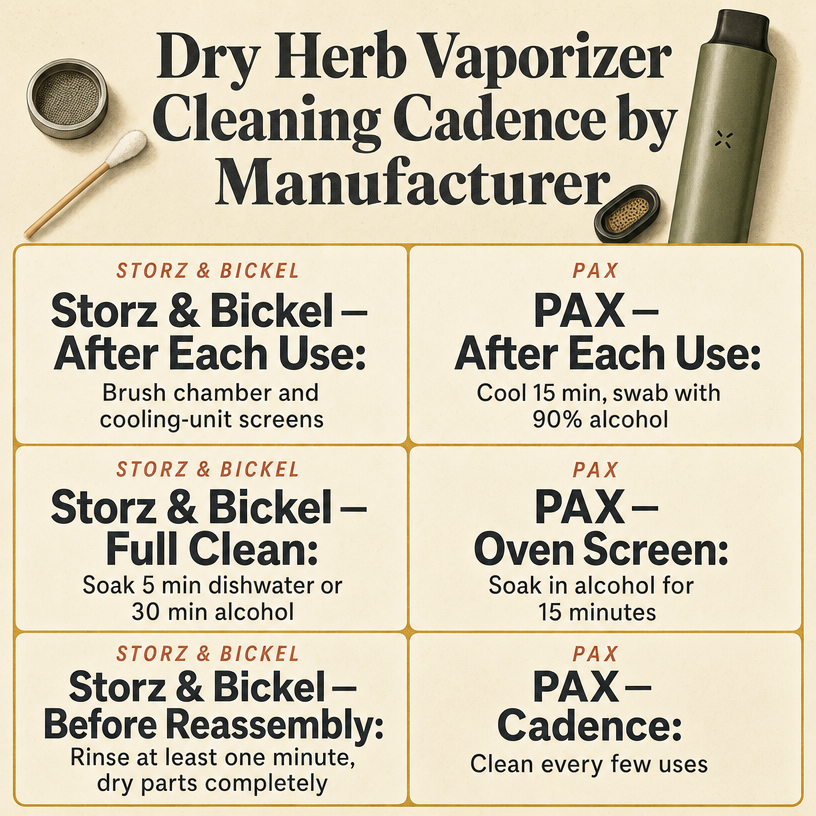
Dry herb vaporizers need the most frequent attention of any gear on this list, because fine plant material works its way into the oven and screens every session. Both of the big-name manufacturers publish similar routines: a short touch-up after each use, plus a full soak every few uses.
Storz & Bickel, the maker of the MIGHTY and VOLCANO lines, tells users to brush the filling chamber screen and the cooling-unit screen after every use. For a full clean, soak all removable parts in warm dishwater for at least five minutes, or in isopropyl alcohol for up to thirty minutes. Rinse every part under running water for at least one minute, then let everything dry completely before reassembly [3].
PAX, the maker of the PAX FLOW and PAX MINI portable vaporizers, recommends cleaning every few uses. After a session, let the device cool for fifteen minutes, then wipe the interior surfaces with a cotton swab lightly dampened with 90% isopropyl alcohol. Remove the oven screen and soak it in alcohol for fifteen minutes, then rinse and dry it before reinstalling [4].
Side by side, the pattern holds: brush or wipe after each session, then do a full soak every few uses. Always let the device cool first, since a swab in a hot oven can leave fibers behind and stress seals that have just been heated. For more on extending the life of a dry herb vaporizer through routine care, see our related guide on How Do You Clean and Maintain a Vaporizer So It Lasts?.
- Let the device cool for at least fifteen minutes after the last session before opening the chamber [4].
- Brush the filling chamber screen and the cooling-unit screen to knock loose any plant material still sitting on the mesh [3].
- Wipe the interior walls of the chamber with a cotton swab lightly dampened with 90% isopropyl alcohol; do not flood the chamber [4].
- Soak all removable parts in warm dishwater for at least five minutes, or in isopropyl alcohol for up to thirty minutes [3].
- Rinse every part under running water for at least one minute, then let each part dry completely before reassembly so no moisture gets trapped near the heating element [3].
How Often Should You Clean a Dab Rig and Quartz Banger?
Dab rigs follow a three-tier rhythm: a quick swab after every dab, a weekly alcohol soak, and a monthly inspection for permanent heat damage called ‘chazzing’. Skipping the swab is what turns a clear quartz banger amber over time.
The first tier is the one most people forget. Right after the last dab, while the banger is warm but cool enough to touch, drop in a dry cotton swab and wipe out the pooled oil before it carbonizes on the quartz. A second swab lightly dampened with 99% isopropyl alcohol clears any film the dry swab missed [5]. That habit does more for the life of a banger than any weekly step.
Once a week, pull the banger off the rig and soak it in 99% isopropyl alcohol for fifteen to thirty minutes, especially if you have been dabbing at higher temperatures. The soak breaks down residue the daily swab leaves behind. Rinse with hot water and let it dry fully before heating it again.
Once a month, hold the banger up to a light and look for cloudy patches that do not wipe away. That is chazzing, a permanent change to the quartz surface that starts when residue carbonizes above roughly 600 degrees Fahrenheit [5]. It cannot be cleaned off, only prevented, so a heavily chazzed banger needs replacing. If you are shopping for one, browse our selection of Quartz Dab Rigs.
- After every dab: swab the warm banger with a dry cotton swab, follow with a second swab lightly dampened with 99% isopropyl alcohol [5].
- Weekly: drop the banger off the rig and soak it for fifteen to thirty minutes in 99% isopropyl alcohol, then rinse with hot water.
- Weekly: while the banger is off, rinse the rig itself with warm water and shake out any leftover oil and water mix.
- Monthly: hold the banger up to a lamp and look for cloudy white or brown patches that signal chazzing.
- Monthly: inspect the downstem, the joint, and any recycler or perc for film buildup that hot water alone will not remove.
How Often Should You Clean Your Herb Grinder?
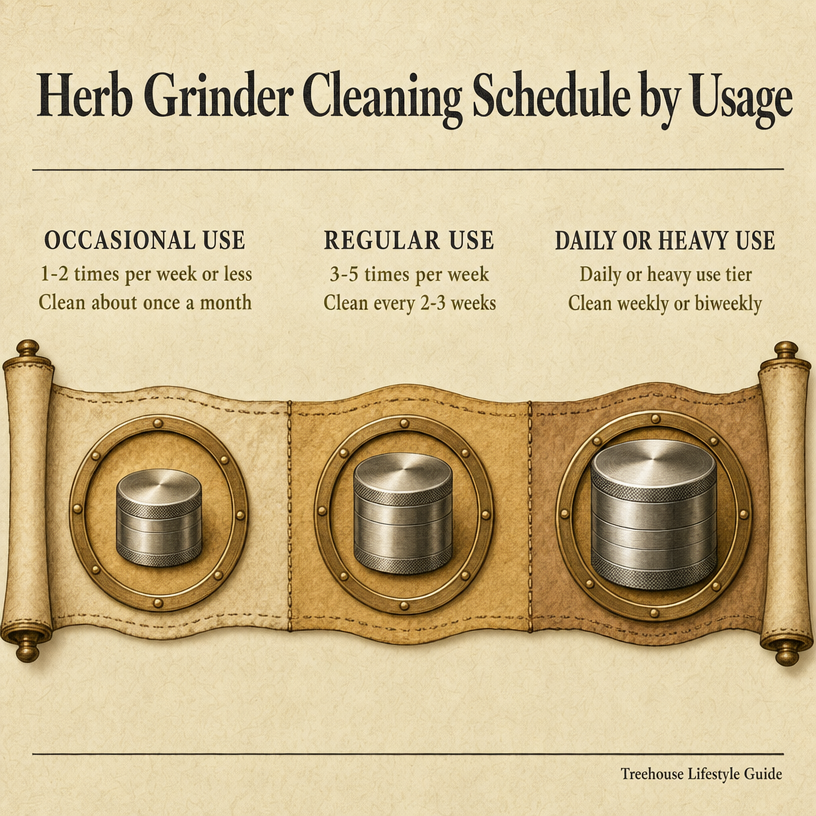
Grinder cleaning frequency scales with how often you use it. A grinder used once or twice a week can go about a month between cleanings. One used three to five times a week should be cleaned every two to three weeks. A grinder used daily, or shared by more than one person, should be cleaned weekly or every other week [6].
The method depends on the material. Metal grinders, meaning the standard aluminum and zinc-alloy designs, tolerate a fifteen to thirty minute isopropyl alcohol soak, after which the resin dissolves and the teeth brush clean [6]. Plastic, wooden, and electric grinders should not be soaked in alcohol. For those, a dry brush, a toothpick for stuck bits, and a damp cloth do the job without warping or staining the material.
A good habit is to empty the kief catcher while you already have the chamber open. A small coin or a dedicated scraper knocks the powder off the screen, and many grinders include a small scoop for exactly this. If you are shopping for a new grinder or a backup, take a look at our Grinders.
Wooden grinders deserve a separate note. The abrasive inside a wooden grinder is usually paint or a thin coating rather than the wood itself. An alcohol soak can strip that coating and leave bare wood exposed, which then absorbs plant material and gets harder to clean over time.
- Occasional use (one to two times per week or less): clean the grinder about once a month [6].
- Regular use (three to five times per week): clean the grinder every two to three weeks [6].
- Daily or heavy use (daily, or shared between multiple people): clean weekly or every other week [6].
- Metal grinders only: a fifteen to thirty minute isopropyl alcohol soak, followed by a brush and a rinse [6].
- Plastic, wooden, and electric grinders: dry brush, toothpick for stuck bits, damp cloth. Do not soak in alcohol.
What Is the Best Solvent and Tool for Cleaning Glass and Metal Gear?
The classic glass solvent is 91% or 99% isopropyl alcohol paired with coarse salt as an abrasive that will not scratch glass. The alcohol dissolves the resin and the salt scrubs the interior [2] [5]. For vaporizer parts, both Storz & Bickel and PAX also endorse warm dishwater as a gentler option for full soaks [3] [4].
Higher-percentage alcohol, meaning 90% and up, cuts resin faster because less water dilutes it. The 70% rubbing alcohol from a drugstore works in a pinch; it just takes longer and a more aggressive shake. Salt grain matters more than people expect: table salt is too fine to scrub, while kosher, rock, and Epsom salt all have the grain size needed to lift residue off glass.
For tools, match the tool to the surface. Cotton swabs, pipe cleaners, and soft brushes clean without scratching. Metal picks, steel wool, and abrasive pads damage glass and most finished metal over time. For bowl and downstem screens, a small brush or a soaked toothbrush works without bending the mesh. We carry replacement Screens if a screen has stretched out or torn.
Dish soap and warm water are the right final rinse for anything soaked in alcohol. A quick wash clears the solvent smell, and on its own it covers everyday glass care between deep cleans.
- Isopropyl alcohol at 91% or 99% concentration for dissolving resin on glass and metal gear [2] [5].
- Coarse salt (kosher, rock, or Epsom) as a glass-safe abrasive to scrub resin off the interior of pipes and bongs [2].
- Warm dishwater for soaking removable vaporizer parts that you do not want to expose to alcohol for long [3].
- Cotton swabs, pipe cleaners, and soft brushes for scrubbing the inside of bowls, airways, and screens without scratching the surface.
- Dish soap and warm water as the final rinse to clear any solvent taste or smell after a soak.
| Solvent or tool | Best for | Typical contact time |
|---|---|---|
| 91% or 99% isopropyl alcohol | Dissolving resin on glass, quartz, and metal | 5-30 minutes |
| Coarse salt (kosher, rock, Epsom) | Scrubbing the interior of pipes and bongs | Shake about 5 minutes |
| Warm dishwater | Removable vaporizer parts you want to keep out of alcohol | At least 5 minutes |
| Cotton swabs and pipe cleaners | Bowls, airways, and warm quartz bangers | Use as needed |
| Dish soap and warm water | Final rinse after any soak | 1-2 minutes |
How Do You Prevent Hard Water Stains and ‘Bloom’ on Glass?
Bloom is a permanent cloudy haze that shows up on glass after long contact with water. It is not a film you can wipe off. It is alkaline deposits, mostly sodium and potassium, leaching out of the glass itself and recrystallizing on the surface as carbonates [1]. Once bloom is visible, cleaning will not remove it, so prevention is the whole game.
The biggest cause of bloom is leaving water inside a glass piece for hours or days. A bong that sits on a shelf with the last session’s water still in it is exactly the setup that produces bloom over time. Rinsing the piece, drying the inside, and storing it empty is the most reliable prevention.
The second tool is the water itself. Distilled water, or water from a reverse-osmosis filter, carries far fewer dissolved minerals than tap water, which means fewer deposits available to crystallize on the glass. Switching over is a small change that keeps a piece looking clear for longer [1]. Our Glass Bongs category includes both borosilicate and soft glass, and the same prevention rules apply to both.
A simple end-of-session habit covers both bloom and odor: empty the bong, rinse the inside with warm water, then leave it open and upside down on a towel to dry. Two minutes of work keeps the glass clear months later.
- Empty the piece and rinse the inside with warm water at the end of every session; never store glass with water still inside [1].
- Use distilled water or reverse-osmosis water in bongs and water pipes instead of straight tap water [1].
- Leave the piece upside down on a towel or in a drying rack after rinsing so the interior dries fully.
- Avoid leaving a glass pipe in a steamy bathroom or anywhere with high ambient moisture for long periods.
- If a piece has already developed bloom, do not scrub it aggressively. The haze is permanent, and over-scrubbing only adds scratches on top of it.
Frequently Asked Questions
How often should I change the water in my bong?
For everyday use, change the bong water daily. Connoisseurs rinse and refill after every session. Stale water is the bigger source of odor and visible film than the resin on the glass, and replacing it daily keeps the piece pleasant to use between weekly deep cleans.
Is a thin layer of resin inside a hand pipe actually desirable?
A thin, even layer, often called a ‘cake’, is normal and can help hold plant material in place. Once airflow starts to feel restricted or the taste turns harsh, that is the cue to clean the pipe rather than letting the cake build up further.
What is the best solvent for cleaning glass pipes and bongs?
The classic glass-safe method is 91% or 99% isopropyl alcohol combined with coarse salt (or Epsom or rock salt) as a glass-safe abrasive. The alcohol dissolves the resin while the salt scrubs the interior; rinse with soap and water afterward.
How often should I deep clean my bong?
Most glass specialists recommend a full deep clean at least once a week for routine users, with the water itself changed daily. People who use their bong several times a day often rinse and refill after every session in addition to the weekly soak.
Can I soak my grinder in isopropyl alcohol?
Only if it is all-metal. Metal grinders tolerate a fifteen to thirty minute isopropyl alcohol soak. Plastic, wooden, and electric grinders should not be soaked in alcohol; clean those with a dry brush, a toothpick, and a damp cloth instead.
What is ‘bloom’ on glass and can it be removed?
Bloom is a permanent cloudy haze caused by alkaline deposits, sodium and potassium, leaching out of the glass during long water contact and recrystallizing as carbonates on the surface. It cannot be removed by cleaning. The fix is prevention: drying glass before storage and using distilled or reverse-osmosis water instead of tap.
What Is the Simplest Cleaning Routine That Actually Keeps Gear in Good Shape?
The shortest routine that keeps every piece working well comes down to three habits. First, swap bong water daily and rinse the piece before putting it away, so the glass never sits wet for hours. Second, brush and swab vaporizer screens and a quartz banger after every session, then do a full soak every few uses or once a week. Third, clean grinders on a usage-based schedule: monthly for occasional users, every two to three weeks for regular users, and weekly or biweekly for daily users.
Free shipping on orders $150+ makes it easy to keep replacement screens and fresh isopropyl alcohol stocked. The bigger payoff is that a clean bong, pipe, rig, vaporizer, or grinder works the way it was meant to every time you pick it up.
Sources
- Tako Glass: How Often Should You Clean Your Glass Pipe or Bong?
- Rolling Stone: How to Properly Clean Your Bong, According to Cannabis Experts
- Storz & Bickel: Cleaning — Storz & Bickel Support
- PAX: Squeaky-Clean: How to Care for 3 PAX Products
- Thick Ass Glass: How to Clean a Quartz Banger Properly (No Chazzing)
- Mission Dispensaries: How To Clean a Weed Grinder: Tips & Essentials
- CDC / NIOSH: Isopropyl alcohol — Immediately Dangerous to Life or Health Concentrations (IDLH)
- National Center for Biotechnology Information (NCBI) / National Academies Press: Isopropyl Alcohol — Emergency and Continuous Exposure Limits for Selected Airborne Contaminants