

The safest way to clean a glass pipe without breaking it is to skip the heat tricks and use the alcohol-and-salt method instead. Fill a sealed bag or container with isopropyl alcohol and coarse salt, drop the pipe in, shake gently, and let it soak. The alcohol dissolves the sticky resin while the salt works as a gentle abrasive to lift stuck-on buildup.
After the soak, rinse the pipe thoroughly with warm water and let it air-dry completely. The key to the whole routine is to keep every step gentle and at room temperature, because sudden temperature changes are what actually crack glass. If you follow that one idea, you can clean your pipe as often as you need to without worrying about damage.
What Supplies Do You Need to Clean a Glass Pipe Safely?
You do not need a fancy cleaning kit to get a glass pipe looking clear again. Nearly every guide for cleaning pipes safely relies on the same three basics: strong isopropyl alcohol, coarse salt, and a sealed bag or container. Everything else is optional and mostly about making the job easier.
The main ingredient is high-concentration isopropyl alcohol. Cleaning guides recommend 91 to 99 percent strength because it mixes with less water and dissolves sticky resin faster than the weaker 70 percent rubbing alcohol you might already have around the house [1] [3].
Salt is the second key piece. It does not dissolve anything by itself. Instead, the coarse grains act like a gentle abrasive that helps break up stuck-on gunk while you shake the bag [2]. Gather everything before you start so the soak goes smoothly.
You can pour out and reuse the alcohol between pipes if you switch pieces often, though fresh alcohol works fastest. And if you want to know more about how alcohol tackles grime across bowls, bubblers, and other glassware, our guide, How Do You Clean Glass Accessories With Isopropyl Alcohol?, walks through the details in depth How Do You Clean Glass Accessories With Isopropyl Alcohol?.
- Isopropyl alcohol at 91 to 99 percent strength, so it breaks down resin quickly [1].
- Coarse salt, such as sea salt or kosher salt, using about a teaspoon for every four inches of pipe [2].
- A sealed zip-top bag or a plastic container with a lid, to keep the alcohol contained while you shake.
- Cotton swabs and pipe cleaners, for the nooks and carb holes you clean by hand later [3].
- A well-ventilated workspace, because isopropyl alcohol gives off fumes [3].
Why Does Rinsing a Hot Pipe with Cold Water Crack It?
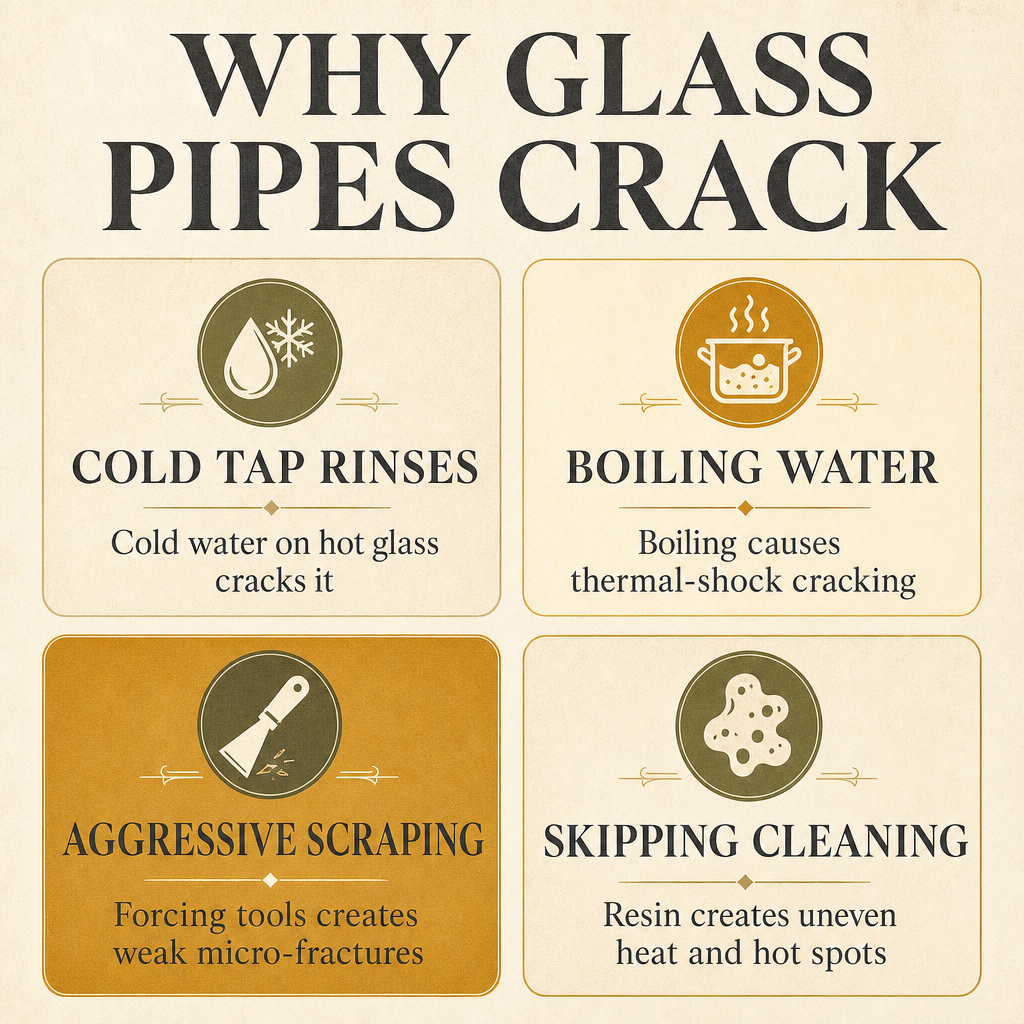
The number one reason glass pipes crack is not a hard bump or a drop. It is thermal shock, which is a simple way of describing glass that heats up or cools down too fast in different spots [5].
Think about what happens when part of the pipe is hot and you suddenly run cold water over it. The part that touches the water shrinks quickly, while the still-hot part keeps its size. That difference pulls the glass in two directions at once, and the built-up stress cracks the piece.
This is why the most common cleaning mistake is rinsing a hot pipe with cold water. The shock is sudden and strong, and it can crack even borosilicate glass, the type most pipes are made from [6].
Borosilicate glass handles temperature change better than softer soda-lime glass because it expands and contracts less. But that only means it needs gradual changes, not no changes. Rapid swings can still cause cracks over time, so the rule is simple: let the pipe cool to room temperature before you rinse it, and keep your water warm rather than ice cold [5] [6].
The same gradual, room-temperature rule applies no matter how big the piece is. If you use a larger glass piece such as a recycler bong, knowing how its design moves water helps you rinse and clean it just as gently; our article What Is a Recycler Bong and How Does It Work? explains the setup What Is a Recycler Bong and How Does It Work?.
- The pipe’s outer surface touches cold water while its inner wall is still warm.
- The cold surface contracts, or pulls in, quickly while the warmer part stays roughly the same size.
- That pull creates internal stress inside the glass wall.
- If the stress is strong enough, the glass cracks, often along a thin or curved spot.
What Is the Safest Way to Soak and Clean Stubborn Resin?
Once your pipe is at room temperature and your supplies are ready, the soak-and-shake method is the gentlest way to remove resin. It works for light film as well as thick, baked-on buildup, and it keeps the glass protected the whole way through [1].
Heavy buildup rarely comes off in a single round. Plan for two or three rounds on an old, well-used pipe. Each fresh soak softens a little more resin, and repeating the gentle routine is safer than trying to scrape it all away at once [3].
Do not try to speed the process up with boiling water or the freezer. Boiling water can crack the glass with heat shock, and a frozen pipe is just as risky. The alcohol-and-salt soak does the job on its own time [1] [5].
For a quick refresher on the basics, our straightforward guide, How Do I Clean a Glass Pipe?, covers the same tips in a shorter version How Do I Clean a Glass Pipe?.
Some cleaners skip the salt entirely and rely on alcohol alone, which is fine for light film. But the coarse grains are worth the extra step on an older pipe, because they reach the spots a rinse cannot. Keep the ratio loose: if the alcohol still looks dirty after a few minutes, add a little more salt and keep shaking gently [2].
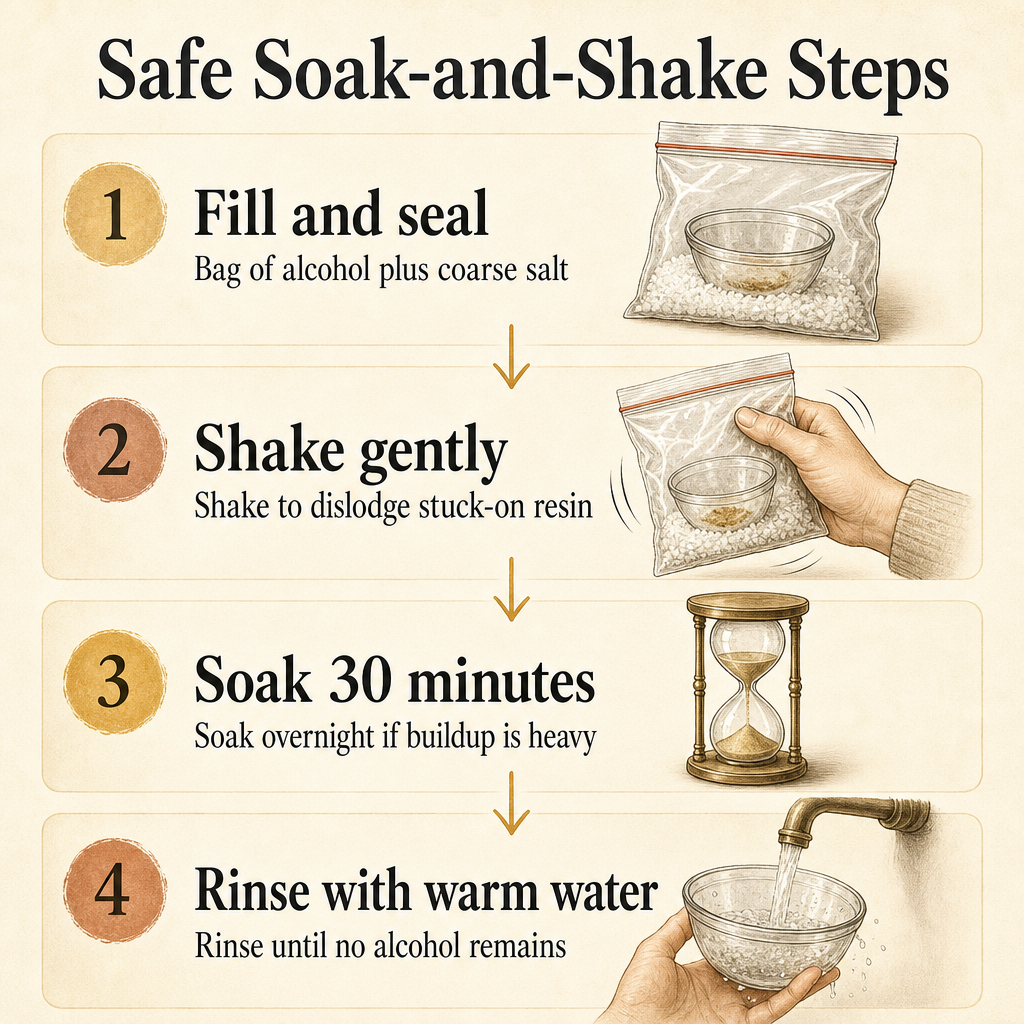
- Put the pipe in a sealed bag or container with enough isopropyl alcohol to cover it, plus coarse salt at about a teaspoon per four inches [1] [2].
- Seal the bag, then shake it gently for a couple of minutes so the salt can work on the resin [2].
- Let the pipe soak, about thirty minutes for most buildup, or a few hours to overnight for very heavy resin, with the occasional gentle shake [1] [3].
- Pour out the dirty alcohol and check the glass, refilling with fresh alcohol and salt if resin still lines the walls.
- Repeat until the alcohol runs clear and very little debris is left behind [2].
Which Tools Reach Resin Deep Inside Without Scratching the Glass?
After a good soak, most of the resin lifts away on its own, but a little can cling inside the bowl, carb hole, or inner stem. This is where thin flexible tools come in. The right tool clears those last bits without harming the glass [2].
The key idea is gentle. Cleaning guides warn that pressing too hard or poking with rigid metal can leave tiny scratches or microfractures. Those small weak spots may not show right away, but they can grow into a visible crack later [5] [4].
Whatever you use, move slowly and never force a tool into a spot it does not fit. If resin will not move, soak the pipe a little longer instead of pushing harder. Patience protects the glass far better than a stronger scrape [5].
Once your pipe is clean and you are shopping for a fresh piece, our Glass Hand Pipes section shows the styles available in the shop Glass Hand Pipes.
A final useful habit is to rinse the pipe with warm water right after any session. That simple step clears loose residue before it dries and keeps the next deep clean shorter. It also lets you spot any film early, while it is still easy to soften with a quick wipe [2].
- Cotton swabs, which bend easily into the bowl and carb without causing damage [2].
- Pipe cleaners, thin and fuzzy, perfect for the narrow inner stem [3].
- Toothpicks, handy for wiping soft, soaked resin out of tight corners.
- Bobby pins, used with a light touch to gently hook out loosened residue [4].
- Soft-bristled brushes, which reach further into the piece than a swab can.
How Often Should You Clean a Glass Hand Pipe?
Most guides suggest cleaning a glass hand pipe about once a month as a starting point. Daily users, though, are often told to clean weekly, because a pipe that sees use every day collects far more resin in a single week [2] [4].
The reason to stay ahead of buildup is practical. Fresh resin rinses away quickly, while old, dry resin hardens into a stubborn crust that needs longer soaks and more effort. Frequent light cleaning is easier than a rare deep clean [5].
Resin also changes how heat spreads across the glass. A layer of baked-on buildup creates hot spots and uneven heating, and those concentrated stress points are part of why manufacturer guides say regularly cleaned pipes hold up better than neglected ones [5].
Some pieces are easier to maintain than others. For example, the silicone beaker bong with removable glass bowl comes apart into separate pieces, which makes running each part through a soak much more manageable SILICONE BEAKER BONG WITH REMOVABLE GLASS BOWL.
Everyone cleans a little differently, so the best schedule is the one you can actually stick to. Pair cleaning with a routine you already have, like the start of each month or the weekly laundry day. A small note in your stash spot or a simple phone reminder is enough to keep the habit from slipping [5].
- Used a few times a week, a monthly deep clean keeps it in good shape.
- Used daily, plan to clean it weekly so resin never hardens [2].
- Only occasional use, clean it anytime it looks cloudy or smells, even if it has been a few months.
- After a heavy session or a long trip, a quick fresh alcohol rinse saves buildup later.
How Should You Rinse, Dry, and Store a Cleaned Glass Pipe?
Cleaning is not finished the moment the resin is gone. The last steps matter just as much, because leftover alcohol or water can dull the glass, and careless storage is another way pipes get damaged between sessions [1].
Storage is easy to overlook, but it protects your piece for the long run. Repeated temperature swings and unpadded bumps slowly weaken glass, so a safe, consistent spot keeps the pipe ready for next time without cracks forming [5].
If you need a dedicated place to keep your cleaning kit and seasoned pieces, browse our Storage section for padded cases and trays that keep glass safe between uses Storage.
- Rinse the pipe under warm running water to wash away every trace of alcohol and salt, keeping the water warm rather than hot to avoid temperature shock [1] [2].
- Shake out the loose water and let the pipe air-dry completely, usually about one to two hours, before using it again [2].
- Pat the outside dry with a soft cloth or paper towel if you like, but let the inside fully air-dry so no moisture stays trapped [3].
- Store the dry pipe somewhere room temperature, padded, out of direct sunlight, and away from heat sources [5].
- Keep it in a padded case, drawer, or padded pouch rather than loose in a bag or a hot car [6].
Frequently Asked Questions
Should I use boiling water to clean a glass pipe?
No. Manufacturer guidance warns against using boiling water on glass pipes because the sudden temperature change causes cracks from thermal shock. Stick with the isopropyl alcohol and salt soak instead.
How long should I soak a glass pipe to remove stubborn resin?
For heavy buildup, soak the submerged pipe for about 30 minutes up to overnight, shake it occasionally, and repeat until the alcohol runs clear and little debris remains.
What supplies do I need to clean a glass pipe?
You need isopropyl alcohol, coarse salt, and a sealed bag or container. Use about a teaspoon of coarse salt for every four inches of pipe, filled nearly to the top with alcohol.
How often should I clean a glass hand pipe?
About once a month is a good baseline, and weekly if you use it daily, because letting resin build up leads to hard deposits that need longer, more aggressive cleaning.
What happens if I use 70 percent rubbing alcohol instead of 91 to 99 percent?
Seventy percent alcohol contains more water, so it dissolves resin more slowly. It still works, but you will likely need a longer soak or an extra round compared with a high-strength alcohol.
Why does my pipe get harder to clean the longer I wait?
Fresh resin rinses away quickly, while old resin hardens into a stubborn crust. Cleaning regularly keeps buildup soft and easy so each soak stays short and gentle.
What Is the Best Way to Clean a Glass Pipe Without Breaking It?
The best way to clean a glass pipe without breaking it comes down to two habits: keep temperatures gentle and clean steadily. Let the piece cool to room temperature, use strong isopropyl alcohol with coarse salt in a sealed bag, shake and soak gently, then rinse with warm water and let it air-dry completely.
Avoid the shortcuts that crack glass, like boiling water, freezer tricks, or rinsing a hot pipe with cold water. Clean on a schedule that matches how often you use the pipe, so resin never has a chance to harden into a stubborn layer.
Take your time with the tools, use a light touch, and store your pipe safely between sessions. A few easy minutes of care now saves you the heartbreak of a cracked favorite later. If you need fresh supplies or a new hand pipe, Treehouse Lifestyle ships nationwide with free shipping on orders $150+.
Sources
- HEMPER: How to Clean a Pipe Correctly
- Business Insider: How to Clean a Glass Pipe in 5 Easy Steps
- Stoked Progressive Smoke Shop & Glass Gallery: How to Clean and Maintain Your Glass Pipes
- Dockside Cannabis: How to Clean your Pipe (or Bong)
- Tahoe Grinder Company: Why Glass Pipes Crack
- Thick Ass Glass: Does Borosilicate Glass Break Easily When Used for a Bong?