

For travel, a smell-proof stash bag wins for portability and flexibility, while a rigid stash box wins for airtight, opaque, humidity-stable storage and organization. Both control odor, but they do it differently: smell-proof bags use an activated carbon lining and sealed zippers to stay packable, while boxes rely on a compression-fit or snap-lock lid to keep air from escaping.
The smart move is often a layered setup that uses an inner jar, a small smell-proof pouch, and a carbon-lined bag or case, so you get the packing ease of a bag with the odor protection of a box. Keep reading to compare the two side by side, then build a travel kit that suits your trip.
What Is the Difference Between a Stash Bag and a Stash Box?
A cannabis stash box is a secure, purpose-built container designed to store cannabis flower, concentrates, and accessories while controlling odor, humidity, and access [1]. It is a rigid case with a real seal, often with an opaque shell and room to organize a few pieces of gear in one place.
A smell-proof stash bag is different. It is flexible and packable, with an activated carbon lining and rubberized zippers that keep air from slipping out while still letting you stuff it into a duffel or a carry-on [2]. Both can control odor, but they approach it from a different angle: a bag stays soft and collapsible, while a box holds its shape and protects what is inside.
The choice comes down to the jobs you need done. On the go, a bag folds away when empty and weighs almost nothing. At home or on a longer trip where you want a fixed home for your gear, a box keeps everything in one place. Many people end up owning one of each: a box for the bedside or counter where gear lives day to day, and a bag for when the stash travels. That split lets each piece do what it does best.
If you want a ready-made middle ground, a Treehouse Smell-Proof Travel Case gives you a durable, carry-friendly way to keep a travel stash odor-contained without a lot of bulk. Rather than debating which single container is superior, think about what each trip looks like. A quick overnight stay may not need more than a small pouch, while a week away with a fuller kit rewards a box that locks everything into place.
- Form: a bag is flexible and collapses when empty, while a box is rigid and keeps its shape.
- Closure: a bag seals with rubberized or waterproof zippers, while a box seals with a compression-fit or snap-lock lid.
- Portability: a bag tucks into other luggage and weighs less, while a box protects contents but takes up fixed room.
- Role: a bag often works best as a secondary layer inside a case, while a box works as the main storage home [1].
| Feature | Stash Bag | Stash Box |
|---|---|---|
| Form | Flexible and collapses when empty | Rigid and keeps its shape |
| Closure | Rubberized or waterproof zipper | Compression-fit or snap-lock lid |
| Portability | Packs into small gaps and weighs less | Takes fixed room but protects contents |
| Best role | Secondary layer inside a travel case | Main storage home at rest |
Which Keeps Smells Contained Better on the Move: a Bag or a Box?
On the move, both can contain smell well, but they earn it in different ways. A stash box controls odor through a real seal: a compression-fit or snap-lock lid that closes with no resistance from its gasket will leak odor, so the quality of that seal matters more than a lid that merely closes [1] [4].
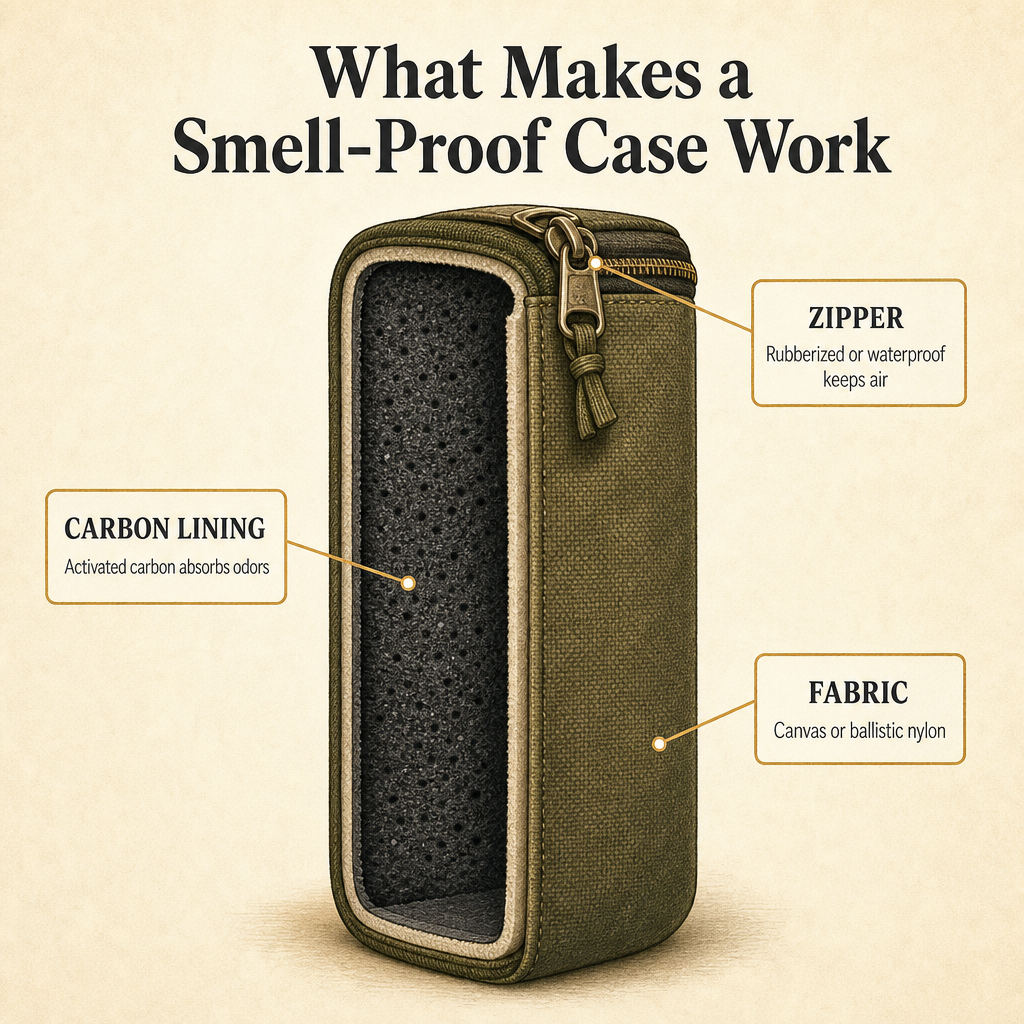
A smell-proof bag relies on its materials. The most effective travel cases use an activated carbon lining to absorb odors, rubberized or waterproof zippers to keep air from escaping, and thick fabric such as canvas or ballistic nylon [2]. When those three work together, a bag stays discreet while it rides in a larger bag.
For moving around, the real test is the seal on whatever you choose. A box that genuinely seals is hard to beat for stationary storage, while a packed bag with a good zip keeps odor low during transit. The difference shows up when you pull gear out on the move: a box you open at a rest stop still reseals tightly, and a bag you unzip in a car closes shut again without wrestling with a lid.
Think about how you will actually use it mid-trip. If you open the container often, a bag with a smooth zipper is easier to work with one-handed. If you mostly open it once at the start and once at the end of the day, a box is simple and secure. If you already use odor-fighting pieces, browse the Odor Control options to round out a kit that keeps things subtle on the road.
- The seal: a compression-fit or snap-lock lid must close with real resistance to keep air and smell in [1].
- Materials: an activated carbon lining absorbs odors that would otherwise escape [2].
- Closures on a bag: rubberized or waterproof zippers keep air from slipping through seams.
- Fabric: a thick canvas or ballistic nylon shell resists wear and adds a stronger barrier.
How Much Can a Portable Stash Case Hold Compared to a Travel Bag?
For travel, portable stash containers prioritize discretion and durability over raw capacity [1]. That is the core trade-off: the more a container holds, the bigger it gets, and the harder it is to keep out of sight. A bag and a box each make that trade-off differently.
A stash bag is often roomier for its footprint because it is soft and can stretch to fit odd shapes. You can tuck it into an open gap in your luggage. A stash box trades some of that flexibility for a fixed, protected interior: it holds only what fits its shape, but it shields that gear from bumps, and it stacks neatly with other items.
Think about what actually goes inside. Flower in jars, a couple of small accessories, and a lighter fit easily in most portable cases. If you need to carry more elaborate pieces, a bigger bag gives you more freedom. For buyers weighing sizes, a related guide like What Size Dab Rig Should You Choose? can help you reason about how much space your gear really needs.
A practical tip: measure the space you will actually pack into before you choose. A box that cannot squeeze into the gap in your luggage is useless no matter how much it holds, and a bag that is too small forces you to leave gear behind. Match the footprint to the bag you travel with, not just to the stash you think you will bring.
- Capacity versus portability: a bigger container holds more but is harder to keep discreet.
- Bag advantage: soft walls flex to fit awkward shapes and pack into small gaps.
- Box advantage: a fixed, rigid interior protects gear and stacks neatly with other luggage.
- Match the size to the gear: a daily stash fits a small case, while multi-piece setups often need a roomier bag.
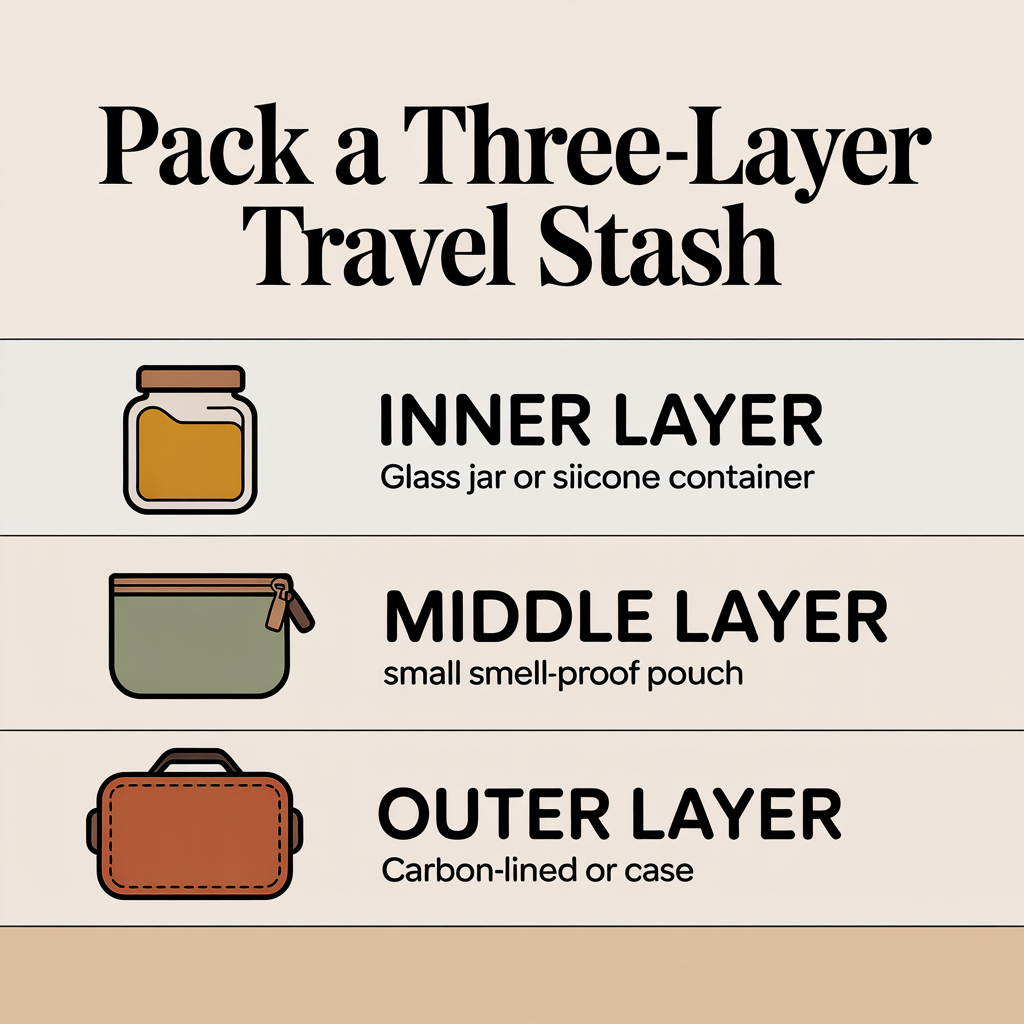
How Do You Build a Three-Layer Travel Stash Setup That Stays Odor-Free?
A verified layered approach gives redundant odor containment that a single container cannot match [2]. The idea is simple: if one layer fails or you need to open one layer mid-trip, the others still hold the smell in. This is the method most travel setups are built around.
Work through the layers in order from the inside out. Each layer carries less responsibility than the one before it, which is exactly the point. These steps give you more than one barrier between your stash and the outside [3]. The layered method also pays off in daily life: it keeps your most-used items together and easy to grab while still sealing shut for storage.
- Pick an inner layer: use a glass jar or a silicone container to hold the flower itself and keep it fresh [2].
- Seal the middle layer: place that jar inside a small smell-proof pouch for a second line of containment.
- Finish the outer layer: put the pouch in a carbon-lined bag or case as the final, most visible barrier [2].
- Keep it organized: tuck accessories and wipes in the outer layer so the inner jar can close tightly for the whole trip.
- Care for the layers: learn How Do You Clean Smell-Proof Bags and Storage Cases Without Damaging Them? so every layer stays effective trip after trip.
What Features Should You Look For in a Smell-Proof Travel Case?
Not every travel case labeled smell-proof lives up to the name. The effective ones share a short list of features that work together to keep odor low [2]. Run through this checklist before you buy so you get a case that actually does the job.
Look first at the liner, then the closing system, then the shell. If a case skimps on any one of these, the other two have to work harder. A case that combines all three gives you the most reliable experience on a trip.
It also helps to check the case when it is new. Open and close the zipper a few times, and press on the fabric to feel how stiff the shell is. A flimsy case will not hold its shape under a packed bag, which defeats the purpose. Spend a minute on these checks and the case will serve you for many trips.
- Confirm an activated carbon lining: this is what absorbs odors so they do not escape [2].
- Check the zipper: a rubberized or waterproof zipper keeps air from slipping out along the seam.
- Look for thick fabric: canvas or ballistic nylon holds up to packing and adds a stronger barrier [2].
- Test the fit: contents should sit snugly so the liner does most of the work.
- Pair it with the right habit: choose an outer case that fits inside your bag, and see gift-level picks in What Are the Best Discreet Smoking Accessory Gifts for Home and Travel?.
What Should You Pack in Your Carry-On When You Fly With Stash Gear?
When you fly, the rules for batteries are clear: electronic smoking devices and their batteries must travel in your carry-on bag and never in checked luggage, because of the fire risk from lithium batteries [3]. Plan your kit around that carry-on rule from the start.
Put the things you actually use often in easy reach, and keep odor-safety pieces tucked near them. A smell-proof bag with an activated carbon lining is a solid choice for the on-plane kit, because it keeps scents low while keeping your gear together in one spot [3]. Keeping everything in one container also makes it faster to pack up after the security belt, instead of fishing items out of separate pockets.
- Keep devices and batteries in your carry-on: never pack them in checked luggage [3].
- Group your stash gear in one spot so it is easy to find and easy to close back up.
- Use a smell-proof bag as the outer layer inside your carry-on for low-profile odor control [3].
- Keep accessories you need during the flight near the top, with the smell-proof layer around them.
How Do You Choose Between a Stash Bag and a Stash Box for Your Next Trip?
By now you have the facts: a bag is flexible and packable, and a box is airtight and organized [1]. Choose by ranking what matters most on your specific trip. These deciding factors will tip you toward a bag, a box, or a layered combination of both.
No single answer is right for everyone. A weekend trip with a small stash may need only a bag, while a longer stay with more gear often calls for a box or a layered setup. Match the choice to how you pack, not to the hype.
One more idea: if you are still torn, let the type of trip decide. For a short overnight with minimal gear, a single bag is all you need. For a road trip where the stash rides in the car for days, a box keeps it stable and secure. When you hear yourself packing more than a few pieces, that is the sign to reach for a layered setup or a dedicated box.
- Rank portability first: if you are stuffing everything into a duffel, choose a collapsible bag [2].
- Rank protection next: if gear needs to stay fixed and safe in a busy bag, choose a rigid box [4].
- Weigh airtightness: a box with a real seal is unmatched for stationary odor control [1].
- Consider a layered combo: an inner jar, a small pouch, and a carbon-lined case cover most trips best.
- Shop the categories directly: see the Stash Boxes collection or the broader Stash Gear range to match your pick.
Frequently Asked Questions
Do I need a lock on my stash storage when I travel?
A lock is not a listed requirement for odor control, but a stash box is designed to limit access as one of its core jobs [4]. Choose a box whose seal keeps air and smell in, then decide on locking based on who will be around your gear and whether your plans call for securing the contents.
Can I put a vape pen or its battery in checked luggage?
No. Electronic smoking devices and their batteries must travel in your carry-on bag and never in checked luggage, because of the fire risk from lithium batteries [3].
Is a smell-proof bag enough on its own, or do I need layers?
A smell-proof bag works well as a secondary layer on its own, but a layered setup offers more redundant odor containment [2]. Use an inner jar, a small smell-proof pouch as the middle layer, and a carbon-lined bag or case as the outer layer for the strongest result.
What makes a travel case actually smell-proof?
So, Which Travel Stash Setup Should You Choose?
For most trips, a layered setup is the smartest pick: an inner jar or silicone container, a small smell-proof pouch, and a carbon-lined bag or case as the outer layer. That combination gives you the portability of a bag and the odor control of a box without forcing you to pick just one.
If you want a single container, let your packing style decide. Travel light and keep things flexible, and a stash bag fits. Want a fixed, protected home for your gear that seals tightly and tracks easily? A stash box is the way to go. Pick the option that fits how you actually pack, and your stash gear will stay organized and odor-contained from departure to arrival.
Either way, the strongest takeaway is the layered habit: an inner jar, a smell-proof pouch, and a carbon-lined outer layer work together better than any single container on its own. Build that habit once, and every future trip gets easier to pack, easier to keep discreet, and easier to unpack when you get home.
Sources
- Tree Lock Box: Types of Cannabis Stash Boxes: 2026 Storage Guide
- Oil Slick Pad: Smell-Proof Cannabis Travel Kits for Flying
- Grasscity: Can You Fly with a Weed Pen? 2026 TSA Rules & Travel Safety Guide
- E10 Labs: The Stash Box, Upgraded: How to Store Cannabis the Right Way