
A stash box is smell proof when it uses two odor-control mechanisms that work together: activated carbon that adsorbs odor molecules into its porous surface, and a physical airtight seal that stops air (and scent) from escaping. [1][2][3]
Hard-shell boxes with compressed rubber O-ring or gasket lids tend to contain odor more reliably than soft zippered bags. Adding a non-porous glass jar inside the box creates an even stronger two-layer barrier. [3][4]
This guide breaks down how each part works, which materials help, which ones fail, and how to pick a box that truly holds the smell in. You will also learn how humidity affects odor and why some boxes stop working long before they should.
How does a smell proof stash box actually keep odor inside?
At its core, a smell proof stash box is trying to stop one thing: scent molecules moving from inside the box to the air around it. Scent travels because odor molecules float in the air and slip through any opening they can find. A box works when it gives those molecules nowhere to go.
There are two main ways a box can do this. The first is a physical barrier. If the box seals tightly and no air can get out, the odor cannot escape with it. The second is a material that actually grabs the smell. Activated carbon does this by pulling odor molecules into its surface and holding them there.
Neither method is perfect on its own. A seal keeps air inside, but smells can still build up and leak the moment the seal is weak. Carbon traps odor, but it needs an airtight housing to be at its most useful. The best boxes use both together. [1][3]
Think of it like two sets of guards at the single exit of a room. The seal is the locked door that keeps everyone in. The carbon is a capture net sitting behind it that grabs anything that tries to get past. One guard alone might let something slip; together they cover each other’s weak spots.
This is why cheap boxes with a thin lid and no lining usually fail the nose test. They may look sturdy, but they offer little to actually hold the smell in. The label might say smell proof, but the design does the real work.
When both mechanisms are in place, you get what many buyers describe as a true smell proof box: tough to detect with a nose test, even up close. To learn more about the bigger picture of odor-free storage, our guide on What Makes a Storage Container Smell Proof? walks through the full range of options for keeping things discreet.
- Activated carbon pulls odor molecules into its porous surface and holds them there.
- An airtight seal stops air from leaving the box, so scent cannot escape with it.
- Used together, the two form a much stronger barrier than either one alone.
- A single weak point, like a loose zipper, can undo the work of both mechanisms.
Why does activated carbon stop strong smells?
Activated carbon is carbon that has been treated to open up a huge number of tiny pores across its surface. Those pores give it an enormous surface area. When odor molecules bump into that surface, they stick to it and stay put. [1]
This is adsorption, not absorption. Absorption means one material soaks another up like a sponge. Adsorption means molecules cling to a surface. Carbon adsorbs odor — it traps the scent on its porous surface instead of letting it pass through the liner. [1][2]
To picture it, imagine a sponge that is woven with millions of tiny hooks. A regular sponge soaks up liquid into its body. Carbon-lined material instead catches odor molecules on all those tiny hooks and holds them on the surface. The scent is trapped before it can travel any farther.
Because the working surface is so large, even a thin carbon liner can be effective in a well-sealed box. The carbon does not have to be thick to do its job. What matters is that the pores stay open and the box keeps the air locked in around it.
Carbon liners do have a limit. Every pore can hold only so many odor molecules. Once the surface is full, the carbon stops working, and the liner needs to be replaced or reactivated over time to pull smells again. [1][3][4]
If you keep your stash box organized and discreet, clean carbon makes a real difference. Pairing it with the right accessories keeps your setup simple — you can browse ideas in our article on What Are the Best Discreet Smoking Accessory Gifts for Home and Travel? for home and travel.
The takeaway is simple: carbon is powerful while its pores are open, but it is not permanent. You have to refresh the liner now and then to keep the box working at full strength.
- Carbon is treated to create a huge network of tiny pores with a large surface area.
- Odor molecules cling to that porous surface — a process called adsorption.
- Adsorption traps scent on a surface, unlike absorption which soaks it in like a sponge.
- Carbon has a saturation point, so liners must be replaced or reactivated over time.
What are the best odor-proof seals for a stash box lid?
The seal is the part of the box that keeps air from slipping out. Not all seals are equal. Some create a true airtight barrier, while others leave small gaps that scent can sneak through. [3]
Shoppers see a few common seal types on stash boxes. Knowing how strong each one is helps you read a product listing and tell real odor control from marketing.
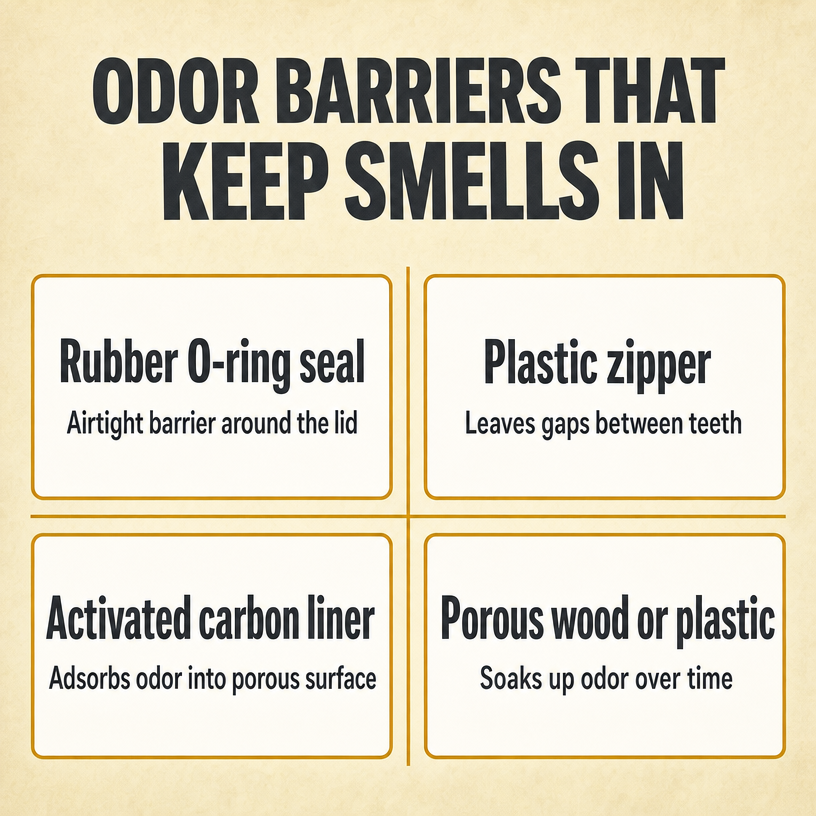
A compressed rubber O-ring or gasket is the strongest option you will see. When the lid closes, it presses that ring flat against the rim, sealing every edge at once. Because the pressure is even all the way around, there is no weak point for air to escape through. [3][4]
Some boxes layer a silicone or rubberized edge onto a hard latch that clamps tight. The latch holds the lid down firmly, and the soft edge does the sealing. This combo is very close to a pure gasket in how well it works.
A standard plastic zipper is the weakest common seal. Its teeth line up but never fully touch, leaving tiny gaps. Over time, fabric around the zipper also stretches and flexes, opening the gaps even wider. That is why zippered bags tend to leak odor more than hard-shell boxes. [3]
Storage products with a reliable gasket-style lid, like a Pulsar Chorus Wax Storage Glass Compartment 5ct, show what a solid airtight design looks like for keeping contents contained. You qualify for free shipping on orders $150+, so you can bundle a box with jars and a humidity pack in one trip.
Whatever seal you choose, test it before you trust it. Close the box, hold it up, and sniff around the lid line. If you catch even a hint of scent at the seam, that weak point will only get worse with use.
- Compressed rubber O-ring or gasket: a tight barrier around the lid that stops air and scent from escaping.
- Silicone or rubberized edge seal: a strong seal that presses firmly against the rim when closed.
- Latch plus gasket combo: a hard clamp that squeezes the gasket flat for an airtight fit.
- Standard plastic zipper: leaves tiny gaps between its teeth, so scent can slip through over time.
Should you choose a soft smell-proof bag or a hard-shell box?
Soft smell-proof bags and hard-shell boxes each have a place, but they are not equal when it comes to holding odor in. The strength of the seal is what separates them. [3][4]
Hard-shell cases usually use a gasket or O-ring around the lid. Because the lid is rigid, it presses the seal flat against the rim, creating a true airtight barrier. This is why hard-shell boxes tend to contain odor more reliably than soft bags. [4]
Soft carbon-lined bags depend heavily on a zipper. Zippers leave small gaps between their teeth, and the fabric around them can flex. Add in carbon saturation over time, and a soft bag has more ways to fail the nose test. [3]
That does not mean soft bags have no use. They are usually lighter and easier to pack into a backpack or duffel. For short trips where you will use and empty them quickly, a well-made carbon-lined bag can be fine. The odor control just will not last as long as a rigid case.
Hard-shell boxes are a better pick for storage at home or for longer stretches where you want to set and forget. Their rigid body keeps the gasket compressed evenly, so the seal holds the same day after day. [4]
There is also a difference in how each handles its interior. A rigid box holds its shape, so the contents stay put and the seal stays true. A soft bag sags and shifts when full, and that shifting can pull on the zipper and open tiny gaps.
The table below sums up the differences so you can match a format to your routine.
To keep any option working well, care matters. Our guide on How Do You Clean Smell-Proof Bags and Storage Cases Without Damaging Them? explains how to clean smell-proof bags and storage cases without damaging them.
- Hard-shell box: rigid lid presses a rubber seal flat for a true airtight fit.
- Soft bag: fabric walls flex and zippers leave tiny gaps, so odor can leak.
- Hard-shell box: carbon lining stays put and compresses evenly against the gasket.
- Soft bag: carbon can be lighter and cheaper, but it saturates and loses power over time.
- Hard-shell box: best for long-term, high-moisture storage where odor control matters most.
| Feature | Soft Smell-Proof Bag | Hard-Shell Box |
|---|---|---|
| Main seal | Plastic zipper with small gaps between teeth | Compressed rubber O-ring or gasket |
| Odor barrier | Relies on zipper plus carbon lining | True airtight barrier around the lid |
| Best for | Short trips and quick on-the-go use | Long-term storage at home |
| Long-run reliability | Zipper gaps widen and carbon saturates over time | Seal holds steady day after day |
| Portability | Light and easy to pack | Heavier and more rigid |
| Wear factors | Fabric flex, zipper stretch, carbon saturation | Mainly the gasket staying compressed and intact |
Which stash box materials soak up odor and are worth avoiding?
The material a box is made from matters as much as its seal. Some materials hold odor in, and some actually soak it up. Over time, the wrong material can start to smell even when the box is empty. [3]
Porous materials are the problem. Unlined wood and ordinary plastic both have tiny spaces that can trap scent. The box may work at first, but the odor builds up in the material itself and becomes hard to remove.
Wood is a natural, open material. Its fibers have countless small gaps, and scent can sink deep into them. Even a nicely made wooden box will start to carry its own smell after months of use, no matter how careful you are.
Ordinary plastic is a bit different but has a similar downside. Its surface can grab onto odor over time, especially if the plastic is soft or textured. Clean it all you want; the smell can still linger inside the material.
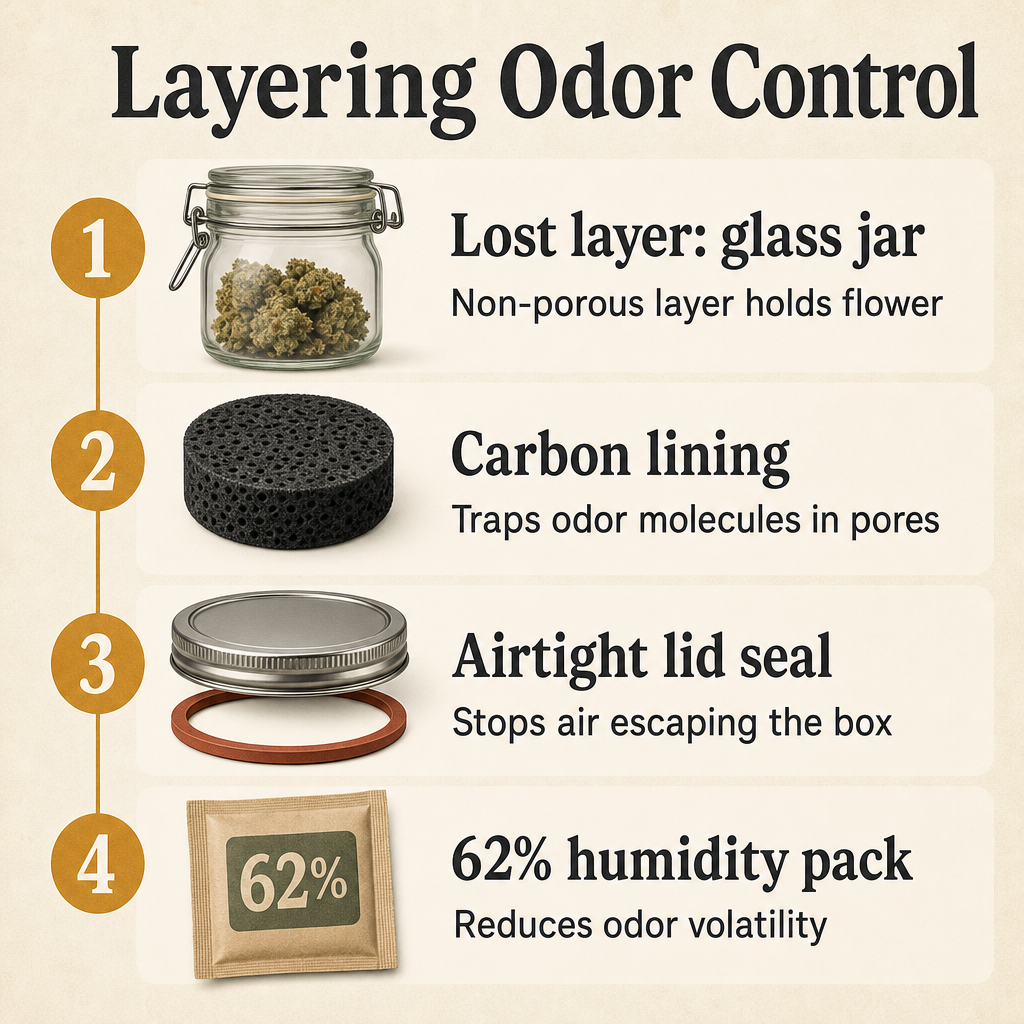
The fix is a double-barrier setup. Store your flower in a non-porous glass jar inside the smell-proof box. Glass gives nothing for odor to soak into, and the box adds a second layer of containment. [3][4]
Non-porous glass is the star of this setup. It has a smooth, sealed surface with no gaps for scent to grab. When you pair that jar with a box that has carbon and a tight seal, you are layering odor control instead of relying on a single layer.
If you are shopping for a container that holds the smell in from the start, a dedicated storage option like the Stash Boxes collection is built for the job.
- Unlined wood: its small pores soak up odor and hold it for a long time.
- Ordinary plastic: can absorb scent into its surface over months of use.
- Non-porous glass: gives odor nowhere to soak in, so it stays inside the jar.
- Lined or coated interiors: a sealed surface resists the smell that porous materials absorb.
How do humidity packs help control odor in a stash box?
Humidity plays a real part in how much odor your box gives off. When stored material is too dry or too wet, it can become more volatile, and strong smells are more likely to escape. [4]
A two-way humidity pack helps keep the air inside the box steady near 62% relative humidity. At that level, the contents hold their moisture and produce less aggressive odor, which makes the box easier to keep clean. [4]
Two-way packs are designed to add moisture when the air is too dry and pull it back when the air is too wet. That steady balance is what keeps the stored material from drying out or becoming overly damp.
You can add a pack right inside the jar or at the bottom of the box. Match the pack size to the amount of storage space you have, and check it over time since packs wear out and need replacing.
Humidity control and odor control work as a team. A steady moisture level keeps the contents calm, and a good seal plus carbon keeps any scent that does arise inside the box. Together they keep the setup quiet and consistent.
When you set up your storage, a humidity pack is a smart add-on. The Humidity Packs collection has options sized for jars and boxes of different capacities.
- Choose a two-way pack designed to hold the air near 62% relative humidity.
- Place the pack inside the glass jar or at the base of the box near the contents.
- Match the pack size to the space you are storing so it can keep up.
- Replace the pack when it dries out so the humidity stays steady.
Frequently Asked Questions
How does activated carbon differ from an airtight seal in a stash box?
Activated carbon adsorbs odor molecules into its porous surface and traps them, while an airtight seal physically stops air and scent from escaping the container. Most effective boxes combine both.
Why can a plastic zipper let odor escape?
A standard zipper leaves tiny gaps between its teeth, which lets scent slip through. A compressed rubber O-ring or gasket around the lid creates a more reliable airtight barrier.
Why does my smell-proof bag stop working over time?
Carbon lining has a saturation point — once its pores are full of odor molecules it stops working, so the liner must be replaced or reactivated over time.
Should I keep flower in a glass jar inside my stash box?
Yes. A double-barrier setup — storing flower in a non-porous glass jar inside a smell-proof box — is a common and reliable way to contain odor.
Is a hard-shell box always better than a soft bag for odor control?
For long-term storage, yes. A rigid lid presses a rubber seal flat for a true airtight fit. A soft bag is lighter and easier to pack, but its zipper and flexible fabric give it more ways to leak scent.
What should you look for in a genuinely smell-proof stash box?
A box is only as good as its two working parts: carbon that traps odor and a seal that keeps air in. Look for a hard-shell case with a compressed rubber O-ring or gasket lid, skip porous materials like unlined wood and plain plastic, and keep flower in a glass jar inside the box.
Add a two-way humidity pack near 62% relative humidity, and remember that carbon liners wear out — refresh them as needed. Built this way, your stash box can pass the nose test and stay discreet for the long haul.
The right box is not the flashiest one on the shelf. It is the one that combines a tight seal, working carbon, and a smart glass-jar setup. When all three come together, you can trust it to hold the smell in.
Sources
- Abscent: Do Smell Proof Bags Really Work? How Activated Carbon Adsorbs Strong Odors
- Cubbi: The Science of Smell-Proof Stash Boxes for Weed: How They Work
- Eatsauca: Why Your Scent Proof Stash Box Probably Fails the Nose Test
- The Pilot Works: Why Your Weed Smell Proof Box Isn’t Working (And What Actually Does)