

An ash catcher is a small glass attachment that sits between your bowl and your bong. It traps ash, resin, and unburned debris before they reach the main water chamber, and most designs hold water with a percolator so smoke is filtered twice — once in the ash catcher, once in the bong [1] [2] [7].
What Is an Ash Catcher and How Does It Work?
An ash catcher is a glass accessory that fits between your bowl and your bong. The bowl screws into one end of the ash catcher, and the other end slides into the joint on your bong’s downstem. Smoke has to pass through the ash catcher before it reaches the bong’s water chamber, which is where the cleaning happens [1] [7].
Most ash catchers have their own small water reservoir and a percolator inside. When you take a hit, smoke is filtered in the ash catcher first and then filtered again in the bong, so debris has two chances to settle out before any air reaches your mouth. This double pass is the main reason ash catchers are sold as a way to keep the main piece cleaner for longer [2] [5].
If you already read our guide on What Is an Ash Catcher and How Do You Choose the Right One for Your Bong?, you know the accessory comes in many shapes, but every ash catcher shares the same basic parts. The parts that show up on every model — wet or dry, cheap or expensive — are the joints, the chamber, and (on most designs) the water line [3].
- A bowl-side joint: the end your bowl slides into, available in 10mm, 14mm, or 18mm.
- A bong-side joint: the end that fits into your bong’s downstem, matched to your bong’s joint size, angle, and gender.
- A debris chamber: the main body of the piece where ash and resin collect during use.
- A water reservoir and percolator (on wet designs): a small chamber you fill with water, plus a diffuser that breaks smoke into bubbles.
- An air pathway: a tube or stem inside the glass that routes smoke from the bowl side to the bong side.
Do You Actually Need an Ash Catcher on a Bong?
You don’t need an ash catcher the way you need a bowl. A bong will work fine without one. The real question is whether the trade-offs — added weight, extra drag, one more piece to clean — are worth the benefits for how you actually use your piece [1] [5].
For most daily-use setups, the answer is yes. An ash catcher pays for itself in saved cleaning time if you find yourself deep-cleaning your bong every few days. By catching debris before it reaches the main chamber, the ash catcher keeps your bong water clearer and your percolators unclogged, which means you can go longer between full cleanings [2] [5] [6].
Our guide on How Do You Prevent Heavy Resin Buildup in Bongs and Pipes? covers the same idea from the cleaning side. If you already know resin buildup is your main annoyance with your bong, an ash catcher targets that exact problem by stopping debris at the source.
- Bongs with multiple percolators that are annoying to clean — an ash catcher keeps those percs from getting clogged with debris.
- Daily-use setups where bong water gets murky fast — the ash catcher takes the brunt of the resin, so the bong stays cleaner between changes.
- Shared pieces — ash catchers cut down on visible debris and make the bong presentable faster between users.
- Anyone who wants extra diffusion without buying a new bong — a wet ash catcher with a perc adds a second filtration stage without changing your main piece.
What Size Ash Catcher Fits Your Bong?
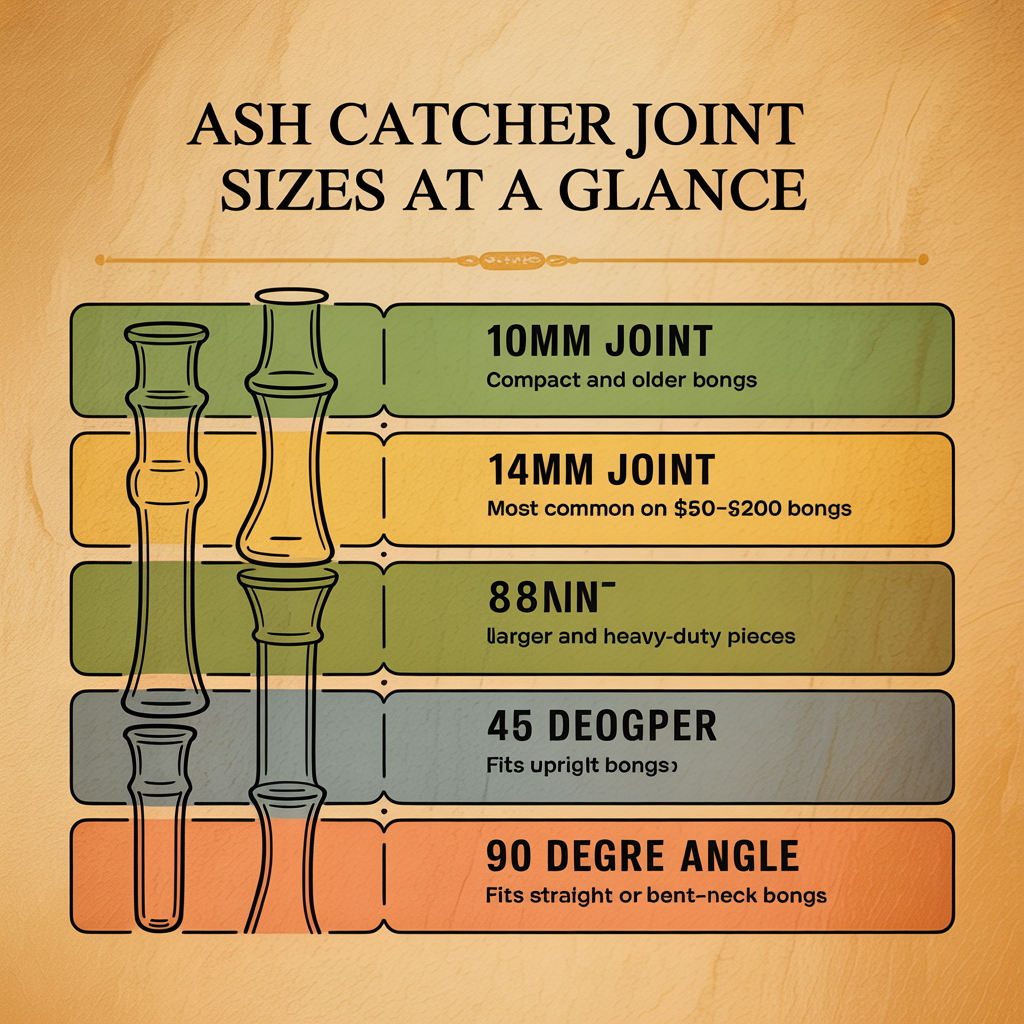
Ash catchers come in three standard joint sizes: 10mm, 14mm, and 18mm. The size you need depends on the joint on your bong’s downstem — the small glass tube that holds the bowl and routes smoke into the water [3] [4].
Most bongs in the $50–$200 range use a 14mm joint, which is why 14mm is by far the most common size for ash catchers and has the widest selection of styles and price points. Smaller or older pieces tend to use 10mm joints, and larger or heavy-duty pieces often use 18mm joints [3].
If you are not sure what size your bong uses, our guide on How Do I Measure My Bong’s Joint Size? walks through how to measure the joint with a ruler or coin. The fastest rule of thumb: most compact and travel-size bongs are 10mm, most mid-range bongs are 14mm, and most larger beaker or straight-tube bongs with thick glass are 18mm [4].
- 10mm joint: found on compact bongs, older pieces, and travel-size water pipes; smallest selection of compatible ash catchers.
- 14mm joint: the most common size on mid-range bongs in the $50–$200 range; widest selection of ash catchers across all price points.
- 18mm joint: found on larger or heavy-duty bongs, often with thicker glass and bigger chambers; smaller but solid selection of ash catchers.
- Always confirm the size before you buy — the joint size is stamped on most downstems or listed in the bong’s product specs.
Which Angle and Gender Ash Catcher Do You Need?
Joint size is only the first fit question. Once you know the size, you also need to match the angle and the gender of the joint. Mixing any of these up is the most common reason an ash catcher won’t sit right, won’t seal, or won’t percolate properly [3] [4].
The angle has to match your bong. A 45-degree ash catcher fits upright bongs that hold the bowl straight up. A 90-degree ash catcher fits straight-neck or bent-neck bongs where the bowl sits at a right angle. Mixing angles doesn’t just look off — it can cause the percolator to function poorly because the water level changes, and the joints can grind against each other and scratch the glass [3] [4].
Gender is the second variable. Joints are either male (a peg that sticks out) or female (a socket that the peg goes into). The bowl-side joint on the ash catcher has to be the opposite gender of your bong’s downstem joint. If the genders don’t match, you can bridge the gap with a joint adapter, but adapters add weight and length, which can make smaller water pipes top-heavy and harder to handle [4].
For a full range of options that match the most common bong sizes and angles, browse our Ash Catchers collection.
- Joint size (10mm, 14mm, or 18mm) — must match your bong’s downstem.
- Joint angle (45° or 90°) — must match the bowl position on your bong; mismatch causes poor perc function and glass scratching.
- Joint gender (male or female) — must be complementary to your bong’s downstem; opposite gender slides in, same gender requires an adapter.
- Adapter requirement — adds weight and length, so it’s worth checking gender before you buy to keep the bong balanced.
Wet vs Dry Ash Catchers: Which Type Should You Buy?
Ash catchers come in two broad types. Wet ash catchers hold a small amount of water and usually include a percolator for a second diffusion stage. Dry ash catchers trap debris without holding water and have no percolator. Both types keep debris out of your bong, but they trade off in different ways [2] [3].
Wet ash catchers add diffusion because the smoke passes through water in the ash catcher before it ever reaches the bong. The trade-off is more drag — every percolator adds some resistance to airflow — and one more chamber to clean. Wet designs are also heavier than dry designs because of the extra glass for the water reservoir and percolator [2] [5].
Dry ash catchers are simpler: debris falls into a small chamber and stays there, with no water and no perc. They add less drag, weigh less, and are easier to clean because there is no water to empty and no perc to soak. The trade-off is no added diffusion — you get debris filtering but not the second percolation stage [2] [5].
If you want a wet design with a strong percolator, the Honeybee Herb Matrix Ash Catcher is a good example of a matrix perc in an ash catcher body.
- Water and percolator: wet designs include both for extra diffusion; dry designs have neither.
- Drag: wet designs add resistance from the second percolation stage; dry designs add almost none.
- Cleaning: dry designs empty and rinse in seconds; wet designs need the water dumped, the perc soaked, and the chamber brushed.
- Weight: dry designs are lighter and put less pull on the bong’s joint; wet designs are heavier and stress smaller bongs more.
- Visual mess: dry designs show the debris they catch, which is a reminder to clean; wet designs hide the debris under water.
Which Percolator Style Should You Pick in an Ash Catcher?
On wet ash catchers, the percolator is the part that breaks smoke into bubbles. Different perc styles break the smoke into different bubble sizes, which changes how the air moves through the piece and how much resistance you feel when you pull [3] [6].
There is no single perfect percolator style. Each one trades off between diffusion (how much the smoke is broken up), drag (how much the perc resists airflow), and cleaning difficulty (how easy the perc is to clear if it gets clogged). The right style is the one that matches what you want from the piece [6].
For a real-world example of a built-in percolator system at the bong level, our Grateful Dead x Pulsar 10 Year Flood Glycerin Water Pipe Kit – 16" / 14mm F shows a glycerin water pipe kit with a full perc stack.
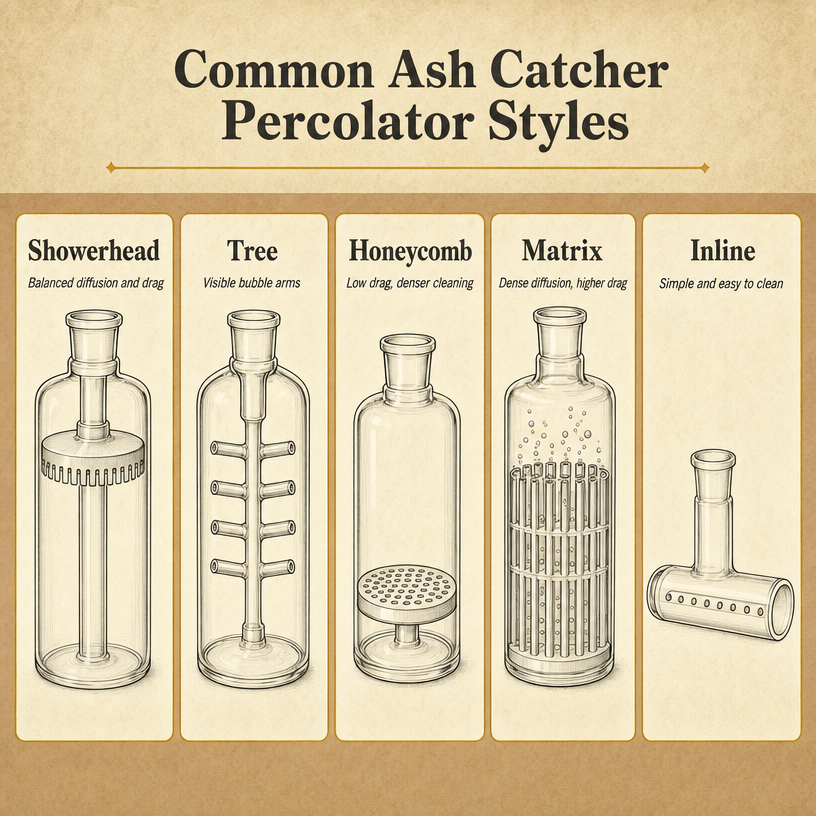
- Showerhead perc: a flat disc with slits that sprays smoke outward; balanced diffusion and drag; easy to clean compared to most other styles.
- Tree perc: vertical arms with slits that branch like a tree; produces visible bubble streams; more drag and more glass surface to clean.
- Honeycomb perc: a flat disc with many small holes; low drag and dense diffusion; harder to clean because the small holes clog easily.
- Matrix perc: a grid of slits across multiple discs; dense diffusion with noticeable drag; cleaning is more involved because of the layered slits.
- Inline perc: a simple horizontal tube with slits; minimal drag, minimal diffusion; the easiest perc to clean and the most forgiving if you skip a deep clean.
What Are the Downsides of Adding an Ash Catcher?
Ash catchers have real benefits, but the trade-offs are worth knowing before you bolt one onto a bong you already like. Three downsides come up consistently: added weight, extra drag, and one more glass piece to clean on a regular schedule [4] [5] [6].
Weight is the biggest mechanical issue. An ash catcher hangs off the joint at the top of your bong’s downstem, so the bong’s joint has to support the weight of the bowl, the ash catcher, and the water inside the ash catcher. On smaller or thinner bongs, this added pull can stress the joint over time, especially if the bong gets knocked around [4] [5].
Drag is the second issue. Every percolator adds resistance to airflow, and a wet ash catcher adds a whole second stage. If your bong already has a heavy perc system, adding an ash catcher on top can make pulls feel noticeably tighter [5] [6].
Cleaning is the third. An ash catcher is one more glass piece to soak, brush, and rinse. For some users this is a non-issue, and for others it’s the reason they skip ash catchers entirely. If you want to keep cleaning easy, dry ash catchers and inline percs are the lowest-effort options [6].
If you tend to favor pieces with built-in percolation and don’t want to add another attachment, our Ice Bongs collection covers bongs that already have perc systems built in.
- Added weight pulling on the bong’s joint — especially noticeable on smaller or thinner glass.
- Increased drag from the second percolation stage — pulls feel tighter, especially on bongs that already have a complex perc.
- One extra glass piece to clean — needs the same soak-and-brush routine as the bong, on the same schedule.
- Risk of glass-on-glass scratching if the angle or joint type is mismatched — always confirm fit before seating the ash catcher.
Frequently Asked Questions
What does an ash catcher actually do on a bong?
It sits between your bowl and your bong and traps ash, resin, and unburned debris before they reach the main water chamber. Most ash catchers also hold a small amount of water with a percolator, so smoke is filtered twice — once in the ash catcher and again in the bong itself.
Do ash catchers just keep the bong clean or do they change the pull?
Both. They keep the bong cleaner by catching debris, and wet ash catchers add a second filtration stage with their own percolator, which adds diffusion. The trade-off is more drag from the extra percolation and one more piece to clean.
How do I know what size ash catcher fits my bong?
Look at the joint on your bong’s downstem where the bowl slides in. Standard ash catcher sizes are 10mm, 14mm, and 18mm. 14mm is the most common size on bongs in the $50–$200 range and has the widest selection of compatible ash catchers.
What is the difference between a 45-degree and 90-degree ash catcher?
The angle has to match your bong. A 45-degree ash catcher fits upright bongs, and a 90-degree ash catcher fits straight or bent-neck bongs. Mixing angles causes the percolator to function poorly and can scratch the glass where the joints meet.
Wet vs dry ash catcher — which should I buy?
Wet ash catchers hold water and usually include a percolator for extra diffusion, at the cost of more drag and an extra chamber to clean. Dry ash catchers trap debris without water, so they add less drag and are easier to clean, but they do not add diffusion.
Are ash catchers also called drop-down adapters or reclaimers?
Yes. The umbrella term across the industry is ‘ash catcher,’ but some manufacturers call the dry, no-water variant a ‘drop-down adapter’ or ‘reclaimer.’ This guide uses ‘ash catcher’ as the umbrella term for both water-filled and dry designs.
So, Should You Buy an Ash Catcher for Your Bong?
If you want cleaner bong water, fewer deep cleanings, and a second filtration stage without replacing your main piece, an ash catcher is one of the cheapest upgrades you can make. The key is matching the joint size, angle, and gender to your bong before you buy — that’s where most fit problems come from.
Start by measuring your bong’s downstem joint and confirming the angle. If you have a 14mm joint on an upright bong, you’ll find the widest selection of ash catchers at the 14mm 45-degree size. If your bong already has a complex perc system, pick a simple perc style (inline or showerhead) for the ash catcher to keep drag manageable. If you’d rather skip the attachment entirely, browse our bong collection for pieces that have the diffusion built in.
Treehouse Lifestyle ships free shipping on orders $150+, so a single ash catcher or a matched bong-and-ash-catcher setup both qualify for free delivery.
Sources
- GRAV: LESSONS: Ash Catchers 101
- Smoke Cartel: Ash Catchers 101: Keep Your Bong Clean & Hits Smooth
- Roots Glass: How to Choose the Right Size Ash Catcher for Your Bong
- Smokea: What to Look for When Selecting an Ash Catcher
- Thick Ass Glass: Are Ash Catchers Worth It | Pros & Cons for Bongs/Dab Rigs
- MunchMakers: Percolator Bong Types: Complete Guide to All Percs
- Purr Glass: What is an Ash Catcher And Why Should You Use One?