

The bong bowl size you need is determined by two details: the joint diameter and the joint gender. Most bowls use a 10mm, 14mm, or 18mm joint, while listings may also call these 14.5mm and 18.8mm. Measure the joint on your bong, identify whether it is male or female, then choose a bowl with the matching diameter and opposite gender. The bong’s height and brand do not decide the bowl size. [1]
This guide explains the standard sizes, the common label differences, a simple dime test, adapter options, bowl designs, and material choices. It also gives you a quick buying checklist so you can confirm the details before ordering.
What Are the Standard Bong Bowl Sizes?
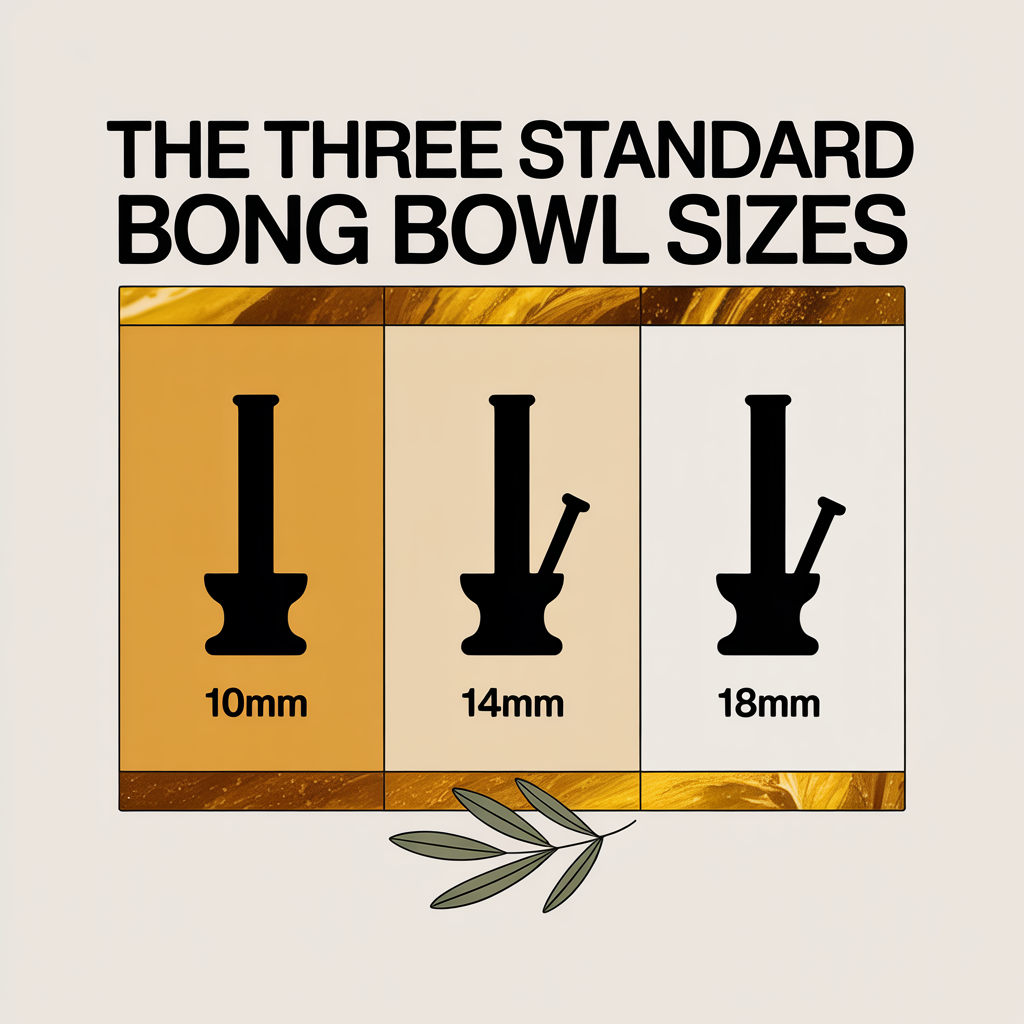
Bong bowls are usually sold in three standard joint diameters: 10mm, 14mm, and 18mm. The number describes the width of the connection point in millimeters, not the depth of the bowl cup. A bowl in one standard size is made to connect with a joint of that same size, regardless of brand. [2]
The 10mm size is the smallest and is often found on mini bongs, travel pieces, and small dab rigs. It is less common in general accessory catalogs, so double-check the listing before buying.
The 14mm size is the everyday middle option and is commonly stocked by retailers. It appears on many beakers, straight tubes, and other medium-size pieces. The 18mm size is the largest of the three and is often used on larger bongs and wide scientific-glass pieces. [5]
For example, the SILICONE BEAKER BONG WITH REMOVABLE GLASS BOWL may look different from another bong, but its bowl choice still comes down to the joint details. A 10-inch piece and a 16-inch piece can both use a 14mm bowl if their downstem joints use that diameter. [6]
If you already own a bowl and it fits, the quickest check is to look at the joint where that bowl connects. Compare that joint to the other details in this guide, and you can confirm whether your existing bowl is 10mm, 14mm, or 18mm before you shop for a matching replacement.
- 10mm: the smallest standard, often found on mini and travel pieces
- 14mm: the most common middle size for everyday bongs
- 18mm: the largest standard, often found on large or wide pieces
- The number refers to joint diameter, not bowl depth or bong height
Is a 14mm Bowl the Same as 14.5mm, and Is 18mm the Same as 18.8mm?
Retailers and manufacturers do not always use the same label for the same standard. In most bong-bowl listings, 14mm and 14.5mm refer to the same size family, and 18mm and 18.8mm refer to the same larger size family. [3]
That means a 14mm bowl is generally listed as compatible with a 14.5mm joint. An 18mm bowl is generally listed as compatible with an 18.8mm joint. These labels do not create two extra sizes that you need to memorize.
When comparing a listing with your piece, focus on the standard family and then confirm gender. If your bong documentation says 14.5mm, shop for 14mm or 14.5mm bowls. If it says 18.8mm, shop for 18mm or 18.8mm bowls. The Vitae Glass 18" Swiss UFO Bong is a useful reminder that the piece’s own specifications matter more than its name.
The important habit is to read the two numbers together with the word diameter or joint on the listing. When a page prints both a whole number and a decimal, they describe the same connection, so you do not need to hunt for a different bowl, and you do not need to memorize a long list of sizes.
- 14mm and 14.5mm: usually the same standard size
- 18mm and 18.8mm: usually the same standard size
- A different label does not automatically mean a different fit
- Check gender as well as the diameter
How Do You Tell If Your Bong Joint Is Male or Female?
Joint gender describes the shape of the connection. A male joint has a stem that protrudes from the bong. A female joint has an open socket that receives a stem. The bowl must be the opposite gender so the two pieces can connect. Most traditional bongs have a female joint and use a male bowl. [1]
Make size and gender as two separate checks. A 14mm male bowl and a 14mm female bowl are not interchangeable, even though both use the same diameter. Product pages usually state the gender with words such as male, female, M, or F.
Look closely at the joint on your piece, and compare it with the [SeshGear product listing]SeshGear Jellyfish Double Chamber Glass Beaker Water Pipe – 17" / 14mm F / Colors Vary. The listing’s specification style shows why it is worth reading the details instead of guessing from a photo.
A clean way to confirm gender at a glance is to hold the bowl over the empty joint. If the stem of the bowl points down into the opening, the bong has a female joint. If the bowl would sit over an exposed stem, the bong has a male joint, and you need the opposite bowl style.
- 1. Look for a stem sticking out of the bong; that is a male joint
- 2. Look for a socket opening; that is a female joint
- 3. Choose the opposite bowl gender
- 4. Confirm the diameter and gender on the product page
How Do You Measure Your Bong Joint at Home Without Tools?
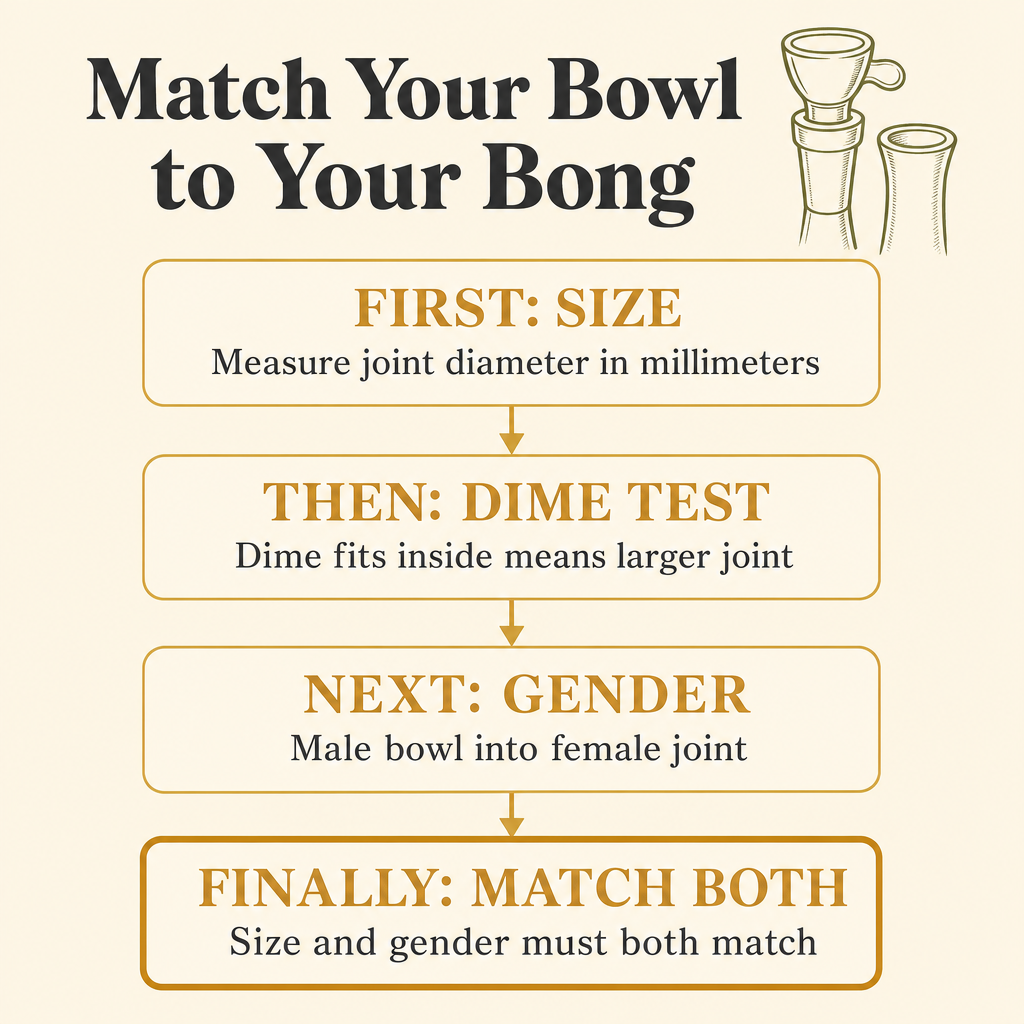
You can usually narrow down the joint size in under a minute. Remove the bowl and measure the connection itself, not the outside of the bowl cup. On a male joint, the relevant measurement is the outside diameter. On a female joint, it is the inside diameter. [3]
A dime can provide a rough at-home reference. A US dime is about 17.9mm wide, so its fit gives you a starting point between the common sizes. It is only a guide; use calipers if you need a precise reading before ordering.
For a deeper walkthrough, read [What Bong Adapter Do I Actually Need?]What Bong Adapter Do I Actually Need?. It covers the same kind of connection details that matter when replacing or adapting a bowl.
Keep the same practice for a male joint: rest a dime flat against the top of the stem and compare widths. This only takes a few seconds, and it is accurate enough to guide most replacement purchases before you ever pick up a set of calipers.
- 1. Remove the bowl and wipe the joint so you can see the opening clearly
- 2. Identify whether the joint is male or female
- 3. Compare the opening with a US dime, about 17.9mm wide
- 4. A dime inside the opening points toward 18mm; a smaller opening points toward 14mm or 10mm
- 5. Confirm the reading with calipers when exact sizing matters
What Is the Difference Between a 10mm, 14mm, and 18mm Bowl When You Smoke?
The main practical differences are the connection size, the amount a bowl can hold, and the draw feel of the finished setup. These are general design differences, not guarantees about a specific piece. Other parts, such as the downstem, percolator, bowl shape, and pack, also affect how a setup feels. [1]
A smaller joint usually creates more resistance in the draw, while a larger joint allows a more open path for air. The 14mm size sits between the two and is popular because it works across many everyday pieces. Bowl capacity also tends to increase with overall bowl size, though exact capacity varies by design. [5]
Use [How Do I Measure My Bong’s Joint Size?]How Do I Measure My Bong’s Joint Size? before comparing options. A correct measurement is more useful than choosing based on a general claim about size.
In practical terms, a smaller joint is not inherently better or worse; it simply changes the feel and the amount you can pack. Pair the size with how often you use the piece alone or with others, and the right choice becomes clearer without overthinking the numbers.
- 10mm: smallest connection, compact bowl options, and a tighter draw feel
- 14mm: middle connection, broadest selection, and a flexible everyday choice
- 18mm: largest connection, larger bowl options, and a more open draw feel
- Bowl shape and depth can change capacity within the same joint size
- Choose based on your piece, routine, and preferred amount to pack
Can You Use a Bowl That Does Not Match Your Bong Joint?
A bowl that does not match the bong’s diameter or gender will not connect directly. A glass adapter can convert the size, gender, or both. Common combinations include 10mm to 14mm, 14mm to 18mm, and male-to-female or female-to-male conversions. [4]
An adapter can help when you want to reuse a bowl with a new piece, or when a replacement in the original size is hard to find. If you are buying a new bowl and have a choice, the direct matching option is usually simpler because it adds fewer parts.
For more connection examples, see [What Are 10mm, 14mm, and 18mm Glass Joint Sizes?]What Are 10mm, 14mm, and 18mm Glass Joint Sizes?. Then compare the adapter’s two ends with the bowl and bong before checkout.
Before you buy an adapter, double-check its two ends against both pieces. Write down your current bong joint and your current bowl gender, then confirm the adapter matches one side to each. That short check prevents ordering a converter that fixes one end but still misses the other.
- 10mm to 14mm: connects a small bowl with a mid-size joint
- 14mm to 18mm: connects a mid-size bowl with a large joint
- Male to female: changes the connection gender
- Female to male: changes the connection gender
- Use an adapter when reusing a bowl is more useful than replacing it
What Types of Bong Bowls Are There?
Once size and gender are settled, shape becomes the next choice. A standard bowl has a round cup and a base hole. A slide bowl adds a glass handle, making it easier to lift the bowl by the handle rather than the cup. [7]
A funnel bowl has a wider, flared top that narrows toward the joint. A pinch bowl has a constricted area near the base that helps hold material in place. These designs can appear in different joint sizes, so shape does not replace the measurement step.
Browse the [Bong Bowls]Bong Bowls category only after you know your diameter and gender. Then compare bowl depth, handle style, and cleaning access.
There is no single best shape for everyone. A slide bowl suits users who clear frequently, while a standard bowl is a dependable default. Choose the design that makes packing and cleaning feel easy for the way you use the piece, and confirm it is offered in your measured joint size.
- Standard bowl: a familiar round cup for general use
- Slide bowl: includes a glass handle for lifting
- Funnel bowl: has a wide top and narrowing sides
- Pinch bowl: has a narrowed base to help hold material
- Design and joint size are separate specifications
What Material Should Your Bong Bowl Be Made Of?
Material affects weight, heat behavior, visibility, durability, and price. Borosilicate glass is a common everyday choice because it is easy to inspect and widely available. Quartz, ceramic, metal, and silicone-wrapped designs each have different trade-offs, so choose based on how you store and use the piece rather than on a one-word material claim. [4]
Glass makes it easy to see the bowl and is available in many replacement styles. Quartz is another glass-like option but can be brittle. Ceramic can retain heat and is usually heavier. Titanium and other metals are durable but can become very hot. A silicone-wrapped bowl may place a glass core inside a sleeve that helps with impact resistance. [7]
If you are comparing complete pieces as well as replacement bowls, the [Glass Bongs]Glass Bongs category can help you compare styles. Keep a spare bowl in the measured size if downtime is annoying and storage is secure.
A practical approach is to buy one bowl in a common material, use it for a few sessions, and only then decide if you want a faster-heating or more impact-resistant option. Replacement bowls are inexpensive, so you can adjust the material without committing to a large purchase.
- Borosilicate glass: widely available, visible, and easy to compare
- Quartz: quick-heating option with a brittle construction
- Ceramic: heavier material with notable heat retention
- Metal: durable construction that may become very hot
- Silicone-wrapped: sleeve design intended to add impact resistance
Frequently Asked Questions
What is the most common bong bowl size?
14mm is commonly described as the most stocked standard size. Still, measure your own joint before buying because the piece may use 10mm or 18mm, and gender must match too.
Does bong height tell me what bowl size I need?
No. The downstem joint decides the size. A short piece and a tall piece can use the same bowl size when their joints match.
Will a 14mm bowl fit an 18mm bong?
Not directly. Match both diameter and gender, or use a glass adapter designed for the two connection sizes.
How do I know if I need a male or female bowl?
A protruding stem is male and needs a female bowl. An open socket is female and needs a male bowl.
Do I need calipers to measure my joint?
No. A dime gives a rough reference, while calipers are optional when you want a more exact measurement.
Is a bigger bowl always better?
No. A larger bowl can hold more, while a smaller bowl can suit compact pieces and smaller packs. The right choice depends on your joint, bowl shape, and routine.
What Should You Check Before Buying a Bong Bowl?
Start with the joint, not the bong’s height, color, or brand. Measure the diameter, identify the gender, and remember that 14mm equals the commonly used 14.5mm label while 18mm corresponds to 18.8mm in many listings. Then choose a bowl shape and material that fit your routine.
Use this final checklist: measure first, confirm both specifications, compare the bowl design, and consider an adapter only when a direct match is unavailable. That small amount of checking saves you from ordering a bowl that sits in the drawer instead of on the bong.
Sources
- Smoke Cartel: Bong Bowl Sizes Explained: 10mm, 14mm, 18mm Size Guide
- DankStop: Bong Bowl Sizes: 10mm vs 14mm vs 18mm
- Toker Supply: Bong Bowl & Joint Size Guide — How To Measure Your Bowl & Joint Size
- Honeybee Herb: How To Measure Bong Bowl & Joint Size
- Roots Glass Supply Co.: Bong Bowl Sizes: 10mm, 14mm, and 18mm Explained
- Grasscity: Bong Bowl Sizes: 10mm vs 14mm vs 18mm
- Phoenix Star Glass: The Ultimate Guide to Bong Bowls: Types, Materials, and How to Choose