

Gravity bongs are smoking devices that use water displacement and air pressure to pull smoke into a chamber, then push it out in a single dense delivery. The term covers a DIY bucket bong that lifts out of water, a DIY waterfall bong that drains through a small hole, and a modern rotating gravity infuser that flips 180 degrees to fill and another 180 to deliver [1].
This pillar guide walks through how each design works, the parts they share, the materials they come in, how they compare to a regular bong, and what to know about U.S. rules before you buy one.
What Is a Gravity Bong and How Does It Build a Smoke Chamber?
A gravity bong is a bong-style device that uses water displacement and air pressure instead of a steady pull to fill the chamber with smoke. The chamber is a bottle, globe, or jug with an open bottom and a small bowl on top. When the open bottom is pushed down into water, the air inside gets trapped. When the chamber is pulled back up, the trapped air has to be replaced, and that replacement air is pulled through the lit bowl, which fills the chamber with smoke [1].
Once the chamber is full of smoke, you push it back down into the water. The water pressure pushes the smoke out through the mouthpiece in a single burst. That two-step motion, lift to fill and push to deliver, is what makes a gravity bong mechanically different from a regular bong, where the user pulls smoke through water during a long draw [5].
Even though the chamber design varies, every gravity bong uses the same five parts working together. The water is the engine that creates the vacuum, the bowl holds the lit material, and the mouthpiece is where the smoke comes out at the end of the cycle. For a closer look at a vacuum-based chamber that uses a different routing path, the recycler bong guide walks through a closely related design What Is a Recycler Bong and How Does It Work?.
- Outer water container: a bucket, sink, or built-in reservoir that holds the water the chamber moves through.
- Chamber: a bottle, globe, or jug that traps air and fills with smoke when the water level changes.
- Bowl piece and screen: a small metal or glass bowl that holds the material, paired with a fine screen that keeps ash from being pulled in.
- Water level: the amount of water in the outer container, which controls how much air gets trapped and how much smoke fits in the chamber.
- Mouthpiece: the open top of the chamber that the user puts their mouth on to inhale the smoke once the chamber is full.
How Do You Use a Bucket Bong Step by Step?
A bucket bong is the classic DIY gravity bong. It uses a 2-liter plastic bottle with the bottom cut off, a cap with a hole that holds a metal or glass bowl, and a separate bucket filled with water. The whole setup sits on a flat surface so the bucket does not tip while the bottle moves up and down [1].
Using a bucket bong is a five-step process. The trick is to keep the bowl lit the entire time the chamber is being lifted, so the rising chamber pulls smoke in instead of fresh air. If you are still sorting out the difference between a water pipe and a small bubbler, the bubbler vs. bong guide is a helpful side read What Is the Difference Between a Bubbler and a Bong?.
After you inhale, the chamber is empty of smoke and the bottle is back in the water. Give the bowl and screen a quick rinse before the next round so old ash does not change the flavor of the next session.
- Cut the base off a clean 2-liter plastic bottle so the bottom is fully open and the cap end is still closed.
- Drill or melt a small hole in the bottle cap, drop in a metal bowl piece with a fine screen, and screw the cap back on.
- Fill a larger bucket with a few inches of water, then push the bottle down into the water until the open base is fully submerged.
- Pack the bowl with material, light it, and slowly lift the bottle straight up while the bowl stays lit; smoke will fill the chamber as the water level drops inside.
- Remove the bowl piece, push the bottle back down into the water, and inhale the smoke through the mouthpiece in one steady breath.
How Does a Waterfall Bong Differ from a Bucket Bong?
A waterfall bong uses one container instead of two. The single bottle has a bowl piece near the top and a small drain hole near the base. Instead of lifting the chamber out of a bucket, you fill the bottle with water, block the drain hole with a finger, light the bowl, and then let the water flow out through the hole. As the water leaves, it pulls air through the lit bowl and smoke fills the empty space left behind [1].
When the bottle is empty of water and full of smoke, you remove the bowl, place your mouth over the opening, and tip the bottle upside down to clear the smoke. The mechanics are similar to a bucket bong, but the fill action comes from water draining out instead of a chamber being lifted. For another take on how water shapes a hit, the percolator bong guide explains how percolators change the draw What Is a Percolator Bong and How Does It Work?.
Because the waterfall bong is one container, it is easier to build and easier to throw away after a session. It is also harder to control than a bucket bong, since you only get one fill cycle per draining event and there is no easy way to stop the water mid-flow.
- Water source: bucket bong uses an external bucket; waterfall bong stores the water inside the single bottle until it drains out.
- Fill mechanism: bucket bong fills when you lift the chamber; waterfall bong fills when water flows out through the drain hole.
- Number of containers: bucket bong needs two (bottle plus bucket); waterfall bong needs just one bottle with a drain.
- Portability: bucket bongs are bulky because of the separate bucket; waterfall bongs are smaller and easier to move or throw away after use.
| Feature | Bucket bong | Waterfall bong |
|---|---|---|
| Containers needed | Bottle plus separate bucket | Single bottle with a drain hole |
| How the chamber fills | Lift the bottle while lighting the bowl | Water drains out the bottom hole |
| Control during fill | You can pause mid-lift | One fill cycle per drain event |
| Cleanup and disposal | Reusable; bucket and bottle rinsed separately | Often treated as single-use |
| Best for | Repeatable sessions at home | Quick builds and disposable use |
What Are the Main Types of Gravity Bongs?
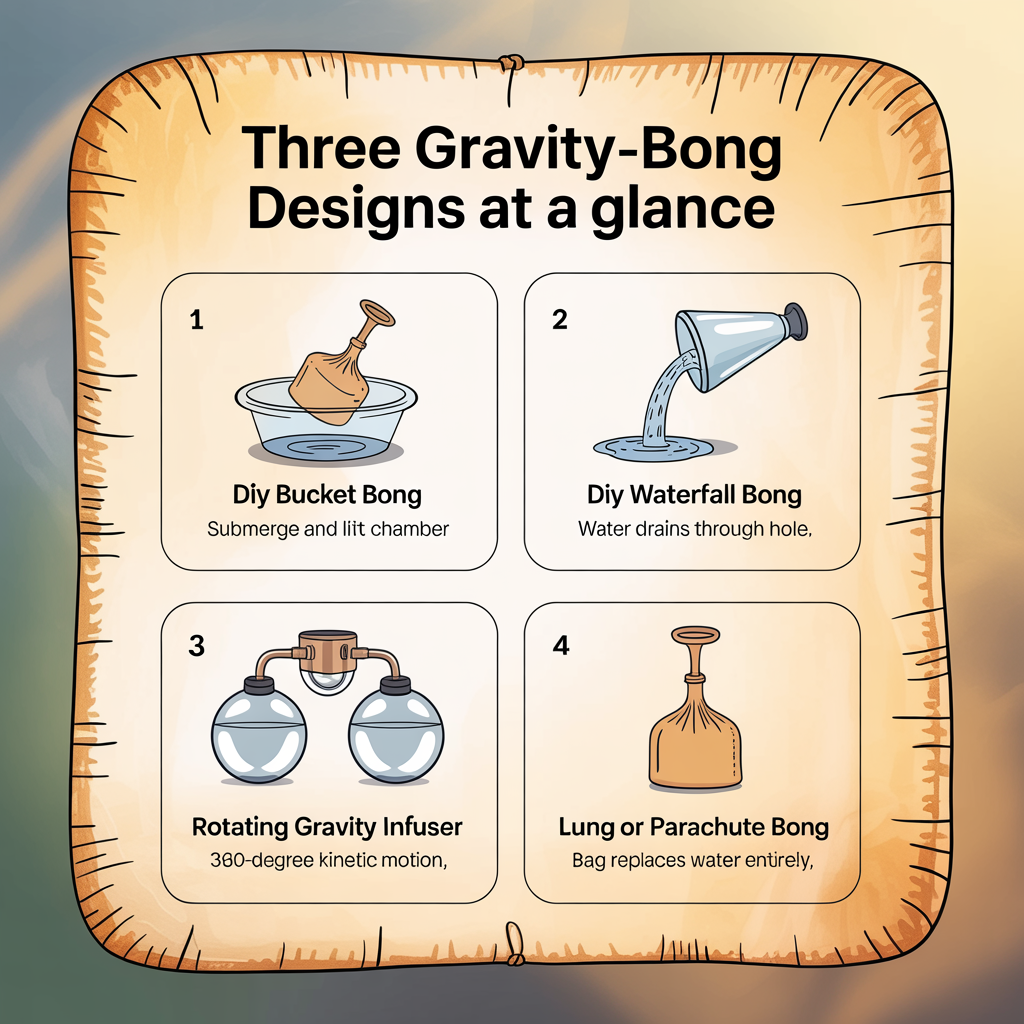
In the consumer market, gravity bongs fall into four main styles. Three use water in the fill cycle, and one uses a bag instead. Knowing which is which makes it easier to read product listings, compare prices, and pick a design that fits how you plan to use it [1] [3].
If you want to skip the DIY step entirely, the Gravity Bongs subcategory at Treehouse Lifestyle carries commercial rotating and glass designs that are ready to use out of the box Gravity Bongs.
Most beginners start with a DIY plastic build because the parts cost almost nothing. People who want a longer-lasting setup usually move up to glass or a rotating infuser once they understand how the chamber fill works.
- DIY bucket bong: a cut plastic bottle and a water-filled bucket. The chamber is submerged and lifted to fill with smoke. Low cost and large chamber volume per fill, but the plastic is not as durable as glass.
- DIY waterfall bong: a single bottle with a bowl and a small drain hole near the base. Water flows out and pulls smoke into the chamber. Simple to build, single use cycle per fill.
- Lung or parachute bag bong: a waterless variant that uses a plastic bag, milk jug, or similar container being withdrawn from the chamber to pull smoke in. Useful in places where running water is not available.
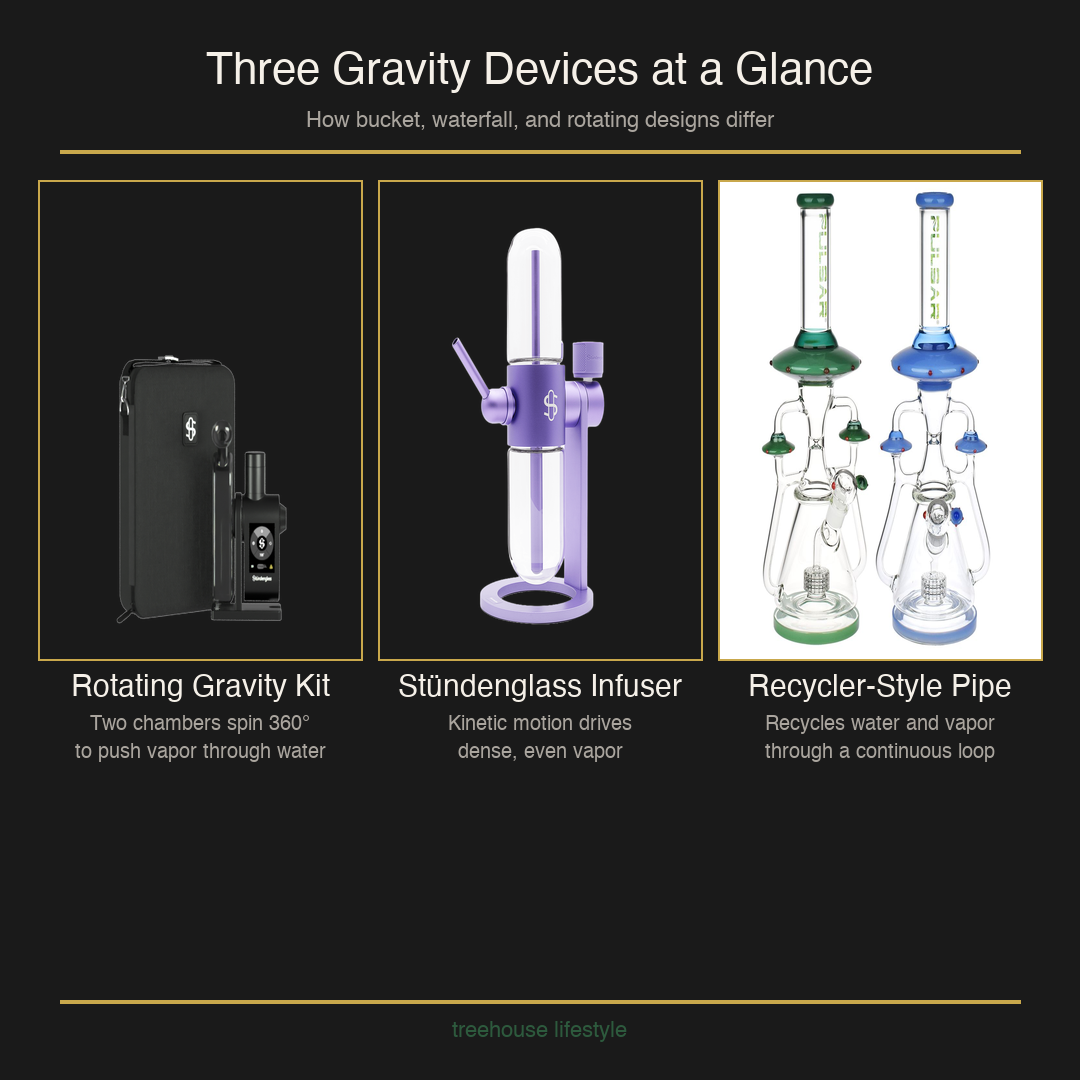
- Modern rotating gravity infuser: a glass and metal device such as the Stündenglass Gravity Infuser that uses 360-degree kinetic motion to fill and deliver smoke. Contactless delivery, premium materials, higher price.
| Type | Fill mechanism | Water or waterless | Typical build |
|---|---|---|---|
| DIY bucket bong | Submerge chamber, then lift | Water | 2-liter bottle plus a bucket |
| DIY waterfall bong | Drain water out a small hole | Water | Single bottle with a drain |
| Lung or parachute bong | Withdraw a bag from the chamber | Waterless | Bottle or jug plus a flexible bag |
| Rotating gravity infuser | Flip 180 degrees to fill and deliver | Water | Borosilicate glass and anodized aluminum |
What Materials Are Gravity Bongs Made From?
Commercial gravity bongs come in four main materials, and each one trades off durability, taste, and price. Glass and silicone are generally seen as the standard options for daily use, while plastic is associated with disposable DIY builds [3].
Glass makers also note that acrylic and other plastics are not designed for the direct heat a flame puts on a bowl, which is why commercial pieces lean on glass for the parts that touch heat [4]. If you want a flexible, dishwasher-safe alternative, silicone pieces like the SILICONE BEAKER BONG WITH REMOVABLE GLASS BOWL combine a silicone body with a removable glass bowl for easier cleaning SILICONE BEAKER BONG WITH REMOVABLE GLASS BOWL.
Anodized aluminum shows up in premium rotating infusers because the metal parts have to handle the rotation cycle and hold a seal under repeated use.
- Borosilicate glass: the standard for flavor neutrality and heat resistance. Heavier, can break if dropped, easy to clean with isopropyl alcohol and coarse salt.
- Anodized aluminum: used in premium rotating infusers for the body and base. Durable, lightweight, but does not have the same flavor profile as glass.
- Silicone: flexible, dishwasher-safe, and difficult to break. Usually paired with a glass bowl piece for the part that touches heat directly.
- Plastic (DIY): cheap, disposable, and the least durable. Manufacturers see plastic as the least flavor-neutral option for a device that is heated during use.
How Does a Gravity Bong Compare to a Regular Bong?
A regular bong and a gravity bong both use water, but they use it for different jobs. In a regular bong, the user pulls smoke through water as they draw, and the water bubbles. In a gravity bong, water is used to create a vacuum that packs smoke into the chamber under pressure, and the smoke does not bubble through the water the way a regular bong’s smoke does [1].
Because of that difference in fill mechanics, a gravity bong typically delivers a larger single burst of smoke than a standard bong of the same size. The chamber holds a full bottle’s worth of smoke, and pushing the chamber down forces all of it out in one push instead of a slow, continuous draw [6] [3].
Material use per fill also looks different. A typical bucket bong fill uses about 0.1 to 0.3 grams of material, compared with 0.4 grams to over 1 gram in a typical joint and up to about 3 grams in a large blunt [1]. To browse the wider category of water pipes side by side, the Bongs collection groups every style together Bongs.
- Water role: a regular bong uses water during a continuous draw; a gravity bong uses water to create the vacuum that fills the chamber.
- Chamber fill: a regular bong fills while the user inhales; a gravity bong fills when the chamber is lifted or water drains out.
- Hit delivery: a regular bong delivers a steady draw through water; a gravity bong delivers a single burst as the chamber is pushed back into the water.
- Material per fill: a gravity bong typically uses 0.1 to 0.3 grams per fill, a joint uses 0.4 grams to over 1 gram, and a blunt can use up to about 3 grams.
| Feature | Regular bong | Gravity bong |
|---|---|---|
| Water role | Cools and filters smoke during draw | Creates the vacuum that fills the chamber |
| How the chamber fills | Fills while the user inhales | Fills when the chamber is lifted or water drains |
| How the hit is delivered | Steady draw through water | Single burst as the chamber is pushed back down |
| Smoke contact with water | Smoke bubbles through water | Smoke sits above the water line |
| Typical material per fill | 0.4 g to over 1 g (joint); up to about 3 g (blunt) | About 0.1 to 0.3 g per fill |
Is It Legal to Buy a Gravity Bong?
Gravity bongs sit in a gray area in U.S. law. Under the Federal Drug Paraphernalia Statute, which is part of the Controlled Substances Act, it is illegal to sell, transport through the mail, transport across state lines, import, or export drug paraphernalia [1]. The statute defines paraphernalia based on how a device is marketed or used, so a seller cannot list a piece as intended for illegal substances.
In states that have legalized recreational cannabis, such as California, Colorado, and Washington, gravity bongs can be sold to adults over 21 in the same way other adult-use accessories are sold. Treehouse Lifestyle ships to legal states and offers free shipping on orders over a set dollar threshold to most U.S. addresses.
Retailers and industry writers also vary the terminology. The same device can show up as a ‘gravity bong’, a ‘gravity pipe’, or a ‘water pipe’ depending on the legal context the seller is targeting [5]. Keeping glass and silicone parts free of old residue also matters; a dedicated cleaner like Formula 420 Cleaner – A2 helps the next session start with a fresh piece Formula 420 Cleaner – A2.
- Federal rules: the Federal Drug Paraphernalia Statute restricts sale, mail transport, interstate transport, import, and export of drug paraphernalia.
- Recreational-state rules: in states with legal adult-use cannabis, gravity bongs can be sold to anyone over 21 in licensed shops.
- Terminology variation: retailers may list the same device as a ‘gravity bong’, ‘gravity pipe’, or ‘water pipe’ depending on the state they are selling into.
- Always check your local state and city rules before ordering, since cannabis laws differ a lot across the U.S.
Frequently Asked Questions
What is another name for a gravity bong?
Common alternative names include GB, grav, geeb, gibby, yoin, ghetto bong, and (in the Southern Hemisphere) Buckie. Retailers and industry writers also vary between the terms ‘gravity bong’, ‘gravity pipe’, and ‘water pipe’ depending on the legal context they are selling into.
What is the difference between a gravity bong and a lung?
A gravity bong uses water to create the vacuum that fills the chamber with smoke, while a lung (also called a parachute pipe or bread-bag bong) is the waterless version that uses a malleable plastic bag, milk jug, or similar container being withdrawn from the chamber to pull smoke in.
How does a rotating gravity infuser like the Stündenglass work?
A modern rotating gravity infuser works through 360-degree kinetic motion. Rotating the device 180 degrees creates a vacuum that fills the top globe with smoke, and rotating another 180 degrees lets water flow back in, which pushes the smoke out through the mouthpiece.
Why do people call a gravity bong a bong if it doesn’t bubble smoke through water?
Gravity bongs use water as the mechanism for creating a vacuum rather than for cooling and filtration, so some references argue they don’t strictly meet the definition of a bong. The term has stuck because the device still uses a chamber, a bowl, and water in the fill cycle.
What Should You Take Away About Gravity Bongs?
A gravity bong is a vacuum-based smoking device that uses water displacement and air pressure to fill a chamber with smoke and then push it out in a single burst. The umbrella covers three water-based designs (the DIY bucket bong, the DIY waterfall bong, and the modern rotating gravity infuser) plus a waterless variant called a lung or parachute bong that uses a bag instead of water. Each design follows the same basic idea: change the volume of trapped air to move smoke [1] [3].
Materials range from disposable plastic bottles to borosilicate glass, anodized aluminum, and silicone. Glass and silicone are the industry standards for daily use because they hold up to heat and do not flavor the hit the way plastic can [4]. If you want a ready-to-use option, commercial rotating and glass gravity bongs skip the DIY step entirely.
Before you buy, check your state’s cannabis and paraphernalia rules. Federal law restricts how paraphernalia can be sold and shipped, but legal recreational states allow licensed shops to sell gravity bongs to adults over 21. Once you have the right setup and the right cleaning routine, a gravity bong is a simple, repeatable way to learn how water shapes the hit.
Sources
- Wikipedia (Wikimedia Foundation): Gravity bong
- National Capital Poison Center (poison.org), authored by Kelly Johnson-Arbor, MD, Medical Toxicologist: Is it dangerous to smoke a joint or use a bong?
- Smoke Cartel (smoke-accessory retailer / industry guide): A Beginner’s Guide to Gravity Bong Designs
- Prism Water Pipes (borosilicate-glass manufacturer): Are Acrylic Bongs Safe?
- NWTN Home (commercial gravity-bong manufacturer; makes the Deco and Vesper glass gravity bongs): How Does a Gravity Bong Work? Understanding the Mechanics of Gravity Bongs
- Mood (smoke-accessory retailer / specialist publication): What Makes Gravity Bongs So Strong Compared to Regular Bongs