

You need a bong adapter when the joint on your water pipe does not match the bowl, banger, or downstem you want to use. Three things have to line up: size (10mm, 14mm, or 18mm), gender (male frosted outside, female frosted inside), and angle (45 degree on beakers, 90 degree on straight tubes). The right adapter fixes any of the three without swapping glass.
What Are the Standard Glass Joint Sizes on Bongs and Rigs?
Glass-on-glass water pipe joints are built around three diameters that show up on almost every bong, rig, and accessory on the shelf. The shorthand you see in product listings is 10mm, 14mm, and 18mm, and those round numbers are what you will see printed on a bowl, banger, or downstem [1].
The real measurements are a little larger than the labels. A joint sold as 14mm measures about 14.4mm, and a joint sold as 18mm measures about 18.8mm. Both names refer to the same connections, so a 14mm bowl still fits a 14mm joint on any brand of bong [1].
Each size tends to show up on a different kind of piece. 14mm is the most common in mid-sized water pipes and accessories, 18mm is the size you will see on larger beakers and many dab rigs, and 10mm is reserved for compact rigs and small travel pieces [2] [4].
- 10mm joint (about 10.4mm actual) — most common on compact rigs and small travel-sized water pipes.
- 14mm joint (about 14.4mm actual) — the most popular size across mid-sized bongs, bowls, bangers, and downstems.
- 18mm joint (about 18.8mm actual) — the standard on larger beakers, straight tubes, and many dab rigs.
- Two pieces only connect when their rounded size labels match — 14mm fits 14mm and 18mm fits 18mm, even if the actual diameters differ slightly between manufacturers.
How Do I Tell Whether a Joint Is Male or Female?
The frosted, sand-blasted surface on a glass joint is what locks the connection together, and the side it sits on tells you the gender. The frosted ring on a male joint sits on the outside of the glass, and the male piece inserts into the female opening. The frosted ring on a female joint sits on the inside of the glass, and the female opening receives the male piece [2].
If you want a wider refresher on every part of a bong or rig and how those parts connect, our parent guide on What Are the Parts of a Bong, Rig, or Pipe and How Do They Work? walks through each component in plain language. The same ground-glass rule applies to every modern glass-on-glass fitting, so once you know it you can read any piece you pick up.
The frosted side is also why size and gender have to match at the same time. Two pieces connect only when their sizes match and one side is male and the other female. A male-to-male or female-to-female pairing of the same size simply will not seat, and that is exactly what a gender-changer adapter fixes.
You can confirm the geometry on a piece you already own by running a fingertip across the joint. A male joint feels rough on the outside and smooth on the inside, and a female joint feels smooth on the outside and rough on the inside. If you want a quick visual reference for the three diameters and their frosted sides, the bridge article What Are 10mm, 14mm, and 18mm Glass Joint Sizes? has a labeled photo set. For a compact piece that shows both a male and a female joint in real use, the HEMPER Flavor Saver Bubbler uses standard ground-glass geometry on a small bubbler.
- Frosting on the outside = male joint, inserts into a female opening.
- Frosting on the inside = female joint, receives the male piece.
- Two pieces connect only when sizes match AND one side is male while the other is female.
- A fingertip check (rough side faces inward on male, inward on female) confirms the gender in seconds.
What Are the Four Types of Bong and Rig Adapters?
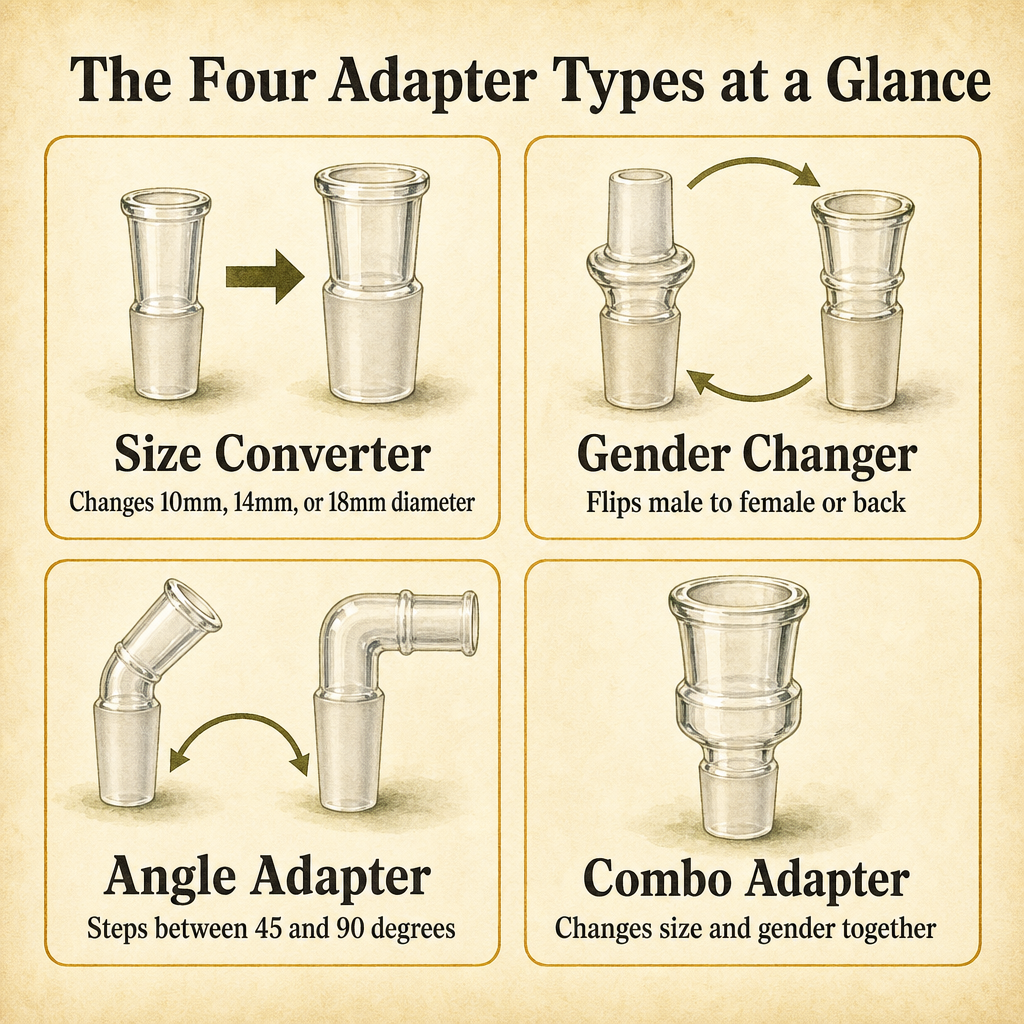
The accessory shelf can feel crowded, but every bong and rig adapter falls into one of four functional groups. Sorting by what each adapter changes makes it easier to pick the right one for the gap between your piece and your bowl or banger [3].
A size converter only changes diameter. A 14mm-to-18mm converter takes a 14mm male bowl and lets it drop into an 18mm female joint, or the reverse. Size converters are the most common adapter in the category and they leave gender alone on both sides [3] [4].
A gender changer flips male to female or vice versa without changing the diameter. You reach for a gender changer when two pieces are the same size but the wrong way around, such as a 14mm male bowl meeting a 14mm male bong joint.
An angle adapter steps between 45 degree and 90 degree joints. Beakers and angled pieces typically use 45 degree joints, while straight tubes usually use 90 degree joints, so an angle adapter saves you when the size and gender are right but the bowl is still sitting crooked [3].
A combo adapter changes more than one variable at the same time. The classic combo is a size converter and a gender changer in one piece, and that is the form factor that solves the very common 18mm-bong-with-14mm-bowl setup. If you want to see how adapters fit into a larger piece of glass, our guide on What Is a Percolator Bong and How Does It Work? shows how percolators and adapters stack together inside a beaker.
- Size converter — changes diameter only (for example 14mm to 18mm or 18mm to 14mm), keeps gender the same on both ends.
- Gender changer — flips male to female or female to male, keeps size the same.
- Angle adapter — steps between 45 degree and 90 degree joints so the bowl sits straight.
- Combo adapter — changes size and gender at the same time, and is the most common solution for an 18mm female bong paired with a 14mm bowl.
| Adapter type | What it changes | When you reach for it |
|---|---|---|
| Size converter | Diameter only | Your bowl or banger is the right gender but a different size. |
| Gender changer | Gender only | The size matches but both joints are male or both are female. |
| Angle adapter | Joint angle only | The bowl or banger is straight-fit but the bowl sits crooked. |
| Combo adapter | Size and gender together | Your 18mm bong needs to use a 14mm bowl, or the reverse. |
Do I Need an Inline or a Drop-Down Adapter?
The inline-versus-drop-down choice is about where the bowl or banger sits relative to the joint. An inline adapter keeps the bowl or banger close to the joint in a straight line, so the accessory sits flush against the glass. A drop-down adapter extends the connection away from the piece, so the bowl or banger hangs further out [3].
Inline adapters are the natural fit for flower bowls. The bowl sits close to the joint, the pull path stays short, and the whole setup feels compact. You will see inline adapters bundled with many beaker bongs because the beaker shape already gives the piece a wider base.
Drop-down adapters are the standard on dab rigs. The drop-down extension keeps the heated banger away from the glass joint, which is helpful on a rig where the joint sits very close to the user’s hand or the table. You can browse the full range of drop-down-friendly setups in our Dab Rigs category.
On a product page the visual cue is simple. An inline adapter looks like a short straight tube or a slight flare between two joints of the same orientation. A drop-down adapter looks like an extended stem with a single bend or step that moves the end joint away from the start joint.
- Inline adapter — bowl or banger sits flush against the joint, in line with the glass. Best for flower bowls on a beaker or straight tube.
- Drop-down adapter — bowl or banger sits further away from the joint, on an extended stem. Best for dab rigs that need clearance for a heated banger.
- Visual cue on a product page — inline is short and straight, drop-down has a visible stem or step between the two joints.
- Most dab rigs ship with a drop-down in the box, while most flower bongs ship with an inline.
| Adapter shape | Where the bowl sits | Typical use case |
|---|---|---|
| Inline adapter | Flush against the joint, in line with the glass | Flower bowls on beakers and straight tubes |
| Drop-down adapter | Further out on an extended stem | Dab rigs that need clearance for a heated banger |
| Visual cue on a product page | Short and straight between the two joints | Visible step or single bend between the two joints |
| What usually ships in the box | Inline with a flower bong | Drop-down with a dab rig |
Why Does Joint Angle Matter When Choosing an Adapter?
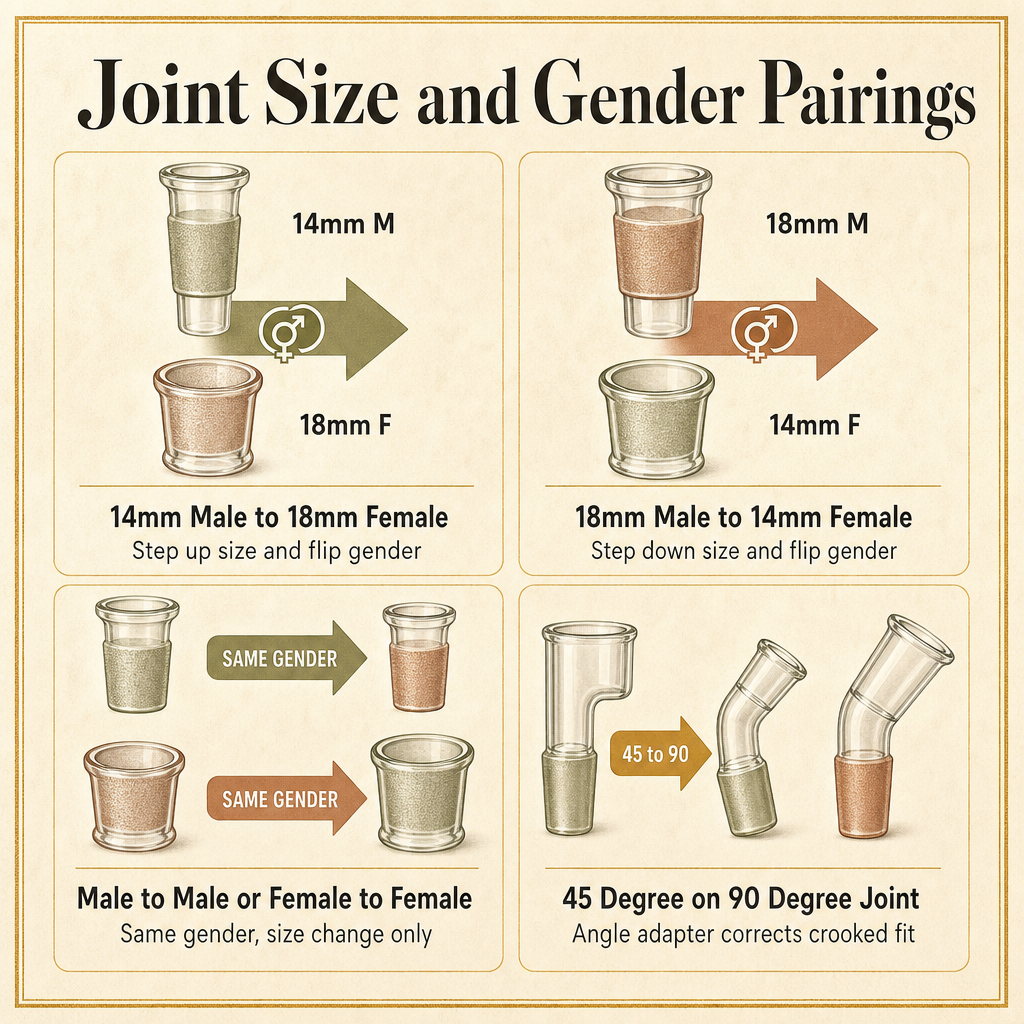
Joint angle is the geometry half of the compatibility check. The two angles that matter are 45 degree and 90 degree, and the angle you need depends on the shape of the piece the joint is built into [3].
Beaker bongs and most angled water pipes use a 45 degree joint so the bowl points up and slightly outward from the neck. Straight tubes usually use a 90 degree joint so the bowl points straight up from the side of the tube. Pairing the wrong angle to the wrong piece leaves the bowl or banger sitting crooked and can compromise the ground-glass seal [4].
If you need to replace a downstem and want to match the existing angle, our guide on How Do You Measure a Downstem Correctly Before Buying a Replacement? walks through the measuring step before you buy. The same rule applies to adapters — confirm the angle on the piece, then pick an adapter that ends in that same angle.
When in doubt, look at the joint on the piece and imagine drawing a line straight up the wall of the glass. If the joint points straight up the wall, it is 90 degree. If the joint leans away from the wall, it is 45 degree. An angle adapter corrects that final mismatch after size and gender are already correct.
- 45 degree joint — common on beaker bongs and most angled water pipes. Bowl points up and outward from the neck.
- 90 degree joint — common on straight tubes. Bowl points straight up from the side of the tube.
- Wrong angle, right size — the bowl or banger will sit crooked and the ground-glass seal may not seat fully.
- Angle adapter — bridges 45 degree and 90 degree when size and gender are already correct.
What Materials Are Adapters Made From, and Does It Matter?
Almost every adapter on the shelf is made from borosilicate glass. Borosilicate is the standard material for water pipes and most accessories because it is heat-tolerant and chemically inert, which means it stands up to warm water and the small heat load of a heated banger without flavor carry [6].
Quartz shows up on smaller heated parts such as bangers and nails rather than on full adapters. Quartz is harder and more durable than borosilicate, but it is also more expensive to work, so manufacturers reserve it for the components that see direct heat [6].
If you are using a flower bowl, a borosilicate adapter in the matching size, gender, and angle is the right pick. If you are running a heated banger on a rig, the adapter itself can stay borosilicate because the heat sits on the banger, not the adapter. Our Glass Hand Pipes category shows the range of borosilicate hand pipes and adapters that share the same material standard.
The one practical reason material matters is weight. Borosilicate adapters are light enough that they do not stress the joint they sit in, and quartz adapters are heavier and reserved for very small pieces. Picking borosilicate for an adapter keeps the joint connection stable.
- Borosilicate glass — the standard adapter material. Heat-tolerant, chemically inert, and light enough to sit in a joint without stress.
- Quartz — reserved for small heated parts like bangers and nails. Harder and more durable but more expensive, so it is rarely used for a full adapter.
- For flower bowls — a borosilicate adapter in the right size, gender, and angle is all you need.
- For heated bangers — the adapter can stay borosilicate; the heat sits on the banger rather than the adapter.
| Material | Where it shows up | Property that matters |
|---|---|---|
| Borosilicate glass | Standard adapter material on every bong and rig | Heat-tolerant, chemically inert, light enough not to stress the joint |
| Quartz | Small heated parts such as bangers and nails | Harder and more durable, but more expensive to work |
| What you want on a flower bowl adapter | Borosilicate glass | Heat tolerance at the joint, light weight, full size range |
| What you want on a heated banger setup | Borosilicate adapter, quartz banger | Heat sits on the banger, not on the adapter |
Frequently Asked Questions
What adapter do I need to make a 14mm bowl fit an 18mm bong?
You need a 14mm-female-to-18mm-male adapter or a 14mm-male-to-18mm-female adapter depending on which side is male. Confirm the gender of the bowl’s stem and the bong’s joint, then pick the size converter that flips both size and gender in one step. The stacked reduction downstem that ships with many 18mm bongs uses the same conversion pattern.
How do I tell whether a joint is male or female?
Look for the ground-glass frosted surface. If the frosting is on the outside of the joint, it is male and it inserts into a female opening. If the frosting is on the inside, it is female and it receives the male piece. Two pieces connect only when their size matches and one side is male.
Why do some 18mm bongs ship with a 14mm bowl and a downstem?
Many 18mm female bongs include a removable 18mm-male-to-14mm-female reduction downstem so the end user can fit the more common 14mm bowls and bangers. That stacked-downstem pattern is one of the most common reasons a buyer needs an adapter in the first place.
Do I need a 45 degree or 90 degree adapter for my rig?
Match the angle of your piece. Beakers and most angled water pipes use a 45 degree joint, while straight tubes usually use a 90 degree joint. A correctly sized adapter in the wrong angle leaves the bowl or banger sitting crooked and can compromise the seal.
Which Bong Adapter Should You Pick Before You Buy?
Walk through the three-part compatibility check before you buy anything. First, match size — confirm whether your piece and your bowl or banger are both 10mm, 14mm, or 18mm. Second, match gender — confirm that one side is male (frosted outside) and the other is female (frosted inside). Third, match angle — pick the 45 degree or 90 degree version that lines up with the shape of your piece.
If only one of those three things is wrong, a single-purpose adapter covers it — size converter, gender changer, or angle adapter. If two or three are wrong, a combo adapter saves you from stacking parts. For most shoppers the very common 18mm-bong-with-14mm-bowl setup is solved by a single 14mm-to-18mm combo adapter.
When you have the right adapter in hand, borosilicate is the default material for flower setups and the banger carries the heat on dab setups. Browse the parts and upgrades category, confirm the three checks above, and add the matching adapter to your cart. Treehouse Lifestyle offers free shipping on orders $150+, so a matching adapter and a replacement bowl can ride in the same order.
Sources
- Grasscity: The Complete Guide to Glass on Glass Joint Sizes and Connections
- Olivastu: Bong Bowl & Joint Size Guide for an Elevated Experience
- Primate Glass: Fit Happens: Adapters 101 for Bowls, Bangers, and Everything in Between
- Fat Ass Glass: An In-depth Guide On Rig & Bong Adapters Size & Style
- Tako Glass: Glass Joints 102: Genders, Angles & Compatibility Explained
- GRAV: What kind of glass does GRAV use?