
A bubbler is a small, handheld, usually one-piece water pipe that combines the portability of a dry hand pipe with the water filtration of a bong. Most bubblers have a fixed downstem and a fixed bowl, and they deliver the hit immediately rather than letting smoke stack in a chamber [1] [2] [3].
To choose a bubbler, decide which shape fits how you hold a pipe, which material matches your priorities (flavor, durability, or weight), which joint size you want to live with, how the piece clears (carb hole or removable bowl), and how easy it is to clean. Get those five decisions right and the rest of the bubbler aisle becomes much easier to navigate.
This guide walks through each of those decisions one at a time, in the order most first-time buyers tend to think about them.
What Is a Bubbler and How Is It Different From a Bong or a Hand Pipe?
A bubbler is a small pipe with a chamber of water built into it. You fill the chamber, light the bowl, and draw the smoke through the water on the way to your mouth. That is the whole idea [1].
What separates a bubbler from a dry hand pipe is the water. A dry spoon or chillum pipe has no chamber, so the smoke travels straight from the bowl to your mouth. A bubbler adds a small water reservoir and a fixed downstem, so the smoke passes through water before it reaches you.
What separates a bubbler from a bong is size and shape. A bong is a larger water pipe that sits on a table, usually has a removable bowl and a removable downstem, and is built so smoke can stack inside the chamber between draws. A bubbler is built to be held in one hand, is usually one piece, and is meant to be cleared in a single pull the way a hand pipe is [3].
If you want the cooling and water filtration of a bong but the portability of a hand pipe, the bubbler is the middle ground. If you have never owned a water pipe at all, this guide on What Is the Best Smoking Piece for a Beginner? can help you decide whether a bubbler, a dry pipe, or a small bong is the right first piece. The full Bubblers is organized by shape and material so you can start browsing once you know which trade-offs you care about most.
- A bubbler is small, handheld, and usually one piece with a fixed downstem and bowl.
- A dry hand pipe has no water chamber, so smoke goes straight from bowl to mouth.
- A bong is bigger, sits on a surface, and typically has a removable bowl and removable downstem.
- A bubbler delivers the hit immediately rather than letting smoke stack in a chamber.
- Bubblers trade off against bongs on portability, weight, and how easy they are to clean [2].
Which Bubbler Shape Should You Buy?
Bubblers come in a handful of recognizable shapes, and each one feels different in the hand. The shape is mostly about how the chamber sits and how the mouthpiece lines up with your grip.
The most common shape is the hammer. A hammer bubbler has a 90-degree body with a wide, flat-bottomed water chamber that sits on a table when you set it down, and a short mouthpiece that comes off at a right angle. Hammers are stable, easy to hold, and the chamber holds enough water to actually bubble the smoke [2] [5].
Sherlock bubblers sit taller. The chamber is vertical and the mouthpiece curves forward from the top, named for the pipe shape famously associated with a certain detective. Sherlocks feel more like a one-hitter in the hand but cool more smoke per hit because the chamber is taller.
Double and triple bubblers add a second or third water chamber to the body, giving the smoke more contact with water before it reaches the mouthpiece. They cost more and weigh more, but they bubble through more water on every draw.
You will also see sidecar bubblers (the mouthpiece sits off to the side of the chamber instead of on top) and Gandalf-style bubblers (a long, straight mouthpiece on a hammer or Sherlock body). The Treehouse Lifestyle guide on What Are Hand Pipes and Bubblers, and How Do They Differ? goes deeper on the family of hand pipes these shapes come from.
If you are deciding between a bubbler shape and a bong, the What Is the Difference Between a Bubbler and a Bong? comparison lays out the size, draw, and cleaning trade-offs side by side. For a concrete example of a hammer-style bubbler, the Happy Feels Kitty Glass Bubbler – 6" / 14mm F shows the proportions and weight a beginner is likely to encounter.
- Hammer: a 90-degree body with a wide, flat-bottomed water chamber; the most common shape and the easiest to set down without spilling.
- Sherlock: a vertical chamber with a curved mouthpiece; feels more like a one-hitter but cools more smoke per hit.
- Double and triple bubblers: two or three connected water chambers for extra diffusion; heavier and pricier than single-chamber pieces.
- Sidecar bubblers: the mouthpiece sits off to the side of the chamber, so the water level is easy to see at a glance.
- Gandalf bubblers: a long, straight mouthpiece attached to a hammer or Sherlock body; less common, mostly an aesthetic choice [5].
What Material Is Best for a Bubbler — Glass, Silicone, Metal, or Ceramic?
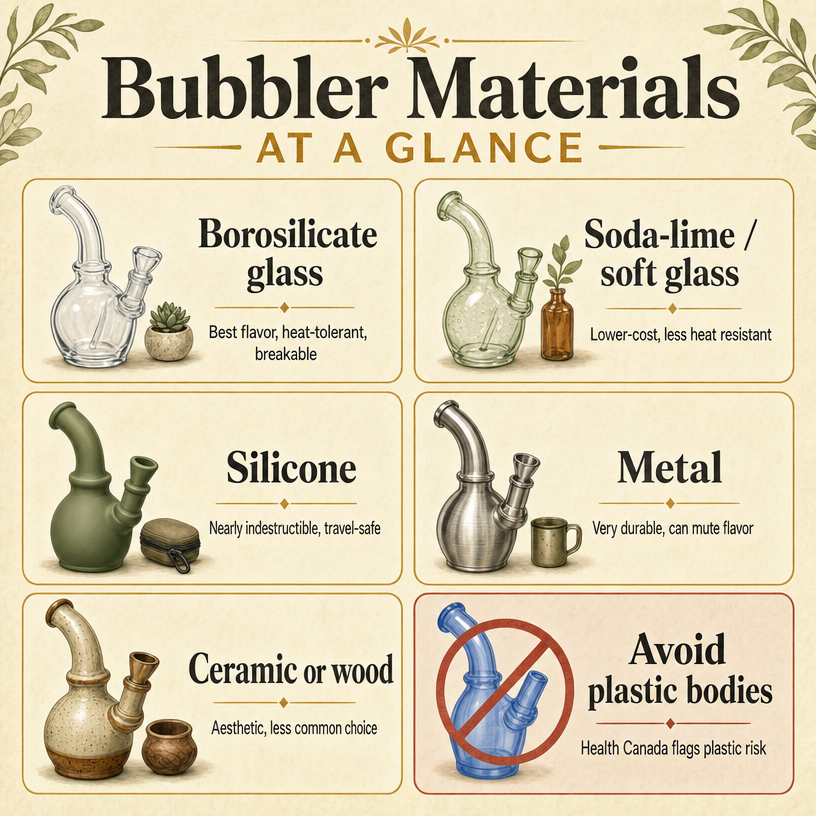
Material is the single biggest decision a bubbler buyer makes. Every other choice on the spec sheet flows from it. Borosilicate glass is the industry default because it has a melting point over 1,000 degrees Fahrenheit, resists thermal shock from repeated heating and cooling, does not off-gas when exposed to a lighter flame, and has a non-porous surface that does not hold flavor [1] [5].
Soda-lime and soft glass are lower-cost alternatives sometimes used in inexpensive pipes. They are easier to work with for colored and fumed finishes, but they do not handle rapid temperature changes as well as borosilicate.
Silicone bubblers are nearly indestructible and drop-safe, which is why they are popular for travel and for people who drop things. Most silicone bubblers still pair a silicone body with a glass downstem so the part that touches the flame is glass. The trade-off is that silicone can mute flavor more than borosilicate glass does [2] [4].
Metal bubblers are very durable and travel-friendly, but metal conducts heat to the lips and can mute flavor. Ceramic and wood bubblers show up mostly as boutique or aesthetic pieces; they insulate heat well but are less common on a typical retail shelf.
Health Canada recommends glass, ceramic, or metal inhalation accessories over plastic and notes that broken glass pieces should not be used because adhesives can be toxic when heated [11]. If you want a deeper look at how these materials compare across hand pipes generally, the Glass vs Silicone vs Wood vs Metal Pipes: Which Material Is Best? guide covers the trade-offs one material at a time.
- Borosilicate glass: the standard for glass bubblers; preserves flavor well, heat-tolerant, but breakable.
- Soda-lime and soft glass: lower-cost alternatives used in inexpensive pieces; less resistant to thermal shock.
- Silicone: nearly indestructible, drop-safe, and travel-friendly; can mute flavor more than glass.
- Metal: very durable and travel-friendly; can mute flavor and conducts heat to the lips.
- Ceramic and wood: less common, valued for aesthetics and heat insulation; usually boutique pricing.
- Plastic bodies: Health Canada flags plastic as a material to avoid in inhalation accessories.
| Material | Durability | Flavor | Best for |
|---|---|---|---|
| Borosilicate glass | Breakable; resists thermal shock [1] [5] | Non-porous, preserves taste [4] | Everyday use where flavor matters |
| Soda-lime / soft glass | Breakable; less heat-tolerant [1] | Decent, can hold residue | Budget pieces, colored finishes |
| Silicone | Nearly indestructible, drop-safe [2] | Can mute flavor [4] | Travel, clumsy hands |
| Metal | Very durable, travel-friendly [2] | Can mute flavor, conducts heat to lips [4] | Rugged use, budget travel |
| Ceramic or wood | Moderate; can chip [2] | Neutral, insulates heat well | Aesthetic or boutique pieces |
What Size Bubbler Should a Beginner Buy?
Size is a real decision on a bubbler because the piece has to fit in your hand, hold enough water to do its job, and not tip over the second you set it down.
Most first-time buyers do best with a compact hammer-style piece around five to seven inches tall. That size holds enough water for the smoke to actually bubble through, fits in one hand, and weighs under about half a pound [1] [2].
Anything smaller than four inches tends to be more of a novelty than a working bubbler — there is not enough chamber volume to bubble effectively. Anything much taller or wider than eight inches starts to feel like a small bong and stops being a hand pipe.
Think about where you will use it. A piece that lives on a shelf at home can be a little larger and heavier. A piece that travels in a bag should be smaller, lighter, and ideally silicone or wrapped. The GRAV® Wedge Bubbler – Assorted Colors is a useful reference point for a beginner-sized glass hammer.
- Length: aim for about five to seven inches for a first bubbler; shorter novelty pieces don’t hold enough water, longer pieces stop being handheld [3].
- Chamber volume: bigger chambers bubble more smoke at once, but the piece gets heavier and tips more easily.
- Weight: under about half a pound is comfortable to hold one-handed for an extended session.
- Footprint: a wide, flat base (hammer-style) sets down safely; tall, round chambers tip more easily when you put them down.
- Portability: if the piece is going in a bag, prioritize silicone, a short length, and a stable base.
What Joint Size Should You Look For on a Bubbler?
If the bubbler you are looking at has a removable bowl or downstem, it will be marked with a joint size. The two standard sizes on glass water pipes are 14mm (about 0.55 inches) and 18mm (about 0.71 inches). The size has to match the part you are sliding in [2] [3].
Joint gender matters too. A male joint sticks out and a female joint has the opening that the male slides into. You cannot put a male 14mm bowl into a female 18mm downstem, and a female 14mm bowl will not sit on a male 18mm downstem. The fix is to match size and gender.
Many mid- and high-end bubblers now ship with a removable ground-glass joint and a removable downstem, the same way a bong does. That setup is easier to deep-clean because you can take the parts apart and scrub each one separately. Budget bubblers more often have a fixed indented bowl, which works fine but is harder to clean inside.
If you do not already own glass parts to match, 14mm is the more common starting point and the more common replacement-part size. The What Are 10mm, 14mm, and 18mm Glass Joint Sizes? guide walks through how 10mm, 14mm, and 18mm parts fit together.
- 14mm joints are the more common size on smaller hand pipes and bubblers; replacement parts are easier to find.
- 18mm joints are more common on larger water pipes; bigger inside diameter, slightly less draw resistance.
- Female vs male matters: match the gender of the joint on the piece to the gender of the part you are sliding in.
- Removable ground-glass joints and downstems are easier to deep-clean than fixed indented bowls.
- Fixed indented bowls work fine day to day but limit the parts you can swap in and out.
How Does Water Filtration in a Bubbler Actually Work?
There are two physical things happening inside a bubbler every time you take a draw, and they are both simple once you see them.
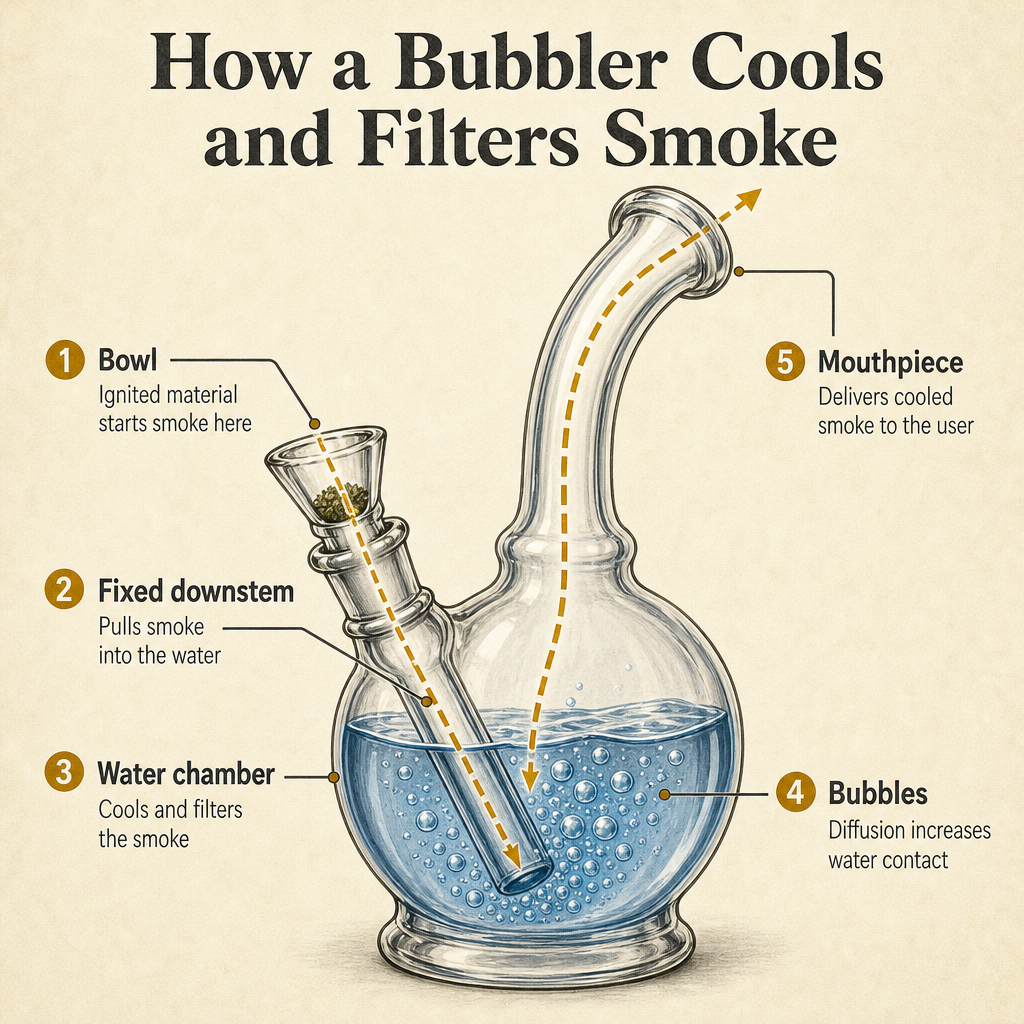
The first is convective heat transfer. The water in the chamber is cooler than the smoke coming off the lit material, so heat moves from the hot smoke into the cooler water. The smoke that reaches your mouth is at a lower temperature than the smoke that left the bowl [7] [8].
The second is diffusion. The fixed downstem on a bubbler pulls the smoke down into the water and breaks it into bubbles. Each bubble has more surface area touching the water than a solid stream would, so heavier particulates and ash tend to end up suspended in the water rather than reaching the mouthpiece [7] [10].
Smaller bubbles and longer time in the water mean more contact with the water and more cooling. That is why a percolator, an extra diffuser, or a second chamber can change the experience — each one is just a way to make the bubbles smaller or to give them more time in water.
What you actually see is the chamber filling with bubbles as you draw, the water turning cloudy with ash and resin over time, and the smoke that comes out the mouthpiece being cooler than the smoke that came off the bowl. What you do not see is the chemistry — most of the active compounds in cannabis smoke do not dissolve meaningfully in water, which is why water filtration cools and filters without removing the things you are smoking for [10].
- Convective heat transfer: water absorbs heat from the hot smoke as it passes through, lowering the temperature that reaches your mouth.
- Diffusion: the downstem breaks the smoke into small bubbles, increasing the surface area that touches the water.
- Heavier particulates and ash tend to end up in the water rather than in the smoke you inhale.
- Smaller bubbles and longer water contact time increase cooling and filtration.
- Active compounds have very low water solubility, which is why water filtration cools and filters rather than removing what you are smoking for [10].
How Do You Clear a Bubbler — Carb Hole or Removable Bowl?
Clearing a bubbler means getting the smoke out of the chamber once you have stopped lighting the bowl. There are two ways bubblers handle that, and they are not interchangeable. You should know which one a piece uses before you buy it.
Most bubblers clear through a carb hole. A carb hole is a small side hole on the chamber. You cover it with a finger while you light the bowl and draw, then you uncover it to let fresh air rush in and push the remaining smoke out through the mouthpiece. It works the same way as a spoon pipe [2].
A smaller set of bubblers clear through a removable bowl or slide, the same way a bong does. You light and draw with the bowl seated, then pull the bowl out at the end of the hit so the chamber clears through the open downstem.
Carb-hole clearing is faster and one-handed. Removable-bowl clearing takes two hands at the moment of clearing but tends to give a slightly larger chamber volume per piece. Neither is better; they are just different [3].
- Carb-hole clearing uses a small side hole; cover it while drawing, uncover it to clear.
- Removable-bowl clearing uses a slide that comes out at the end of the hit.
- Carb-hole clearing is one-handed and fast; removable-bowl clearing is two-handed at the moment of clearing.
- Removable-bowl bubblers tend to have larger water chambers because the joint takes up less space than a carb setup.
- Carb and removable-bowl setups are not interchangeable on the same piece — buy the clearing style you actually want.
| Clearing style | How it works | Hands needed | Implication for the buyer |
|---|---|---|---|
| Carb hole | Cover a side hole while drawing, uncover to clear [2] | One-handed [3] | Faster; matches spoon-pipe feel; harder to deep-clean under the fixed bowl |
| Removable bowl / slide | Pull the bowl out at the end of the hit to clear [2] | Two-handed at the moment of clearing [3] | Larger chamber per piece; removable parts make deep-cleaning easier |
How Do You Clean and Maintain a Bubbler?
A bubbler used a few times a week should be deep-cleaned at least every week or two, and the water should be refreshed every session. Resin, bacteria, and mold can build up on the inside walls, and switching the water is the cheapest part of routine care [6] [11].
The standard cleaning method uses isopropyl alcohol and coarse salt as an abrasive. The alcohol dissolves resin and the salt scrubs it loose without scratching glass. Add the water, pour in the alcohol and salt, cover the openings, and shake.
After the shake, scrub the parts that the shake cannot reach — the downstem slits, the inside of the bowl, and any curved corners — with cotton swabs or pipe cleaners. If the piece has a removable ground-glass joint and downstem, take them apart first so the alcohol and swabs can reach every surface [9].
Rinse thoroughly with warm water after cleaning. Any alcohol or salt left behind will affect the taste of the next session. Let the piece dry fully before putting it away so moisture does not sit inside the chamber.
One-piece bubblers with fixed indented bowls are harder to deep-clean because the openings are smaller and the corners are harder to reach. That is the practical argument for spending a little more upfront on a bubbler with a removable ground-glass joint.
- Empty the old water and rinse the chamber with warm water to flush loose resin.
- Add isopropyl alcohol and a tablespoon or two of coarse salt, cover the openings, and shake for about a minute.
- Use cotton swabs or pipe cleaners on the fixed downstem slits, the inside of the bowl, and any tight corners the shake cannot reach.
- Take apart removable ground-glass joints and downstems before cleaning so every surface gets scrubbed.
- Rinse thoroughly with warm water, let the piece dry fully, and only refill the chamber right before the next session.
Frequently Asked Questions
Are bubblers better than bongs?
Neither is objectively better — they trade off. A bubbler is handheld, single-piece, and easier to carry and store, while a bong is bigger, often has removable parts, and tends to deliver a cooler hit because of the larger water volume. Choose a bubbler for portability and a bong for easier cleaning.
What size bubbler is best for a beginner?
Most first-time buyers do well with a compact hammer-style glass bubbler that fits in one hand, holds enough water to actually bubble the smoke, and weighs under about half a pound. Larger chambered pieces cool more smoke at once but are heavier, more spill-prone, and harder to clean.
Do bubblers need percolators?
Most bubblers do not have separate percolators — they rely on the single fixed downstem to break smoke into bubbles through the water. A few mid- and high-end bubblers add a second or third water chamber for extra diffusion, but the basic cooling and filtering work comes from the downstem and water contact time, not from add-on percs.
How often should you clean a bubbler?
A bubbler used a few times a week should be deep-cleaned with isopropyl alcohol and coarse salt at least every week or two to prevent resin, bacteria, and mold buildup on the inside walls, and the water should be refreshed every session. Health Canada advises keeping water pipes clean and switching the water regularly.
Is silicone as good as glass for a bubbler?
Silicone bubblers are nearly indestructible, drop-safe, and travel-friendly, and many of them pair a silicone body with a glass downstem so the part that touches the flame and the smoke is still glass. The trade-off is that silicone can mute flavor more than borosilicate glass, which is non-porous and preserves taste well.
Which Bubbler Should You Actually Buy?
If you are shopping for a first bubbler, the shortest path is to make the five decisions in this order: shape (hammer is the safe default), material (borosilicate glass for flavor, silicone for travel), size (five to seven inches, under half a pound), joint (14mm if you have no other glass parts to match), and clearing style (carb hole for one-handed use, removable bowl for a larger chamber).
Once those are settled, the rest of the bubbler aisle stops looking like a wall of similar shapes and starts looking like a set of choices. The bubblers category page is organized by shape and material, and the parent guide on hand pipes covers how bubblers fit into the larger family of pieces.
If you would rather skip the browsing and pick a beginner-friendly glass piece, a compact glass hammer in the five-to-seven-inch range is a solid reference point for what a small, well-balanced piece looks like. The Treehouse Lifestyle store ships these in plain packaging with free shipping on orders $150+, so you can pick a shape and have it sent without overthinking the rest of the choice.
Sources
- GRAV: The Difference Between Bongs and Bubbler Pipes
- 420 Science: What is a Bubbler? Bubblers Vs. Pipes
- Smoke Cartel: Bubbler vs Bong: Main Differences (Size, Hits, Cleaning)
- HEMPER: Types of Hand Pipes: Your Guide to Smoother Hits
- The Cave Smoke Shop: Introduction to Pipes
- Weedmaps: How to Clean a Bubbler Step-by-Step
- Grasscity: The Science of Bong Water: Filtration, Cooling & Smoother Hits
- Thick Ass Glass: How Does A Water Bong Work | Smoke Physics
- Healthline: How Does a Bong Work? Benefits, Risks, and Myths
- Leafly: Cannabis science 101: The complex chemistry of the bong
- Health Canada: Cannabis Accessories for Inhalation: Minimizing Your Risk