

A dugout pipe is a small two-cavity case that combines a one-hitter (also called a bat, chillum, or taster) with a built-in storage compartment for ground dry herb, all in a single pocket-sized container. Open the lid, pop the one-hitter out, dip the bowl into the herb cavity to pack it, then light and draw — no need to invert the case.
What Is a Dugout Pipe and What Are Its Main Parts?
A dugout pipe is a small rectangular case, usually about the size of a cigarette pack or a little smaller, that holds two things at once: a one-hitter pipe and a small amount of ground dry herb. The one-hitter is also called a bat, a chillum, or a taster — all three names refer to the same narrow, straight pipe that fits a single draw. The word "dugout" refers to the case itself, not the pipe inside it.
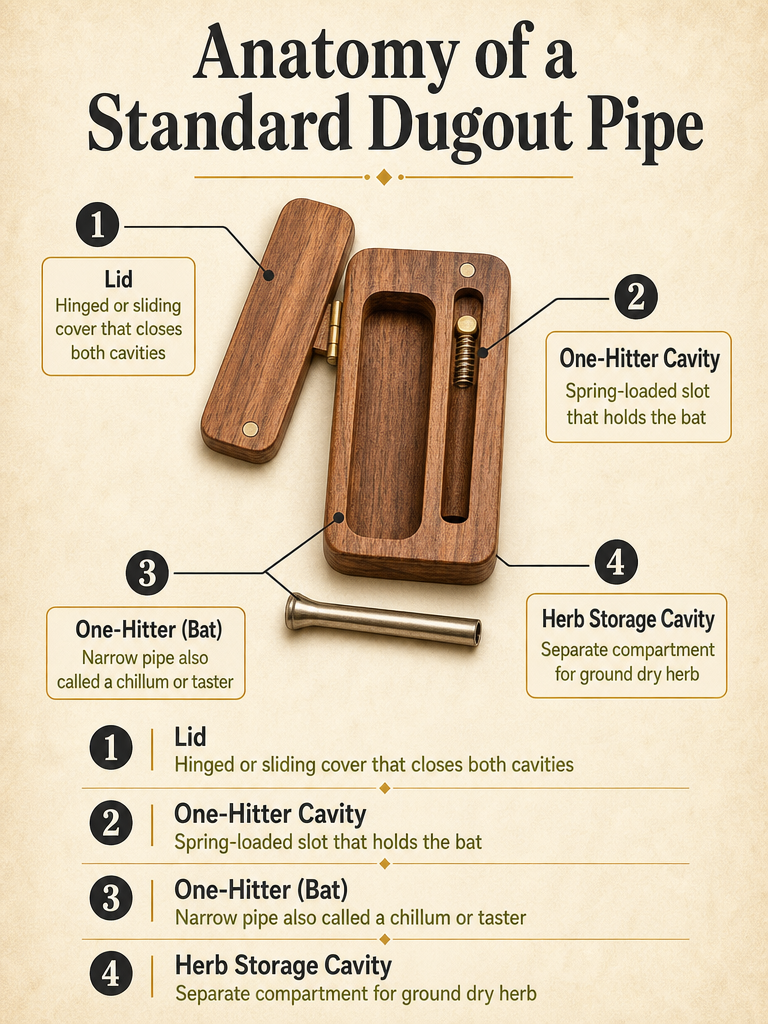
Inside the case there are two cavities cut side by side [1]. One cavity is shaped like the pipe and is spring-loaded so the one-hitter pops up when you open the lid [2]. The other cavity is shallower and wider, with a thick base, and it holds your ground herb. A hinged or sliding lid closes both cavities at the same time, which keeps the contents contained and reduces open-air odor during transport [3].
The standard operation is simple. You open the lid, lift the one-hitter out of its spring-loaded slot, dip the bowl end straight down into the herb cavity to pack it, lift it out, light the bowl end, and take a single draw. You do not need to invert the case, shake it, or scoop with anything else — the layout of the two cavities does the work. The same compact kit also doubles as your travel Storage, which is why so many first-time buyers end up keeping one in a jacket pocket or a bag.
Because the two cavities are tuned to each other, the one-hitter will only dip and lift out cleanly if it matches the slot it came with. Most dugouts ship with their own bat, and the slot is sized to that exact pipe, so mixing and matching parts from different kits rarely works well.
- Lid — a hinged or sliding cover that closes both the one-hitter cavity and the herb storage cavity at the same time.
- One-hitter cavity — a spring-loaded slot that holds the bat and pops it up when the lid opens.
- One-hitter (bat) — the narrow pipe itself, also called a chillum or a taster, sized for a single draw.
- Herb storage cavity — a separate compartment, usually shallower and wider, that holds ground dry herb with a thick base for tamping.
Where Did the Dugout Get Its Name and Its Design?
The name "dugout" has two common stories, and neither one is fully settled. The first story is the most direct: the earliest cases were made from solid blocks of wood, and the two cavities were literally carved or "dug out" of the wood by hand. The second story is more colorful — it compares the case to a baseball dugout (where players stash their gear) and the one-hitter to a bat. Both explanations appear in modern guides, and both are reasonable for a small wooden box with a sliding cover [1].
The actual design, however, is easier to pin down. US patent US4214658A, titled "Smoking system," was filed on August 21, 1978 by inventor Floyd Crow and granted on July 29, 1980 [4]. The patent describes a rectangular receptacle with two cavities: one for a pipe and one for smoking material, with a thick base in the material cavity used for tamping. The cover slides, and the pipe itself is spring-biased so it rises when the cover is opened. That is exactly the layout we now call a dugout.
Before the 1978 patent, similar two-part travel kits existed in different forms, but the Crow patent is the clearest written description of the spring-loaded, slidable-cover layout that defines the modern dugout. After the patent was granted, the design spread into the wider market and the word "dugout" stuck as the generic name for any compact case that pairs a one-hitter with an herb cavity. If you have ever wondered why the pipe inside is called a bat, that is the same baseball-dugout reference — the case is the dugout, and the one-hitter is the bat.
If you want a side-by-side read on how a different two-piece kit solved a similar problem, the What Is a Bong and How Does It Work? guide walks through how a bong and its bowl fit together — same idea of matching two parts to one another, but on a much larger scale.
- Two origin stories for the name — either the wooden case was carved ("dug out") from a solid block of wood, or the name compares the case to a baseball dugout and the one-hitter to a bat.
- The 1978 patent US4214658A, filed by inventor Floyd Crow and granted July 29, 1980, is the earliest clear written description of the modern two-cavity layout with a spring-biased pipe and a slidable cover.
- After the patent granted, the design spread into the wider market and the word "dugout" became the generic name for any compact case that pairs a one-hitter with a built-in herb cavity.
- The name "bat" for the one-hitter comes from the same baseball-dugout reference — the case is the dugout, the pipe is the bat.
What Materials Are Dugouts and One-Hitters Made From, and How Do They Compare?
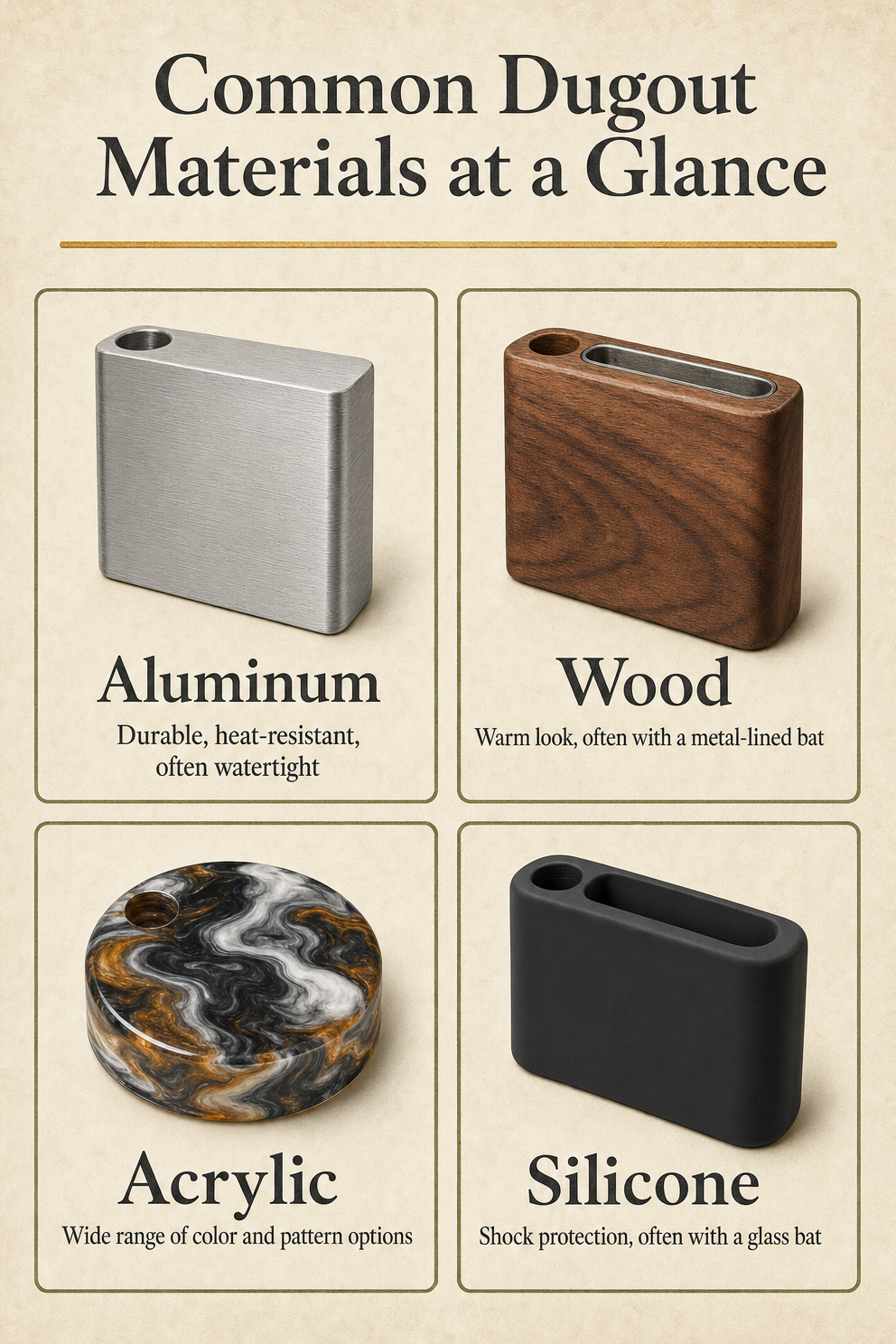
Most dugouts on the market today are made from one of four materials: aluminum, wood, acrylic, or silicone. Each material changes how the kit feels in the hand, how it handles heat, how it handles water, and how easy it is to clean. The one-hitter bat inside the case is usually metal, glass, or wood, and it is chosen to match the case.
Aluminum dugouts are durable, heat-resistant, and often watertight, which makes them a common choice for a travel kit that gets knocked around in a pocket or a bag [3]. Wood dugouts have a warm, natural look and often ship with a metal-lined bat, but wood cases are not watertight and can be damaged by long soaks or high heat. Acrylic dugouts come in the widest range of colors and patterns, which is their main draw, and they clean up easily but can scratch over time. Silicone dugouts are flexible and shock-absorbent, and they are often paired with a glass or metal bat inside [1].
The bat that sits in the spring-loaded cavity is its own decision. Metal bats are durable and heat-tolerant but can get hot to the touch during a long session. Glass bats give a clean, neutral taste and are easy to soak and scrub, but they break if dropped. Wooden bats have a classic look and stay cooler in the hand, but they need more careful cleaning and should not be soaked for long. A matched set — for example, an aluminum case with a metal bat, or a wood case with a wood bat — usually feels more consistent than a mix-and-match setup.
If you already know you want a small hand pipe for at-home use rather than travel, a one-piece option like the WIG WAG SPOON HAND PIPE is a different category entirely — a single sculpted pipe, no case, no herb cavity. For buyers comparing dugouts, the short version is: pick aluminum or silicone for travel and easy cleaning, pick wood or acrylic for looks and a quieter feel in the hand.
- Aluminum — durable, heat-resistant, and often watertight; a common pick for a travel kit that gets knocked around.
- Wood — warm, natural look, often shipped with a metal-lined bat, but the case is not watertight and should not be soaked.
- Acrylic — the widest range of color and pattern options, easy to wipe down, but it can scratch over time.
- Silicone — flexible and shock-absorbent, usually paired with a glass or metal bat inside for extra drop protection.
| Material | Heat tolerance | Water resistance | Cleaning effort |
|---|---|---|---|
| Aluminum | High | Often watertight | Low — wipe or soak |
| Wood | Low — can crack | Not watertight | Medium — wipe only |
| Acrylic | Medium | Watertight | Low — wipe or soak |
| Silicone | High | Watertight | Low — wipe or soak |
How Do You Pack and Use a Dugout Pipe Step by Step?
Using a dugout the right way is mostly about order: grind first, open the lid, pop the one-hitter, pack the bowl, light, draw. Doing those steps in that order keeps the herb from spilling and keeps the lid closing cleanly. Rushing the grind or skipping the tamp is what usually causes the lid to stick or the bowl to come up half-empty.
Start with a fine, consistent grind — coarse pieces leave air pockets in the narrow bowl and tend to spill when the lid opens. Open the dugout lid, pop the one-hitter out of its spring-loaded cavity, and hold it bowl-end-down over the herb cavity [2]. Dip the bowl straight into the herb, twist a quarter turn, and lift it out. The bowl should be evenly packed with a level surface — tamp it lightly with a finger if it is uneven [3]. Light the bowl end with a standard lighter or a hemp wick, draw slowly, and clear the bowl in a single pull.
Because the bowl is small, each session is a single draw rather than a full bowl, so the kit works best for short, on-the-go use rather than a long sit-down session. Keep the dugout flat on a table when you are opening and packing it so the herb stays in its cavity — tilting the case is what causes spills. For more on keeping a different small smoking tool lit evenly across a session, the Why Does My Joint Burn Unevenly and How Do You Fix It? guide covers how to manage an unevenly burning joint, which uses some of the same flame-handling habits.
A few neutral safety notes: keep the dugout away from open flame when the lid is closed, let the one-hitter cool before sliding it back into the spring-loaded cavity, and never pack or light the kit while you are driving. Dry herb only — the bowl is sized for ground flower and is not designed for concentrates or liquid.
- Grind the herb to a fine, consistent texture — coarse pieces leave air pockets and spill when the lid opens.
- Open the lid, pop the one-hitter out of the spring-loaded cavity, and dip the bowl straight down into the herb cavity with a quarter turn.
- Tamp the bowl lightly so the surface is level, light the bowl end, and take a single slow draw.
- Slide the one-hitter back into its cavity only after it has cooled, and keep the dugout flat on a table while packing.
What’s the Best Way to Clean a Dugout and the One-Hitter Inside It?
The standard deep-clean routine for a dugout and its one-hitter uses three things you can find at any drugstore or hardware store: isopropyl alcohol (commonly 90% or higher), coarse salt, and either pipe cleaners or cotton swabs. The routine is the same across most cited guides and works on metal, glass, and acrylic parts. Wooden cases are the one exception — they are not watertight and should not be submerged.
To deep-clean the kit, disassemble it first: take the one-hitter out of its spring-loaded cavity and empty the herb cavity. Put the one-hitter into a small sealable bag or a shot glass, add enough isopropyl alcohol to cover it, and add a teaspoon or so of coarse salt. The salt acts as a gentle scrubber. Let it soak for roughly 30 minutes to an hour — longer soaks are fine for metal and glass, but do not exceed a couple of hours on parts with glued joints [5] [6].
After the soak, shake the bag gently for a few seconds so the salt scrubs the inside of the bowl. Use a pipe cleaner or a cotton swab to push out any remaining residue from the mouthpiece end. Rinse the one-hitter under warm running water, shake it out, and set it on a paper towel to air dry. Wipe the inside of the herb cavity with a slightly damp cloth or a cotton swab dipped in a small amount of alcohol, then leave the lid open until everything is dry to the touch.
Boiling water is a separate method that works only for metal and glass one-hitters. Drop the bat into a small pot of boiling water for a few minutes, then use a pipe cleaner to push out the loosened residue. Do not boil a wooden dugout case or a wooden bat — wood can crack from the heat and the case is not watertight, so the water will damage it [3] [6]. For more on cleaning the rest of your travel kit, the How Do You Clean Smell-Proof Bags and Storage Cases Without Damaging Them? guide covers how to clean smell-proof bags and storage cases without damaging them, which is a useful companion read.
A light wipe-down after every few uses is what keeps a deep clean from being a big chore. The more often you wipe the herb cavity and the mouthpiece, the less often you need to do a full alcohol soak.
- Disassemble the kit and remove the one-hitter from its spring-loaded cavity before any cleaning.
- Soak the metal or glass bat in isopropyl alcohol (90%+) with coarse salt for 30 minutes to an hour.
- Scrub with a pipe cleaner or cotton swab, rinse under warm water, and air dry on a paper towel before reassembly.
- Wipe the herb cavity with a slightly damp cloth or a small amount of alcohol — do not submerge a wooden case.
Is a Dugout Legal to Buy, Carry, or Travel With?
Legality is the one part of this guide that varies the most by where you live and how you are traveling. A dugout is a small case plus a one-hitter pipe, and laws around possession of small smoking accessories are set at the state level in the US, not the federal level [2]. Some states classify a one-hitter or a dugout as drug paraphernalia, others classify them as ordinary tobacco-style accessories, and a few draw no real distinction at all.
Before you buy or carry one, run through a short checklist of four checkpoints: the law in the state where you live, the law in any state you are driving through, the rules of the carrier you are traveling with (airline, bus, train), and the rules of any private property you are on (rental cars, hotels, workplaces). The same compact case that is unremarkable in one state can be a problem in another, so the rule of thumb is to assume the stricter jurisdiction applies until you have confirmed the more lenient one [2].
Air travel and federal property add their own layers on top of state law, and the cited research only addresses the general state-by-state patchwork — it does not spell out every airline, federal building, or national-park rule. The practical approach is to handle the dugout as a regulated accessory, check the destination state’s rules before you travel with it, and leave it at home when you cannot confirm the local rules in advance. If you are shopping for a more discreet, battery-powered option for places where any flame or pipe is restricted, a portable vaporizer like the Dr Dabber XS e-Rig Portable Vaporizer is a different category of device entirely and follows its own set of rules.
None of this is legal advice — it is a checklist of questions to ask before you buy or carry. State laws change, city ordinances add extra rules on top, and federal property follows a different framework. When in doubt, the practical move is to check the destination state, the carrier’s policy, and any private-property rules before you pack the kit into a bag.
- Check the law in the state where you live — small smoking accessories are regulated at the state level, not the federal level.
- Check the law in any state you are driving through — a kit that is fine at home can be a problem one state over.
- Check the carrier’s policy — airlines, buses, and trains each have their own rules about smoking accessories in carry-on and checked bags.
- Check the property rules — national parks, federal buildings, rental cars, hotels, and workplaces each have their own restrictions on top of state law.
Frequently Asked Questions
What’s the difference between a dugout, a one-hitter, and a chillum?
A one-hitter (also called a bat or taster) is the small pipe itself — sized for a single draw — and a chillum is essentially the same straight, narrow pipe shape. A dugout is the two-cavity case that holds the one-hitter plus a storage compartment for ground herb. So the one-hitter or chillum is the pipe, and the dugout is the kit that carries it.
Do I need to grind my herb before packing a dugout?
Yes. The cited guides all describe grinding the herb before dipping the one-hitter bowl into the storage cavity. A fine, consistent grind packs more evenly into the narrow bowl and helps the lid close cleanly; coarser pieces tend to leave air pockets and spill when the lid is opened.
Can I soak a wooden dugout in isopropyl alcohol to clean it?
No. The research is consistent that wooden dugout cases are not watertight, and the cited guides recommend the isopropyl-alcohol-and-coarse-salt soak for the one-hitter bat and metal or glass parts only. Wooden cases should be wiped down with a slightly damp cloth or a small brush and left to air dry, not submerged.
Can boiling water damage any part of a dugout?
Boiling water works for glass and metal one-hitters, but the cited guides specifically say to avoid it on wooden dugouts, which can crack from the heat and are not watertight. The standard deep-clean routine for any material remains the isopropyl-alcohol-and-coarse-salt soak followed by a pipe-cleaner scrub.
How portable is a dugout compared to a regular hand pipe?
A dugout is more portable than a standalone hand pipe because it bundles the pipe and the herb in one pocket-sized case with a hinged or sliding lid that closes both cavities, which helps keep the contents contained and reduces open-air odor during transport. The tradeoff is that the one-hitter bowl is small, so each session is a single draw rather than a full bowl.
So Is a Dugout Pipe the Right Travel Kit for You?
A dugout is the simplest version of a two-part smoking kit: a one-hitter pipe and a small herb cavity in a single pocket-sized case, closed by a hinged or sliding lid. The 1978 Crow patent (US4214658A, granted July 29, 1980) is the design the name refers to, and modern cases come in aluminum, wood, acrylic, and silicone to match how and where you want to use one.
If you want a discreet, self-contained travel kit and you are willing to do the simple routine — grind, dip, light, draw, then a periodic alcohol-and-salt soak — a dugout is one of the simpler two-piece kits to live with. Match the material to your habits (aluminum or silicone for travel, wood or acrylic for at-home use), keep a wooden case out of long soaks, and run through the four-point legality checklist before you carry one across state lines or onto a plane.
Treehouse Lifestyle carries hand-pipe and bubbler options across every common material, with free shipping on orders $150+. If a one-piece hand pipe fits your routine better than a two-piece travel kit, browse the hand-pipe and bubbler category to compare shapes and materials side by side.
Sources
- GRAV: Dugouts 101: The Best Travel-Friendly Cannabis Too
- Vessel: Dugout One Hitter — What is It?
- The Green Dragon CBD: The Do’s & Dont’s of Dugouts! : How to Use Dugouts & More Tips & Tricks
- Google Patents (United States Patent and Trademark Office): US4214658A — Smoking system
- Best One Hitters: Maintaining Hygiene and Quality: How to Clean a One Hitter Dugout
- PRO420: How to Clean a One Hitter Pipe: Easy Methods That Actually Work