

A Gandalf pipe is a long-stemmed hand pipe, named after the wizard Gandalf from J.R.R. Tolkien’s The Lord of the Rings. [3] The same shape has been known in the European pipe-making tradition for centuries as a churchwarden pipe, so "Gandalf pipe" is the popular nickname for a long-standing design rather than a separate invention. [1]
Modern Gandalf pipes are most often made from borosilicate glass, though wood and ceramic versions are also widely sold. [3] The defining feature is a long, slender stem, usually with a gentle curve, that lets smoke travel further from the bowl to the mouthpiece before it reaches you. [2]
What exactly is a Gandalf pipe?
A Gandalf pipe is a hand pipe defined by one simple feature: a long, slender stem between the bowl and the mouthpiece. The shape traces back to a centuries-old European style called a churchwarden pipe, which is why you will see both names used for the same form. [1] When you see a glass pipe with a foot-long or longer stem and a soft curve near the mouthpiece, that is the silhouette people are pointing at when they say "Gandalf." [3]
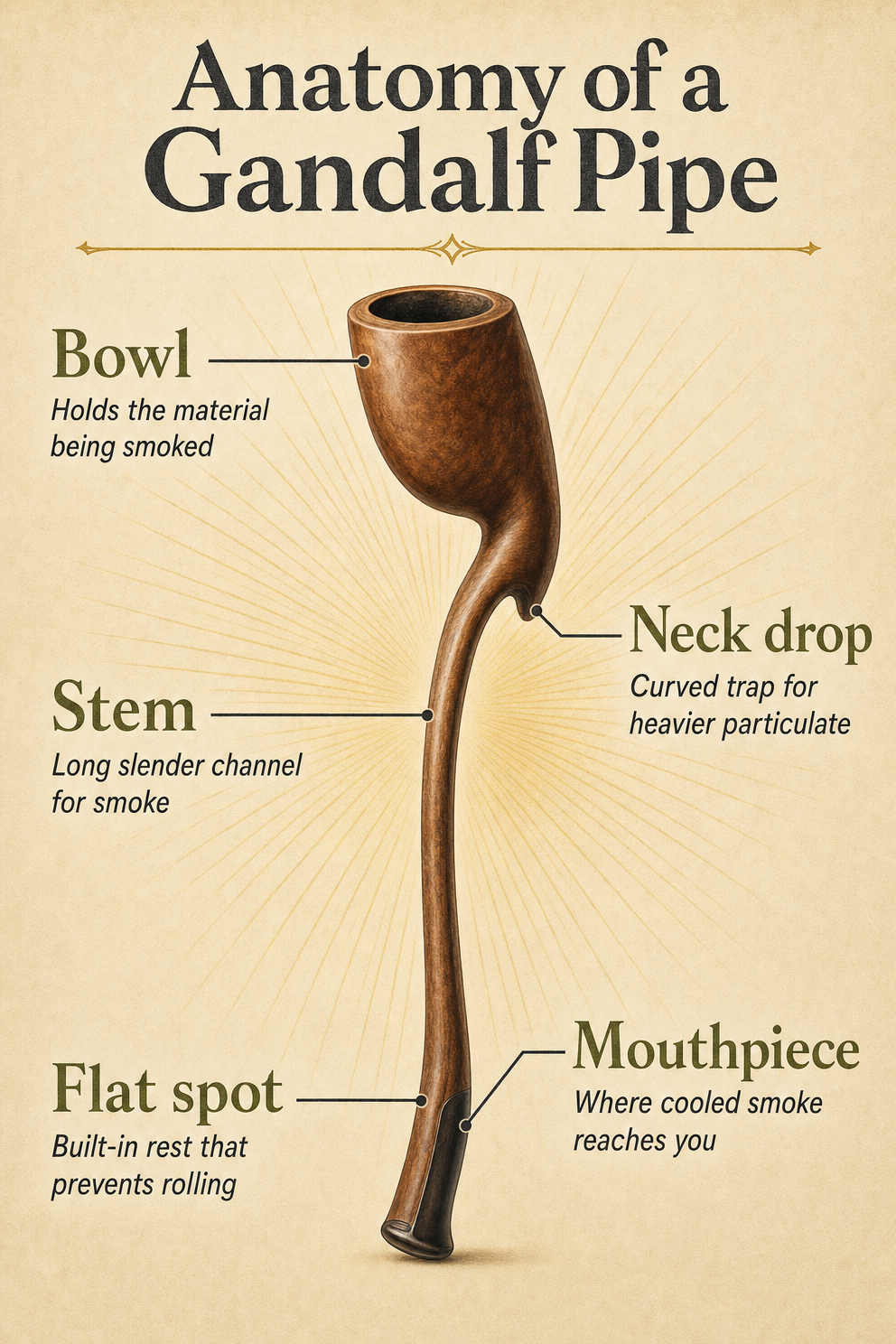
The silhouette has four main parts, and the parts matter because each one does something different in the draw. Once you know what each piece is for, it is much easier to compare pipes in a shop or to describe what you want when ordering online. [2] A simple straight-stemmed version like the ICE-CUBE GLASS HAND PIPE shows the same anatomy in its simplest form, which is a good reference point when you are starting out.
The stem is what makes the form distinctive. Everything else — bowl, neck, mouthpiece — sits at either end of that long channel. The rest of the pipe looks much like a standard hand pipe, only stretched out. [1]
- Bowl: the chamber at the end of the pipe where the material is loaded and lit. [1]
- Tenon and shank: the joint where the stem meets the bowl; this is the part under the most stress on a long-stemmed pipe. [2]
- Stem: the long, slender channel that carries smoke from the bowl toward you. [3]
- Neck drop: the gentle curve partway along the stem that forms a natural low point in the channel. [2]
- Mouthpiece: the end you draw on, where the cooled smoke finally reaches you. [1]
- Flat spot: a small flat section built into the stem so the pipe can rest on a table without rolling off. [2]
Where does the name "Gandalf pipe" come from, and why did it become so popular?
The long-stemmed pipe style is much older than the nickname that made it famous. Pipe-makers in Europe were making long-stemmed pipes as far back as the late eighteenth and early nineteenth centuries, with the churchwarden form well documented by the nineteenth century. [1] Long-stemmed designs in general had been circulating even earlier, with Oriental-influenced versions reaching Europe from the seventeenth century onward. [2]
The name "Gandalf pipe" is a popular nickname built on that older design, not a separate invention. In J.R.R. Tolkien’s The Lord of the Rings, the wizard Gandalf and the Hobbits smoke long-stemmed pipes, and that image stuck. [3] The 2001 film adaptation of The Fellowship of the Ring pushed the silhouette into mainstream culture, and demand for long-stemmed glass pipes surged almost overnight. [2]
If you have ever wondered why a glass pipe with a curved stem keeps showing up in shops next to shelves of other hand pipes, that is the reason. The shape is older than the wizard, but the wizard is what gave it the brand recognition that turned a niche churchwarden form into a global glass category. For readers who want a closer look at how a different, equally popular long-tube smoking device developed its own mainstream following, this guide to What Is a Percolator Bong and How Does It Work? walks through one well-known example.
- Seventeenth to nineteenth century: long-stemmed and Oriental-influenced pipe designs circulate through Europe, well before Tolkien writes about them. [2]
- Late 1700s to early 1800s: the churchwarden pipe form is firmly established in European pipe-making and named for the long-stemmed silhouette. [1]
- Mid-twentieth century: Tolkien’s The Lord of the Rings features Gandalf and the Hobbits smoking long-stemmed pipes, seeding the visual in popular culture. [3]
- 2001 onward: Peter Jackson’s The Fellowship of the Ring film pushes the curved churchwarden silhouette in front of a much wider audience. [2]
- Today: "Gandalf pipe" becomes the everyday nickname for the long-stemmed form in modern glass shops and online stores. [3]
Does the long stem actually do anything, or is it just for looks?
The long stem is not just decoration. It changes how the pipe actually draws in three ways, two of them welcome and one of them a real downside to keep in mind. [1]
The biggest functional effect is cooling. Because smoke has to travel further from the bowl to the mouthpiece, it has more time to lose heat along the way. [2] The second effect is the curve itself: the gentle drop in the neck forms a natural low point where heavier particulate can settle out of the smoke stream instead of traveling all the way to your mouth. [2]
The downside is mechanical. A longer stem means more leverage on the tenon — the joint that holds the stem to the bowl — which is one reason this style is more prone to breakage than shorter hand pipes. [1] That is also why many long-stemmed designs have a small built-in flat spot on the stem: it gives you a place to set it down on a table so it does not roll off the edge. [2] If you use any pipe with ash and loose debris nearby, this overview of What Are Ash Catchers and Do You Actually Need One? covers how an accessory can catch material before it gets into your main piece.
- Extra distance: the long channel gives smoke more length to travel, so it cools before it reaches you. [1]
- Cooler draw: heat from the lit material has further to travel and more time to dissipate along the stem. [2]
- Natural trap: the curve in the neck creates a low point where heavier particulate can settle. [2]
- More leverage: the extra length puts more stress on the bowl joint, so the pipe is more prone to breakage. [1]
- Built-in flat spot: a small flat section on the stem keeps the pipe from rolling when you rest it down. [2]
What materials are Gandalf pipes made from, and which should I choose?
Three materials dominate the Gandalf pipe market: glass, wood, and ceramic. Each one has a different feel in the hand, a different look on the shelf, and a different set of strengths in everyday handling. [3] For a broader look at how these materials stack up across the wider pipe category, this Glass vs Silicone vs Wood vs Metal Pipes: Which Material Is Best? is a useful side-by-side read.
Glass is the most common material in modern shops, and borosilicate glass is the most common type of glass used. Borosilicate contains boron trioxide, which gives it strong heat resistance and durability, so it handles repeated thermal stress without cracking. [4] It is also harder and more scratch-resistant than standard glass, and because it is non-porous and chemically stable, it does not leach or carry flavors between sessions. [4] That is a big reason glass is the default pick for collectors who want a piece that stays neutral in flavor and is easy to clean.
Wood and ceramic are the two most common non-glass options, and both have long histories in pipe-making. [3] Wood has a traditional, warm look and a familiar feel, while ceramic tends to be heavier and more decorative. Borosilicate glass, by contrast, gives you a clear view down the long stem so you can actually see the smoke travel through the curve.
- Borosilicate glass: heat-resistant, durable, scratch-resistant, and chemically stable, so cleaning solutions do not degrade it. [4]
- Glass as a category: clear, non-porous, and flavor-neutral, so it does not carry taste from one session to the next. [4]
- Wood: a traditional pipe-making choice with a warm look and the classic hand-pipe feel. [3]
- Ceramic: heavier, often decorative, and a common alternative when you want something that feels solid in the hand. [3]
- Glass is most common in modern Gandalf pipes, while wood and ceramic versions are widely sold in the same category. [3]
How do you clean and care for a long-stemmed pipe?
A long-stemmed pipe cleans the same way as any other hand pipe, but the length of the stem changes a few practical details. The biggest one is that a standard short pipe brush does not reach all the way down the channel. You will want a longer brush or a flexible cable cleaner that can navigate the curve. [1]
The other detail to keep in mind is the curve in the neck. That drop is the lowest point in the channel, and it is where residue naturally collects over time. A flexible cleaner that follows the bend will do a much better job in that section than a stiff straight brush. [2] For shoppers who want everything they need in one place, the Cleaning Supplies subcategory pulls together brushes, solutions, and other pipe-care basics.
Borosilicate glass is especially easy to keep clean because the surface is non-porous and chemically stable, so standard cleaning solutions do not degrade it. [4] That is one more practical reason borosilicate is the default pick for long-stemmed pipes — it can take repeated deep cleans. The flat spot built into many stems is also worth using as the resting point on a table, so the pipe does not roll onto the floor mid-cleanup. [2]
- Wipe the bowl and outside of the stem after each session while residue is still soft. [2]
- Run a long brush or flexible cable cleaner down the full length of the stem, not just the first few inches. [1]
- Work the cleaner gently through the curve in the neck, where heavier residue tends to settle. [2]
- Soak in a pipe-cleaning solution suited to the material; borosilicate glass tolerates standard solutions without degrading. [4]
- Rinse thoroughly and let the pipe dry completely before the next use. [4]
- Rest the pipe on its built-in flat spot on flat surfaces so it does not roll and fall. [2]
What is the difference between a Gandalf pipe and a churchwarden pipe?
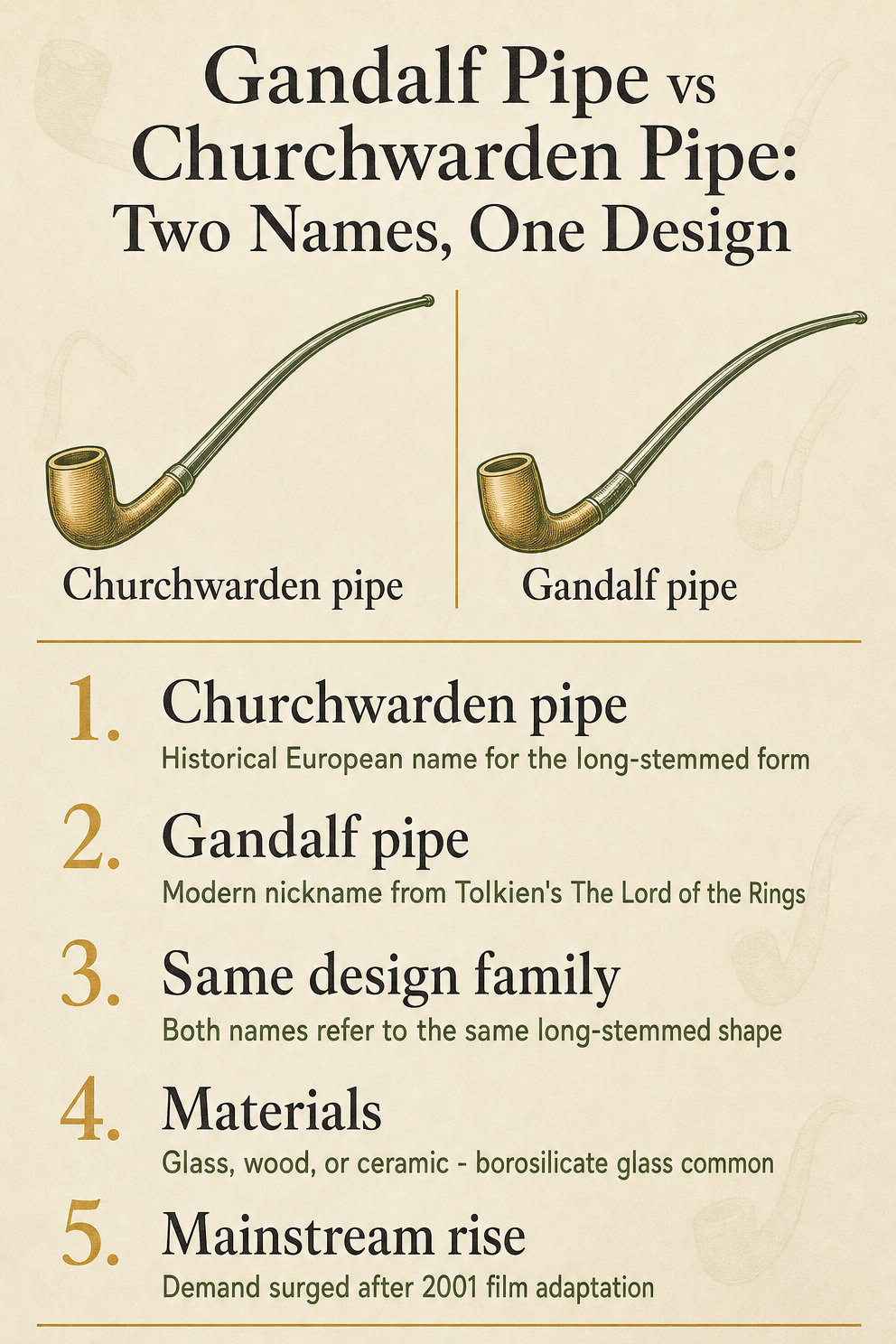
There is no real design difference between a Gandalf pipe and a churchwarden pipe — they are two names for the same long-stemmed pipe form. "Churchwarden" is the historical European name, used by pipe-makers since at least the late eighteenth and early nineteenth centuries. "Gandalf pipe" is the modern pop-culture nickname that took hold after The Lord of the Rings and especially after the 2001 film adaptation. [1]
What changed over time is the material most shoppers see. Traditional churchwarden pipes were typically made from briar or other woods, while modern Gandalf pipes are usually made from borosilicate glass, with wood and ceramic versions also widely sold. [3] The shape is the same; the material mix and the name are what shifted. [2]
In everyday language today, "churchwarden" tends to show up in traditional pipe circles and in older references, while "Gandalf pipe" is the name you will hear in most modern glass shops and online stores. [1] If you want to browse a full selection, the Gandalf Pipes subcategory on Treehouse Lifestyle pulls together long-stemmed glass pipes in one place.
- Origin: churchwarden is the historical European name from the late 1700s and early 1800s; Gandalf pipe is the modern nickname from Tolkien. [1]
- Naming: churchwarden is the traditional name; Gandalf pipe is the popular nickname built on the same design. [3]
- Design family: both names refer to the same long-stemmed pipe form, with the curve in the neck as the defining feature. [1]
- Materials: traditional churchwardens lean wood; modern Gandalf pipes lean borosilicate glass, with wood and ceramic also sold. [3]
- Where the names show up: churchwarden in older pipe circles and traditional references; Gandalf pipe in modern glass shops and online stores. [2]
Frequently Asked Questions
Are Gandalf pipes and churchwarden pipes the same thing?
They refer to the same long-stemmed pipe design. [1] "Churchwarden" is the historical European name for the long-stemmed tobacco pipe form, traced to the late eighteenth and early nineteenth centuries. [1] "Gandalf pipe" is the popular nickname that took hold after J.R.R. Tolkien’s The Lord of the Rings and especially after the 2001 film adaptation. [2]
Why is the stem on a Gandalf pipe so long?
The long stem gives smoke more distance to travel from the bowl to the mouthpiece, which lets it cool before it reaches you. [1] The characteristic curve in the neck also forms a natural trap where heavier particulate can settle. [2] The trade-off is that a longer stem puts more leverage on the bowl joint, which is why long-stemmed pipes can be more prone to breakage than shorter hand pipes. [1]
What is a Gandalf pipe usually made from?
Glass, wood, and ceramic are the three most common materials. [3] Borosilicate glass is especially popular because it contains boron trioxide, which gives it strong heat resistance, makes it harder and more scratch-resistant than standard glass, and because it is non-porous and chemically stable, it does not leach flavors or degrade in cleaning solutions. [4]
Is a Gandalf pipe practical for everyday use or just a display piece?
It is a fully functional hand pipe. [3] The long stem and curved neck do real work — cooling smoke before it reaches the mouthpiece and giving heavier particulate a place to settle. [2] The flip side is that the extra length puts more stress on the bowl joint, so it is worth handling it with a bit more care than a short hand pipe and using the built-in flat spot on the stem to keep it from rolling off a flat surface. [1]
So is a Gandalf pipe the right pick for you?
A Gandalf pipe is the right pick if you want a long-stemmed hand pipe with a centuries-old silhouette and a clear story behind the name. The shape predates Tolkien by a wide margin and was known as a churchwarden long before it became a Gandalf pipe. [1] The 2001 film adaptation simply gave the form a new mainstream nickname. [2]
Pick borosilicate glass if you want a flavor-neutral surface, easy care, and a clear view down the long stem. Pick wood or ceramic if you want a more traditional look and feel. [3] Either way, plan on handling it with a bit more care than a short hand pipe, use the built-in flat spot when you set it down, and grab a longer brush or flexible cable cleaner for the curve in the neck. [4]
Sources
- Wikipedia: Churchwarden pipe
- Chameleon Glass: The Gandalf Pipe: History, Design & Why It’s Still a Classic
- MunchMakers: Gandalf Pipes: Long-Stemmed Pipes for Cooler Smoke
- Smoke Cartel: Borosilicate Glass Colors: A Guide to Quality Pipe Materials