

A 10-14 inch bong is the most widely recommended starting point in any bong size guide because it balances cooling distance, ease of clearing, and a stable base for most first-time buyers. [2] [3] Choose a smaller bong when portability and discreet storage matter more, then step up to a taller piece when you have dedicated home space and want greater chamber capacity.
What Bong Size Categories Should You Compare?
Most shoppers compare three broad groups: mini, standard, and tall. Those labels are useful, but they are not fixed industry measurements. One guide calls pieces under 6 inches small, while others place mini bongs near or below 6-8 inches. Medium or standard pieces often fall around 8-14 inches, and large or tall pieces may begin around 15 inches. [1] [2] [3]
That overlap means the name on the product page is only a starting point. Two products called "standard" may have different heights, base widths, chamber shapes, and joint sizes. Compare the listed measurements instead of assuming every brand uses the same chart.
Start by browsing Bongs across several heights. If a compact setup is the goal, compare Mini Bongs by their actual dimensions. If the piece will stay in one home location, look at Tall Bongs and measure the intended shelf or table before ordering.
Height is only one part of total size. A short beaker with a wide base can need more shelf space than a taller straight tube. A long neck, angled mouthpiece, or side-mounted feature can also change the room needed for handling and storage.
Product photos can make scale hard to judge. Read the dimensions, note whether the stated height includes the bowl, and check the base width when that measurement is listed. Those details give a better picture of how the piece will fit into daily life.
- Mini: often under about 6-8 inches, built for compact storage and easier transport.
- Standard or medium: often about 8-14 inches, offering a middle ground for size, stability, and cooling distance.
- Large or tall: often 15 inches or more, designed mainly for home use with more chamber room.
- Measurements to verify: total height, base width, joint size, joint gender, and any removable parts.
| Common label | Approximate height | Best starting use |
|---|---|---|
| Mini | Under about 6-8 inches | Compact storage or travel |
| Standard | About 8-14 inches | General home use or a first bong |
| Tall | About 15 inches and up | Dedicated home setup |
How Does Bong Height Change Cooling and Capacity?
Height changes the distance smoke travels through the piece. A taller neck creates a longer path before it reaches the mouthpiece. A compact body creates a shorter path. Specialist sources use this difference to explain why taller pieces allow more time for smoke to cool. [1] [2]
A larger body also tends to offer more chamber volume and may hold more water. That does not mean every tall bong holds more than every short bong because shape matters too. A wide beaker and a narrow straight tube can have very different capacity even at the same height.
Larger bodies can also provide more room for complex percolators. Extra features add internal structure, so the full design matters more than height alone. For a basic explanation of the parts and airflow path, read What Is a Bong and How Does It Work?.
More size can bring tradeoffs. A larger chamber may take more effort to clear, a wide base needs more table space, and extra internal parts can add cleaning steps. A small piece is easier to move and store, but its shorter path provides less cooling distance.
The most useful comparison is therefore not "bigger is better." It is whether the height and shape support your routine. The guide Mini Bong vs Full-Size Bong: Which Size Fits Your Routine? gives a direct side-by-side look at compact and full-size options.
- Travel distance: taller pieces give smoke a longer route through the body before the mouthpiece.
- Water capacity: larger bodies generally have room for more water, though shape changes the exact amount.
- Chamber volume: a bigger chamber can hold more smoke but may take more effort to clear.
- Percolator room: larger designs may support bigger or more complex internal features.
- Cleaning and handling: added size and internal parts can require more reach, time, and care.
Should You Choose a Small, Standard, or Tall Bong?
Choose based on where the bong will live and how often it will move. A mini piece can fit into a smaller cabinet and is easier to carry. A standard piece is usually easier to leave on a table without letting it dominate the space. A tall piece works best where it has a dedicated, stable spot.
Small bongs suit people with limited storage or a routine that requires frequent packing. Their direct path and compact chamber keep the setup simple, but they provide less cooling distance than taller designs. Specialist guides commonly connect small sizes with portability and discreet storage. [2] [3]
Standard bongs suit the broadest range of buyers. Around 10-14 inches, they are large enough to offer useful cooling distance while remaining manageable for clearing, cleaning, and storage. That is why several guides place this range in the daily-driver role. [2] [3]
Tall bongs suit a home setup with enough open space. They offer more chamber capacity and a longer cooling path, and some designs use the extra room for larger percolators. They are less convenient to carry and need more careful placement because their height gives them a larger profile. [1]
Think about the full routine, not only the session. You will need to fill, empty, clean, dry, and store the piece. A size that feels impressive on a product page can become annoying if it does not fit under the faucet or inside the cabinet.
- Choose small when portability, low-profile storage, and simple handling are the top needs.
- Choose standard when you want a balanced daily-use piece with moderate height and a stable footprint.
- Choose tall when the piece will stay at home and greater capacity or percolator room matters.
- Choose by exact dimensions when cabinet height, sink clearance, or table space is limited.
| Size | Main advantage | Main tradeoff |
|---|---|---|
| Small | Easy to carry and store | Shorter cooling distance |
| Standard | Balanced for everyday use | Less compact than a mini |
| Tall | More capacity and design room | Needs dedicated space |

What Bong Size Is Best for a Beginner?
A 10-14 inch bong is the most common beginner recommendation in the supplied specialist guides. It gives useful cooling distance, a manageable chamber, and a stable base for a first-time buyer. It is a practical starting range, not a strict rule. [2] [3]
A very small piece can look easier because it is compact, yet its short path offers less cooling distance. A very tall piece may offer more capacity, but it can be harder to store, lift, clean, or clear. The middle range avoids many of those extremes.
Beginners should also favor a simple shape over extra height and many internal features. A stable beaker or straightforward tube is easier to understand and maintain than a complex design with several chambers. The best first piece is the one you can confidently handle and clean.
If you are still deciding between a bong and another format, read What Is the Best Smoking Piece for a Beginner? before narrowing the size. Your available room, cleaning habits, and need for portability may point toward a different type of piece.
- Start with the space: measure the shelf, cabinet, table, and sink area you plan to use.
- Choose a manageable height: use 10-14 inches as the default range unless your storage needs suggest smaller.
- Check the base: look for a footprint that sits securely on the intended surface.
- Keep the chamber practical: choose a volume you expect to clear without strain.
- Limit complexity: begin with features you can reach and clean without special tools.
Which Bong Joint Size Should You Check Before Buying?
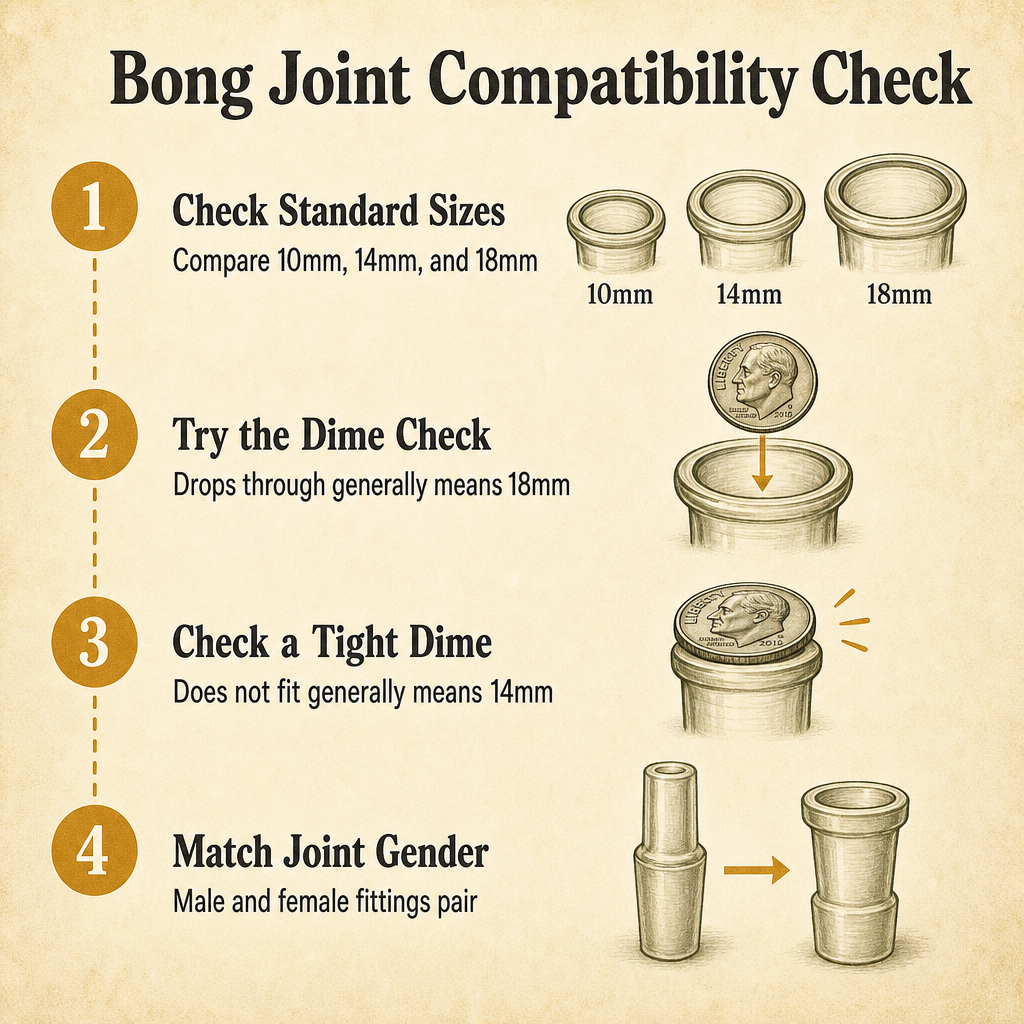
Joint size controls which bowls and other fittings will connect to the bong. The three standard sizes are 10mm, 14mm, and 18mm. The supplied guides describe 14mm as the most common modern size and an easy choice for finding compatible parts. Larger pieces are more likely to use 18mm joints, which allow more airflow. [2] [3]
Size alone is not enough. Joint gender must match too. A male bowl goes into a female joint, while a female bowl fits over a male joint. A 14mm accessory with the wrong gender will not connect correctly even though the diameter number matches. [2]
Do not assume a taller bong automatically uses 18mm or a mini always uses 10mm. Product designers choose joints based on the whole piece. Read the specifications for the exact model and compare them with every bowl, adapter, ash catcher, or downstem you plan to use.
When shopping for Accessories, write down the bong’s joint diameter and gender first. This simple note prevents most compatibility mistakes and makes replacement shopping much faster.
Also check whether the downstem is fixed or removable and whether the listed joint measurement refers to the bowl connection or another fitting. Product pages may show several numbers, so use the diagram or ask the seller when the label is unclear.
- Identify the bong’s joint diameter: 10mm, 14mm, or 18mm.
- Identify the bong’s joint gender: male or female.
- Match both details on the bowl or accessory you intend to buy.
- Check whether a downstem or adapter changes the final connection size.
- Confirm the exact product specifications before placing the order.
| Joint size | Typical use | Shopping note |
|---|---|---|
| 10mm | Compact pieces | Smaller accessory selection |
| 14mm | Many modern bongs | Most common and easy to match |
| 18mm | Often found on larger pieces | Higher airflow and larger fittings |
How Can You Measure a Bong Joint Size at Home?
The best method is to read the maker’s specification or use a ruler or caliper. If that information is missing, a US dime can provide a rough check for common 14mm and 18mm openings. This coin method is only an estimate because glass thickness, joint shape, and measurement points can vary.
According to the supplied guide, a dime that drops fully through the opening generally points to an 18mm joint. If the dime does not fit through, the opening is generally 14mm. [2]
This check does not identify joint gender, and it is not a reliable way to confirm every 10mm connection. Look at how the bowl connects: a fitting that enters the bong uses the opposite gender from the receiving joint. Then compare your result with the product listing or seller information.
A product such as the SILICONE BEAKER BONG WITH REMOVABLE GLASS BOWL can help you see how a removable bowl sits in a piece, but use its own listed measurements rather than applying its joint details to another model.
- Remove the bowl and place the bong on a stable, padded surface.
- Find the joint opening and make sure it is empty and dry.
- Hold a dime flat over the opening without forcing it into the glass.
- If the dime drops fully through, the joint generally indicates 18mm; if it does not fit, it generally indicates 14mm.
- Check joint gender and confirm the result against official specifications before buying parts.
How Do You Choose the Right Bong Size for Your Routine?
Turn the choice into a short checklist. First decide where the bong will be used and stored. Then decide how often it must move. Those two answers usually tell you whether to start with a mini, standard, or tall range.
Next, measure the real space. Include cabinet height, shelf depth, base width, faucet clearance, and the room needed to lift the bowl. Add a little extra space so the bong does not scrape a shelf or sit at the edge of a table.
Then compare chamber shape and features. A wide beaker may feel more stable but occupy more surface area. A straight tube may need less width but stand taller. A complex percolator can add interest, yet it may also add cleaning steps and make the inside harder to reach.
Finally, confirm the joint. A good size choice can still become a poor purchase when the bowl or planned accessories do not fit. Record diameter and gender, and check removable parts before checkout.
For most new buyers, this process leads back to a simple 10-14 inch model with a 14mm joint. It is a starting point, not a rule. A compact home or frequent travel may make a mini the better choice, while a fixed display space may support a taller piece.
- Choose the location: decide whether the bong will stay at home or travel.
- Measure the space: check height, depth, base width, and cleaning clearance.
- Rank portability: decide whether easy packing matters more than chamber capacity.
- Select a size range: start with mini, 10-14 inch standard, or tall based on the first three steps.
- Review shape and features: compare base stability, chamber volume, percolator room, and cleaning access.
- Confirm compatibility: match joint diameter, joint gender, bowl, and any planned accessories.
- Verify the listing: use exact measurements rather than the product’s size label alone.
Frequently Asked Questions
What is the most common beginner bong size?
Are bong size labels standardized?
Is a small bong easier to store?
What joint size is most common on modern bongs?
Can you estimate joint size with a coin?
Yes, but only roughly. A dime that drops fully through the opening generally points to 18mm, while a dime that does not fit generally points to 14mm. Confirm with product specifications before buying a fitting. [2]
Which Bong Size Is Right for You?
For most buyers asking what size bong they should get, a 10-14 inch model is the practical answer. It offers a balanced mix of cooling distance, stability, manageable clearing, and storage. Go smaller for portability and limited space, or taller for a dedicated home setup with more chamber room.
Do not let a size label make the decision for you. Measure your storage and cleaning space, compare the exact height and base width, and confirm joint size and gender. The right bong is not the biggest one; it is the one that fits your routine without creating a daily hassle.