
A recycler bong moves water through connected chambers in a repeating cycle, while a percolator bong uses an internal diffusion component such as a showerhead, tree, honeycomb, or inline perc. The two labels are not true opposites, because a recycler can also include a percolator. The best choice depends on the complete design, including its chambers, diffusion points, cleaning access, size, and accessory fit. [1] [2]
What Is the Main Difference Between a Recycler Bong and a Percolator Bong?
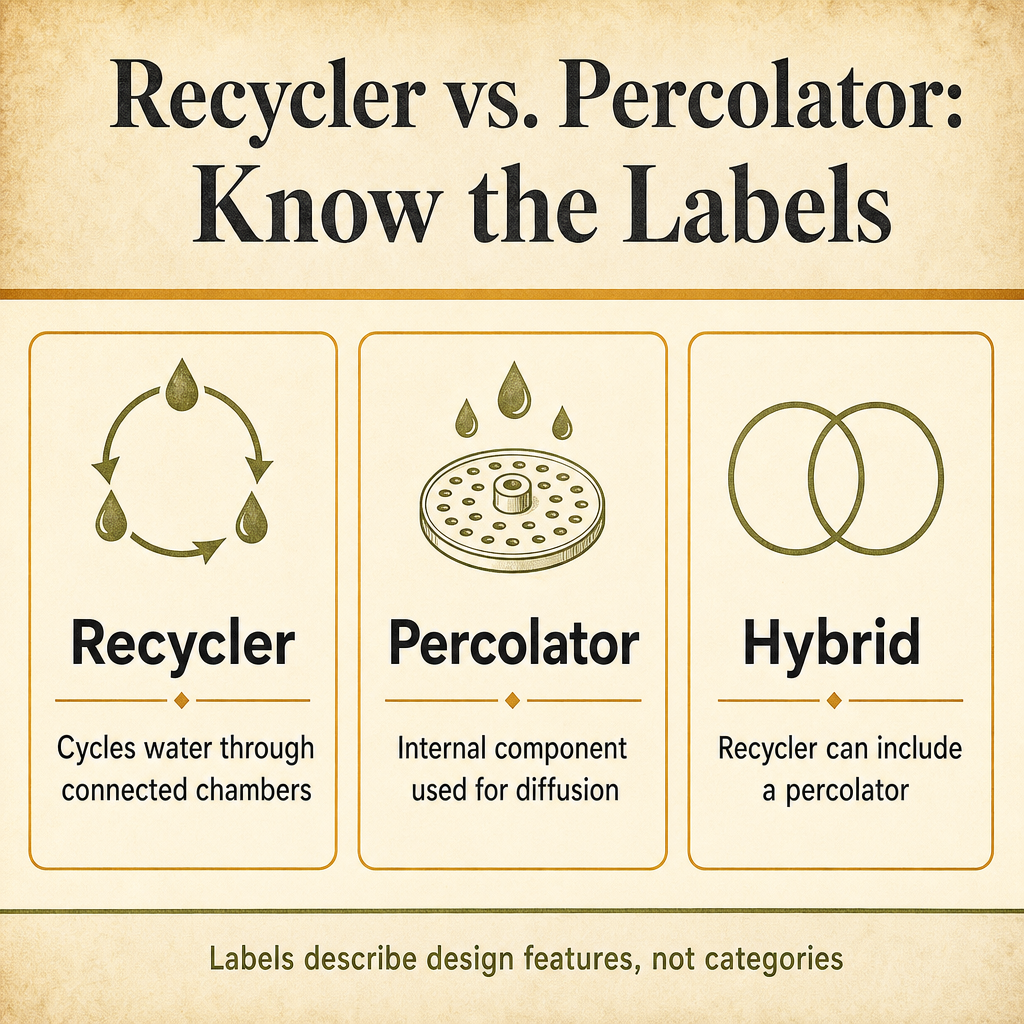
The main difference is what each label describes. "Recycler" describes the overall water-cycling layout of a bong, where water moves through two or more connected chambers in a loop. "Percolator" (often shortened to "perc") describes an internal diffusion component inside the bong, such as a showerhead, tree, honeycomb, or inline design. One label talks about how water moves, and the other talks about how a part inside the bong breaks up flow. [1] [2]
Because the labels describe different things, they are not opposites. A recycler can include a percolator, and many recycler designs pair their chamber layout with a specific perc. Calling a bong one or the other without checking the construction can lead shoppers to compare the wrong features.
Terminology is also not standard across the industry. Different sellers use the words "recycler" and "percolator" in different ways, and the same construction can be marketed under different names. Two products called "recycler" may have very different chamber shapes, return paths, and connection points. [1]
The practical takeaway is to compare full designs rather than labels. Look at how many chambers the bong has, whether water returns through a second path, and what kind of internal component is included. That tells you more than the marketing term on the product page. [2]
Treehouse Lifestyle offers a deep selection of Recycler Bongs in many chamber layouts, so it helps to browse the recycler and percolator collections side by side to see how these designs actually look once the construction is more than just a name.
- Recycler: a water-cycling layout with connected chambers and a return path for water.
- Percolator: an internal diffusion component, with examples like showerhead, tree, honeycomb, and inline designs.
- Not opposites: a recycler can include a percolator, so the two terms can describe the same bong.
- Terminology varies: different sellers may use these words differently for similar constructions.
| Label | What it describes |
|---|---|
| Recycler | The overall layout that cycles water through connected chambers. |
| Percolator | An internal component that divides flow into smaller paths. |
| Hybrid | A recycler layout that also contains one or more percolators. |
How Does Water Move Through a Recycler Bong?
Recycler designs use two or more chambers linked by tubes so water can move in a cycle rather than just sit in a single base. As the user pulls, water is pushed up through one chamber and travels into the next, then loops back through a return path. The exact path depends on the maker’s chamber shapes and tubing layout. [1]
Not every recycler uses the same geometry. Some use a stacked chamber setup, while others use side-by-side chambers connected at the base. The product name often hints at the style (for example, "twister" or "barrel recycler"), but the name alone is not a full description. Inspecting the product photos or the maker’s own description gives a clearer picture of the actual water path. [1]
The return path is what defines the cycle. Water that has been pushed up through one side has to come back down to keep the loop going, and the shape of that return path affects how the piece draws. Some designs make the return path visible with external tubing, while others hide it inside the body of the bong.
Because recyclers vary, shoppers should not expect one universal flow path. Asking how many chambers the bong uses, where the return path runs, and whether the chambers are stacked or side by side gives a much more useful comparison than just the label. [1]
Examples from our shop show how different recycler layouts can look in practice. A piece like the Pulsar Twister Glass Recycler Water Pipe | 14.5" | 14mm F shows a recycler design with external tubing and a twisting return path, which makes the cycling water easy to see. For more background on bong parts and how water moves through a basic piece, see What Is a Bong and How Does It Work?, the dedicated recycler guide What Is a Recycler Bong and How Does It Work?, and the matching percolator guide What Is a Percolator Bong and How Does It Work?.
- Chamber setup: stacked chambers, side-by-side chambers, and barrel layouts are all common recycler styles.
- Return path: the tube that brings water back into the loop can run inside or outside the body.
- Visible flow: external tubing makes water movement easy to watch, while hidden tubing keeps the shape cleaner.
- Cycle behavior: water is pushed up on one side and returned on the other, creating a repeating loop.
How Does a Percolator Bong Create Diffusion?
A percolator, or "perc," is the internal component that breaks water and incoming flow into smaller bubbles or smaller channels. Diffusion happens when flow is split into many smaller paths, which spreads it across a wider surface inside the bong. Common examples include showerhead, tree, honeycomb, and inline percs, and each one splits flow in a slightly different way. [2]
Terminology for percs varies by seller, so the name alone does not always describe the construction. A "honeycomb" perc usually means a flat disc with many small holes, but the number of discs and the hole pattern can differ. An "inline" perc usually means a horizontal tube with slits or holes, but the tube length and number of slits can differ too. [2]
Designs also differ in how they are mounted. Some percs sit low in the base, some sit higher up the neck, and some appear in multiple places in the same bong. Each placement affects the path the flow takes before reaching the mouthpiece and the surfaces that need cleaning.
When a bong has multiple perc components, the term "percolator" can describe the whole system. A recycler that contains a showerhead and an inline perc is still described as having percolation, even though the chamber layout is what makes it a recycler. That is why comparing a single perc name is rarely enough.
Looking at a real product makes the differences easier to see. The SeshGear Triple Honeycomb Perc Straight Tube Water Pipe – 15" / 14mm F / Colors Vary shows a triple honeycomb perc setup with three stacked discs, which is one way to add more diffusion points inside a tube. The honeycomb holes are small, and that is part of what defines the style.
- Showerhead perc: a single disc with slits or holes that spreads flow in many directions.
- Tree perc: vertical arms with openings, often chosen for a wider visual bubble effect.
- Honeycomb perc: a flat disc drilled with many small holes, often stacked in multiple layers.
- Inline perc: a horizontal tube with slits or holes, common in straight-tube designs.
- Terminology warning: perc names vary by seller, so inspect the actual component when comparing.
How Do Recycler and Percolator Bongs Compare in Everyday Use?
Recycler and percolator bongs can be compared by looking at five practical features: how water moves, what diffusion component is used, how many chambers the design has, how much product variety exists in each category, and whether the two features are ever combined. Most modern bongs fall somewhere on this list, and many use both features together. [1] [2]
Water movement is where the two terms first diverge. A recycler focuses on cycling water through connected chambers, while a percolator bong with a single chamber focuses on what the internal perc does. That means a recycler design is more about the overall loop, and a perc design is more about a single diffusion stage. [1]
Diffusion components vary widely. A recycler may pair its loop with a showerhead, inline, honeycomb, or tree perc, while a single-chamber perc bong may use one or more of those same components. The component itself is often the same; the difference is whether the surrounding layout cycles water or not. [2]
Chamber complexity is usually higher in recycler designs because they need a return path and at least two chambers. A perc-only design can be simpler, with one chamber and one diffusion component. Complexity is not the same as quality, but it does change cleaning and handling.
Product variety is high in both categories. Many pieces sold as percolator bongs are essentially any bong with a perc, while recycler bongs are a more specific subset with a chamber loop. Hybrid designs that include both are also widely available, and they show how the two features overlap. [1] [2]
A piece like the Human Grade Bongception Water Pipe shows how recycler and perc features can be combined in a single piece. Browsing the Percolator Bongs collection helps show how the same idea plays out across different constructions. Treehouse Lifestyle ships orders over $150 with free shipping, so shoppers can compare several options without paying extra to have them delivered.
- Water movement: recyclers cycle water through chambers, while perc bongs focus on diffusion through a component.
- Diffusion component: both designs can use showerhead, tree, honeycomb, or inline percs.
- Chamber complexity: recyclers usually need a return path and more than one chamber.
- Product variety: both categories include many sizes, materials, and perc styles.
- Hybrid builds: many bongs combine a recycler loop with one or more percs.
Which Bong Design Is Easier to Clean and Maintain?
Cleaning effort depends on the exact build, not on whether the bong is called a recycler or a percolator. Designs with more chambers, joints, diffusion points, and hard-to-reach surfaces usually need more inspection and cleaning time. That is true whether those features are inside a recycler loop or stacked inside a single-chamber perc bong. [3]
The number of removable parts matters. A bong with a fixed downstem is harder to reach inside than a bong with a removable downstem, because the downstem opening is often the widest access point. A recycler with multiple chambers can add even more internal areas to reach, especially where chambers connect through tubing.
The diffusion component itself changes cleaning. A showerhead with several slits, a tree with several arms, or a stack of honeycomb discs each create small surfaces that need careful rinsing. Smaller holes can also trap residue, so a longer soak and a softer brush are usually needed. [3]
Manufacturer guidance should always be followed, because materials, joint types, and finishes vary. Some pieces are made for warm water and mild cleaners, while others can handle more. Skipping the maker’s instructions is the most common cause of avoidable damage.
Practical inspection points include the chamber walls, each joint connection, the downstem, and the diffusion component. Walking through these areas after each cleaning helps spot residue early. That habit matters more for complex builds, which is why extra chambers and joints are often listed as a tradeoff. [3]
- Chambers: each chamber adds interior space that needs to be reached, rinsed, and dried.
- Joints: every joint is a connection point where residue can collect and a seal needs inspection.
- Diffusion points: small slits, holes, and arms need softer brushes and a longer soak.
- Removable parts: removable downstems and bowls make cleaning easier than fixed pieces.
- Maker guidance: follow the individual product maker’s instructions for water temperature and cleaners.

How Should You Choose Between a Recycler Bong and a Percolator Bong?
Choose by focusing on the complete design rather than the label. A useful buying order is to start with chamber layout, then look at the diffusion component, then check cleaning access, then consider size and storage, and finally confirm accessory compatibility. That order keeps the comparison focused on what actually changes the setup. [1] [2]
Chamber layout comes first because it shapes how water moves. A two-chamber recycler with a visible return path differs from a single-chamber beaker with one perc, even when both pieces use the same type of perc. The chamber count and the return path also affect how much space the bong needs.
The diffusion component comes next because it defines the internal construction. Compare showerhead, tree, honeycomb, and inline percs in actual product photos or descriptions. Some designs stack multiple percs, which adds more cleaning work and more internal parts to inspect.
Cleaning access is a practical filter. Look for removable downstems, removable bowls, and chambers wide enough to fit a brush. If the piece is hard to take apart or has very narrow chambers, expect a longer routine even when the rest of the design looks good. [3]
Size and storage matter because more chambers and longer return paths usually mean a larger overall piece. Measure the shelf or table where the bong will live, and check the product’s listed height and base width. A piece that looks compact in a photo can still need more room than expected.
Accessory compatibility is the last check. Joint size, joint angle, bowl size, downstem length, and gender all matter, and not every recycler or perc bong uses the same measurements. Always confirm the exact specs listed on the product page before buying a bowl, downstem, or other add-on. [1] [2] [3]
- Chamber layout: start by comparing two-chamber recyclers, single-chamber perc bongs, and hybrid builds.
- Diffusion component: check whether the perc is a showerhead, tree, honeycomb, inline, or stacked design.
- Cleaning access: prefer removable downstems and bowls when possible, and check chamber width for brushes.
- Size and storage: measure the intended shelf or table against the listed height and base width.
- Accessory fit: confirm joint size, joint angle, bowl size, and downstem length before buying add-ons.
- Label caution: recycler and percolator are not opposites, so judge the full build rather than the name.
Frequently Asked Questions
Can a recycler bong also have a percolator?
Yes. Recycler describes a design that cycles water through connected chambers, while percolator describes an internal diffusion component. A single bong can use both features, and many recycler designs pair their chamber loop with a specific perc.
Is a recycler the same thing as a percolator?
No. A recycler refers to the overall water-circulation layout. A percolator is a component inside a bong, with examples including showerhead, tree, honeycomb, and inline designs.
Which type usually takes more work to clean?
Cleaning effort depends on the exact build. Designs with more chambers, joints, diffusion points, and hard-to-reach surfaces generally require more inspection and cleaning, whether those features are part of a recycler loop or a single perc.
Do recycler and percolator bongs use the same accessories?
Not always. Compatibility depends on the individual product’s joint size, joint angle, bowl size, downstem length, and other specifications, so shoppers should verify the listed measurements before buying bowls, downstems, or other add-ons.
Should I shop by the bong label alone?
No. Seller terminology is not universal, and recycler models can include percolators. Compare the actual chambers, diffusion component, cleaning access, dimensions, and accessory specifications before deciding.
Which Bong Should You Actually Buy?
Recycler and percolator bongs each describe a different part of a bong’s construction, so the better question is which full design fits the buyer. Start with the chamber layout and return path, then look at the diffusion component, then check cleaning access, size, and accessory fit. That order turns a confusing label comparison into a clear checklist.
A recycler makes sense when the chamber loop and water cycling are part of why the piece is appealing, and when there is room for a more complex build. A perc bong makes sense when the focus is on the internal diffusion component and a simpler chamber layout. A hybrid build that includes both is also a valid choice, because many modern pieces pair the two features on purpose.
Always read the maker’s specs, confirm joint size and angle, and check the cleaning instructions before buying. Treehouse Lifestyle offers free shipping on orders $150+, which makes it easier to compare a recycler, a perc bong, and a hybrid piece side by side without paying extra to have them delivered.
Sources
- Lookah: What Is a Recycler Bong?
- Grasscity: What Is a Percolator Bong?
- Grasscity: How to Clean a Bong
- Centers for Disease Control and Prevention: Cannabis and Your Health