
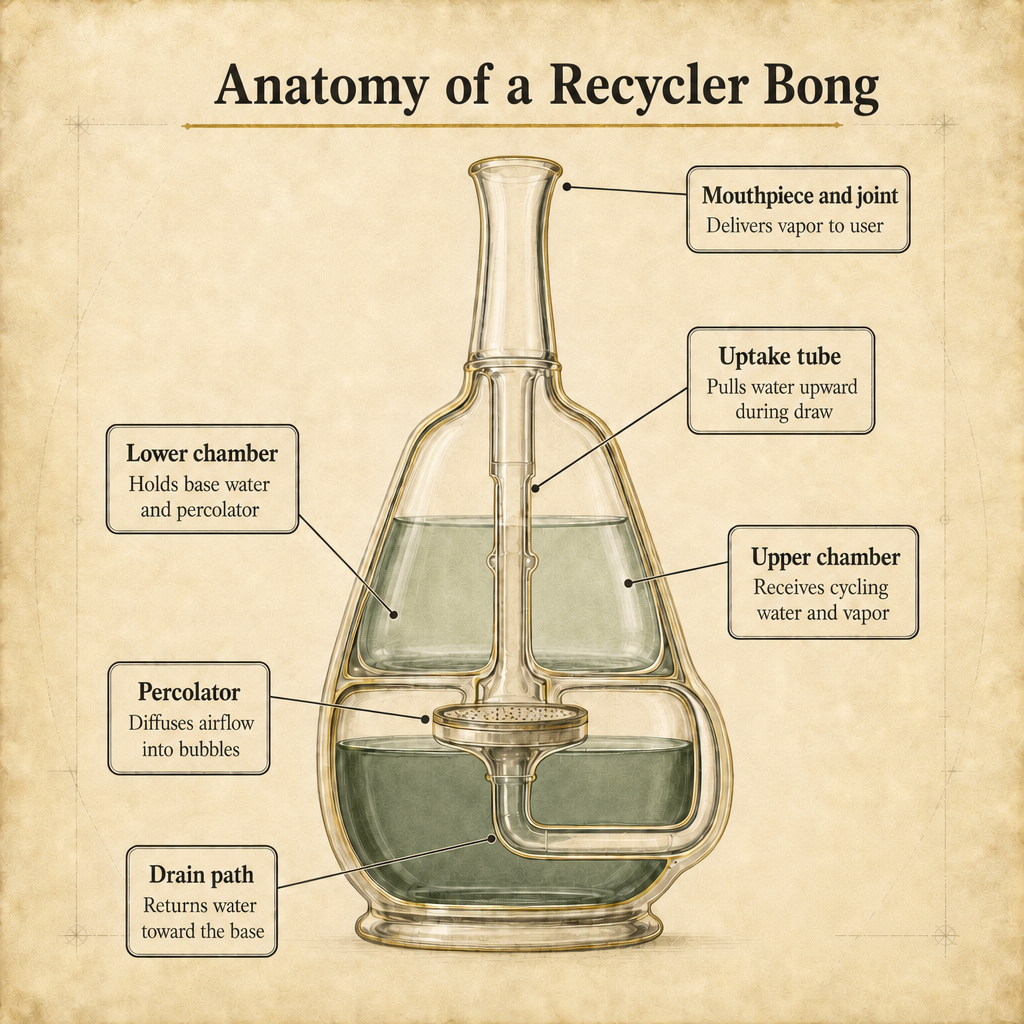
A recycler bong is a multi-chamber water pipe that keeps water moving through a connected loop during a draw. Material first enters a submerged percolator in the lower chamber, airflow pulls water and smoke or vapor up the uptake into a second chamber, and water drains back toward the base. That continuous circulation is the defining feature, and it is what separates a recycler from a standard single-chamber bong. [1] [2]
How Does a Recycler Bong Move Water Through Its Chambers?
A recycler works as a connected system. The lower chamber, percolator, uptake path, upper chamber, and drain all have to work together, and a draw is what keeps them moving. Water does not rise on its own; airflow carries it through the route built into the glass.
The cycle starts near the joint and lower chamber. Smoke or vapor enters the water and passes through a percolator. The percolator has small openings that split the incoming flow into bubbles, and it has to sit under the water line, or it cannot bubble as intended. For a closer look at what the perc itself does, see What Is a Percolator Bong and How Does It Work?. [1]
Next, the draw pulls water and the smoke or vapor into one or more uptake tubes. Those tubes rise toward an upper chamber, and their width, height, curves, and entry points shape how easily the piece cycles. A narrow tube may need a different draw than a broader one, so two recyclers can behave differently even with similar water volumes.
In the upper chamber, water changes direction and starts to separate from the moving air. Gravity then sends the water back toward the base through a drain path. As long as the draw continues and the passages stay open, new water rises while returning water falls, and that is the visible looping action recycler glass is known for. [2] [3]
Circulation is the defining feature, not a claim about health or quality. The longer glass route and the moving water change how the device functions, but they do not make inhaled smoke harmless. A recycler is still a water pipe, and its behavior depends on the geometry, the fill level, and the draw.
- First, incoming smoke or vapor reaches the submerged percolator in the lower chamber.
- Second, airflow carries water and smoke or vapor upward through the uptake tube.
- Third, the moving mixture enters the upper chamber and changes direction.
- Fourth, water returns through the drain while the draw keeps the loop going.
What Parts Make Up a Recycler Bong?
Recycler glass can look like a puzzle, but most pieces share the same core parts. The shape and placement change from piece to piece, yet every part has a clear job. Knowing the names makes product descriptions easier to read and helps narrow down where a clog or fill problem is happening.
The lower chamber is the base reservoir. It holds the starting water and usually houses the percolator. A wide, flat foot helps on tall or top-heavy designs, since the upper chamber and external tubing can shift weight away from the center.
The joint is the fitted opening that holds a bowl, banger, or other compatible component. Joint diameter, joint angle, and male or female fit all have to match the part you plan to use. The parent guide What Is a Bong and How Does It Work? covers the basic water-pipe layout, and What Are the Names of All the Parts on a Bong? runs through the broader vocabulary used in product listings.
The percolator sits in or near the lower chamber and pushes the incoming flow through small openings. The uptake carries water upward, the upper chamber receives that moving water, and the drain returns it to the base. Some pieces use several uptake or drain paths, but the same basic loop still applies. [1] [3]
The neck and mouthpiece finish the air path. Their height and position help keep cycling water below the opening when the fill level is right. On compact pieces, the upper chamber and neck sit close together, which leaves less room for fill error than on a taller model.
- Lower chamber: holds the base water and supports the cycling system.
- Percolator: sends incoming flow through submerged openings.
- Uptake tube: carries water toward the upper chamber during a draw.
- Upper chamber: receives the rising water and changes its direction.
- Drain path: returns water toward the lower chamber to keep the loop going.
- Joint, neck, and mouthpiece: connect the installed component to the final air path.
How Is a Recycler Different From a Standard Bong or Dab Rig?
A standard bong often has one main water chamber. Air moves through the downstem or percolator, passes through the water once, and travels up the neck. A recycler adds a separate rising path and a return path, so water can travel around the piece while the draw continues.
The word recycler describes the water route, while bong and dab rig usually describe the intended setup. A bong is generally fitted with a bowl for flower. A dab rig is generally fitted with a nail or banger for concentrates. Recycler layouts are especially common in dab rigs, but a recycler can be sold with a flower bowl, and shops sometimes use recycler bong and recycler rig as overlapping labels. [1] [5]
That is why the title on a product page is not enough. Check the included component, the joint size and angle, the recommended use, and any limits stated by the maker. What Are the Different Types of Dab Rigs? gives a wider look at concentrate-focused layouts so a recycler can be compared against them.
A recycler also tends to have a longer, more complex internal route than a basic pipe. The added glass supports visible water movement and can help keep water away from the mouthpiece when everything is tuned correctly, but it also adds narrow passages and extra surfaces that take longer to rinse. [2]
None of these labels guarantee good function. A basic bong with balanced airflow may be easier to use than a poorly designed recycler. Build quality, proportions, joint fit, and cleaning access matter more than how complicated the glass looks.
- Standard bong: usually one main chamber and a mostly one-way water path.
- Recycler: connected uptake and drain paths that let water circulate during a draw.
- Dab rig: identified mainly by its concentrate setup, often a nail or banger, not by whether it recycles.
- Recycler bong or rig: may be intended for flower or concentrates, so the included component and specifications have to be checked.
| Design | Typical water route | Common setup |
|---|---|---|
| Standard bong | Through one main chamber and up the neck | Bowl for flower |
| Recycler | Up an uptake and back through a drain | Bowl or banger, depending on the model |
| Dab rig | Simple or recycling route | Nail or banger for concentrates |
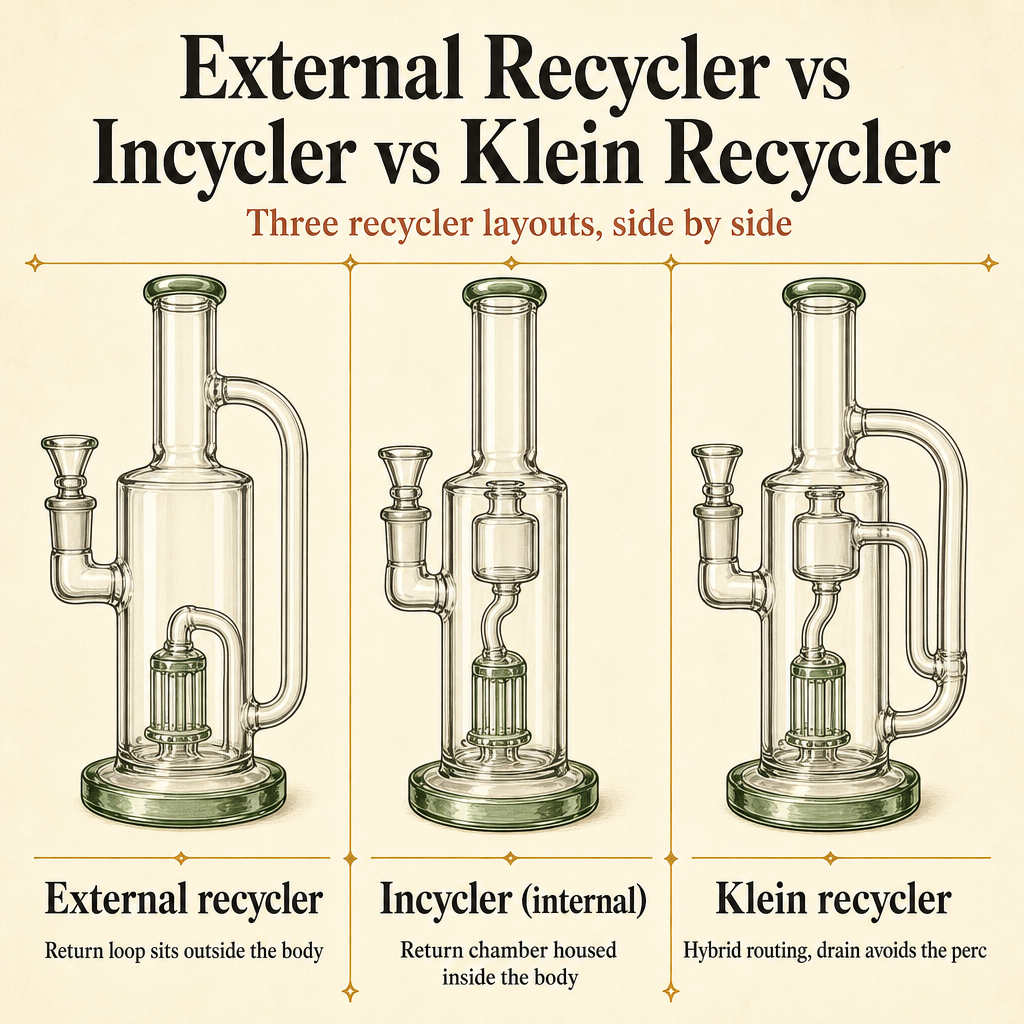
What Is the Difference Between an External Recycler, an Incycler, and a Klein Recycler?
Recycler names are useful, but they are not fully standardized across glassmakers and retailers. The easier move is to look at the actual water route instead of relying on a label. The simplest question to ask is whether the return chamber and drain are outside the main body, inside it, or split between both areas.
An external, or classic, recycler shows much of its loop outside the main body. Uptake tubes rise along the exterior into a second chamber, and a visible drain carries water back down. The exposed route makes the recycling action easy to watch, but the extra glass arms can take more careful handling.
An incycler means internal recycler. Its return chamber or drain is housed inside the main body instead of hanging fully outside, which can create a compact silhouette with fewer exposed arms. Internal construction can also make some passages harder to inspect or reach during cleaning. [2] [4]
A Klein recycler combines internal and external routing. In a common Klein-style layout, an exterior uptake feeds an internal return path, and the drain routes water back without sending it straight through the percolator. That setup creates the nested loop the name is known for. [3] [4]
Real products often borrow features from more than one layout. If a listing uses several terms, trace the path in the photos: find the lower chamber, follow the rising tube, locate the upper chamber, and then follow the drain back to the base. That route tells you more than decorative glass details do.
- External recycler: much of the uptake and return loop sits outside the main body.
- Incycler: the second chamber or drain path is housed within the body.
- Klein recycler: combines exterior and interior routing, often with a drain that avoids the percolator.
- Hybrid design: mixes these features, so the visible water path matters more than the marketing name.
What Practical Benefits and Trade-Offs Do Recycler Designs Have?
The clearest recycler benefit is active water movement. The loop gives the water a longer route through the glass and creates a visible cycling effect. When the geometry and fill level work together, the return path can also help keep water away from the mouthpiece. These are mechanical design traits, not proof that inhalation is safe. [1] [2]
A recycler can be satisfying to operate because its function is easy to see. Visible cycling also gives useful feedback. If the water rises, separates, and returns in a steady pattern, the main paths are probably open. If it stalls or suddenly floods the upper chamber, that is the signal to check the fill level and the draw.
The main cost is complexity. Extra chambers, bends, welds, and narrow tubes add more places where residue can collect. They can also make the piece more fragile and harder to dry. A compact incycler has fewer exposed arms, but its internal passages can still be awkward to reach.
A recycler may also need more careful setup than a basic beaker. Beaker Bongs have a simpler shape that can be easier to fill and rinse, while a recycler has to balance its percolator, uptake, upper chamber, and drain. Neither layout is automatically better; the better choice is the one that fits the use case, storage space, cleaning habits, and budget.
Before buying, look for a stable base, even glass connections, a compatible joint, usable airflow, and a water loop that cycles without an extreme draw. A complicated design that barely cycles is not a bargain. Clear product photos or a short function video can reveal more than a long list of decorative features. [4]
- Benefit: moving water follows an extended route through connected chambers.
- Benefit: visible cycling makes the piece’s function easier to observe.
- Benefit: balanced routing can reduce splash reaching the mouthpiece.
- Trade-off: narrow tubes and extra chambers require more cleaning effort.
- Trade-off: exposed glass arms and extra welds may need more careful handling.
- Trade-off: water level and draw speed may take time to dial in.
How Much Water Should Go in a Recycler Bong?
There is no single fill line that works for every recycler. The right amount depends on the percolator height, the chamber shape, the tube width, and the drain position. Start with just enough water to cover the percolator openings, then adjust in small amounts instead of filling the upper chamber by guesswork. [1]
A dry test draw is the simplest setup method. Do not load material or heat anything while testing. Draw gently and watch the lower chamber, uptake, upper chamber, and drain. The goal is for the percolator to bubble and for the water to complete the loop without reaching the mouthpiece.
If the percolator openings are not covered, add a small amount of water. If water surges too high, remove a small amount. The working range can be narrow on a compact recycler, so teaspoons can matter. Once it cycles, take a few gentle draws, because the first pull may only be priming the pathways.
Percolator Bongs also need submerged perc openings, but a recycler adds the return loop to the equation. Water has to bubble, and it also has to rise and drain in a stable pattern. Marking the working level with a removable note or taking a quick photo can save time after cleaning. [2]
Do not force the piece to cycle with an unusually hard pull. That can send water into the neck and hide an underlying fill problem. A properly filled recycler should cycle within the airflow intended by its maker.
- Set the piece on a level surface and add enough water to cover the percolator openings.
- Take a gentle test draw with no material and watch whether water reaches the upper chamber.
- Add or remove a small amount, then repeat the same gentle draw.
- Stop when the water completes the loop without entering the mouthpiece.
- Record the working level so the piece can be refilled faster after cleaning.
Why Might a Recycler Fail to Cycle or Splash Water Into the Mouthpiece?
Most recycler problems come down to fill level, blocked passages, or airflow. Check one variable at a time. Changing the fill level and the draw speed together makes it hard to tell which adjustment actually solved the problem.
If the piece bubbles but water never climbs the uptake, the fill may be too low or the draw may be too gentle for that design. Add a small amount and repeat a dry test draw. If a much harder pull is the only way to make it move, inspect the tubes for residue before assuming that level of force is normal. [1]
If water reaches the mouthpiece, the fill is probably too high. Remove a little and test again. Splash can also happen when a sharp pull sends water upward faster than the drain can return it. Use a steady draw and confirm that the drain is clear.
Residue can narrow an uptake or drain long before the tube looks fully blocked, and that changes the balance of the whole loop. A restricted drain may hold too much water in the upper chamber, while a restricted uptake may stop circulation. Clean and rinse the piece, then retest with fresh water. [2]
Inspect removable components and seals as well. A joint that does not seat correctly can admit extra air and weaken the intended pull through the percolator. Recycler Dab Rigs can have compact paths and small joints, so it helps to confirm that the banger or other component matches the stated joint size and angle.
- Too little water: the percolator may not stay submerged, and the uptake may not receive enough moving water.
- Too much water: the upper chamber or neck may flood during a draw.
- Blocked uptake: residue can limit upward movement and stop the loop.
- Blocked drain: returning water can back up and rise toward the mouthpiece.
- Airflow mismatch: a draw that is too sharp or too weak can upset the intended balance.
- Poor joint fit: unwanted air can reduce flow through the designed path.
Are Recycler Bongs Harder to Clean Than Simpler Water Pipes?
Recycler bongs are usually harder to clean than simple straight-tube or beaker pipes. They have more chambers, bends, and narrow paths, so cleaning liquid has to reach more surfaces. The same loop that creates the cycling action also creates extra places for residue and rinse water to stay. [1] [4]
Frequent rinsing keeps buildup from becoming stubborn. Empty used water after the piece has cooled, rinse with warm water, and let it drain. For a deeper cleaning, follow the maker’s instructions and use a method suited to the glass and any attached materials, and never expose hot glass to a sudden temperature change.
The uptake and drain deserve extra attention, because even a partial restriction can change the cycle. Turn the piece slowly so cleaning liquid enters each path. Plug only the openings that can be closed without stressing the glass, and avoid pushing rigid tools into curved tubes.
After cleaning, rinse every chamber thoroughly and rotate the piece to release trapped liquid. Set it where air can reach the openings and let it dry fully before storage. Internal recycler chambers can take longer to drain because water can hide behind walls that are difficult to see.
When comparing Recycler Bongs, it helps to weigh maintenance before choosing the most complex shape. Wide, visible passages are easier to inspect than tightly nested tubes. A design that can be cleaned on a regular schedule is a better long-term choice than an elaborate piece that gets avoided. [2]
- Rinse promptly so residue has less time to build inside narrow paths.
- Move cleaning liquid through both the uptake and drain rather than only the base.
- Avoid rigid tools and sudden temperature changes that can stress the glass.
- Rinse all chambers until no cleaning residue remains.
- Rotate and air-dry the piece so hidden chambers can drain.
Frequently Asked Questions
What is a recycler bong in one sentence?
A recycler bong is a multi-chamber water pipe with connected uptake and drain paths that keep water circulating through the glass during a draw.
Are recycler bongs designed for flower or concentrates?
Recycler designs are especially common in concentrate rigs, but some are fitted with bowls for flower. Check the included component, joint specifications, and the maker’s stated use instead of relying only on the words bong or rig.
How much water should I put in a recycler bong?
Add enough to submerge the percolator openings, then use gentle test draws with no material. Adjust in small amounts until the water completes the loop without reaching the mouthpiece.
Why is my recycler not cycling or splashing water into the mouthpiece?
The likely causes are too much or too little water, residue narrowing an uptake or drain, a poor joint fit, or a draw that does not match the piece’s airflow. Check and retest one item at a time.
Does water filtration make recycled smoke harmless?
Are recycler bongs harder to clean than simpler water pipes?
Generally, yes. Their extra chambers and narrow return tubes create more passages to rinse, inspect, drain, and dry than a simple single-chamber pipe.
Is a Recycler Bong the Right Water Pipe for You?
A recycler is a good fit for someone who values visible water movement, a multi-chamber design, and the look of a working glass loop. Its defining feature is simple: water rises through an uptake and returns through a drain while the draw continues. External recyclers, incyclers, and Klein recyclers arrange that route in different ways, but all of them rely on balanced water volume and open passages.
The best move is to choose based on function rather than complexity alone. Check the intended material, joint fit, base stability, percolator, airflow, cleaning access, and whether the water cycles without excessive splash. If quick filling and easy maintenance matter most, a simpler pipe may be the smarter choice. If the recycler form is appealing and the extra cleaning is not a problem, a well-made model can be a practical addition to a glass collection.
Related Reads
Continue exploring: Recycler Bongs · What Is a Bong and How Does It Work? · What Is a Percolator Bong and How Does It Work? · What Are the Names of All the Parts on a Bong? · What Are the Different Types of Dab Rigs? · Beaker Bongs · Percolator Bongs · Recycler Dab Rigs.
Sources
- AFM Smoke: What Is a Recycler Bong? How They Work and Why
- Smoke Cartel: Incyclers Explained: Internal Recycler Dab Rigs
- The Dab Lab: What is a Recycler Rig? | Types of Recycler Dab Rigs
- Thick Ass Glass: Differences Between Incyclers vs. Recyclers
- Weedmaps: Bongs vs dab rigs: get to know your cannabis gear
- Centers for Disease Control and Prevention: About Cannabis
- UCSF Center for Tobacco Control Research and Education: New Study: Secondhand Bong Smoke is full of Hazardous Fine Particles