

The Complete Guide to Bongs and Water Pipes
A bong is a water pipe that filters and cools smoke through water before inhalation. Smoke travels from the bowl through the downstem, into the water chamber where it bubbles upward through water, and then exits through the mouthpiece. This process uses water’s high heat capacity to absorb thermal energy, cooling the smoke before it reaches your lungs. Water filtration also catches ash and heavy particles through two mechanisms called diffusion and inertial impaction. This guide covers how bongs work, their parts, percolator types, materials, sizes, and maintenance so you can choose and care for the right bong.
How Does a Bong Actually Filter and Cool Smoke?
A bong uses water as a thermal sink — water has a high heat capacity, meaning it can absorb a lot of thermal energy from hot smoke without the water itself heating up significantly. [2] This is the same principle behind water-cooled engines and radiators. When hot smoke meets the cooler water, heat flows from the gas into the liquid through convective heat transfer.
- Convective cooling: water absorbs heat from smoke through direct contact, lowering the temperature of the gas before inhalation. [2]
- Diffusion: small bubbles from a diffused downstem or percolator dramatically increase the surface area of smoke touching water, improving heat transfer efficiency. [2] [3]
- Inertial impaction: heavy particles like ash and resin have too much momentum to follow bubble walls and are caught in the water rather than traveling onward. [2] [3]
Water filtration in a bong works through two separate mechanisms. The first is diffusion: when smoke is forced through water through small slits or a percolator, it breaks into thousands of tiny bubbles. Smaller bubbles have a much higher surface-area-to-volume ratio than large ones, which means more smoke is in direct contact with water at any given moment. That extended contact allows heat to transfer more efficiently. [2] [3]
The second mechanism is inertial impaction. Heavy particles in smoke — such as ash and resin — have too much momentum to follow the curved walls of a bubble. Instead, they crash into the water and get trapped there rather than continuing onward. [2] [3] This is the same principle used in industrial smoke scrubbers.
It is important to understand what water filtration does not do. Smoke from any combustion method — including through a bong — contains harmful byproducts that water alone cannot remove. [9] A bong cools smoke and catches ash, but it does not eliminate the health risks associated with inhaling combustion byproducts. [9]
If you are looking for a bong that cools smoke efficiently, Glass Bongs are the most common choice. [6] Browse Glass Bongs, Beaker Bongs, Straight Tube Bongs, Recycler Bongs, Percolator Bongs, Mini Bongs, and Silicone Bongs at Treehouse Lifestyle.
What Are the Parts of a Bong and What Does Each One Do?
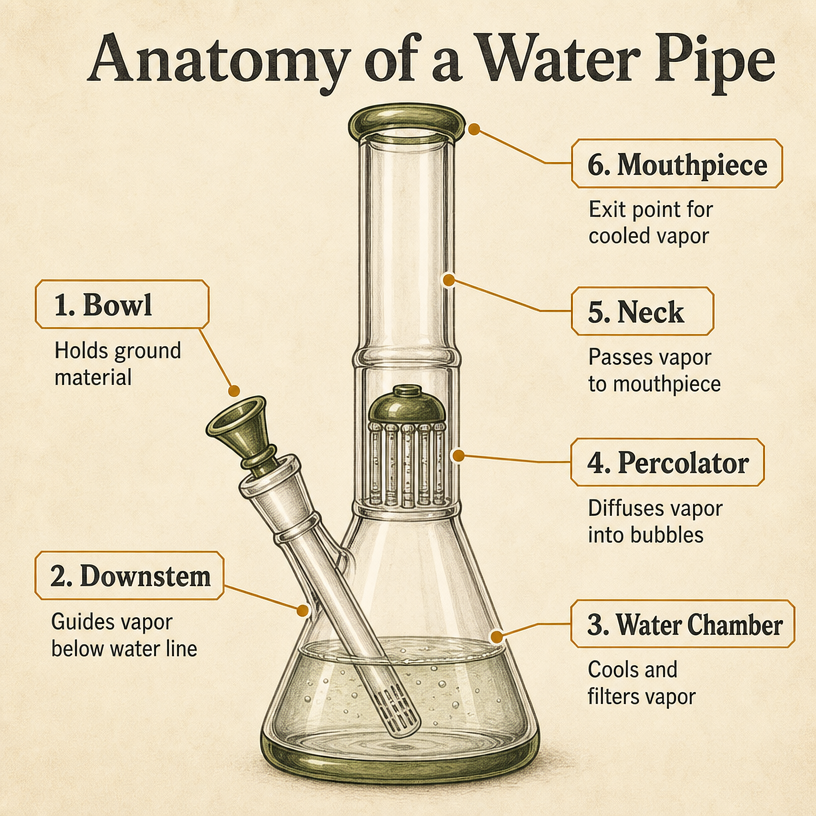
Every bong, regardless of size or style, is built from the same core components. Understanding what each part does makes it easier to compare options and spot the difference between a well-designed bong and a poorly designed one.
- Bowl: holds the smoking material and feeds smoke into the downstem
- Downstem: channels smoke below the water line; diffused downstems have slits that break smoke into bubbles [5]
- Water chamber: the base reservoir where smoke bubbles through water for cooling and initial filtration
- Percolator: an internal component that diffuses smoke into many small bubbles before it reaches the main water chamber [4]
- Neck: the vertical tube that carries cooled smoke from the water chamber to the mouthpiece
- Mouthpiece: the top opening where you inhale; the final point of contact before smoke enters your lungs
The bowl is the small cup at the top of the bong where you pack your smoking material. It holds the material in place while air is drawn through it, feeding smoke into the downstem. Bowls come in different sizes to match the joint, and they can be replaced if they break or wear out.
The downstem — sometimes called a slide — is the tube that connects the bowl to the water chamber. It channels smoke from the bowl downward, below the water line. [5] Many downstems are diffused, meaning they have small slits at the bottom that break smoke into bubbles before it enters the water. [5] Standard downstem joint sizes are 10mm, 14mm, and 18mm. [5]
The water chamber is the base of the bong where water sits. This is where smoke actually bubbles through water, transferring heat and catching particles. The size and shape of the water chamber directly affects how much cooling and filtration occurs.
The percolator is an optional but common filtration component that sits inside the water chamber. A percolator diffuses smoke into many small bubbles before it reaches the main water chamber, increasing surface area for heat transfer and filtration. [4] Not all bongs have percolators, but most quality bongs include at least one.
The neck is the vertical tube that carries smoke from the water chamber up to the mouthpiece. The length and diameter of the neck affects how much additional cooling happens before smoke reaches your lips.
The mouthpiece is the opening at the top of the neck where you put your mouth to inhale. It is the final point of contact before smoke enters your lungs. The joint is the connection point where the bowl or downstem attaches to the bong. [1] [5]
What Types of Percolators Do Bongs Have?
A percolator is a filtration component inside the water chamber that diffuses smoke into thousands of tiny bubbles before it reaches the main body of water. [4] More bubbles mean a larger total surface area of smoke in contact with water at once, which increases cooling and filtration efficiency. [4] There are many percolator styles, ranging from simple add-on components to complex multi perc designs.
- Tree perc: multiple vertical tubes branching from a central stem, each one diffusing smoke into bubbles [4]
- Honeycomb perc: flat disc with a grid of small holes that spreads smoke into a wide, even stream of bubbles [4]
- Showerhead perc: cup-shaped bottom with slits or holes that diffuse smoke downward through the water [4]
- Matrix perc: intersecting slit pattern that produces very even, wide diffusion [4]
- Turbine perc: angled disc slits that create a spinning water effect for additional cooling [4]
- Inline perc: horizontal bar with narrow slits that diffuse smoke evenly across the chamber [4]
- Recycler perc: circulates water back into the main chamber for repeated filtration passes [4]
- Multi perc: two or more percolators combined in one bong for maximum diffusion [4]
The simplest percolator is a diffused downstem, which has narrow slits at the bottom that split smoke into small streams of bubbles as it enters the water. [4] Beyond that, percolators generally fall into several recognized categories.
Tree percs use multiple vertical tubes branching from a central stem, with each tube creating its own bubbles. [4] They provide solid diffusion and are a common mid-range option.
Honeycomb percs are flat discs with many small holes arranged in a grid pattern. Smoke passes through all the holes at once, creating a wide, even field of bubbles. [4] They are known for producing a smooth, diffuse draw.
Showerhead percs narrow at the bottom and diffuse smoke through a cup with slits or small holes, similar in concept to a showerhead. [4]
Matrix percs have a web-like pattern of intersecting slits that produce a very even, wide diffusion pattern. [4]
Turbine percs use angled disc slits that cause water to spin as smoke passes through, creating a centrifuge-like effect. [4]
Inline percs are horizontal bars with narrow slits that diffuse smoke evenly across the perc chamber. [4]
Recycler percs pump water back up through a separate tube and into the main water chamber, causing the water to circulate repeatedly through the filtration process. [4]
Some Bongs combine two or more percolators in a single piece, sometimes called a multi perc or stacked perc. [4] These setups maximize diffusion but can be harder to clean. You can shop all Bongs at Treehouse Lifestyle.
What Are Bongs Made Of and Which Material Is Best?
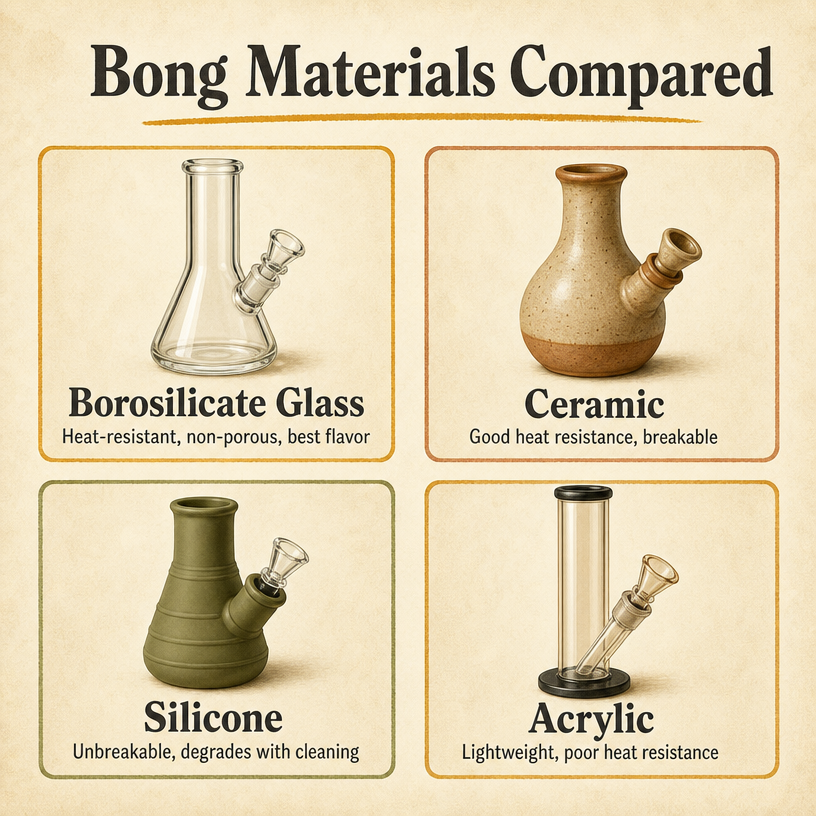
Bongs are made from several different materials, and the material affects heat resistance, cleanability, flavor preservation, and durability. [6] Each material has a distinct set of tradeoffs worth understanding before you buy.
- Borosilicate glass: heat-resistant, non-porous, best flavor preservation, easiest to clean thoroughly [6]
- Ceramic: good heat resistance and cleanability, more aesthetic variety, but chips or cracks if dropped [6]
- Silicone: nearly unbreakable, easy to clean, but degrades with repeated alcohol cleaning and becomes more porous over time [6]
- Acrylic: lightweight and affordable, but poor heat resistance and cannot be cleaned thoroughly [6]
- Bamboo: eco-friendly with natural antimicrobial properties, but requires more maintenance and can crack if dried out [6]
Borosilicate glass is the most common material for quality bongs. It handles heat well, does not absorb odors, and cleans easily with standard methods. [6] It also preserves the flavor of your material better than most other materials because it does not leach flavors into the smoke. [6]
Ceramic offers good heat resistance and cleanability similar to glass, with more visual variety since it can be glazed and painted in ways glass cannot easily replicate. [6] The main drawback is that ceramic breaks more easily if dropped.
Silicone bongs are nearly unbreakable and clean easily, making them a popular choice for travel or for anyone who wants low maintenance. [6] However, repeated cleaning with isopropyl alcohol can degrade the material over time, making it more porous and harder to fully clean. [6]
Acrylic is the least recommended material. It is lightweight and affordable, but it cannot handle high heat well and becomes increasingly difficult to clean thoroughly as it ages. [6]
Bamboo offers an eco-friendly alternative with natural antimicrobial properties. [6] The tradeoff is more maintenance — bamboo components can dry out and crack if not stored properly, and the wood itself requires occasional oiling to stay in good condition.
For most people, borosilicate glass is the best overall choice. [6] It performs well across every category that matters for a bong: heat resistance, cleanability, flavor, and durability.
| Material | Heat Resistance | Cleanability | Flavor |
|---|---|---|---|
| Borosilicate Glass | High | Excellent | Best |
| Ceramic | Good | Good | Good |
| Silicone | Moderate | Good | Fair |
| Acrylic | Low | Poor | Fair |
| Bamboo | Good | Moderate | Good |
What Size Bong and Joint Type Should I Get?
Bong size affects portability, smoke cooling, and how much water is available for filtration. [7] Choosing the right size depends on where you plan to use your bong and how important portability is to you.
- Mini bongs (4–10 inches): highly portable and easy to store, but limited water capacity means less cooling and filtration [7]
- Medium bongs (10–16 inches): the most popular size range, balancing portability with solid cooling and filtration performance [7]
- Large bongs (16–22+ inches): maximum water capacity for the coolest hits, but difficult to travel with and awkward to store [7]
- Joint size: 10mm (nano), 14mm (standard), and 18mm (large) — must match your bowl and downstem [7]
- Joint gender: female joints require male accessories, male joints require female accessories [7]
Mini bongs range from 4 to 10 inches tall. They are highly portable and easy to store, fitting in bags and jacket pockets. [7] The tradeoff is limited water capacity, which means less cooling compared to larger bongs. [7] Mini bongs are best for casual use or for anyone who prioritizes portability and discretion.
Medium bongs range from 10 to 16 inches tall. This is the most popular size range because it strikes a good balance between portability and performance. [7] The taller neck gives smoke more time to cool before reaching the mouthpiece, and the larger water chamber provides better filtration. [7]
Large bongs range from 16 to 22 inches or taller. They offer the maximum water capacity for the coolest hits and typically accommodate multiple percolators for extra diffusion. [7] The tradeoff is that they are difficult to travel with and require more storage space. [7]
Joint size refers to the diameter of the connection point where the bowl or downstem meets the bong. [7] Standard sizes are 10mm (nano), 14mm (most common), and 18mm (large). [7] Joint gender also matters — female joints require male bowls and downstems and vice versa. [7] Always match both the size and the gender when buying bowls or downstems. [7] Treehouse Lifestyle offers free shipping on orders $150+.
How Do I Clean and Maintain a Bong?
Regular cleaning keeps a bong functioning well and prevents buildup that can affect flavor and hygiene. The most effective cleaning method uses 90%+ isopropyl alcohol and coarse kosher salt. [8] Isopropyl alcohol dissolves resin buildup, and the salt provides gentle abrasive friction that helps scrub residue from glass surfaces. [8]
- Empty bong water after every session to prevent bacterial, mold, and fungal growth [8]
- Rinse the interior with warm water after each use to remove loose residue before it bakes on [8]
- Use 90%+ isopropyl alcohol and coarse kosher salt — the alcohol dissolves resin while the salt provides gentle abrasive friction [8]
- Shake the bong with the solution for 30–60 seconds, then soak for 30 minutes to overnight depending on buildup [8]
- Rinse thoroughly with warm water until all residue and salt are completely removed [8]
- Never use boiling water — thermal shock can crack or shatter borosilicate glass [8]
- Avoid bleach and abrasive scrubbers — bleach leaves toxic residue, and scrubbers scratch glass surfaces [8]
Start by emptying the dirty bong water after each session. Rinse the interior with warm water to remove loose residue. [8]
Add approximately one tablespoon of coarse kosher salt per inch of bong height. Pour in enough 90%+ isopropyl alcohol to fill the bong around the salt. [8]
Cover the openings and shake the bong vigorously for 30 to 60 seconds, making sure the salt and alcohol reach all interior surfaces. [8]
Let the solution soak for 30 minutes for light buildup, or several hours to overnight for heavy resin accumulation. [8]
After soaking, rinse the bong thoroughly with warm water, repeating until all residue and salt are completely gone. [8]
There are several common mistakes to avoid. Never use boiling water on a glass bong — sudden temperature changes can crack borosilicate glass. [8] Avoid bleach, which can leave toxic residue inside the bong. [8] Do not use abrasive scrubbers or brushes that can scratch glass and create places for residue to accumulate. [8]
Bong water should be changed after every session. Stagnant water can harbor bacteria, mold, and fungi including E. coli and Streptococcus, which can become aerosolized and inhaled on subsequent uses. [8] If your bong develops a persistent musty smell even right after cleaning, it may indicate bacterial buildup that requires deeper cleaning or more frequent water changes going forward. [8]
What Are Common Questions About Smoking Accessories?
Does a bong filter out all harmful chemicals from smoke?
No. A bong cools smoke and filters ash and some tar through water, but it does not eliminate combustion byproducts. Any combustion method produces harmful chemicals that water filtration alone cannot remove. [9]
What is the difference between a 10mm, 14mm, and 18mm joint?
Joint size refers to the diameter of the connection point where the bowl or downstem meets the bong. Ten millimeter joints are small (nano), 14mm is the most common standard, and 18mm is larger. Joint gender also matters — female joints require male accessories and vice versa. [7]
What is the difference between a tree perc and a honeycomb perc?
A tree perc uses multiple vertical tubes branching from a central stem, each one diffusing smoke into bubbles. A honeycomb perc uses a flat disc with many small holes that spread smoke into a wide, even stream of bubbles. Both increase surface area for cooling, but honeycomb percs tend to produce a more diffuse, even draw. [4]
How often should I change the water in my bong?
Bong water should be changed after every session. Stagnant water can harbor bacteria, mold, and fungi including E. coli and Streptococcus, which can become aerosolized and inhaled on subsequent uses. [8]
Can I use boiling water to clean a glass bong?
No. Sudden temperature changes can crack borosilicate glass. The recommended method is 90%+ isopropyl alcohol combined with coarse kosher salt — the alcohol dissolves resin while the salt provides gentle abrasive friction without the thermal shock of boiling water. [8]
What Is the Best Bong for Your Setup?
A bong is a water pipe that filters and cools smoke through water before inhalation. Smoke travels from the bowl through the downstem, into the water chamber where it bubbles upward through water, and then exits through the mouthpiece. [1] This process uses water’s high heat capacity to absorb thermal energy, cooling smoke before it reaches your lungs. [2] Water filtration also catches ash and heavy particles through diffusion and inertial impaction. [2] [3]
Choosing the right bong depends on your priorities. Borosilicate glass offers the best combination of heat resistance, cleanability, and flavor preservation. [6] Joint size and gender must match your accessories — 14mm is the most common standard. [7] Percolators add diffusion and cooling but make cleaning more involved. [4] Water should be changed after every session to prevent bacterial and fungal growth. [8]
Browse the full selection of bongs and water pipes at Treehouse Lifestyle. Free shipping applies on orders $150+.
Where Does This Smoking Accessory Information Come From?
- Wikipedia: Bong (Water Pipe)
- Grasscity: The Science of Bong Water: Filtration, Cooling & Smoother Hits
- Leafly: Cannabis Science 101: The Complex Chemistry of the Bong
- HEMPER: Understanding Different Types of Bong Percs
- ThickAssGlass: Downstems Demystified: From Open-End to Showerhead Explained
- Tank Glass: 6 Types of Materials Used to Manufacture Bongs
- ThickAssGlass: Bong Sizes Guide: Find the Right Bong for You
- GRAV: How to Clean Your Bongs & Pipes
- Healthline: How Does a Bong Work? Benefits, Risks, and Myths