

How often to clean a bong depends on the piece. Change water every session and deep clean weekly, or every two to three days for heavy users [2]. Hand pipes get a thirty-minute alcohol soak [1], bowl screens brush every few uses [4], vaporizers cool and swab after each session [3], and grinders deep clean every two weeks for daily users [1]. Biofilms form in stagnant water [5].
What Cleaning Cadence Does Each Type of Smoking Accessory Need?
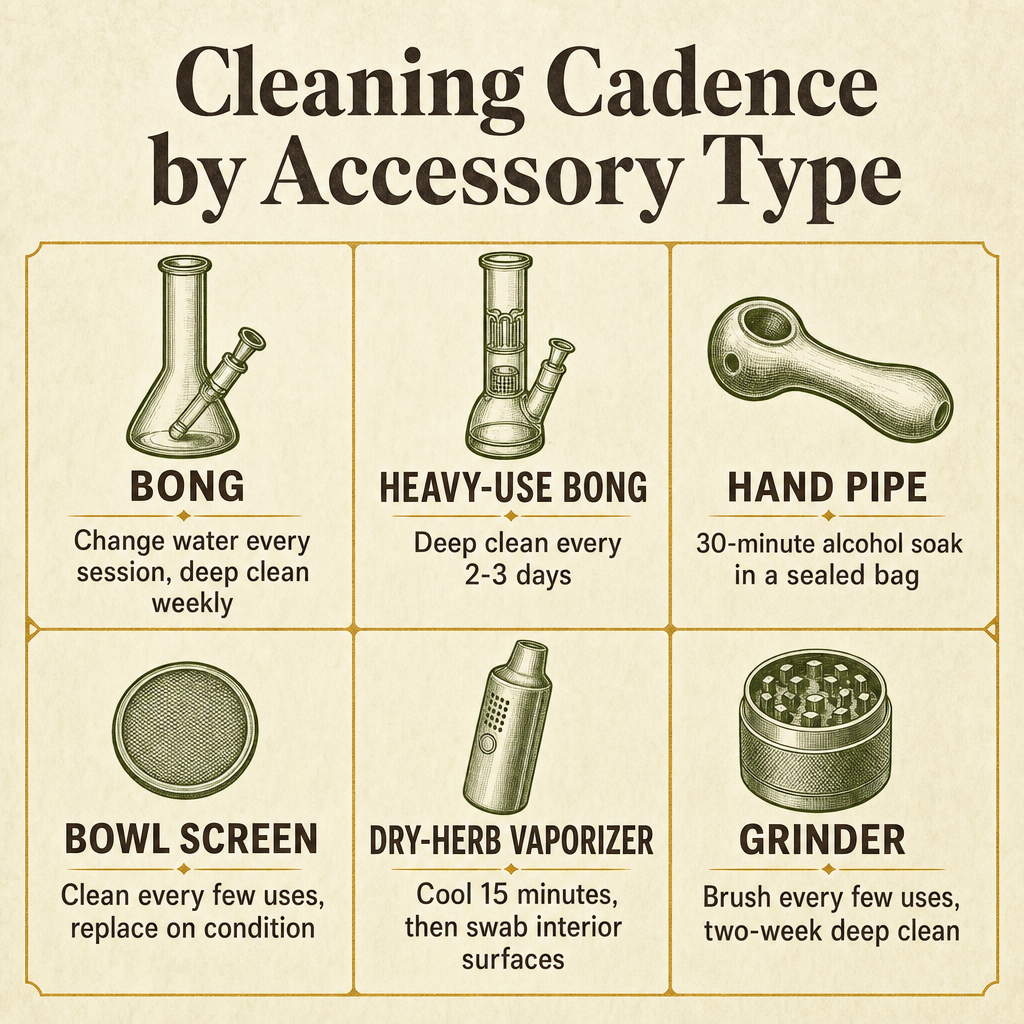
Each accessory family runs on its own rhythm. A bong holds water, so it needs fresh water after every session and a deeper clean on a weekly cadence. A glass hand pipe does not hold standing water, so it can go longer between deep cleans, but resin still builds up inside the bowl and stem and responds best to a soak. A dry-herb vaporizer runs on heat and airflow, so its rhythm is built around cool-down time and quick post-session wipe-downs rather than long soaks. A grinder holds no water at all, so its rhythm is a brush-out between uses and a deeper disassemble-and-clean on a longer cycle.
Because the rhythms differ, it helps to gather the right tools before you set a schedule. Replacement brushes, coarse salt, isopropyl alcohol at 90 percent or higher, cotton swabs, and zip-top bags cover most of the per-piece routines below. You can find these supplies together in the Cleaning Supplies collection so you do not have to track each item down one at a time.
The remainder of this article walks through the cadence piece by piece, then closes with the three factors that stretch or shorten every interval: how often you actually use the piece, how complex the piece is, and how you store it between sessions. For the full how-to on each cleaning method, the The Complete Guide to Cleaning Smoking Accessories pillar walks through every accessory family in one place.
- Bong: change water after every session, deep clean once a week for average users and every two to three days for heavy users [2].
- Glass hand pipe or one-hitter: a roughly thirty-minute isopropyl alcohol and coarse salt soak in a sealed bag [1].
- Bowl screen: brush after every few uses and replace on condition, with regular users swapping screens every few months [4].
- Dry-herb vaporizer: fifteen-minute cool-down after each session, then a 90 percent isopropyl alcohol swab and a fifteen-minute oven screen soak [3].
- Grinder: a quick brush-out every few uses and a deeper cleaning on roughly a two-week cadence for daily users [1].
How Does Cleaning Frequency Compare Across Bongs, Hand Pipes, Vaporizers, and Grinders?
Looking at the four major accessory families side by side makes the per-piece cadence easier to set. A bong wants fresh water every session and a weekly deep clean on average [2]. A glass hand pipe can go a week or more between deep cleans if you keep up with quick rinses, and the maker-recommended method is a thirty-minute soak in a sealed bag with 90 percent or higher isopropyl alcohol and coarse salt [1]. A dry-herb vaporizer lives on a per-session rhythm: cool down for fifteen minutes, swab the interior, and soak the oven screen [3]. A grinder has the longest interval between deep cleans, but it also rewards a quick brush-out every few uses so loose particles do not compact into the threading.
Multi-chamber bongs deserve a note here. Their intricate chambers trap resin faster than a simple beaker, so the deep-clean interval shortens when you step up from a single-chamber piece [2]. The same idea applies to ceramic water pipes with built-in percolators: more internal surface area means more places for residue to settle. A piece like the SeshGear Chinese Vase Ceramic Water Pipe – 5.75" / 14mm F / Bubble Base has a percolator-style interior that benefits from the bong cadence above, with attention to the downstem and any internal slits.
For readers who want every how-to in one place, the full step-by-step for each piece lives in our The Complete Guide to Cleaning Smoking Accessories pillar. The rest of this article focuses on the cadence question, not the how-to, so you can come back here when you need to plan a rhythm and skip ahead to the how-to when you are ready to clean.
- Bongs: change water after every session, deep clean once a week for average users, every two to three days for heavy users, and more often for multi-chamber pieces [2].
- Hand pipes: a thirty-minute isopropyl alcohol and coarse salt soak in a sealed bag, with overnight soaking for heavily soiled pieces [1].
- Dry-herb vaporizers: fifteen-minute cool-down after each session, swab interior surfaces with 90 percent isopropyl alcohol, and soak the oven screen for fifteen minutes [3].
- Grinders: brush out the chamber every few uses for daily users, with a deeper cleaning on roughly a two-week cadence for daily users [1].
- Bowl screens: clean after every few uses to prevent buildup and replace on condition rather than on a fixed timer [4].
| Accessory | Quick signal | Deep clean cadence |
|---|---|---|
| Bong (average use) | Stale or discolored water | Once a week [2] |
| Bong (heavy, multiple sessions/day) | Resin building up faster | Every 2-3 days [2] |
| Hand pipe / one-hitter | Sticky bowl or reduced airflow | Thirty-minute alcohol soak in a sealed bag [1] |
| Bowl screen | Visible residue or clogging | Clean every few uses; replace every few months on condition [4] |
| Dry-herb vaporizer | Reduced airflow or off flavor | Fifteen-minute cool-down, then swab and oven screen soak [3] |
| Grinder (daily use) | Compacted material in threading | Brush every few uses; deeper clean about every two weeks [1] |
How Often Should a Bong Be Cleaned and the Water Be Changed?
Bong water is the simplest piece of the routine, and skipping it is the fastest way to build up problems. Maker guidance is to replace the water with fresh water at the start of each session, so the piece is never used with stagnant water [2]. Between sessions, a quick warm-water rinse keeps film from settling on the inside walls. The daily warm-water rinse is part of the maker step-by-step for glass pipes, bubblers, and bongs [1].
The deep-clean cadence scales with how often you use the bong. Average users do a full deep clean once a week. Heavy users running multiple sessions per day shorten that to every two to three days. Multi-chamber bongs need more frequent cleaning than simple beaker bongs because their intricate chambers trap resin faster [2]. The shape of the piece is the easiest way to predict the interval before any resin shows.
For pieces with downstems and percolators, the same cadence applies, but the deep clean takes a little more disassembly. A How Do You Clean a Dab Rig and Keep It Working Well? walkthrough covers the rig-specific version of this routine if your water pipe is set up for concentrates rather than dry herb. After every deep clean, dry the piece completely and store it in a cool dry place away from direct sunlight so it is ready for the next session [1].
- Replace bong water with fresh water at the start of every session [2].
- Rinse with warm water between sessions to keep film from settling on the glass [1].
- Schedule a full deep clean once a week for average use [2].
- Shorten the deep clean to every two to three days for heavy multiple-times-daily use [2].
- Clean multi-chamber bongs more often than simple beakers because intricate chambers trap resin faster [2].
- Store the bong in a cool dry place after it dries completely [1].
How Often Should Hand Pipes and One-Hitters Be Cleaned?
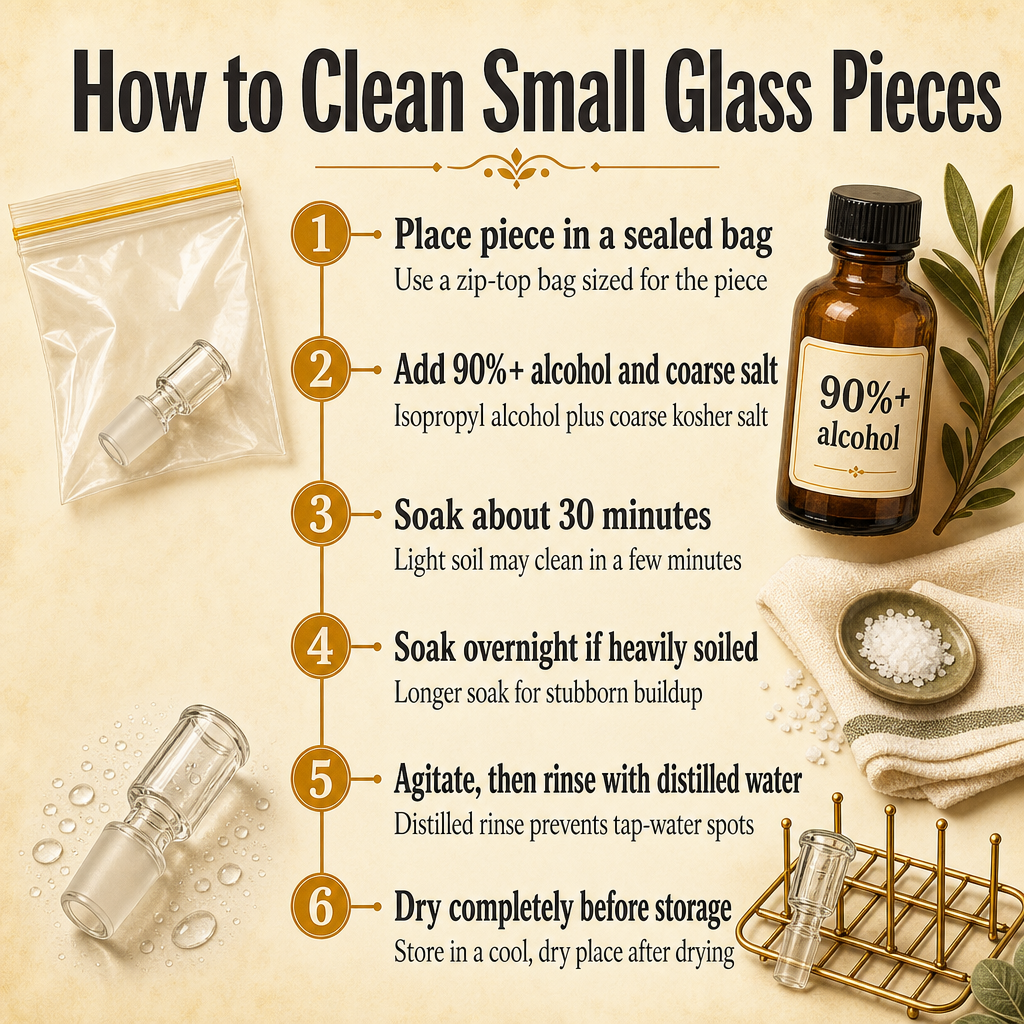
Glass hand pipes and one-hitters do not hold standing water, so the cleaning rhythm is built around resin rather than water turnover. A practical cadence is a thirty-minute isopropyl alcohol and coarse salt soak in a sealed bag, with overnight soaking for heavily soiled pieces and a much shorter soak for lightly soiled pieces [1]. The alcohol does the dissolving work and the coarse salt acts as an abrasive to loosen residue from the inside walls when you shake the bag.
One-hitters benefit from frequent short cleans because their narrow channels clog fast. A piece like the One-Hitter [Matte Black] is small enough that a quick soak and shake clears most residue in one pass. The maker-recommended method applies at any size: 90 percent or higher isopropyl alcohol plus coarse kosher salt in a sealed bag sized for the piece, then shake, then rinse with distilled water to avoid the spots and mineral deposits that tap water can leave on glass [1].
After the rinse, dry the piece completely before you put it away. Maker guidance for glass pipes, bubblers, and similar pieces is to store them in a cool dry place away from direct sunlight after they are fully dry, which is the same storage habit that applies to a clean bong [1]. If you want every step of this routine in one place, the The Complete Guide to Cleaning Smoking Accessories pillar has the full walkthrough.
- Place the glass hand pipe or one-hitter in a sealed zip-top bag sized for the piece [1].
- Add 90 percent or higher isopropyl alcohol plus coarse kosher salt as an abrasive [1].
- Soak for about thirty minutes for routine cleans, longer overnight for heavily soiled pieces, and shorter for lightly soiled pieces [1].
- Shake the bag to agitate the salt against the inside walls, then rinse with distilled water to avoid tap-water spots [1].
- Dry completely and store in a cool dry place away from direct sunlight [1].
How Often Should Bowl Screens Be Cleaned and Replaced?
Bowl screens sit at the bottom of a bowl and keep small pieces from pulling through into the downstem. They are small, but they affect airflow and clog quickly, so cleaning them on a short cadence matters more than cleaning them on a long one. The recommended cadence is to brush or rinse the screen after every few uses to prevent residue from building up in the first place [4].
Replacement is a different question from cleaning. Screens are replaced on condition rather than on a fixed timer. Regular users typically swap screens every few months, and replace sooner if the screen is cracked, persistently clogged, or discolored in a way that cleaning will not remove [4]. Reading the screen’s condition tells you which action applies: a cleanable screen has light residue that comes off with a brush or short soak, while a worn screen has damage or stubborn buildup that survives cleaning.
When it is time to swap, having spare screens on hand makes the change quick. The Screens subcategory has screen options that fit common bowl sizes, so a worn screen can be replaced before it affects airflow. Pair a replacement habit with the per-few-use brush-out above and the screen stays out of the way of the rest of your routine.
- Brush or rinse the screen after every few uses to prevent residue buildup [4].
- Replace screens on condition rather than on a fixed timer [4].
- Regular users typically swap screens every few months [4].
- Replace sooner if the screen is cracked, persistently clogged, or discolored in a way that cleaning will not remove [4].
| Screen condition | Action | Cadence |
|---|---|---|
| Light residue after a few uses | Brush or rinse | After every few uses [4] |
| Light to moderate buildup over time | Short soak and brush | As needed between replacements |
| Cracked, persistently clogged, or discolored | Replace the screen | Sooner than the regular interval [4] |
| Regular user, no damage | Replace on routine | Roughly every few months [4] |
How Often Should a Dry-Herb Vaporizer Be Cleaned?
Dry-herb vaporizers run on heat and airflow, so their cleaning rhythm is built around cool-down time and quick post-session wipe-downs rather than long soaks. Maker guidance from PAX is to allow the device to cool for fifteen minutes after use, then wipe interior surfaces with a cotton swab dampened with 90 percent isopropyl alcohol, and remove the oven screen and soak it in isopropyl alcohol for fifteen minutes before rinsing and drying [3]. The fifteen-minute cool-down is the part that is easiest to skip and the part that matters most for keeping the swab from smearing warm residue around the chamber.
Sticking to a post-session routine keeps the vaporizer from needing a heavier clean later. A quick swab and a fifteen-minute oven screen soak after each session is faster than waiting until the chamber is visibly coated and trying to work residue off a hot surface. Maker guidance is that regular cleaning helps maintain airflow, flavor, and draw strength over time [3], which is the practical case for the per-session rhythm rather than a calendar-fixed rhythm.
If you want a deeper walkthrough of vaporizer cleaning, including how to handle the mouthpiece and any removable parts without damaging seals, the How Do You Clean a Vaporizer Without Damaging It? guide covers the step-by-step. The cadence above works with that walkthrough: clean lightly after every session, and reach for the deeper clean only when the device has been used heavily between routines.
- Allow the vaporizer to cool for fifteen minutes after use before opening the chamber [3].
- Wipe interior surfaces with a cotton swab dampened with 90 percent isopropyl alcohol [3].
- Remove the oven screen and soak it in isopropyl alcohol for fifteen minutes [3].
- Rinse the oven screen and dry it before putting it back in the device [3].
- Follow this routine after each session so the vaporizer does not need a heavier clean later [3].
How Often Should a Grinder Be Cleaned?
Grinders do not hold water, and they are not exposed to heat the way a vaporizer is, so the cleaning rhythm is built around the material that builds up in the chamber and threading. A two-tier routine works well: a quick brush-out every few uses for daily users, and a deeper disassemble-and-clean on roughly a two-week cadence for daily users [1]. The brush-out is what keeps loose particles from compacting into the threading in the first place.
The deeper clean is where you take the grinder apart, brush out everything that the quick pass missed, and wipe the pieces before reassembly. Because grinder cleaning frequency scales with how often the grinder is actually used, casual users can stretch the deep-clean interval out and heavy users should shorten it [1]. The brush-out cadence scales the same way: more uses means more frequent brushing.
Storing the grinder in a cool dry place between sessions keeps the deeper-clean interval on track. If you notice material compacting faster than the rhythm predicts, the grinder is being used more than you estimated and the interval should shorten. A grinder that gets the brush-out cadence right rarely needs the deep clean to take long.
- Brush out the chamber and threading every few uses for daily users [1].
- Run a deeper disassemble-and-clean on roughly a two-week cadence for daily users [1].
- Stretch the interval for casual use and shorten it for heavy use, since frequency scales with actual use [1].
- Store the grinder in a cool dry place between sessions to keep the rhythm on track [1].
What Factors Change the Cleaning Interval for Any Smoking Accessory?
Three independent factors decide how long any interval on this list actually lasts. The first is use frequency: casual users clean less, and users who run multiple sessions per day clean more. This is the maker framing for bongs, where the weekly average-use deep clean shortens to every two to three days for heavy users [2], and the same scaling applies to every other piece on the shelf.
The second factor is piece complexity. Multi-chamber bongs trap resin faster than simple beakers because their intricate chambers have more internal surface area for residue to settle on [2]. The same logic explains why percolators and bubblers want a slightly shorter interval than a plain tube. The more internal structure a piece has, the shorter its deep-clean interval.
The third factor is storage. Maker guidance is to store pieces in a cool dry place away from direct sunlight after they dry completely [1]. Biofilms can form in water systems under stagnant conditions, and favorable conditions for biofilm formation are present when structures and equipment that hold water are not cleaned for extended periods [5]. Good storage habits reduce the conditions that make biofilm growth possible, and they keep the cleaning rhythm you set actually working. The maker’s rule of thumb is to apply the same hygiene standard you would to a drinking glass [1].
Read those three factors together and the schedule writes itself. Pick the per-piece cadence that matches the simplest version of the piece on your shelf, then shorten the interval for heavier use or more complex glass, and add the storage habit so the rhythm holds between deep cleans. When you are ready to replace a worn piece or pick up a new one, the Lighters collection covers lighters and accessories that round out the routine, and Treehouse Lifestyle offers free shipping on orders $150 and up so replacement supplies ship together.
- Use frequency scales every interval: casual users clean less and multiple-times-daily users clean more [2].
- Piece complexity scales every interval: multi-chamber bongs and pieces with percolators trap resin faster than simple beakers [2].
- Storage conditions scale every interval: a cool dry place after complete drying reduces conditions favorable to microbial growth [1].
- Biofilms form in water systems under stagnant conditions, which is why water-containing pieces need regular turnover and cleaning [5].
Frequently Asked Questions
How often should bong water be changed?
Change bong water after every session. Maker guidance is to replace the water with fresh water at the start of each session so the piece is never used with stagnant water [2].
How often should a bong be deep cleaned?
Once a week for average users, and every two to three days for heavy users running multiple sessions per day. Multi-chamber bongs need more frequent cleaning than simple beaker bongs because their intricate chambers trap resin faster [2].
How often should a hand pipe or one-hitter be cleaned?
A glass hand pipe or one-hitter can be soaked in a sealed bag with 90 percent or higher isopropyl alcohol and coarse salt for about thirty minutes. Heavily soiled pieces can be soaked overnight, and lightly soiled pieces often come clean in a few minutes. Rinse with distilled water afterward [1].
How often should a bowl screen be cleaned or replaced?
Clean a bowl screen after every few uses to prevent residue buildup. Replace the screen on condition rather than on a fixed timer: regular users typically swap screens every few months, and sooner if the screen is cracked, persistently clogged, or discolored in a way that cleaning will not remove [4].
How often should a dry-herb vaporizer be cleaned?
Wipe interior surfaces after each session once the device has cooled for fifteen minutes, using a cotton swab dampened with 90 percent isopropyl alcohol. Remove the oven screen and soak it in isopropyl alcohol for fifteen minutes, then rinse and dry it before putting it back. Maker guidance is that regular cleaning helps maintain airflow, flavor, and draw strength over time [3].
How often should a grinder be cleaned?
Specialist guides suggest brushing out the grinder every few uses for daily users and doing a deeper cleaning on roughly a two-week cadence for daily users. Stretch the interval for casual use and shorten it for heavy use, since grinder cleaning frequency scales with how often the grinder is actually used [1].
What Is the Simplest Way to Remember When to Clean Each Piece?
The simplest mental model is per-piece, not per-calendar. Bong water gets fresh water at the start of every session. Glass hand pipes and one-hitters get a thirty-minute isopropyl alcohol and coarse salt soak in a sealed bag, with overnight soaking for heavily soiled pieces. Bowl screens get brushed after every few uses and replaced on condition. Dry-herb vaporizers cool for fifteen minutes after each session, then get a swab and an oven screen soak. Grinders get a quick brush-out every few uses and a deeper clean on roughly a two-week cadence for daily users.
Three factors stretch or shorten every one of those intervals: how often the piece is used, how complex the piece is, and how it is stored between sessions. Casual users stretch the intervals out, heavy users shorten them, multi-chamber pieces shorten them further, and storage in a cool dry place after the piece dries completely keeps the rhythm on track. Biofilms form in water systems under stagnant conditions, which is why water turnover and regular cleaning are the part of the routine that does the most work [5].
When you are ready to pick up replacement brushes, coarse salt, isopropyl alcohol, cotton swabs, and zip-top bags, the Cleaning Supplies collection has everything in one place, and Treehouse Lifestyle offers free shipping on orders $150 and up so a restock ships together. For the full step-by-step on each method, the The Complete Guide to Cleaning Smoking Accessories pillar walks through every piece in detail.
Sources
- GRAV: A Clean Bong Is a Happy Bong: A Step-By-Step Guide to Cleaner Glass (How to Clean Your Bongs & Pipes)
- Thick Ass Glass: How Often Should You Clean Your Bong?
- PAX Labs: Squeaky-Clean: How to Care for 3 PAX Products (PAX FLOW, ERA GO, PAX MINI)
- Badass Glass: Screen Savers: Choosing the Right Glass Bong Screen
- U.S. Centers for Disease Control and Prevention (CDC), Healthcare Infection Control Practices Advisory Committee (HICPAC): Guidelines for Environmental Infection Control in Health-Care Facilities (2003) — Appendix C. Water