
To clean glass with isopropyl alcohol, seal the piece in a zip-top bag with 91 to 99 percent IPA, add two to three tablespoons of coarse salt, and shake for two to five minutes. For heavy buildup, soak thirty minutes to overnight, then rinse with warm water and wait thirty minutes before use. Glass, ceramic, and most metals are safe; silicone, acrylic, plastic, rubber, and wood are not [3] [5] [6].
The rest of this guide covers the chemistry, the 70/91/99 percent tradeoffs, the material compatibility list, the full step-by-step method, and the safety rules that keep the routine simple. The same approach scales from a small hand pipe to a tall beaker piece.
Why Is Isopropyl Alcohol the Standard Solvent for Cleaning Glass?
Isopropyl alcohol has become the default cleaning solvent for glass accessories because it dissolves the very thing that water cannot: resin. Cannabis resin is mostly lipids and plant oils, which are hydrophobic, meaning they do not mix with water. Hot water alone loosens the surface, but it does not break the resin down. The non-polar structure of IPA is what allows it to grab those oily deposits and lift them off the glass [1] [5].
Chemists describe isopropyl alcohol as a secondary alcohol with a molecular structure that mixes well with both water and oils. That dual behavior is what makes it so effective. It cuts through resin the way dish soap cuts through grease, but it also evaporates cleanly without leaving a film behind. Glass surfaces end up clear, and there is no soapy aftertaste or residue that would change the next session [8].
The same properties that make IPA work on resin also explain why it is not the right choice for every material. Because the solvent is so good at breaking down oils, it can also dry out and crack softer materials like silicone and rubber. Knowing which materials hold up with IPA is part of the routine, and it is the reason the alcohol-and-salt method has stayed the standard for glass [3].
When the piece is sealed inside a leak-proof bag, vented only briefly during shaking, and handled away from any open flame, the routine stays contained. The same logic that makes IPA ideal for glass is why silicone pieces, like the SILICONE BEAKER BONG WITH REMOVABLE GLASS BOWL, should be cleaned with warm soapy water instead, and why a category like Cleaning Supplies exists to keep cleaning supplies organized.
- Resin is hydrophobic, so water alone cannot break it down; IPA dissolves the lipids and oils in cannabis resin that water leaves behind.
- Isopropyl alcohol is a secondary alcohol that mixes with both water and oils, which is why it cuts through resin and evaporates cleanly with no film left on the glass.
- Glass, glazed ceramic, and most metals are safe with IPA, but softer materials like silicone and rubber can dry out or crack, which is why material matters.
- The alcohol-and-salt method is the long-standing shop standard because it combines a chemical solvent with a physical abrasive, and the bag keeps the work contained.
What Concentration of Isopropyl Alcohol Should You Use on Glass?
Isopropyl alcohol is sold over the counter in three common concentrations: 70 percent, 91 percent, and 99 percent. The number tells you how much of the bottle is pure IPA and how much is water. 70 percent contains about 30 percent water, which slows down how fast the solvent can dissolve heavy resin. 91 percent is the everyday pick for most glass pieces, and 99 percent is the strongest retail option and the fastest on thick buildup [1] [4].
Picking the right concentration is mostly about matching the strength of the solvent to the amount of resin on the piece. A clean piece that gets a weekly rinse can use 91 percent. A piece that has sat for a month will clean faster in 99 percent. A bottle of 70 percent is fine for a light touch-up, but the water content will lengthen the soak and the shake. Many regular users keep a 91 percent bottle for daily cleaning and a 99 percent bottle for the once-a-month deep clean [4].
For readers who want the full picture on matching concentrations to different glass pieces, the The Complete Guide to Cleaning Smoking Accessories covers the broader cleaning routine, and the step-by-step walkthroughs in How Do You Clean a Bong the Right Way? and How Do I Clean a Glass Pipe? apply the same concentration logic to a bong and a small hand pipe respectively.
- 70 percent IPA is the slowest at dissolving heavy resin because about 30 percent of the bottle is water, which dilutes the solvent and lengthens soak times [1] [3].
- 91 percent IPA is the standard everyday choice and works well for routine cleaning of glass pipes, bongs, and small accessories [2] [5].
- 99 percent IPA has the least water and is the fastest on heavy buildup, so it is the pick when a piece has gone a long time between cleanings [4] [5].
- Higher concentrations cost a little more per bottle, but they save time because the solvent does not have to push past as much water to reach the resin [4].
| Concentration | Water content | Best for |
|---|---|---|
| 70% IPA | About 30% water | Light touch-ups; the slowest at dissolving heavy resin |
| 91% IPA | About 9% water | Everyday cleaning of glass pipes, bongs, and small accessories |
| 99% IPA | About 1% water | Heavy buildup; the fastest retail option on thick resin |
Which Materials Are Safe to Clean With Isopropyl Alcohol?
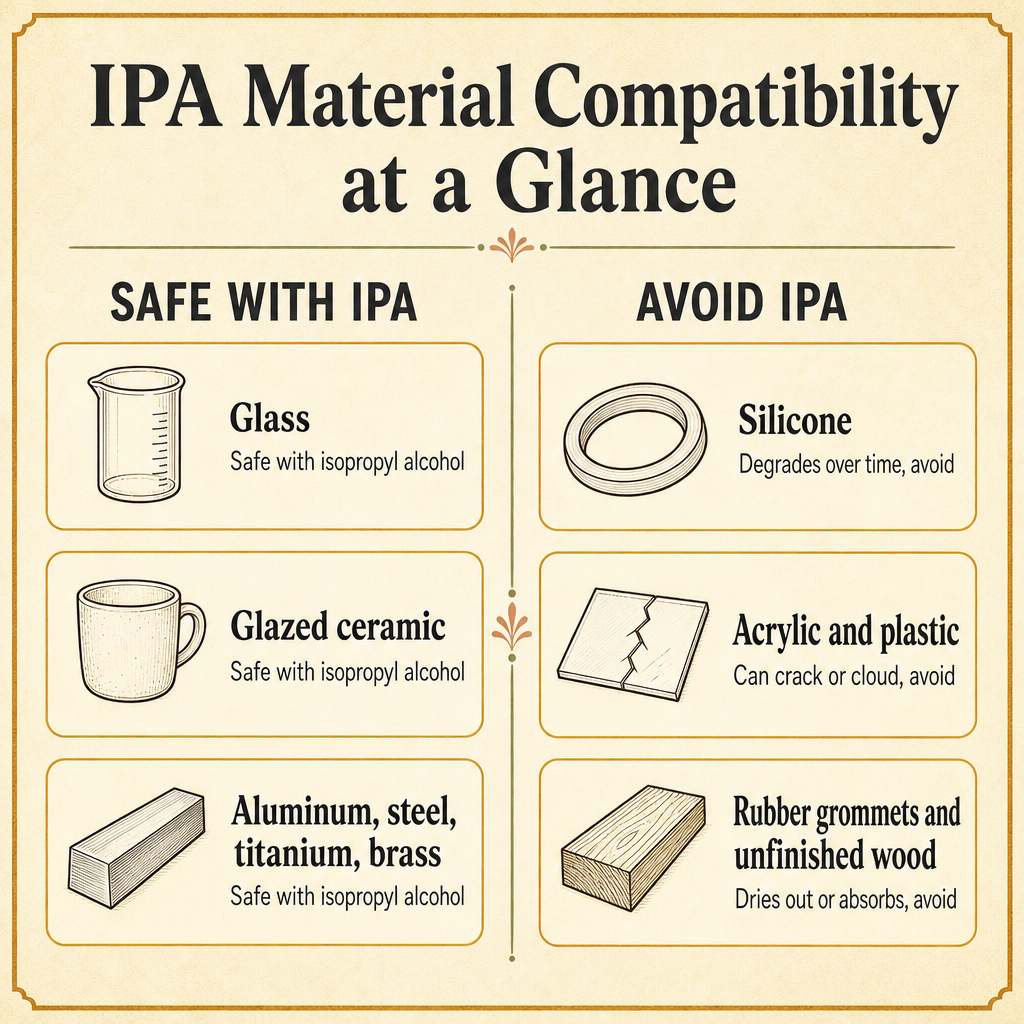
Not every material can handle the alcohol-and-salt method, and using IPA on the wrong surface is one of the most common ways to ruin a piece. Glass, glazed ceramic, and most metals are safe to clean with isopropyl alcohol, with no risk of damage to the surface. The list of metals that hold up well includes aluminum, steel, titanium, and brass, so any metal bowl, downstem, or screen in those materials can go in the bag [3].
The list of materials that do NOT hold up is just as important. IPA degrades silicone over time, even though silicone is often advertised as a tough, flexible material. Acrylic and plastic can crack, cloud, or develop stress fractures when soaked in alcohol. Rubber grommets and seals dry out and lose flexibility. Unfinished wood absorbs the solvent, which can swell or stain the surface. None of those materials belongs in the soak bag.
When a glass piece has silicone or rubber parts, those components need to come off before the soak. Sliding grommets and removable silicone sleeves are easy to set aside. Acrylic or plastic mouthpieces should never be soaked in alcohol. For those parts, warm soapy water is the safer routine. Keeping the alcohol-and-salt method limited to glass, ceramic, and approved metals protects the pieces that are not designed for it.
This is also why the comparison infographic that follows focuses only on materials that are part of the routine. The safe-with list and the avoid list are short on purpose. A quick check before the soak takes a few seconds and prevents a cracked bowl or a cloudy mouthpiece. The same material discipline applies to other accessories, too; the How Do You Clean a Grinder Without Damaging It? walks through the right approach for metal and acrylic grinders without damaging the teeth or the thread.
- Safe with IPA: glass, glazed ceramic, aluminum, steel, titanium, and brass — all of these can go in the bag without damage [3].
- Avoid IPA on silicone — the solvent degrades the surface over time, even if the damage is not visible after a single soak.
- Avoid IPA on acrylic and plastic, which can crack, cloud, or develop stress fractures in the alcohol.
- Avoid IPA on rubber grommets, seals, and unfinished wood, which dry out or absorb the solvent.
- Remove silicone and rubber parts from a piece before the soak; clean those parts with warm soapy water instead.
| Material | Safe with IPA? |
|---|---|
| Glass | Yes |
| Glazed ceramic | Yes |
| Aluminum, steel, titanium, brass | Yes |
| Silicone | No — degrades over time |
| Acrylic and plastic | No — can crack or cloud |
| Rubber grommets | No — dry out |
| Unfinished wood | No — absorbs the solvent |
Why Is Coarse Salt Added to Isopropyl Alcohol When Cleaning Glass?
The coarse salt in the alcohol-and-salt method is not a flavoring. It is a physical abrasive that does not dissolve in alcohol, so it stays in the bag as a scrubbing agent while the alcohol does the chemical work. Kosher salt, rock salt, and Epsom salt are the most common picks because their crystals are large enough to scrub without dissolving. Fine table salt dissolves too quickly to do any scrubbing, so it is not a good substitute [3] [5].
The two actions run at the same time inside the bag. The alcohol breaks the chemical bonds in the resin, and the salt crystals knock the loosened material off the glass. The combination is faster and more complete than either step on its own. Alcohol alone will dissolve the resin but leave a thin film that needs extra rinsing. Salt alone will scrub the surface but not reach into the small nooks and chambers of a piece.
- Coarse salt such as kosher, rock, or Epsom salt does not dissolve in alcohol, so it stays solid and scrubs the inside of the glass [3] [5].
- Alcohol breaks the chemical bonds in the resin, while the salt crystals physically knock loosened material off the surface.
- Either step alone is weaker than the combination; together they reach spots that alcohol or scrubbing by hand would miss.
What Is the Step-by-Step IPA and Salt Method for Glass Pieces?
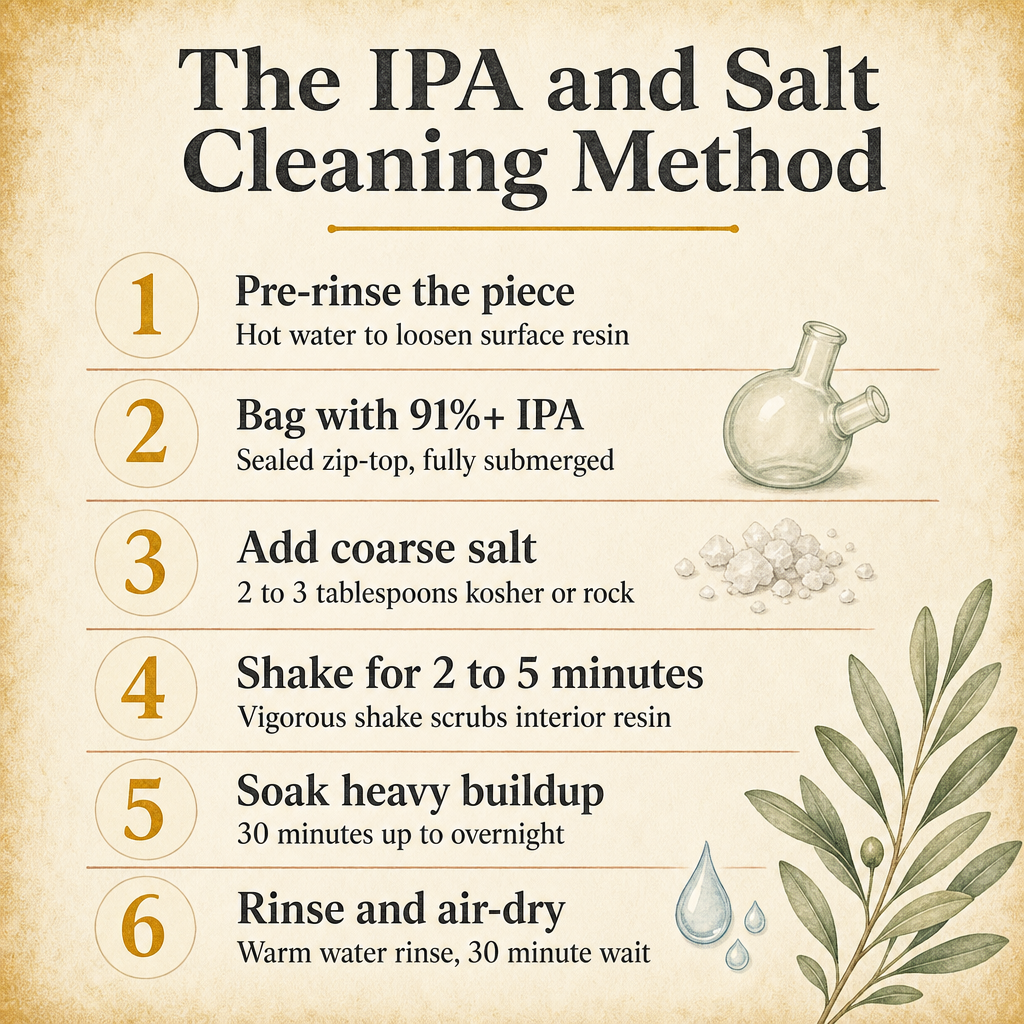
The full IPA-and-salt method runs from a quick pre-rinse through the final air-dry. The order matters because each step sets up the next. A hot-water pre-rinse loosens the surface resin so the alcohol can reach the layers underneath. A sealed bag keeps the alcohol in contact with every part of the piece. A vigorous shake does most of the scrubbing. A long soak handles anything the shake missed. A warm rinse and an air-dry remove any solvent before the piece goes back into use [2] [3] [4].
For a typical cleaning, the shake alone is enough. For a piece that has gone weeks or months between cleanings, the long soak is the difference between a five-minute job and a frustrating afternoon with a cotton swab. The full method is the same in both cases; the only variable is how long the piece sits in the bag.
Before any of this starts, take a quick look at the piece. Glass bowls, downstems, and metal parts in approved materials can all go in together. Silicone sleeves, rubber grommets, and any acrylic or plastic parts need to come off first. A piece that has been dropped or has a small crack should not go through the vigorous shake; a long soak without shaking is a safer choice.
- Pre-rinse the piece with hot water to loosen surface resin and warm the glass so the alcohol works faster [2].
- Place the piece in a leak-proof zip-top bag, then pour in enough 91 percent or higher IPA to fully submerge it [3] [4].
- Add two to three tablespoons of coarse kosher, rock, or Epsom salt to the bag, then seal it with a small air gap [3] [5].
- Shake the bag vigorously for two to five minutes so the salt scrubs the inside of the glass while the alcohol dissolves the resin [2] [3].
- For heavy buildup, let the piece soak in the bag for thirty minutes up to overnight instead of moving straight to the rinse [2] [4].
- Rinse the piece thoroughly with warm water, then leave it to air-dry for at least thirty minutes so any remaining IPA fully evaporates before the piece is used again [2] [4].
How Should You Handle Isopropyl Alcohol Safely While Cleaning?
Isopropyl alcohol is a useful cleaner, but it is also a Class IB flammable liquid with a flash point of 53 degrees F and a lower explosive limit of 2.0 percent in air. Those numbers come straight from the CDC NIOSH Pocket Guide to Chemical Hazards, and they are the reason every cleaning session needs to start with a quick safety check [6] [7].
Work in a well-ventilated area, not in an enclosed bathroom or any space near an open flame. The bag stays sealed during the shake and the soak, and the bag is opened only when the piece goes to the rinse. Gloves are a smart choice because prolonged skin contact dries and cracks the skin, and any eye contact means immediate irrigation. Eye protection is a small step that pays off the first time a bag leaks.
The exposure limits from NIOSH are a useful reference even for short cleaning sessions. The recommended exposure limit is 400 parts per million as an 8-hour time-weighted average, and the short-term exposure limit is 500 parts per million. The immediately dangerous to life or health value is 2,000 parts per million, which is set at 10 percent of the lower explosive limit for safety [6] [7].
For most home cleaning sessions, those numbers will not be reached. A small bag of alcohol opened briefly in a room with an open window produces vapor levels well below the limits. The reason the limits matter is to flag what not to do: do not clean with IPA in a closed bathroom, do not pour it near a stove or pilot light, and do not smoke while the bag is open. Following those three rules keeps the routine as safe as the chemistry is effective.
A small setup step makes the routine cleaner: lay out the bag, the salt, the gloves, and a towel before pouring any alcohol, and have the warm water ready for the rinse. That way the alcohol is poured once, the bag is sealed quickly, and the room is back to normal within a few minutes. Tools like the Vessel Care Kit bundle brushes and bags together so the same routine stays consistent.
- Isopropyl alcohol is a Class IB flammable liquid with a flash point of 53 degrees F, so keep it away from open flames, sparks, pilot lights, heaters, and stoves [6] [7].
- Work in a well-ventilated area, not in an enclosed bathroom or any space near an ignition source [3] [6].
- The NIOSH recommended exposure limit is 400 ppm over eight hours, with a short-term limit of 500 ppm and an IDLH value of 2,000 ppm [6] [7].
- Wear nitrile or rubber gloves because prolonged skin contact can cause dry, cracking skin; eye protection is a good idea for any bag-handling step [3] [6].
How Do You Dispose of Used IPA and What Materials Should Never Go in the Soak?
The used alcohol in the bag is not something to pour down a sink. Once it has dissolved resin from a piece, it carries oily material that can coat the inside of drain pipes and build up over time. The safer move is to pour the used IPA into a shallow dish, leave it to evaporate in a well-ventilated area, and then throw the dried residue in the trash. Paper towels work as well: soak up the used alcohol with paper towels, let the towels dry outside, and toss them in the trash [3].
Keep the disposal area away from open flames and sparks for the same reason the cleaning area needs to be. The IPA evaporates faster than water and the vapor is what carries the fire risk. A garage or a covered porch is a better spot than a kitchen counter near a stove. The process is slow, but it is the right way to close out the cleaning session.
The other half of closing out the session is making sure the wrong materials never end up in the bag in the first place. The same material list from earlier in this guide applies at disposal: silicone, acrylic, plastic, rubber grommets, and unfinished wood should never have been in the soak. The disposal step is the last chance to spot a piece that should not have gone in.
For shop owners and regular users who go through a lot of IPA, it helps to keep a few extras on hand. The Rolling Papers subcategory covers the rest of the kit so a deep clean can turn into a full refresh in one trip.
- Never pour used IPA down a drain because dissolved resin can coat and clog pipes over time [3].
- Pour used IPA into a shallow dish or onto paper towels and let it evaporate in a well-ventilated area away from flames and sparks.
- Keep silicone, acrylic, plastic, rubber grommets, and unfinished wood out of the soak bag from the start so disposal stays simple.
- Match the disposal area to the cleaning area: same ventilation, same distance from any ignition source.
Frequently Asked Questions
Is isopropyl alcohol safe to use on glass bongs and pipes?
Yes. Glass, glazed ceramic, and most metals including aluminum, steel, titanium, and brass are safe to clean with isopropyl alcohol. The solvent will not damage those materials, which is why the alcohol-and-salt method is the standard recommendation for resin removal on glass.
How long should you soak a glass piece in isopropyl alcohol?
For routine cleaning, a two to five minute shake inside a sealed bag with coarse salt is enough. For heavy buildup, the piece can soak from thirty minutes up to overnight. After the soak, rinse thoroughly with warm water and wait at least thirty minutes for any remaining alcohol to evaporate before use.
Is isopropyl alcohol safe to use on silicone or acrylic bongs?
No. IPA degrades silicone over time and can crack or cloud acrylic and plastic. Rubber grommets dry out and unfinished wood absorbs the solvent. Use a manufacturer-recommended alternative such as warm soapy water on those materials.
Why is coarse salt added to isopropyl alcohol when cleaning glass?
Coarse salt such as kosher, rock, or Epsom salt does not dissolve in alcohol, so it stays in the bag as a physical abrasive that scrubs resin off the glass while the alcohol dissolves it. The combination is more effective than either alone.
Do you need to fully rinse off isopropyl alcohol before using the piece again?
Yes. Rinse the piece thoroughly with warm water after the alcohol soak and wait at least thirty minutes for any remaining IPA to fully evaporate. Skipping the rinse or the wait can leave solvent residue on the surface when the piece goes back into use.
How do you dispose of isopropyl alcohol that has dissolved resin in it?
Do not pour it down the drain, where dissolved resin can clog pipes. Leave the used IPA to evaporate in a ventilated area, or absorb it with paper towels and dispose of those in the trash. Keep the disposal area away from open flames and sparks.
Is the Isopropyl Alcohol Method the Right Choice for Your Glass?
The isopropyl alcohol and coarse salt method is the right choice for most glass accessories because it relies on chemistry and physics that have been tested for years. Alcohol dissolves the resin, salt scrubs the surface, and the bag keeps the work contained. Picking 91 percent or higher IPA keeps the water content low, and the compatibility list keeps silicone, acrylic, plastic, and rubber out of the soak. A quick look at the piece before the bag goes on is the most important habit of the whole routine.
The safety side of the routine is short but worth taking seriously. Working in a ventilated area, keeping the alcohol away from any flame or spark, and wearing gloves are the three habits that turn a useful cleaning method into a safe one. Letting the used IPA evaporate in a dish or on paper towels is the closing step that keeps the rest of the house out of the routine.
For anyone setting up a regular cleaning kit, the core shopping list is short: a bottle of 91 percent or 99 percent IPA, a bag of coarse kosher or rock salt, a pack of leak-proof zip-top bags, nitrile gloves, and a soft brush for any tight corners. Pair that with the patience to let the piece air-dry for thirty minutes after the rinse, and the routine will keep glass clear and ready without any risk to the material. The same approach scales from a small hand pipe to a tall beaker piece, which is why the method has stayed the standard for so long.
Sources
- Cannabis & Glass: How To Clean and Maintain Your Glass for the Best Flavor
- HEMPER: How to Clean a Bong: Breaking Down Resin Step by Step
- MunchMakers: Isopropyl Alcohol for Cannabis Accessories: Complete Guide
- Hygenix: 70% vs 91% vs 99% Isopropyl: Which Cleans the Fastest?
- Silver Therapeutics: How to Clean Your Glass Pieces
- CDC NIOSH (Pocket Guide to Chemical Hazards): Isopropyl alcohol
- CDC NIOSH (IDLH Values): Isopropyl alcohol — Immediately Dangerous to Life or Health Concentrations
- PubChem (National Library of Medicine, NIH): Isopropanol (CID 3776)