

To measure a downstem correctly, you only need two numbers: the joint size that fits your bong (10mm, 14mm, or 18mm) and the insert length that sets how deep the tip sits in the chamber. Confirm the joint size from the stem’s label or the dime test, find the length with the pencil method, then match that length to the standard range for your joint size [1] [2].
If you have a removable downstem on hand, the fastest path is to read the size etched or printed on the glass and match the length from there. If you do not have a stem, the pencil method is the standard DIY test that the industry has used for years. Either way, you are looking for two numbers and writing them down before you shop. Browse our full Downstems collection to see how sizes are listed on real products.
What Two Measurements Do You Actually Need Before Buying a Replacement Downstem?
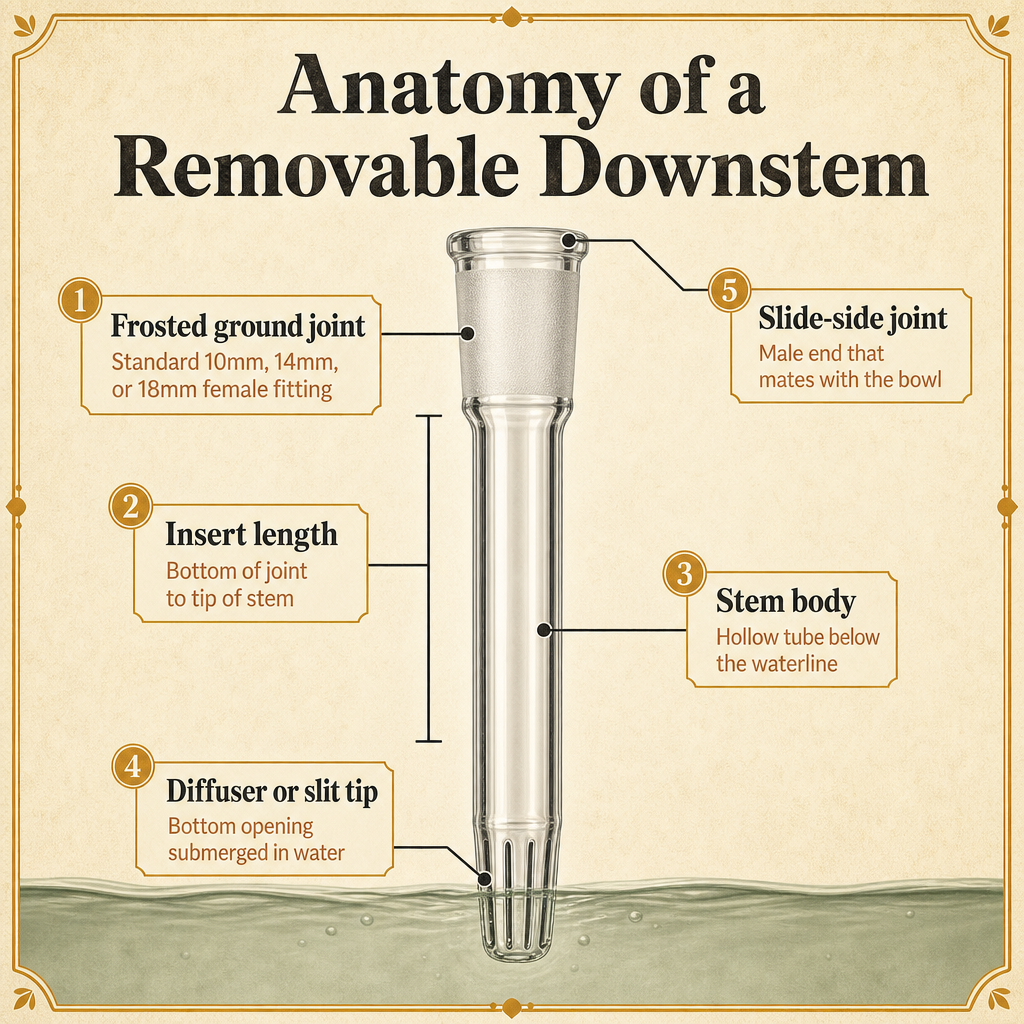
Every removable downstem is described by two numbers: the joint size that fits the bong and the insert length that sets how deep the tip sits in the chamber. Those two numbers fully determine fit, which is why a one-line label like "14/14mm, 5 inch" is enough to find a matching replacement [1].
The joint size is the diameter of the frosted ground-glass connection at the top of the stem. The insert length is the straight run from the bottom edge of that frosted joint down to the very tip of the stem. Together they tell you whether the stem will seat in your bong and whether the tip will land at the right depth in the water [2].
Before you start shopping, write down both numbers. If you skip one, the replacement will not seat, the tip will float dry, or the stem will press against the chamber bottom. Pieces like the SILICONE BEAKER BONG WITH REMOVABLE GLASS BOWL are designed around the same two-number system, so matching the bong-side and slide-side joints is what lets the part swap in cleanly.
- Joint size: the diameter of the frosted ground joint at the top of the stem, measured in millimeters (10mm, 14mm, or 18mm).
- Insert length: the straight run from the bottom edge of the joint to the tip of the stem, rounded to the nearest 1/4 inch.
- Both numbers must match before you buy: a stem with the right length but the wrong joint will not seat, and a stem with the right joint but the wrong length will not filter correctly.
How Do You Find Your Bong’s Joint Size (10mm, 14mm, or 18mm)?
Start by looking at the downstem you already have. Most removable downstems have the joint size printed or etched on the glass, often near the frosted connection. If the old stem is labeled 14mm or 18mm, you can shop for the same size and skip the rest of this step [1].
If you do not have a stem on hand, the dime test is the standard DIY trick. Take a US dime and try to slip it into the female joint on the bong. A dime slips halfway into a 14mm female joint, slips fully into an 18mm female joint, and will not fit at all into a 10mm female joint. That single test rules the three common sizes in or out in a few seconds [3].
You can also sanity-check the size against the piece itself. 10mm joints are often called "micro" or "nano" and show up on mini pieces and pocket rigs. 14mm is the most common size on small to mid-size bongs. 18mm is the most common size on medium to large bongs. For a deeper look at where these joints sit on the rest of a piece, see our breakdown of What Are the Parts of a Bong, Rig, or Pipe and How Do They Work?, and for a full walkthrough of choosing the right stem, read How Do You Choose the Right Downstem for Your Bong?. For a focused look at the three sizes, see What Are 10mm, 14mm, and 18mm Glass Joint Sizes?.
- Read the label on the existing stem first: most removable downstems have the size printed or etched on the glass.
- Use the dime test if no stem is on hand: a dime slips halfway into a 14mm joint, fully into an 18mm joint, and not at all into a 10mm joint.
- Sanity-check against the piece: 10mm on mini pieces and pocket rigs, 14mm on small to mid-size bongs, and 18mm on medium to large bongs.
What Is the Difference Between 14mm and 14.5mm, or 18mm and 18.8mm?
The rounded and the technical labels describe the same joint family. A "14mm" joint technically measures about 14.4mm or 14.5mm, and an "18mm" joint technically measures about 18.8mm. The industry rounds the numbers for short labels, so 14mm and 14.5mm appear interchangeably on shop pages, and 18mm and 18.8mm appear interchangeably as well [4].
This is also why a 14mm bowl fits a 14.5mm female joint without wiggling. The two naming conventions describe the same physical size, so you do not need to worry about chasing the exact decimal. If you see a listing that says 14.5mm and the rest of your setup is labeled 14mm, they will mate.
The other thing to know is gender. Ground-glass joints come in male and female versions, and they must be opposite to mate. A standard removable downstem has a female frosted joint on the bong side and a male joint on the slide side so a bowl can plug into it. For a step-by-step walkthrough of measuring a joint that does not already have a stem in it, see How Do I Measure My Bong’s Joint Size?.
- 14mm and 14.5mm are the same joint family: the technical measurement is 14.4mm or 14.5mm, rounded to 14mm on labels.
- 18mm and 18.8mm are the same joint family: the technical measurement is 18.8mm, rounded to 18mm on labels.
- Male and female joints must be opposite to mate: a removable downstem is female on the bong side and male on the slide side so a bowl can plug in.
How Do You Measure Downstem Length Correctly With the Pencil Method?
The pencil method is the standard DIY way to measure insert length when no downstem is on hand. You insert a straight object into the female joint, mark where it exits the top of the joint, pull it out, and measure from the mark to the tip of the object. Most guides use a pencil, a wooden dowel, or a thin chopstick because the tip is narrow enough to mimic the bottom of a real stem and the wood is easy to mark with a pen [1] [3].
The tip of the pencil should sit roughly 1/4 inch above the chamber bottom for most pieces. For pieces taller than about 8 inches, leave about 1/2 inch of clearance instead. This keeps the diffuser tip submerged so smoke is pulled through the water, and it keeps the tip from pressing against the glass [2] [3].
Once the pencil is at the right depth, mark it where it exits the top of the frosted joint, pull it out, and measure from the mark to the tip with a ruler. That measured run is your insert length. Round to the nearest 1/4 inch because both stores and manufacturers list lengths in 1/4 inch steps. Downstems for pieces like the Red Eye Tek 12" Orion Beaker Base Glass Water Pipe follow the same length system, so the pencil measurement will line up with the listed lengths on the product page.
- Insert a straight object (pencil, dowel, or chopstick) into the female joint until the tip is about 1/4 inch above the chamber bottom (about 1/2 inch for pieces taller than 8 inches).
- Mark the object where it exits the top of the frosted joint, pull it out, and measure from the mark to the tip with a ruler.
- Measure from the bottom edge of the frosted joint to the tip, not from the top of the joint, and round to the nearest 1/4 inch.
How Long Should a Downstem Be for a Beaker vs. a Straight Tube vs. a Mini?
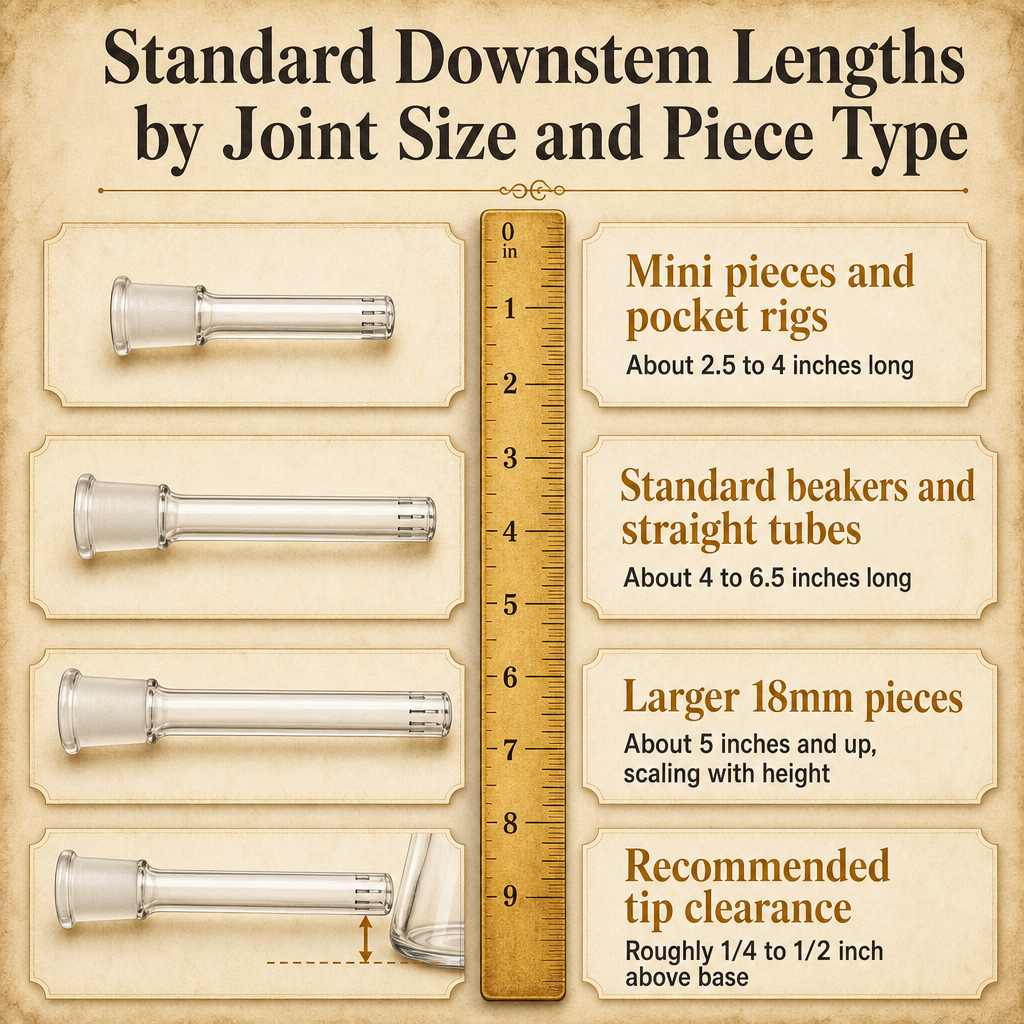
Standard downstem length ranges scale with joint size and piece type. Mini pieces and pocket rigs use short stems in the 2.5 to 4 inch range. Standard beakers and most straight tubes use medium stems in the 4 to 6.5 inch range. Larger 18mm pieces run longer than that, with their length scaling with chamber height [3].
These ranges are the sanity check on the pencil method. If your pencil reads about 5 inches and you have a typical 14mm beaker, the pencil measurement is right in the middle of the standard range. If your pencil reads about 3 inches and the piece is a small 14mm straight tube, that fits the standard range too. If your pencil reads a number that does not fit the range for your joint size, double-check the joint size first and then re-measure the length.
Removable downstems are also labeled with two numbers, one for the bong-side joint and one for the slide-side joint. Common configurations are 18/14mm, 18/18mm, 14/14mm, and 14/10mm. The first number matches the joint in your bong, and the second matches the bowl or slide you already own.
The tip of the stem should sit roughly 1/4 inch to 1/2 inch above the base of the chamber. This is the clearance that keeps the diffuser submerged without pressing against the glass, and it is the same clearance the pencil method targets [2] [5].
- Mini pieces and pocket rigs: short stems in the 2.5 to 4 inch range, usually paired with 10mm or 14mm joints.
- Standard beakers and most straight tubes: medium stems in the 4 to 6.5 inch range, usually paired with 14mm or 18mm joints.
- Larger 18mm pieces: longer stems, starting around 5 inches and scaling with chamber height.
- Tip clearance: keep the diffuser tip roughly 1/4 to 1/2 inch above the chamber bottom so it stays submerged without pressing against the glass.
What Happens When a Downstem Is the Wrong Size?
A downstem that is the wrong size creates one of two mechanical problems: the stem is too long, or the stem is too short. Both are easy to spot once you know what to look for, and both are fixed by re-measuring with the pencil method and matching the length range for your joint size [1] [5].
A stem that is too long can press against the chamber bottom. When the bottom of the diffuser or slit tip rests on the glass, even small pressure changes can crack the chamber. If you can see or feel the tip touching the glass at the base of the bong, the stem is too long and needs to be swapped for a shorter insert length.
A stem that is too short leaves the diffuser tip above the waterline. Smoke then bypasses the water and the bong draws dry. If you fill the chamber normally and the tip sits above the water, the stem is too short. The right fix is a longer stem, not a higher water level, because raising the waterline often just pushes water into the mouthpiece.
Splashy, rough draws after a downstem swap are almost always a sizing issue. Re-measure with the pencil method, confirm the joint size with the label or dime test, and match the length to the standard range for your joint size.
- Too long: the diffuser tip presses against the chamber bottom and can crack the glass under pressure.
- Too short: the diffuser tip sits above the waterline, so smoke bypasses the water and the draw feels dry.
- Splashy or rough draws after a swap: a sizing issue, not a cleaning issue. Re-measure with the pencil method and match the length range for your joint.
What Other Parts Should You Check or Upgrade Alongside the Downstem?
A downstem is only one part of a removable setup. The bowl on the slide-side joint, the ash catcher on the bong side, and any joint adapters in between all need to match the same two-number system. If you replace one part in the chain, the others still have to fit, so it is worth checking the whole setup in one pass.
If you already have a bowl that fits your piece, write down its joint size before you buy a downstem. The slide-side joint on the downstem has to match that bowl, which is why removable downstems are sold in two-number configurations like 14/14mm, 14/10mm, 18/14mm, and 18/18mm.
If you want to add filtration between the bong and the downstem, an ash catcher is the standard upgrade. The end that plugs into the bong must match the bong-side joint size, and the end that holds the downstem must match the downstem’s bong-side end. Browse Ash Catchers to see how ash catchers line up with different joint sizes.
If the bong and the bowl do not share a joint size, a joint adapter is the bridging piece. Adapters convert one joint size to another, so a 14mm male and an 18mm female can mate through the adapter. Confirm the gender labels on each end of the adapter before you buy, because the adapter only works if the genders line up on both sides.
- Bowl: the slide-side joint of the downstem must match the bowl you already have, which is why downstems are sold in two-number configurations.
- Ash catcher: the bong-side joint must match the bong and the downstem-side joint must match the downstem you plan to install.
- Joint adapter: a bridging piece that converts one joint size or gender to another when the bong and bowl do not match.
Frequently Asked Questions
What is the difference between 14mm and 14.5mm downstems?
There is no practical difference. The industry rounds 14.4mm and 14.5mm joints down to 14mm on labels, so a 14mm bowl fits a 14.5mm female joint. The same pattern applies to 18mm joints, which technically measure 18.8mm.
How do you measure a downstem without removing the old one?
Use the pencil method. Insert a straight object such as a pencil into the female joint until the tip is about 1/4 inch above the chamber bottom (about 1/2 inch for pieces taller than 8 inches), mark where it exits the top of the joint, pull it out, and measure from the mark to the tip.
How long should a downstem be for a beaker bong?
Most beakers and straight tubes use a medium downstem in the 4 to 6.5 inch range. Larger 18mm beakers often run longer than that, while mini pieces and pocket rigs use shorter stems in the 2.5 to 4 inch range.
Why does my bong splash or hit rough after a downstem swap?
A rough, splashy hit usually means the downstem is the wrong size. A stem that is too long can press against the chamber bottom, while a stem that is too short leaves its tip above the waterline so smoke bypasses filtration. Re-measure with the pencil method and match the length range for your joint size.
Do I need to match both numbers on a removable downstem?
Yes. Removable downstems are labeled with two numbers, for example 18/14mm, 18/18mm, 14/14mm, or 14/10mm. The first number is the bong-side joint that fits your piece, and the second is the slide-side joint that fits your bowl.
What Should You Do Next to Get the Right Replacement Downstem?
Start with two numbers and write them down: the joint size (10mm, 14mm, or 18mm) and the insert length you measured with the pencil method. If you have an old stem, the label tells you both. If not, the dime test rules the joint size in or out, and the pencil method gives you the length.
Match the length to the standard range for your joint size and piece type: about 2.5 to 4 inches for mini pieces, about 4 to 6.5 inches for standard beakers and straight tubes, and roughly 5 inches and up for larger 18mm pieces. That sanity check catches the two common sizing mistakes before you order.
If you are also shopping for a new bowl, an ash catcher, or a joint adapter, line up the parts in one pass so the bong-side and slide-side joints all match. The right two numbers on each piece in the chain are what make the whole setup seat and filter the way it should. Browse our Downstems collection to find a replacement that fits your measurements, and remember that free shipping on orders $150+ applies across the rest of your parts when you bundle the pieces together.
Sources
- DankStop: How to Measure and Buy a Downstem: Simple Sizing Guide
- Thick Ass Glass: Downstem Sizing & Measurement Guide
- DankGeek: How to Measure a Downstem and Find the Right Joint Size
- Smoke Cartel: Everything You Need to Know About Glass Joint Sizes and Shapes
- Thick Ass Glass: Does Downstem Length Matter for Bong Functionality