
Most glass pieces break at home from a hard-floor drop, a shelf-edge knockoff, or a thermal-shock event — not from low-quality glass. To prevent a bong from breaking, store it upright in a low-traffic spot, use a padded hard-shell case or padded bag, and let glass cool to room temperature before sealing it. Borosilicate with consistent wall thickness and controlled annealing helps, but physical habits are what prevent impact breaks.
Why Do Glass Pieces Break at Home in the First Place?
Glass pieces rarely fail for one big reason. They fail because small habits stack up over months — a piece left near the edge of a shelf, a cold rinse after a session, a piece shoved into a crowded drawer. The three real-world failure modes are impact, thermal shock, and tip-overs, and each one has its own fix. Once you know which one you are protecting against, the storage question gets simpler.
Most smoking glass is made from borosilicate glass, which SCHOTT describes as a material with a low coefficient of thermal expansion, higher chemical durability, and stronger thermal resistance than soda-lime glass [6]. In plain language, borosilicate handles temperature swings better than the glass in a drinking tumbler — but it is not unbreakable. A drop on a hard floor will chip, crack, or shatter it just like any other glass.
Manufacturer guidance is clear on what borosilicate does and does not do. The material resists thermal shock well, but whether a piece actually reaches that durability depends on glass thickness and on whether the glass was properly annealed during manufacturing to release internal stress [1]. A thin, poorly annealed bong will break faster than a thick, well-annealed one, even when both are labeled borosilicate. That is why physical habits — where you put the piece, how you store it, what you do before sealing it in a case — do more to prevent breakage than the label on the box.
If you are starting fresh and want a piece that can take everyday handling, browse our Bags / Cases for bags, hard-shell cases, and padded stash options that match the storage habits below. The joint size on your piece also matters for fit and replacement parts — the What Are 10mm, 14mm, and 18mm Glass Joint Sizes? walks through 10mm, 14mm, and 18mm in plain language.
- Impact breaks: the most common cause at home, usually a hard-floor drop, a knock off a shelf edge, or two pieces clinking together in a drawer [1].
- Thermal shock: abrupt hot-to-cold transitions (a hot rinse into a cold bowl) stress thin glass sections and can crack them [5].
- Tip-overs: a tall or unanchored shelf can bring the whole collection down in one second, especially in homes with kids, pets, or vibration from speakers or footsteps.
- Borosilicate resists thermal shock better than soda-lime glass, but it does not make a piece impact-proof, and it only delivers its potential when thickness and annealing are right [1] [6].
Where in the Room Should You Keep a Bong or Glass Pipe So It Does Not Get Knocked Over?
The room-placement decision matters more than most people think. A piece that lives in the back corner of a stable shelf, away from the edge, out of direct sun, and away from a heater or kitchen steam will be there in a year. A piece that lives at the front of a crowded shelf, next to a vibrating speaker, or on a wobbly side table is living on borrowed time. The good news is that placement is free — it just takes a one-time reset.
Published home-storage guides converge on the same advice: store a piece in a cool, dark, dry corner, off a cluttered shelf, and away from direct sunlight, humidity, and heat sources [2]. The reason for the dark and dry conditions is not just breakage — temperature swings stress glass over time, and UV light can fade artistic color finishes on decorated pieces. A closet shelf, a low cabinet, or a padded drawer all qualify if the spot stays cool and dry year-round.
If you have kids, pets, or unstable furniture in the home, anti-tip anchoring is non-negotiable. The American Academy of Pediatrics’ HealthyChildren.org guidance recommends securing bookcases, dressers, and similar furniture with anti-tip anchoring devices, and placing heavier items on lower shelves to lower the risk of tip-overs [7]. Glass pieces qualify as heavier items, and shelves holding them should be anchored with metal L-bracket or strap-style hardware rather than relying on the shelf’s own weight.
For a deeper walk-through of the broader accessory-storage setup, our How Do I Store My Smoking Accessories the Right Way? covers the full routine for bongs, pipes, rigs, and tools in one place. For people who split time between home and the road, our How Do You Protect Glass Accessories While Traveling? covers how to protect glass while traveling so the habits here translate to a car trunk or a checked bag. New to glass in general? The What Is the Best Smoking Piece for a Beginner? lays out the beginner-friendly pieces that tend to hold up best under everyday handling.
- Pick a low-traffic spot in a cool, dark, dry part of the room, away from the edge of any shelf [2] [3].
- Store the piece upright on a stable, level surface — a wobbly side table or a vibrating speaker stand is a break waiting to happen.
- Keep pieces out of direct sunlight and away from heat sources, humidity, and kitchen or bathroom steam, since UV fades color finishes and temperature swings stress glass over time [2].
- In homes with kids or pets, anchor the shelf or cabinet with metal L-brackets or anti-tip straps, and put glass pieces on lower shelves rather than the top [7].
What Kind of Storage Case or Padding Actually Protects Glass at Home?
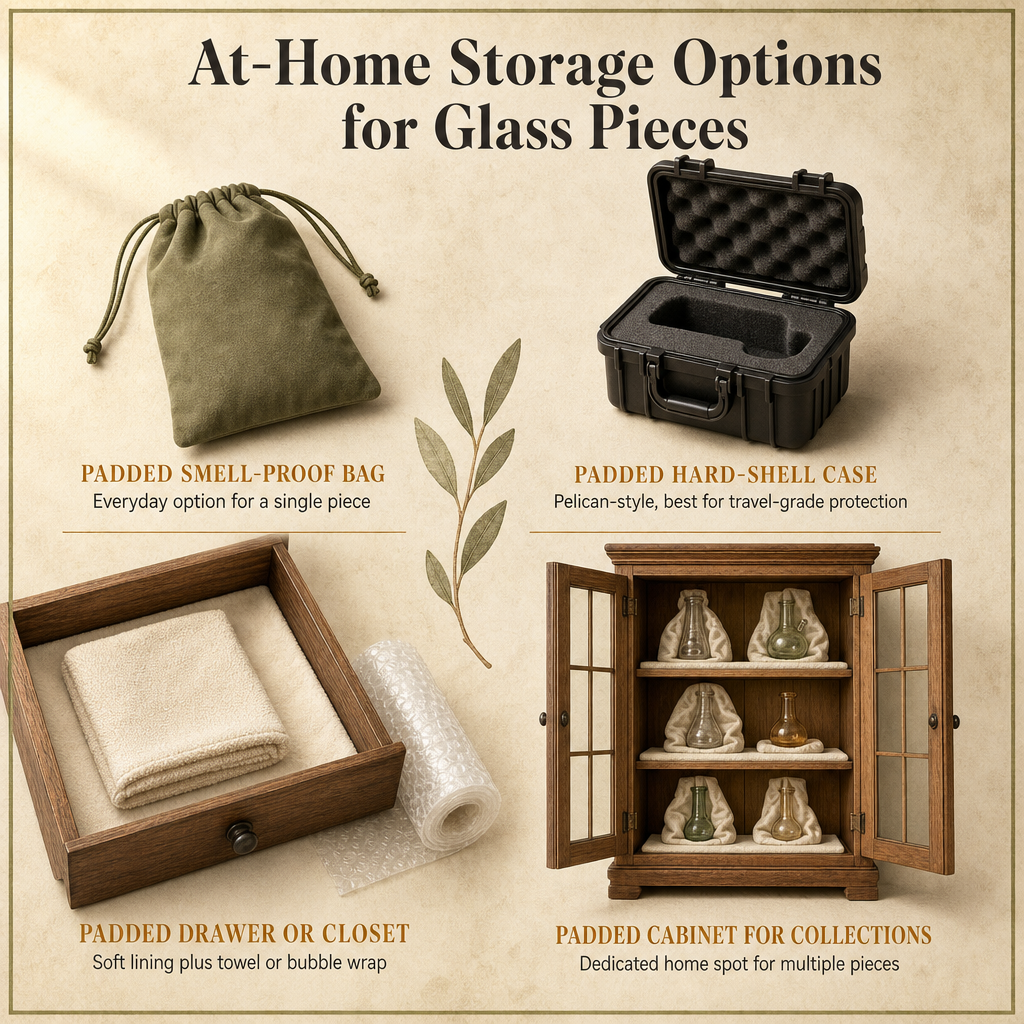
Once you have a placement spot, the next decision is what the piece actually sits in. The four practical options for everyday home storage are: a padded smell-proof bag, a padded hard-shell case (Pelican-style cases are the most common example), a padded drawer, and a padded closet shelf. None of these is the best in every situation — they trade off size, mobility, and how often you reach for the piece. The right one depends on whether the piece lives at home full-time, travels with you, or sits in a collection.
A padded hard-shell case is the strongest option for protecting glass against drops, knocks, and being stacked on top of other things, and it is the closest thing to a Pelican-style camera case that the cannabis space routinely points to [3] [4]. A padded smell-proof bag is the everyday option for a single piece — it absorbs light bumps and reduces odor in the room. A drawer lined with soft padding works for pieces that never leave the house, and a closet shelf wrapped in a towel or bubble wrap is the low-cost option for short-term storage.
For people who want a single product that handles the everyday case, the Treehouse Smell-Proof Travel Case is the smell-proof padded case we built specifically for keeping a piece and its attachments together in one place. For larger collections, a dedicated padded cabinet adds another layer of protection and keeps all your pieces in a stable spot [2]. Whichever option you pick, the pre-storage prep matters more than the case itself — a piece that goes into a hard-shell case still warm, wet, or with the bowl and downstem attached is a piece that can crack, spot, or grow residue inside the case.
Here is the prep routine to do before any piece goes into any case or bag: clean the piece, dry it completely, detach the bowl and downstem, let everything cool to room temperature, then pack. That checklist is what makes the difference between a case that protects your glass and a case that traps the conditions that damage it.
- Padded hard-shell case (Pelican-style): the strongest drop and knock protection; best for valuable pieces and any glass that travels in a car [3] [4].
- Padded smell-proof bag: the everyday option for a single piece at home; light, soft, and reduces odor in the room [2] [4].
- Padded drawer or closet: line a drawer with soft padding or wrap a piece in a towel or bubble wrap for short-term, low-mobility storage [4].
- Padded cabinet for collections: a dedicated spot for multiple pieces, with compartments or dividers so glass does not knock against glass [2] [3].
| Storage option | Best for | Key strength |
|---|---|---|
| Padded hard-shell case | Valuable pieces, travel-grade protection | Strongest drop and knock resistance |
| Padded smell-proof bag | Everyday single-piece storage | Light, discreet, reduces odor |
| Padded drawer or closet | Pieces that never leave the house | Low-cost, low-mobility setup |
| Padded cabinet | Multi-piece collections | Centralized, organized storage |
Which Parts of a Glass Piece Are Most Likely to Chip or Crack?
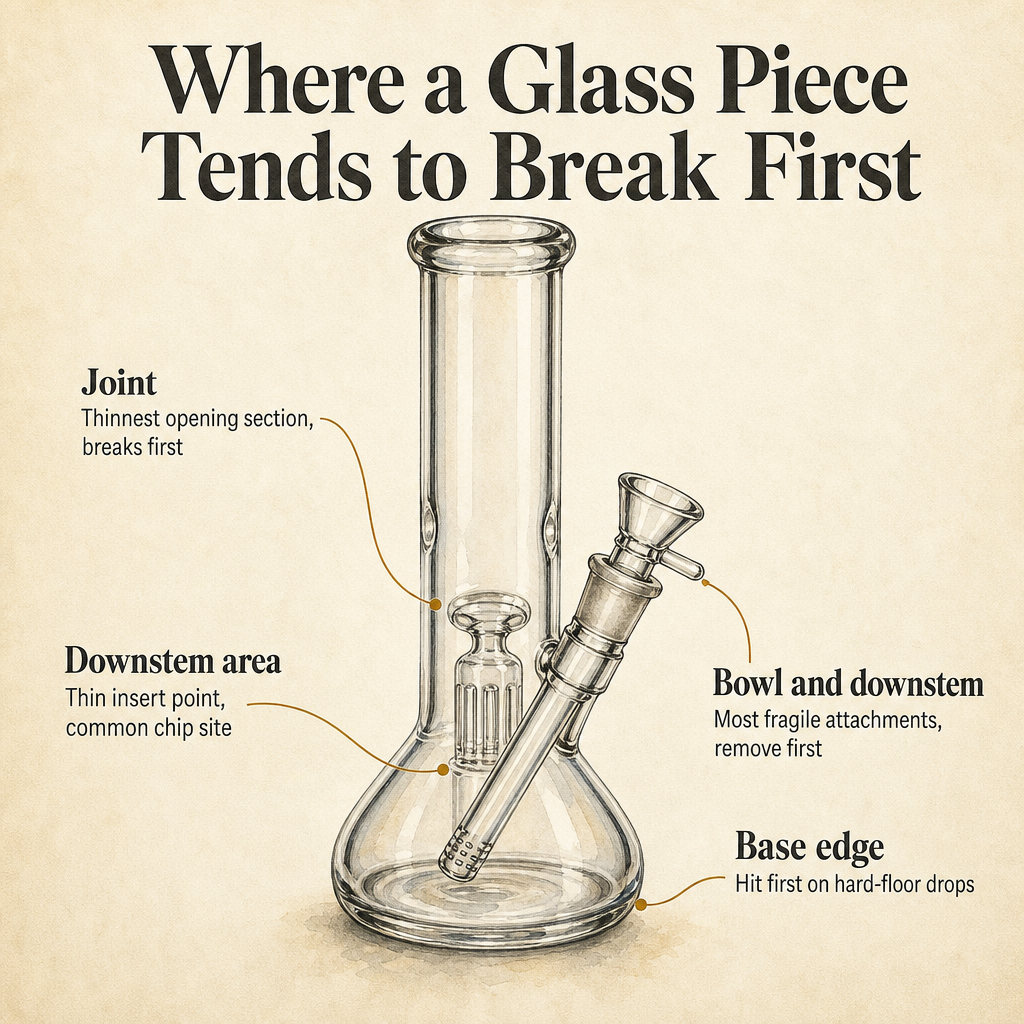
Glass does not usually break in the middle of a thick wall. It breaks where the wall is thinnest or where stress concentrates. For a bong or pipe, that means the joint (where the bowl or downstem inserts), the downstem area itself, the base edge, and any thin decorative sections. When a piece hits a hard floor, the base edge or the joint is almost always where the crack starts, because those points absorb and concentrate impact force [1]. The thicker parts of the wall can flex a little; the thin sections cannot.
The same thin sections are the first to crack under thermal shock. Borosilicate glass resists thermal shock better than soda-lime glass because it has a low coefficient of thermal expansion — it expands and contracts less when temperature changes [1] [6]. But less is not none. A piece that just finished a session and is still warm, then gets hit with cold rinse water or sealed into a hard-shell case in a cool closet, can crack at the same thin sections that drops would crack. The thermal-shock mechanism is different (stress from temperature differential, not direct impact), but the break-initiation points overlap [5].
The practical implication is that protecting the thin sections protects the whole piece. Manufacturer guidance recommends removing the bowl and downstem before placing a piece in padded storage, because those are typically the most fragile parts [4] [1]. Wrapping each piece individually when more than one is stored together keeps glass from knocking against glass. Matching the right bowl and downstem to the right joint — measured correctly — matters too, because a forced fit stresses the joint every time it is inserted. Our How Do I Measure My Bong’s Joint Size? walks through how to measure a bong joint at home in a few seconds with a ruler.
Treating the joint, downstem area, and base edge as the high-priority zones for storage and handling is what turns a fragile piece of glass into one that lasts. The thicker parts can take more stress; the thin parts cannot.
- Joint (where the bowl or downstem inserts): thinnest opening section on most pieces; common chip and crack site under both impact and thermal stress [1].
- Downstem area: thin insert point, often the first place a crack travels from when force hits the joint [1] [4].
- Base edge: hit first on a hard-floor drop, especially on flat-bottomed pieces with a thin rim [1].
- Bowl and downstem attachments: the most fragile parts by design; remove them before placing a piece in any padded storage [4].
Does Cleaning or Water Left Inside a Piece Make It More Likely to Break Later?
Water left inside a piece does not weaken the glass itself — that is a common myth. What it does is create the conditions for other problems. Trapped moisture in a sealed case can support mold growth over time and leave mineral spotting on the inside of the glass that is hard to clean later. Residue in the bowl or downstem attracts dust and odor, and a wet piece sealed in a padded bag is essentially a slow, damp environment for whatever is in there with it [2] [3].
The recommended pre-storage routine is the same across the major guides: clean the piece, dry it completely, let it cool to room temperature, detach the bowl and downstem, and only then put it into a padded case or bag [2] [3] [4]. The cooling step is the one people skip most often — they rinse a warm piece, dry the outside, and seal it into a hard-shell case. Inside that case, residual heat meets a smaller air volume, and the glass sees a faster temperature change than it would on an open shelf.
For people who want a more forgiving material that handles drops and rough handling without breaking, Silicone Bongs covers silicone bongs as an alternative to glass for everyday use. Silicone is not glass and behaves differently under heat and cleaning, so it is a complement rather than a replacement — but for households where drops and knocks are unavoidable, it is worth knowing the option exists.
The bottom line: water left inside a piece will not crack the glass on its own, but it will shorten the useful life of the piece by trapping moisture, residue, and odor in a closed space. The five-minute prep routine before storage is what keeps the piece clean, dry, and ready to use the next time.
- Clean the piece: residue in the bowl or downstem attracts dust and odor in storage [2] [3].
- Dry it completely: trapped moisture supports mold growth and leaves mineral spotting on the inside of the glass [2].
- Let it cool to room temperature: putting a warm piece into a sealed case exposes it to a fast temperature change inside that enclosed space [2].
- Detach the bowl and downstem: those are the most fragile parts, and storing them separately keeps them from chipping each other or the joint [4].
- Then pack: only after clean, dry, and cool should the piece go into a padded case, bag, drawer, or cabinet.
What Glass Quality Markers Actually Matter When You Buy a New Piece?
If you are shopping for a new piece — or wondering whether your current one is worth keeping — three durability markers are worth checking. They are not about color, percolators, or branding. They are about whether the glass itself can take everyday handling without failing.
The first marker is the material: borosilicate glass. SCHOTT describes borosilicate as a glass with a low coefficient of thermal expansion, which is the property that gives it better thermal-shock resistance than soda-lime glass [6]. A piece labeled borosilicate will handle temperature changes better than a generic glass piece. The second marker is glass thickness. Manufacturer guidance is explicit that borosilicate only delivers its full durability when the glass is thick enough — thin walls can chip and crack even when the material is right [1].
The third marker, and the one most people have never heard of, is annealing. Annealing is the controlled cooling process that releases internal stress locked into the glass during forming. A well-annealed piece has uniform internal stress, which means force applied to one spot does not travel unpredictably through the wall. A poorly annealed piece can crack from internal stress alone, even without a drop [1]. You cannot see annealing by looking at a piece, but a manufacturer that talks about controlled annealing in their process documentation is signaling that they take this seriously.
- Borosilicate composition: the standard for smoking glass; resists thermal shock better than soda-lime glass because of its low coefficient of thermal expansion [6].
- Glass thickness: thicker walls resist impact and chipping better than thin walls, even when the material is the same [1].
- Controlled annealing: the manufacturing step that releases internal stress in the glass; a well-annealed piece handles everyday stress without cracking from internal pressure alone [1].
What Is the Single Best Anti-Tip Fix for a Shelf Holding Glass?
If you take one action after reading this article, anchor the shelf. The American Academy of Pediatrics’ HealthyChildren.org guidance is unambiguous: secure bookcases, dressers, and similar furniture with anti-tip anchoring devices, and place heavier items on lower shelves to lower the risk of tip-overs [7]. Glass pieces are heavier items by this definition. A shelf holding glass should be anchored, period.
The recommended hardware is metal L-brackets or anti-tip straps, not plastic anchors or adhesive strips. Metal anchors hold under the dynamic force a tip-over generates, and they are easy to install with a drill and a stud finder. Plastic and adhesive options tend to fail at exactly the moment you need them. If you cannot anchor the shelf — because it is built-in, rental-restricted, or simply not worth modifying — the next best fix is to move the glass pieces to a lower shelf, where a tip-over is less destructive and less likely to land on a hard floor.
If your furniture is genuinely unstable (wobbly legs, an uneven floor, particleboard that has started to sag), do not store glass on it at all. Move the piece to a stable, low shelf in a cool, dark, dry spot and anchor that shelf if possible. The fix is rarely the shelf itself — it is the relationship between the piece, the surface, and the room.
- Use metal L-brackets or anti-tip straps to anchor any shelf or dresser holding glass pieces — plastic or adhesive hardware is not reliable under tip-over force [7].
- Place glass pieces on lower shelves, not the top, so a tip-over is less destructive and less likely to land on a hard floor [7].
- Move pieces off furniture that is wobbly, sagging, or uneven; the fix is a different shelf, not a different piece of glass.
Frequently Asked Questions
Where in the room should I keep a bong or glass pipe to keep it from breaking?
Store a bong upright in a low-traffic area, off cluttered shelves, and on a stable surface away from the edge. Keep it out of direct sunlight, away from heat sources, and out of humid spots — temperature swings stress glass over time and UV light can fade artistic color finishes, so a cool, dark, dry corner of a room is the target.
Why do glass pieces tend to crack at the joint, downstem, or base?
Impact breaks usually start at the thinnest sections of the piece — the joint, downstem area, and base edge — because those points absorb and concentrate force. That is why manufacturer guidance recommends removing the bowl and downstem before padded storage, and why abrupt hot-to-cold transitions (thermal shock) tend to crack those same thin sections first.
Does cleaning or water left inside a piece make it more likely to break later?
It does not weaken the glass structurally, but storing a piece wet traps moisture that can support mold growth and leave mineral spotting, and residue attracts dust and odor. The recommended pre-storage routine is to clean the piece, dry it completely, let it cool to room temperature, and only then put it into a padded case or bag.
What kind of storage case or padding actually protects glass at home?
Padded hard-shell cases (Pelican-style cases are cited as one example) and smell-proof padded bags are the most reliable everyday options. For larger collections, a dedicated padded cabinet adds another layer; for single pieces, a drawer lined with soft padding or a closet wrapped in a towel or bubble wrap is the practical low-cost option.
Is borosilicate glass unbreakable?
No. Borosilicate has a lower coefficient of thermal expansion and higher chemical durability than soda-lime glass, which is why it resists thermal shock better, but it still breaks on impact. Whether borosilicate reaches its full durability depends on glass thickness and manufacturing quality — controlled annealing to release internal stress and uniform wall thickness across the piece.
What home storage mistakes are most likely to chip or shatter glass?
The most common are: putting a piece near a shelf edge where it can be knocked off, leaving glass attachments and adapters loose so they rattle against each other, sealing a piece into a case while it is still warm, and storing pieces on tall or unanchored furniture in a home with kids or pets.
So What Is the Easiest Way to Stop Breaking Glass at Home?
The single highest-leverage habit is to pick a placement spot and stick with it: a cool, dark, dry, low-traffic corner of a stable, anchored shelf, with the piece upright and away from the edge. Once the placement is right, the rest of the routine — clean, dry, cool, detach fragile parts, then case — keeps the piece in good shape between uses. Borosilicate glass with consistent wall thickness and controlled annealing gives you a better starting point, but it does not replace the physical habits that prevent drops in the first place.
If you want to upgrade your setup in one move, start with a padded case and an anchored shelf. Those two changes cover most of the failure modes described above — impact, tip-overs, and case-interior thermal shock — and they do not require replacing any of your existing glass. From there, the pre-storage prep routine (clean, dry, cool, detach, then pack) is what keeps the piece ready to use the next time you reach for it.
For pieces that move between home and the road, our guide on how to protect glass while traveling covers the travel-specific habits — bag choice, vehicle placement, and airport-bag thinking — so the storage habits here translate outside the house. A single padded case or a replacement smell-proof bag is an easy add-on to your next restock.
Sources
- Thick Ass Glass: Does Borosilicate Glass Break Easily When Used for a Bong?
- Smoke Cartel: Best Ways to Store a Bong & Dab Rig Safely
- Weedmaps: A Guide to Storage Essentials for Your Cannabis Gear
- Thick Ass Glass: Bong Storage Ideas: Smart Ways to Store Your Glass Safely
- Aegg Creative Packaging: Thermal Shock — An Explanation of Why Glass Breakage Occurs and How to Prevent It
- SCHOTT AG: Borosilicate Glass — Material Properties
- American Academy of Pediatrics (HealthyChildren.org): Preventing Furniture and TV Tip-Overs