

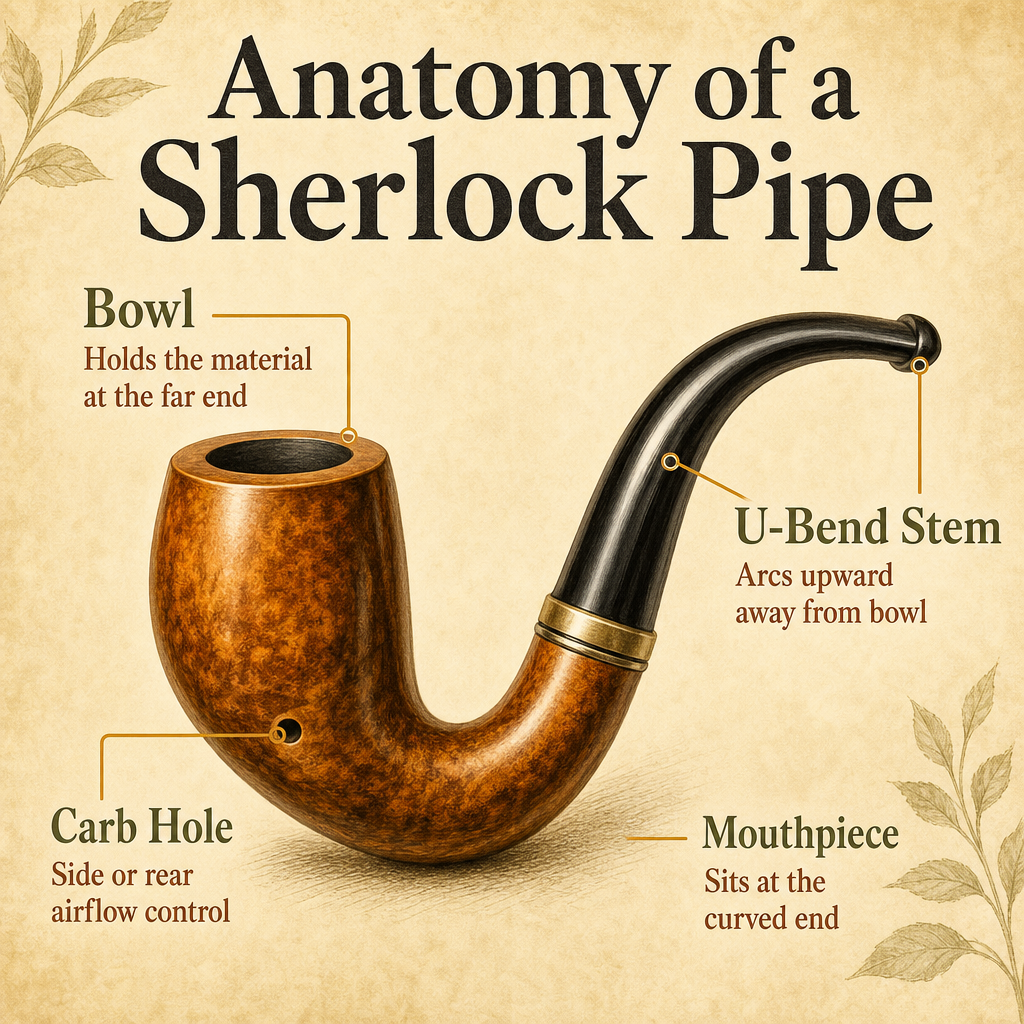
A sherlock pipe is a hand pipe with a long stem that arcs upward and away from the bowl toward the mouthpiece, often compared to a saxophone silhouette. [1] [2] The name comes from the curved pipe associated with Sherlock Holmes, created by Arthur Conan Doyle in 1887. [4] The U-bend cools the smoke by forcing it to change direction before reaching the mouthpiece, [1] [3] and most include a carb hole. [1]
If you have ever spotted a long, gracefully curving pipe on a shelf and wondered why it looks so different from a spoon or a chillum, this guide walks through the shape, the parts, the materials, and how a sherlock compares to the other common hand pipes.
What Is a Sherlock Pipe and Where Does the Name Come From?
A sherlock pipe is a hand pipe whose calling card is a long stem that arcs upward and away from the bowl before ending in a mouthpiece. [1] Industry guides describe the silhouette as resembling a saxophone or a walking cane, and the same U-bent profile is a familiar shape on head-shop shelves and online catalogs. [2] The defining trait is the curve itself: rather than the bowl and mouthpiece sitting on a flat line, the stem lifts away from the bowl and travels through a deep bend before reaching your lips.
The name is a direct nod to literature. Sherlock Holmes — the detective created by British author Arthur Conan Doyle — is shown with a curved pipe in illustrations and stage adaptations, and the arched profile became shorthand for the character. [4] Doyle’s first Holmes story, A Study in Scarlet, was originally published in the November 1887 issue of Beeton’s Christmas Annual, which is why the 1887 date is quoted as the origin of the look. [4] Manufacturers of traditional briar pipes also made an official Sherlock Holmes collection, which used a tubular, calabash shape that reinforced the curved silhouette. [4]
Industry sources also point out that the same deep-curve shape goes by other names on the same shelf. The profile is sometimes marketed as a "gandalf" pipe, borrowing from the wizard staff imagery in The Lord of the Rings, and traditional pipe-making has long referred to the long-stemmed bent profile as a calabash shape. [2] [4] [3] A "gandalf" or "calabash" listing on a product page is the same family of pipes.
- Arched stem that lifts away from the bowl and ends in a mouthpiece set apart from it [1] [2]
- Bowl fixed at one end, with a stem that travels through a deep U-bend before reaching the mouthpiece [1] [3]
- Carb hole on the side of or behind the bowl that controls airflow during use [1]
- Body usually made from glass, wood, or metal, with each material shaping the look and feel of the curve [1] [5]
- Named for the curved pipe associated with Sherlock Holmes, created by Arthur Conan Doyle in 1887 [4] [2]
- Industry nicknames for the same deep-curve silhouette include gandalf pipe and calabash shape [2] [4] [3]
How Does the Curved Stem Shape Actually Work?
The curved stem is the single biggest reason a sherlock looks and feels different from a spoon pipe. Instead of a straight tube, the smoke has to turn a sharp corner and travel a longer path before reaching your mouth. [3] Manufacturer sources describe the U-bend as an abrupt change of direction where hot smoke and vapor meet the relatively cool inner glass, which changes how the smoke feels as it travels. [3] Sources describe the result as a cooler pull relative to a straight pipe, not as a filter. [1] [5]
If you are new to hand pipes, our overview of What Are Hand Pipes and Bubblers, and How Do They Differ? explains how unbent and bent hand pipes fit into the wider category, and our guide on What Are the Different Types of Hand Pipes? walks through the other common shapes you will find on the same shelf. For a side-by-side look at the most familiar straight-stem alternative, the spoon pipe has its own breakdown in What Is a Spoon Pipe and How Does It Work?, which is useful reading before you decide which shape feels right for you.
The benefit of the curve is not magic. Sources are careful to note that the U-bend does not filter the smoke; it simply gives the smoke a longer path and a quick temperature change of direction. [1] [3] That extra travel is what shoppers usually mean when they describe a sherlock as feeling different from a straight spoon, and it is also why the shape is so closely tied to its literary namesake.
- Bowl sits at one end of the pipe and holds the material at the far tip [1] [3]
- Stem lifts away from the bowl and runs through a deep U-bend, lengthening the path the smoke has to travel [1] [3]
- Hot smoke changes direction at the bend, meeting the relatively cool inner surface of the glass along the way [3]
- Mouthpiece sits at the curved end of the stem, well away from the bowl, which is what gives the sherlock its saxophone look [1] [2]
What Is a Carb Hole on a Sherlock Pipe and What Does It Do?
A carb hole is a small extra opening on the side of or behind the bowl that lets air in and out of the pipe. [1] It is not there for looks — it is the main airflow control you have while the pipe is in use. When you cover the carb hole with a finger, air can only enter through the bowl, which slows the draw and lets you control the pace of the burn. [1]
When you lift your finger off the carb hole, fresh air rushes in through the side opening, which mixes with the smoke in the chamber and pushes it through the stem and out the mouthpiece. [1] This is the moment most users describe as "clearing" the bowl. The carb hole is what lets you clear the last of the smoke without having to lift the pipe away from your face.
Not every sherlock has a carb hole. Some designs are open-ended by default, which means airflow is controlled only by lifting the pipe off the bowl. If you prefer the covered-and-released style, look for a sherlock with a side or rear carb hole before you buy. [1]
- Most sherlocks have a carb hole on the side of or behind the bowl for airflow control [1]
- Covering the carb hole with a finger pauses airflow through the bowl and slows the draw [1]
- Releasing the carb hole lets fresh air in, which clears the last of the smoke through the mouthpiece [1]
What Materials Are Sherlock Pipes Typically Made From?
The three most common materials for a sherlock pipe are glass, wood, and metal, and each one shapes the experience in a different way. [1] [5] Glass is the most popular choice for the curved shape because the material can be shaped into a clean U-bend and stays relatively neutral in flavor. Wood has a warm, classic look but interacts with whatever you burn in it. Metal is the most durable option and is the simplest to wipe down, but it can affect flavor over time. [1] [5]
If you are shopping for a glass sherlock, look for borosilicate glass. Reference sources describe borosilicate as harder to break on impact and more resistant to cracking from significant temperature changes than soda-lime glass, which is why it is the common glass choice for hand pipes. [6] That extra resistance matters on a sherlock, because the long stem has more leverage during an accidental drop than a small spoon pipe.
Wooden sherlock pipes are porous and can absorb the smell of what is burned in them. Sources recommend dedicating a wooden sherlock to a single material or flavor profile rather than rotating between very different ones. [1] If you want flexibility with different flavors, glass is the safer choice. Our Sherlock Pipes collection of Sherlock Pipes is a good starting point for comparing glass and other materials, and Glass vs Silicone Smoking Accessories: Which Should You Choose? covers the broader glass vs silicone question if you want to compare materials across the full accessory category.
Metal sherlock pipes are the most rugged and travel-friendly, but they also tend to get hot to the touch during longer sessions and can change the flavor profile of your material. [1] [5] For shoppers who want something between glass and metal, silicone is a separate category altogether.
- Glass sherlocks are usually made from borosilicate glass, which is harder to break on impact and more resistant to thermal-shock cracking than soda-lime glass [6]
- Wood sherlocks have a classic look but can absorb the smell of what is burned in them, so most sources recommend dedicating a wooden sherlock to a single material or flavor profile [1]
- Wood sherlocks are porous and benefit from careful cleaning and rotating less frequently between very different materials [1]
- Metal sherlocks are the most durable option for travel and accidental drops, though they can get hot to the touch during use and may change the flavor profile over time [1] [5]
- Glass sherlocks are the easiest to deep-clean with isopropyl alcohol and salt because the inside of the bowl and stem is non-porous [5]
| Material | Durability | Flavor neutrality | Cleaning notes |
|---|---|---|---|
| Glass (borosilicate) | Resistant to impact and thermal shock [6] | High — clean-tasting pulls [1] | Isopropyl alcohol and salt [5] |
| Wood | Moderate; can chip or crack if dropped | Lower — wood absorbs smells [1] | Dedicate to one material; gentle cleaning [1] |
| Metal | High — best for travel [1] | Lowest — can change flavor over time [5] | Wipe-down; avoid abrasive scrubbing |
How Does a Sherlock Pipe Compare to a Spoon, Chillum, or Steamroller?
If you have ever wondered why a sherlock costs more than a spoon pipe, or whether a chillum is the same thing in a smaller package, the short answer is that the shape changes how the pipe feels and how you use it. A sherlock is built around a long, clearly visible curve, while a spoon, chillum, and steamroller are all straight or nearly straight shapes that sit much closer to the bowl. [1] [5]
A spoon pipe is the most familiar comparison. It is a small hand pipe with a bowl on one end and a mouthpiece directly opposite, with the carb hole on the side of the bowl. [1] Compared to a sherlock, a spoon has almost no stem to speak of, which makes it easier to pack into a small bag but means the smoke has a much shorter path to your mouth. [1] [5]
A chillum is a straight, tube-shaped pipe with a bowl on one end and an open mouthpiece on the other, traditionally wrapped at one end where you place the material. [1] There is no carb hole on a chillum because the bowl itself is the open end, which means you control airflow by lifting the chillum off the bowl. A steamroller is a long straight tube with a wide bowl on one end, a small mouthpiece on the other, and a carb hole on the side. [1] Steamrollers move more air than the other three shapes because of the wide bowl and open tube.
You can browse all of these shapes — including sherlocks, spoons, chillums, and steamrollers — from our main Hand Pipes category page, which keeps the family of unbent and bent hand pipes in one place.
- Sherlock vs spoon: sherlock has a long visible U-bent stem; spoon sits almost flat with the mouthpiece directly opposite the bowl [1]
- Sherlock vs chillum: sherlock is bent with a defined mouthpiece; chillum is a short straight tube with no separate mouthpiece and no carb hole [1]
- Sherlock vs steamroller: sherlock has a curved stem and a soft draw; steamroller is a long straight tube with a wide bowl and an aggressive airflow [1]
- Carb hole presence: sherlock and steamroller typically have one; spoon usually has one; chillum generally does not [1]
- Shape signature: sherlock is the only one of the four defined by a U-bend — the others are all straight or near-straight silhouettes [1] [2] [5]
How Do You Clean and Care for a Sherlock Pipe?
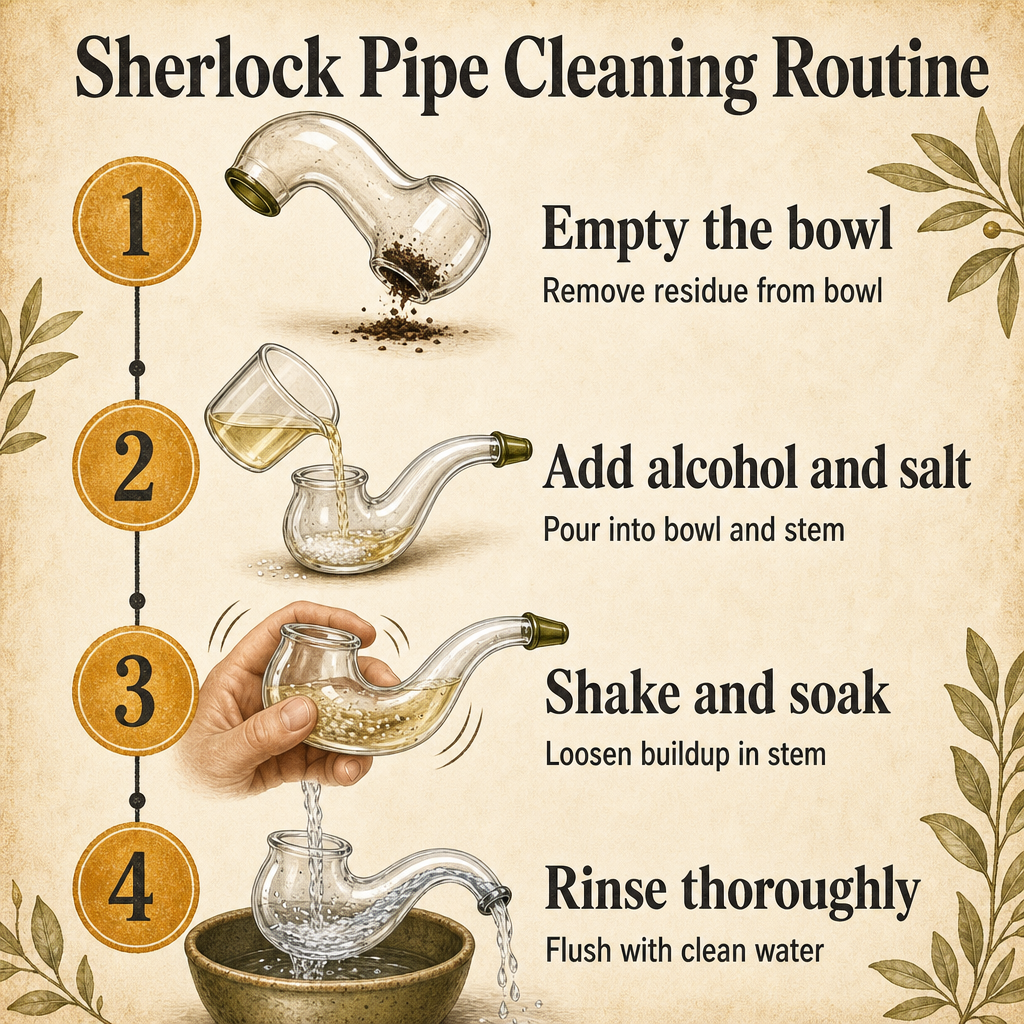
Cleaning a sherlock is not very different from cleaning any other hand pipe, but the long U-bend means you want to give the inside of the stem a little extra attention. Retail sources describe a simple routine using isopropyl alcohol and coarse salt, which is gentle enough for glass, wood, and metal variants when used with care. [5] Routine cleaning keeps residue from building up in the bend and helps the pipe taste neutral session after session.
For the glass version, the U-bend is the part most people miss. The longer path means residue can settle along the inside of the curve, so a longer soak and a careful rinse are worth the extra minute. Our Glass Hand Pipes subcategory of Glass Hand Pipes is a useful reference when you want to compare cleaning needs across the wider glass family.
Wood and metal need a softer touch. Wooden sherlocks should not be soaked in alcohol for long periods, because the wood is porous and can absorb the liquid along with the smell of whatever was last burned in the bowl. [1] Metal sherlocks should not be scrubbed with anything abrasive, since the finish can scratch and affect flavor. [5] Borosilicate glass, by contrast, can handle the full alcohol-and-salt routine without special treatment. [6]
- Empty the bowl and rinse the pipe with warm water to remove loose residue [1] [5]
- Pour isopropyl alcohol and a teaspoon of coarse salt into the bowl and stem, then cover both ends with your fingers or a stopper [5]
- Shake gently for one to two minutes so the salt scrubs the inside of the U-bend where residue tends to settle [5]
- Let the pipe soak for twenty to thirty minutes if buildup is heavy, then shake again before draining [5]
- Rinse thoroughly with warm water and let the pipe dry completely before the next use [5]
- Wooden sherlocks should not be soaked — wipe the bowl and stem with a salt-dampened cloth and avoid long alcohol baths [1]
- Glass sherlocks made from borosilicate can handle the full alcohol and salt routine, since the material resists thermal-shock cracking [6]
- Metal sherlocks should be cleaned with a soft cloth and avoided with abrasive scrubbers that can damage the finish [5]
Frequently Asked Questions
Is a sherlock pipe the same as a gandalf pipe?
Does the curve in a sherlock pipe filter the smoke?
Why are glass sherlock pipes often labeled borosilicate?
Borosilicate glass is harder to break on impact and more resistant to cracking from significant temperature changes than soda-lime glass, which is why it is the common glass choice for hand pipes. [6]
Can you use a wooden sherlock pipe for different flavors?
Wood can absorb the smell of what is burned in it, so sources recommend dedicating a wooden sherlock to a single material or flavor profile rather than rotating between very different ones. [1]
What is the easiest way to clean a sherlock pipe?
Retail sources describe cleaning with isopropyl alcohol and salt for the bowl and stem, then rinsing thoroughly — a routine that works for the glass, wood, and metal variants covered in this guide. [5]
How do I tell a sherlock pipe apart from a spoon pipe at a glance?
A sherlock has a long stem that visibly arcs away from the bowl toward the mouthpiece, while a spoon pipe sits almost flat with the mouthpiece directly opposite the bowl. [1]
Which Sherlock Pipe Is the Right Fit for Your Shelf?
A sherlock pipe is more than a nod to a famous detective — it is a hand pipe whose long, U-bent stem gives the smoke a longer path and a quick change of direction before it reaches the mouthpiece. [1] [3] The shape is what defines the piece, and the material — glass, wood, or metal — is what shapes the day-to-day experience of using it. [1] [5]
If you want the lightest flavor profile and the easiest cleaning, a borosilicate glass sherlock is the standard choice. [6] If you want a classic wooden look and are willing to dedicate the pipe to one material, a wooden sherlock is the traditional pick. [1] If you want something travel-friendly and durable, metal is the most rugged option. [5] For a clean routine, isopropyl alcohol and coarse salt will keep any of the three looking and tasting right. [5]
Tell us in the comments — which sherlock shape is going on your shelf first, and what material are you leaning toward?
Sources
- SMOKEA: What is a Sherlock Pipe?
- Hemper: Glass Sherlock Pipe: What is it? – Learn More
- Chameleon Glass: Sherlock Style Glass Pipes from Chameleon Glass
- Peterson: Sherlock Holmes Pipes
- Zen Leaf Dispensaries: Sherlock Pipe: A Classic Choice for Cannabis Enthusiasts
- Wikipedia: Borosilicate glass